by Marion Nestle

Currently browsing posts about: MAHA

Feb 10 2026

The Super Bowl ads: Processed food kills

I guess I have to say something about the Super Bowl ads.

Much as I am in favor of eating real food and reducing ultra-processed foods, I was trained in science.  I would never go as far as this astonishing Super Bowl ad featuring Mike Tyson.

The scientist in me says yes, diets high in ultra-processed foods promote poor health and raise the risk of chronic disease and overall mortality, but no single food or food category is going to do that alone.

The sociologist in me appreciates that Mike Tyson has a powerful redemption story: His sister died at 25 from a heart attack caused by obesity, he has a weight problem, is now a vegan, and is atoning for his conviction as a rapist.

Coming from him, “Processed Food Kills” and “Eat Real Food” are powerful messages.

The Super Bowl venue ensures that they will reach a wide audience.

MAHA endorses these messages Even on taxicabs.

So do food advocates, although some of us wish so much of the burden of healthy eating did not fall on individuals.  As I like to put it, trying to eat healthfully in today’s food environment means that you are fighting an entire food system on your own.

Michael Jacobson, former founding director of the Center for Science in the Public Interest adds:

Another ad that will run during the Super Bowl is an amusing Pepsi ad that attacks Coke. That ad immediately reminded me of CSPI’s classic The Real Bears video (almost 3 million views!) that used polar bears to attack Coke (but did not promote Pepsi!).

How much to Super Bowl ads cost?

A minimum of $8 million.  Why are they worth it?  See this contextual analysis: shared experience.

Who paid the $8 million for this one?  The MAHA Center, according to this analysis.

Think of that when you watch the other food ads, courtesy of the New York Times.

And then there’s this.  MAHA sure does have a terrific graphic designer.  If only calories didn’t matter…

Jan 27 2026

My latest publication: BMJ editorial on the dietary guidelines

Politics trump science in new US dietary guidelines Evidence takes a backseat to conflicting interests in the latest health mandates

BMJ 2026;392:s143 doi: https://doi.org/10.1136/bmj.s143 

The new dietary guidelines1 and food pyramid2 issued by the US Departments of Health and Human Services and Agriculture have been met with great fanfare and furore.34 Under the aegis of “make America healthy again,” their overall message is the sensible, “Eat real food.” Among the actual guidelines, three repeat longstanding advice: “Eat the right amount for you,” “Focus on whole grains,” and “Eat vegetables and fruits throughout the day.” The guidelines reiterate longstanding recommendations to limit sugars and saturated fat to 10% of calories, and sodium to 2300 mg/day. But for the first time, they also include food processing: “Limit highly processed foods, added sugars, and refined carbohydrates.” Although this guideline does not use the term “ultraprocessed,” that is what it means; it calls for limits on petroleum based dyes and artificial sweeteners, flavours, and preservatives.5 So far, so good.

But then come four additional guidelines: “Prioritise protein foods at every meal,” “Consume dairy,” “Incorporate healthy fats,” and “Limit alcoholic beverages.” These redefine protein to favour meat rather than plant consumption, prioritise full fat rather than low fat dairy foods, specify butter and beef tallow as examples of healthy fats, and omit warnings about alcohol as a cancer risk. This reverses decades of heart health advocacy.

Questionable provenance

Most troubling is the lack of due process, dismissal of scientific consensus, and overt conflicts of interests in producing these guidelines, despite stated promises that they would reflect “gold standard science” and would not reflect corporate interests.6 Since 1980, the production of the guidelines has followed a two to three year process: a scientific report is written by the Dietary Guidelines Advisory Committee, the report is used to develop the guidelines, and a food guide is based on the guidelines. When I was a member of the committee in 1995, we set the research questions, reviewed the research, wrote the scientific report, and wrote the guidelines. Later, the departments of health and agriculture jointly took over all stages except the research review, allowing politics to overpower the science.

For these new guidelines, the agencies rejected the scientific report commissioned during the Biden presidency7 and appointed their own committee, giving it only three months to produce its 90 page report and 418 page appendix.89 Although the agencies insisted that these guidelines would not reflect industry influence and would be free of conflicts of interest, they kept neither promise. Most members of the research committee reported financial ties to food companies with vested interests in dietary advice; four members, for example, reported financial relationships with beef, pork, and dairy trade associations.910

One lawsuit is already charging the agencies with disregarding congressionally mandated processes for preparing the guidelines and, instead, relying on the recommendations of a “hastily assembled … panel of meat, dairy, and fat diet industry insiders,”11 whose names were revealed only on publication of their report. Who wrote the guidelines and designed the pyramid remains undisclosed.

Previous guidelines emphasised the benefits of diets based on lean meats, low fat dairy products, and plant sources of protein.12 These do the opposite. Although they say, “Every meal must prioritize high-quality, nutrient-dense protein from both animal and plant sources,” animal sources clearly come first, making protein seem a euphemism for meat. The guidelines recommend increasing protein intake from 0.8 g/kg body weight to 1.2 to 1.6 g/kg, despite current US consumption levels already being close to 1.2 g/kg, two thirds of which comes from meat.13 Furthermore, there is scarce evidence that exceeding current levels provides additional benefit.14 Adhering to higher protein goals while keeping saturated fat to 10% of calories will be challenging.

The messages about meat and full fat dairy are explicitly evangelical.7 Health and human services secretary, Robert F Kennedy Jr, posted on X, “Beef is BACK.” He and agriculture secretary, Brooke Rollins, appear on X with milk moustaches promoting full fat dairy. It too is “BACK,” supported by a new law requiring whole milk to be offered in schools.15 As for alcohol, health official Mehmet Oz said, “I don’t think you should drink alcohol, but it does allow people an excuse to bond and socialise, and there’s probably nothing healthier than having a good time with friends in a safe way.”16 Such messages minimise the risks of alcohol to health and society.17

The idea behind these messages is that eating real food and avoiding ultraprocessed food will achieve satiety and promote health, which they well might.51819 But largely plant based diets benefit health—and the environment.2021 In contrast, meat and dairy production pollute the environment, release greenhouse gases, and raise issues of animal welfare and worker safety.2223 These guidelines ignore such issues.

Also omitted is any discussion of the resources needed to follow such advice. Real food is more expensive than ultraprocessed foods and requires cooking skills, kitchens, equipment, and time. Not everyone has such things, but the agencies explicitly reject equity as a consideration.7 These guidelines also must be understood within the context of the current dismantling of the US public health system. We need public health to support diets that really can promote human and environmental health.

Footnotes

  • Competing interests: MN has no competing interests with food and beverage companies; she earns royalties from books and honorariums from lectures about the politics of food.

  • Provenance and peer review: Commissioned, not externally peer reviewed.

References

  1. ↵ HHS, USDA. Dietary guidelines for Americans, 2025-2030. https://cdn.realfood.gov/DGA.pdf
  2. ↵ HHS, USDA. Real food starts here. https://realfood.gov/
  3. ↵ USDA. Kennedy, Rollins unveil historic reset of U.S. nutrition policy, put real food back at center of health. Press release, 7 Jan 2026. https://www.usda.gov/about-usda/news/press-releases/2026/01/07/kennedy-rollins-unveil-historic-reset-us-nutrition-policy-put-real-food-back-center-health
  4. ↵ Tanner J. Experts reveal greatest concerns with RFK Jr.’s new dietary guidelines. The Hill 17 Jan 2026. https://thehill.com/policy/healthcare/5692009-experts-reveal-greatest-concerns-with-rfk-jr-s-new-dietary-guidelines/
  5. Monteiro CA, Louzada MLC, Steele-Martinez E, et al. Ultra-processed foods and human health: the main thesis and the evidence. Lancet 2025;406:2667-84. doi:10.1016/S0140-6736(25)01565-X.
  6. ↵ HHS. Fact sheet: Trump administration resets US nutrition policy, puts real food back at the center of health. 2026. https://www.hhs.gov/press-room/fact-sheet-historic-reset-federal-nutrition-policy.html
  7. ↵ Scientific Report of the 2025 Dietary Guidelines Advisory Committee. 2025. https://www.dietaryguidelines.gov/sites/default/files/2024-12/Scientific_Report_of_the_2025_Dietary_Guidelines_Advisory_Committee_508c.pdf
  8. ↵ HHS, USDA. The scientific foundation for the dietary guidelines for Americans. 2026. https://cdn.realfood.gov/Scientific%20Report.pdf
  9. ↵ HHS, USDA. The scientific foundation for the dietary guidelines for Americans Appendices. 2026. https://cdn.realfood.gov/Scientific%20Report%20Appendices.pdf
  10. ↵ Cueto I. Behind new dietary guidelines: Industry-funded studies, opaque science, crushing deadline pressure. Stat News 17 Jan 2026. https://www.statnews.com/2026/01/17/new-food-pyramid-behind-the-scenes-dietary-guideline-development/
  11. ↵ Physicians Committee for Responsible Medicine. Petition for investigation and administrative action. 2026. https://pcrm.widen.net/s/p6qggt8j6n/dietary-guidelines-usda-hhs-complaint-physicians-committee-for-responsible-medicine
  12. ↵ US Government. Previous editions of the Dietary Guidelines for Americans.https://www.dietaryguidelines.gov/about-dietary-guidelines/previous-editions
  13. ↵ Hoy MK, Clemens JC, Moshfegh AJ. Protein intake of adults in the US: what we eat in America, NHANES 2015-2016. Food surveys research group dietary data brief No 29. 2021. https://www.ncbi.nlm.nih.gov/books/NBK589212/
  14. ↵ USDA. Whole Milk for Healthy Kids Act of 2025—implementation requirements for the national school lunch program. 2026. https://www.fns.usda.gov/nslp/wmfhka-implementation
  15. ↵ Rabin RC. New dietary guidelines abandon longstanding advice on alcohol. New York Times 7 Jan 2026. https://www.nytimes.com/2026/01/07/health/dietary-guidelines-alcohol.html
  16. ↵ Centers for Disease Control and Prevention. Alcohol use and your health. 2025. https://www.cdc.gov/alcohol/about-alcohol-use/index.html
  17. ↵ Dicken SJ,
Jan 16 2026

The MAHA Dietary Guidelines VII: The Documents

A brief note about the political history of the dietary guidelines.  When I was on the Dietary Guidelines Advisory Committee in 1995, our committee selected the topics for review, reviewed the science, wrote the scientific report, and wrote the dietary guidelines.  We did the whole thing, except for the USDA’s food guide pyramid.   For this version, HHS and USDA ignored the scientific report and appointed a committee to do the rest.  They got all this done in a year, which must have been one big rush.

The press release

This was confusing because its list of recommendations differs from those in the actual guidelines, does not use the term “Eat Real Food,” and does not list the accompanying documents.

  • Prioritize protein at every meal
  • Consume full-fat dairy with no added sugars
  • Eat vegetables and fruits throughout the day, focusing on whole forms
  • Incorporate healthy fats from whole foods such as meats, seafood, eggs, nuts, seeds, olives, and avocados
  • Focus on whole grains, while sharply reducing refined carbohydrates
  • Limit highly processed foods, added sugars, and artificial additives
  • Eat the right amount for you, based on age, sex, size, and activity level
  • Choose water and unsweetened beverages to support hydration
  • Limit alcohol consumption for better overall health

Fact Sheet

This sends up red flags.  Anytime I hear suggestions that everything you thought you knew about nutrition is wrong, I think uh-oh.  Science doesn’t work that way.  But these guidelines are not about science.  They are about politics.  They say Americans are sick

because their government has been unwilling to tell them the truth. For decades, the U.S. government has recommended and incentivized low quality, highly processed foods and drug interventions instead of prevention. Under the leadership of President Trump, the government is now going to tell Americans the truth.

Vast numbers of nutrition scientists have been lying about healthy diets?  Seems unlikely.

Dietary Guidelines for America 2025-2030

The only place where the message “eat real food” appears is in the secretaries’ introduction: “The message is simple: eat real food.”  Weirdly, that political message is not part of the actual guidelines.  These are:

  • Eat the right amount for you
  • Prioritize protein foods at every meal
  • Consume dairy
  • Eat vegetables & fruits throughout the day
  • Incorporate healthy fats
  • Focus on whole grains
  • Limit highly processed foods, added sugars, & refined carbohydrates
  • Limit alcoholic beverages

Press conference video

You can watch HHS and USDA official enthuse about the new guidelines and pyramid.

Eat Real Food: The Interactive Website

Here, at last, is where you get the real-food message: “whole, nutrient-dense, and naturally occurring.”  It is also where you get a sense of the guidelines’ priorities: “Every meal must prioritize high-quality, nutrient-dense protein from both animal and plant sources” (meat and full-fat dairy come first).  The site provides links to the scientific reports and the servings document, and also a Q & A.

The Scientific Foundation for The Dietary Guidelines of America

This 90-page document was produced by a committee appointed by HHS and USDA to redo the work of the Scientific Advisory Committee because “Equity considerations and public policy preferences pervaded the DGAC Report. The Committee consistently advocated plant-based dietary patterns, deprioritized animal-sourced proteins, and favored high linoleic acid vegetable oils.” Instead, this committee is ostensibly “free from ideological bias, institutional conflicts, or predetermined conclusions.” The report lists their ties to meat, dairy, and other food associations with vested interests in what the guidelines might say.  There’s some surprising stuff in here: “Supporting testosterone health in men.”

Scientific Foundation Appendices

This is 418 pages of research review.  For this, I am taking the easy way and quotinKevin Klatt’s detailed analysis.

Their whole basis is that nutrition is the key determinant of chronic disease risk, that you need to take personal responsibility to reduce your risk and that you’ve been lied to by past administrations who’s recommendations caused your health issues….There is no illusion from reading the Review and Appendix that the DGAs resulted from a rigorous and transparent process that pre-registered questions to be addressed, reviewed the data, and got the experts in a room to set down a common measuring stick by which they’re assessing the evidence- the approach is little more than a gish gallop to support the preformed conclusions that the HHS Secretary, MAHA advocates and influencers have been pushing since the moment they got into office. 

Daily Servings by Calorie Level

This one came as a surprise.  I wish it had been included with the guidelines because it specifies what the guidelines actually mean in practice.

South Park’s take on this

History of the Dietary Guidelines and Pyramid

My version of this history

I have written extensively about dietary guidelines and food guides on this site since the 2010 guidelines and pyramid.  Search for either term.  Here is a selection of my academic papers on the topic.

Other views

Jan 15 2026

The MAHA Dietary Guidelines VI. Some Concluding Thoughts.

Let’s start with what I like about the 2020-2030 Dietary Guidelines and New Pyramid, taken together.

Eat Real Food

It’s how I eat, and prefer to eat.

It’s consistent with Michael Pollan’s Eat food.  Not too much.  Mostly plants.

Pollan’s version, to which I subscribe, is supported by at least three of the guidelines:

  • Eat vegetables & fruits throughout the day
  • Focus on whole grains
  • Limit highly processed foods, added sugars, & refined carbohydrates

The New Pyramid

It’s bright and cheerful.

It illustrates a basic nutrition message: eat a wide variety of foods from all food groups.

It’s possible to eat healthfully following this diagram if eating a wide variety of foods and balancing calories.

It’s consistent with food movement objectives, and is bringing attention to these objectives.

What’s missing and I wish were included

  • Eat Real Food as the first dietary guideline
  • Greater emphasis on plant sources of protein
  • Inclusion of whole grain foods in the “eat more” part of the pyramid
  • Policy support

The need for policy

Much about these guidelines and food guides connects with long-desired objectives for a food system aimed at promoting the health of people and the planet.  As I noted in an earlier post, these guidelines focus explicitly on personal responsibility, not system change.

To create a food system that supports eating according to these guidelines and pyramid, we need:

  • Agricultural subsidies: for foods for people (not feed for animals or fuel for automobiles, as the current system does)
  • School food: kitchens and cooks in every school, gardens wherever possible, and enough money to pay for real food
  • Education: cooking classes for kids and adults, men as well as women
  • Equity: enough money to buy real food, and the space, equipment, and time to prepare it

I will have more to say about all this as time goes on, so stay tuned.

Jan 13 2026

The MAHA Dietary Guidelines IV: Eat more meat!

The Eat Real Food Website says “We are ending the war on protein. Every meal must prioritize high-quality, nutrient-dense protein from both animal and plant sources….” But here’s what comes up first and is clearly the first priority.

And here’s an exultant RFK Jr on X:

Protein is well understood to be a euphemism for meat.  I’ve already written about how most people already eat twice the protein needed so advice to eat more of it is unlikely to do anyone any good.

And the document, Daily Servings by Calorie Level, makes it clear that you have to eat meat if you are going to reach the level of protein intake recommended.  For this, I am indebted to Kevin Klatt, who posted this on X.

What’s wrong with recommending more meat?

  • It’s healthier getting protein from plant sources.
  • The way we produce meat pollutes the environment with pesticides and herbicides to grow their feed.
  • It also presents major food safety hazards (see Eric Schlosser’s update on Fast Food Nation)
  • Cattle burp methane and are the single largest food source of greenhouse gas emissions.
  • Beef cattle are raised in CAFOs under crowded and dirty conditions.
  • The meat industry exploits workers.
  • Consolidation in the meat industry keeps prices high (Tyson’s just agreed to an $82.5M settlement in a beef price-fixing lawsuit)
  • Producing meat the way we do is not sustainable and adds to inequities.

Of course, sustainability and equity are non-topics for this administration.  But they matter and should very much be on the table for discussion.

We already eat plenty of meat—more than 100 pounds per capita per year of red meat alone (according to USDA).  We don’t need to be eating more.

Correction

In my first post on these dietary guidelines, I said:

Some of the instructions don’t make sense: “Consume meat with no or limited added sugars?”  Who does this?

Several readers wrote to object.  Renata M, for example, said she could think of so many examples, she just had to say something.

  • BBQ sauce
  • Ketchup
  • Teriyaki sauce
  • Other popular “Chinese” foods
  • Brown sugar-glazed pork chops
  • Pasta sauce
  • Sloppy Joe’s
  • Brines and marinades
  • and more, if honey and maple syrup are considered added sugars [they are]

Oops. Sorry about that.  Thanks!

Jan 9 2026

The MAHA Dietary Guidelines II: Personal Responsibility vs. Public Health Policy

This is the second in a series of posts I will be writing about the new Dietary Guidelines for America, 2025-2030.

Yesterday, I gave an overview of the guidelines, finding them cheerful, but muddled, contradictory, ideological, and retro.

I do like the cheerful message: Eat Real Food.

But after reviewing lsome of the rest of the materials that come with the guidelines, I think those terms miss a more important concern: they are about personal responsibility, not public health.

This is most explicit from the Eat Real Food Website.

Our nation is finding its footing again, moving past decades of unhealthy eating and rebuilding a food culture rooted in health, science, transparency, and personal responsibility.

In March, I posted a a comment about a statement made by USDA Secretary Brooke Rollins.

Secretary [of HHS] Kennedy and I have a powerful, complementary role in this, and it starts with updating federal dietary guidance. We will make certain the 2025-2030 Guidelines are based on sound science, not political science. Gone are the days where leftist ideologies guide public policy.

I could not imagine how anyone could think the dietary guidelines reflected leftist ideology and guessed that she must have been talking about plant- as opposed to meat-based diets.  I wasn’t entirely wrong.  Eating meat is the first priority of the guidelines, a matter I will discuss next week.

But now I think she must have meant personal responsibility as opposed to public health policy.

This approach leaves it entirely up to you to make healthful food choices, never mind that if you try to eat healthfully, you are fighting the entire food system on your own.

The goal of food companies—even those selling real food—is to get you to buy as much of it as possible, regardless of how their products affect your health or that of the planet.

Given this administration’s destruction of the public health system in America, you really are on your own.

The groups in America who eat most healthfully are educated; have decent jobs, money, and resources; have homes with functioning kitchens; can cook; live in safe neighborhoods with grocery stores; and have access to affordable health care.  That’s what public health is about.

If the government leaves it to you to “do your own research” and fight the food system on your own, it is saying it has no responsibility for creating a food environment that can help you eat and enjoy real food.

It’s all on you.

The eat-real-food message is cheery and for sure it’s how I eat, at least most of the time.  I will have more to say about it next week too.

But the focus on personal responsibility troubles me.  Shouldn’t all of us be able to eat as healthfully as possible?

The Fact Sheet rejects health equity out of hand, but then says:

We reject this logic: a common-sense, science-driven document is essential to begin a conversation about how our culture and food procurement programs must change to enable Americans to access affordable, healthy, real food.

Isn’t that what health equity is about?  For that we need policy backed by resources.  Personal responsibility won’t work without it.

Jan 8 2026

The MAHA 2025-2030 Dietary Guidelines have arrived: Cheerful, Muddled, Contradictory, Ideological, Retro

The new Dietary Guidelines  [The guidelines are in bold; my summary follows]

  • Eat the right amount for you: balance calories
  • Prioritize protein foods at every meal: prioritize animal sources
  • Consume dairy: prioritize full-fat
  • Eat vegetables & fruits throughout the day: eat more, but not as much as previously recommended
  • Incorporate healthy fats: prioritize animal fats
  • Focus on whole grains: prioritize, but eat less than previously recommended
  • Limit highly processed foods, added sugars, & refined carbohydrates: eat less
  • Limit alcoholic beverages

These were released along with a fact sheet, scientific report, and interactive website.  I’ve summarized the details below in a table comparing these guidelines to the previous version.

Why muddled?  The lists of guidelines differ among the various documents.  The prioritization of protein is hard to understand; most Americans already eat plenty.  Some of the instructions don’t make sense: “Consume meat with no or limited added sugars?”  Who does this?

Why contradictory?  If you increase the amount of protein, meat, and full-fat dairy in your diet, you will not be able to keep your saturated fat intake below 10% of calories, and will have a harder time maintaining calorie balance (fat has twice the calories of protein or carbohydrate).  If you want to increase the amount of fiber in your diet, you need to prioritize vegetables, fruits, and whole grains, not meat and dairy.

Why ideological? The fats recommended as sources of essential fatty acids—olive oil, butter, and beef tallow—have little or no essential linoleic or alpha-linolenic acids. For those, seed oils (not mentioned in these guidelines) are much better sources.  The prioritization of animal-based as opposed to plant-based is inconsistent with research on diet and health.  USDA Secretary Rollins said these guidelines would no longer reflect leftist ideology.  The fact sheet and website make the ideology explicit.

Why retro?  Except for the excellent advice to reduce intake of highly processed foods, which were not particularly prevalent back then, these guidelines take us back to the diets of the 1950s when everyone was eating lots of meat and dairy and not worrying much about vegetables, and heart disease was rampant.  I’m all for eating whole foods but these guidelines dismiss 75 years of research favoring diets higher in plant foods.   

Bottom line:  A mixed bag.  These guidelines are big wins for the meat, dairy, and alcohol industries (alas).  The loser: ultra-processed foods (yes!).  The recommendation to reduce highly processed foods (a euphemism for ultra-processed) is the one great strength of these recommendations.  Following that advice might help Make America Healthy Again.  But the rest must be viewed more as ideology than science, and also must be interpreted in the light of  this administration’s destruction of what was once a reasonably effective public health service (CDC, FDA, NIH) and system.  Eating more meat and fat is unlikely to help people resist measles and other illnesses preventable by vaccination.

I will have more to say about the specific recommendations in subsequent posts.  In the meantime, here’s my quick summary.

Dietary Guidelines: 2020-2025 vs. 2025-2030

RECOMMENDATION 2020-2025 2025-2030 CHANGE?
       
Number of pages 149 10  
Calories Measure by weight status Eat the right amount Same
Water Choose Choose Same, but stronger
Protein 56 g/2000 kcal [based on 0.8 g/kg]


Prioritize at every meal. [ 84 to 112g/2000 kcal, based on 1.2 -1.6 g/kg] Increase
Dairy 3 cups/day 3 servings Same
Vegetables 2.5 cups/day 3 servings/day Decrease**
Fruits 2 cups/day 2 servings/day Decrease**
Fats 27 grams/day oils Healthy Prioritize animal sources
Saturated fat <10% calories <10% calories Same
Grains 6 ounces, >3 whole/day 2-4 servings/day Decrease, prioritize whole
Processed foods other than meat Not mentioned Limit, avoid Major improvement
Added sugars Eat less Limit, avoid Stronger
Sodium <2300 mg/day <2300 mg/day Same
Alcohol <2 drink/d for men; 1 for women Limit, consume less Weaker
Eat more Vegetables, Fruits, Legumes, Whole grains, Low- Or Non-Fat Dairy, Lean Meats, Poultry, Seafood, Nuts, Unsaturated Vegetable Oils Animal-source foods, full-fat dairy, vegetables, fruits, healthy fats, butter, beef tallow, whole grains  
Eat less Red and Processed Meats, Sugar-Sweetened Foods and Beverages, Refined Grains, Alcohol Added sugars, refined grains, chemical additives, fruit and vegetable juices, highly processed foods and beverages, sodium, alcohol  
Dietary sustainability Not mentioned Not mentioned  Same, alas

**Correction: I wrote this before I saw Daily Servings by Calorie Level.  These make it clear that the new guidelines do not decrease fruit and vegetable recommendations.

I will be writing about the details in subsequent posts.  Stay tuned.

Resources

Dec 31 2025

A food politics round up of sorts

Alert to readers: Amazon.com displays listings for several more workbooks, study guides, and cookbooks purportedly based on my book, What to Eat Now (see previous post on this).  I did not write any of them.  Caveat emptor!

___________________________

From FoodDive: How MAHA transformed the food industry in 2025:  Lawmakers capitalized on anxieties around ultraprocessed ingredients to introduce new regulations, with companies choosing to reformulate or fight back.

To summarize:

  • Artificial food dyes: food companies voluntarily said they would get rid of them by the end of 2026 or 2027.  Will they?  We shall see.
  • Ultra-processed foods: The first MAHA report mentioned them 40 times.  By the second, the only issue was to define them, and RFK Jr said they might not even do that.
  • GRAS loophole: The FDA says it will require better evidence of safety before allowing new additives in food.
  • Seed oils: some food companies are replacing them with beef tallow or avocado oil.  How will this affect health?  It depends on the quality of the replacement.
  • High fructose corn syrup: Coca-Cola said it would replace it with cane sugar, no doubt at higher cost.  Since both sweeteners have the same sugars and calories, this switch is unlikely to make any difference to health.
  • School food: Whole milk is back.  Will this help children maintain healthy weight?  We shall see.
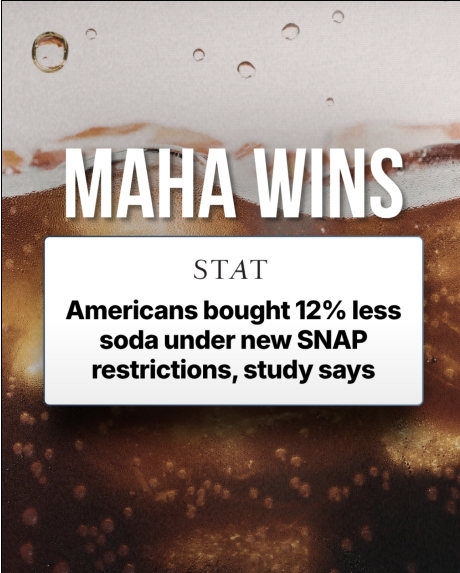
  • SNAP: 18 states are restricting sodas (some also restrict candy or desserts) from purchases using SNAP benefits.  Will this encourage SNAP recipients to buy less soda?  I hope states will collect data on this and other points.
  • Dietary guidelines: They are expected next week.  We shall see.

The food industry’s response?

So far, most of what is happening in the food arena is either still in the promise stage, voluntary, and unlikely to have much health benefit (See: A MAHA Check-Up: Is The United States Getting Healthier?)

All of what is happening with food must be understood in the context of the devastating destruction of America’s public health and scientific research systems.

MAHA’s work is focused on the dietary choices of individuals.

Any individual who tries to make healthful dietary choices is up against a food system designed for profit, not public health.

Diet matters to health, but healthy diets are not enough to prevent measles.

We need functioning public health systems: CDC, FDA, NIH.  We no longer have them.

Happy new year everyone.  Let’s hope the new year brings us peace, kindness, and public health.