by Marion Nestle

Search results: meat drugs

Mar 13 2019

FDA and USDA agree on how to regulate cell-based (“fake”?) meat

Last week, the USDA and FDA ended their turf battle and announced a joint framework for jointly regulating cell-based meat products.

Congress instructed them to do this in a statement related to the Appropriations Act:

Not later than 60 days after the date of the enactment of this Act, the Secretary of Agriculture and the Commissioner of Food and Drugs shall enter into a formal agreement delineating the responsibilities of the two agencies for the regulation of cell-cultured food products derived from livestock and poultry. Such agreement shall be made public on the USDA and FDA websites within one day of the completion of the agreement.

These products, not yet on the market, are made from animal cells grown in tissue culture; no animals are killed in the process.

What to call these emerging products is a matter of some debate.  Proponents call them such things as in vitro, lab-based, vat-grown, or clean.

The meat industry wants them called artificial, synthetic, or fake.  It publishes a flier called “Fake Meat Facts.”

The proposed plan calls for the FDA to regulate the collection of animal cells, cell banks, and cell growth—the processes.  USDA will oversee production, as it does for live animals and poultry.

Much must be at stake.  The agencies’ framework is proactive; the products are not expected to be marketed for several years.

The meat industry is relieved that USDA is in charge.

National Cattlemen’s Beef Association President Jennifer Houston said, “The formal agreement announced today solidifies USDA’s lead oversight role in the production and labeling of lab-grown fake meat products.”

“This is what NCBA has been asking for, and it is what consumers deserve,” Houston said.

The market for these products is expected to be huge, but questions remain:

We will be hearing a lot more about these products as they head to market.

Tags: , ,
Mar 3 2013

Food Matters: Horsemeat scandal has eaters nervous

My monthly (first Sunday) column in the San Francisco Chronicle is now out, this time on the horsemeat scandal.

Q: It makes me sick to think that anyone could eat horsemeat. I don’t see how it could get into so many foods. Tell me how I can be sure I’m not eating it.

A: From this side of the Atlantic, the discovery of horsemeat in European hamburger and frozen dinners is the most riveting of scandals, replete with DNA technology, veterinary drugs, impossible-to-trace supply chains, smuggling, organized crime and outright fraud – not to mention the usual finger-pointing, cover-ups and protestations of shock that accompany food crises.

It is easy to explain how horsemeat got into vast amounts of hamburger and prepared meals. Horses are expensive to house and feed. Something has to be done with them when they are no longer wanted for farming, transport, racing or recreation. Horsemeat is edible, even delicious to some, and costs less than beef.

Complications

In Europe, the supply chains are exceptionally complicated, involving countless companies in more than 21 countries that process, transport or sell horses or horsemeat. The complexity makes it relatively easy to use horses to smuggle people or drugs, to label horsemeat as beef or to slip it into hamburger.

This would just be a matter of economic fraud if people didn’t care whether they ate horsemeat. But some Europeans, and most Americans, care very much. Like you, many people are appalled at the idea of eating any companion animal, let alone one symbolic of the rugged West.

Beyond cultural prohibitions, there are other reasons to avoid eating meat from horses not raised for food. Horses are routinely treated with veterinary drugs, legal and not. The drug traces found in European horsemeat may be too low to cause harm, but hardly seem likely to promote human health.

How long horsemeat has been passed off as European beef is unknown, as is why officials in Ireland decided to do DNA tests on supermarket meals in the first place. Whether done as routine testing or because of a tip, the results were startling. More than one-third of the tested “beef” samples contained horsemeat. Later tests in Great Britain identified “beef” meals made entirely from horsemeat.

This, as the Guardian’s writer Felicity Lawrence wrote in her guide to the scandal, can only be “industrial scale adulteration.”

The ensuing crisis forced many food companies and retailers to recall vast numbers of products, some intended for school meals. Nestlé (no relation) recalled pasta meals, but issued assurances that such products do not leave Europe and that none of its American products contains horsemeat-laden European beef.

What to make of this? In our food studies programs at New York University, we discuss food as a marker of cultural identity. People in other nations eat horsemeat. But like you, about 80 percent of Americans are appalled at the idea of eating horsemeat and oppose slaughtering horses for food or any other reason.

Yet horsemeat used to be eaten by Americans (and still is, by some), and even more so by pets. As Malden C. Nesheim and I wrote in our book about the pet food industry, “Feed Your Pet Right,” horse slaughterhouses created pet food companies to dispose of the meat. Through the 1940s, nearly all domestic horsemeat ended up in pet food.

Under pressure from horse lovers and animal welfare advocates, pet food companies replaced horsemeat with meat from other animals. Although horsemeat is permitted in pet food, and in theory could show up in rendered byproducts and meals, no American company would knowingly use it as an explicit item in an ingredient list. One can only imagine the uproar if it did.

Inspection issues

In 2007, Congress blocked the Department of Agriculture from inspecting slaughterhouses, effectively banning their use. As unintended consequences, the 140,000 or so unwanted horses each year had to be transported to slaughterhouses in Canada or Mexico, and populations of neglected and abandoned horses increased. As a result, Congress permitted horse slaughterhouses to reopen last year, but the USDA has yet to authorize inspectors to work in them.

Could American beef be contaminated with horsemeat? We had a similar scandal in the 1950s. But if U.S. officials are testing hamburger for horsemeat DNA these days, they aren’t saying.

Because horsemeat is not produced here, it won’t be in butcher shops or supermarkets – unless the stores imported it or acquired contaminated products before the recalls, or unless the USDA assigns inspectors and allows horse slaughterhouses to reopen. Right now, without DNA testing, you can’t be sure.

You find this alarming? Short of going vegetarian, you have an option: Buy kosher meat. Jewish dietary laws prohibit horsemeat – horses are not ruminants and do not have cloven hooves – and kosher slaughterhouses are diligent about excluding forbidden animals.

This gives the horsemeat scandal one clear winner: Sales of kosher meat are booming.

Feb 19 2013

The horsemeat scandal–an object lesson in food politics

The unfolding drama around Europe’s horsemeat scandal is a case study in food politics and the politics of cultural identity.

Cultural identity?  They (other people) eat horsemeat.  We don’t.

Most Americans say they won’t eat horsemeat, are appalled by the very idea, and oppose raising horses for food, selling their meat, and slaughtering horses for any reason.

These attitudes have created dilemmas.  Since Congress effectively banned horse slaughter in 2006, roughly 140,000 horses a year have been transported to Canada and Mexico to be killed.  Whether this is better or worse for the horses is arguable.  Some—perhaps most—of that meat will be exported as food.

As Mal Nesheim and I wrote in our book about the pet food industry, Feed Your Pet Right, most—more than 90%—of domestic horsemeat ended up in pet food (the rest was eaten or shipped to Europe).  In the 1920s, horse slaughterhouses started pet food companies as a means to dispose of the meat.  Horsemeat remained a major ingredient of dog foods throughout the 1940s.

Since then, pet food companies replaced horsemeat with meats from other animals.  Although it continues to be permitted in pet food, I’m not aware of any company that would dare use it.  It would have to be disclosed on package labels.

That brings me to the European horsemeat crisis, one brought about by advances in DNA technology that allow officials to test for species in foods.

I’m indebted to Joe O’Toole, president of Lucullus, a French specialty food company, for keeping me up to date on the unfolding saga of how horsemeat got into European hamburger and so many other foods.  He sent me links to early stories:

The problem first emerged earlier in January when the Food Safety Authority of Ireland handed over results of DNA tests it had carried out on burgers produced in Ireland for sale in the UK. Samples from 10 of 27 products sourced from three processing plants had tested positive for horse DNA. One sample is said to have contained 29 percent horse.

As the article explained, the immediate response was “a relatively faultless exercise in damage control.”  Food processors immediately recalled their products and Tesco, Britain’s largest supermarket chain, placed an ad and followed it up with a video apology.  This is viewed as excellent damage control.  Although Tesco shares dropped by 1 percent for a loss of  $475 million, it could have been worse.  

Leaving aside the cultural prohibitions against eating horsemeat, here’s what I find fascinating:

  • DNA technology made this possible.
  • The supply chain is so complicated and involves so many countries—Romania, Ireland, Netherlands, Spain, Poland, France, and, no doubt, others—that where the meat comes from is impossible to trace.
  • The finger pointing  over who is to blame.
  • The enormous number of companies involved.
  • The idea that this is a drug issue (horses are treated with drugs).
  • The idea that horse transport is used as a cover for smuggling (drugs and people).
  • The involvement of organized crime (if selling horsemeat is illegal…).

By far the best place to start on this story is Felicity Lawrence’s Horsemeat Scandal: The Essential Guide, in The Guardian. She did this as a Q and A:

1. Where did the horsemeat scandal begin?

2. Where did the horse and pig found by the Irish in beef products come from?

3. Why did some products contain so much more horse than others?

4. How did the rest of Europe get involved?

5. Is the source of the Irish horsemeat the same as the French one?

6. Why are the supply chains so complex?

7. Why has it happened?

8. How is the meat industry regulated?

9. What about industry claims that it has full traceability?

10. What happened to government control of food safety and standards?

11. Where do the horses come from?

12. What part do UK horse abattoirs play?

13. Why are governments talking about organised crime?

14. Is it a health problem?

I will have more to say about this later, as more details emerge.  Stay tuned!

Addition, February 27: Australia Food Safety News offers this terrific infographic on the scandal.

Apr 19 2011

The politics of contaminated meat

By this time, you must have heard about the study in Clinical Infectious Diseases sponsored by the Pew Charitable Trusts.  The study found nearly half of supermarket meat and poultry samples to be contaminated with Staphylococcus aureus. Half of the contaminated samples were resistant to multiple antibiotics.

Staph causes awful infections.  When I was a child, my mother had a Staph infection that kept her out of commission for what seemed like months in that pre-antibiotic era.  Antibiotics can keep Staph under control, but not if the Staph are antibiotic-resistant.   Staph resistant to multiple drugs are a clear-and-present danger.  No wonder this study got so much attention.

The study provides strong support for the idea that we ought to be reducing use of antibiotics as growth promoters in farm animals, an idea strongly supported by the CDC.

Even though 80% of U.S. antibiotic use is for farm animals, the meat industry strong opposes any proposal to change its practices.

The National Cattleman’s Beef Association responds by attacking the science:

Calling into question the safety of U.S. beef without conclusive scientific evidence is careless and misleads consumers. Pew Charitable Trusts, an agenda-driven organization on this issue, funded this study, which concludes that its extremely small sample size was ‘insufficient to accurately estimate prevalence rates’ and that ‘public health relevance of this finding is unclear.’ The study’s authors clearly call into question the validity of their own study. The bottom-line is U.S. beef is safe and is part of a healthy, well-balanced diet.

The American Meat Institute reassures the public that meat is safe.  After all, you are going to cook your meat, aren’t you?  In any case, the responsibility rests with you.

While the study claims that the many of the bacteria found were antibiotic resistant, it does note that they are not heat resistant.  These bacteria are destroyed through normal cooking procedures, which may account for the small percentage of foodborne illnesses linked to these bacteria.

As with any raw agricultural product, it is important to follow federal safe handling recommendations included on every meat and poultry package that urge consumers to wash hands and surfaces when handling raw meat and poultry and to separate raw from cooked foods to ensure that food is safe when served.

These sound like the arguments that the meat industry has made for years for Salmonella and E. coli O157:H7.

I see this study as another reason why we need better food safety regulation, and the sooner the better.

Postscript: Bill Marler reports that he had 100 samples of chicken tested from Seattle markets:

IEH Labs found S. aurea [sic], or staph, in 42 percent of the samples overall and Campylobacter in 65 percent. The supermarket chicken was contaminated with other pathogens as well: 19 percent of the samples tested positive for Salmonella, one tested positive for Listeria, and 10 percent showed the presence of the methicillin-resistant S. aureus (MRSA). In an unusual finding, one of the chicken samples tested positive for E. coli 0126, Shiga-toxin producing E. coli (STEC) bacteria more likely to be a contaminant of beef than poultry. Organic Chicken proved to be slightly less contaminated than nonorganic with 7 of the 13 (54%) testing positive for harmful bacteria.

As I said….

Sep 30 2025

USDA expands SNAP stocking requirements: Will this help?

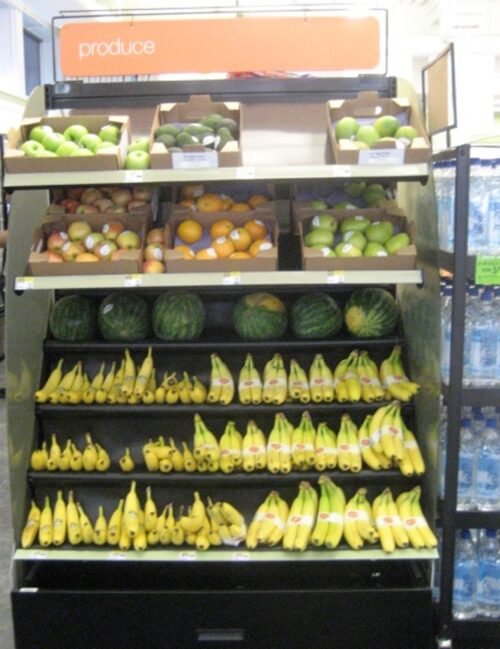
The USDA requires retailers who accept SNAP benefits to stock a few fruits and vegetables.  Formerly, USDA required retailers to provide three varieties of food in each of four categories—dairy, protein, grain, and fruits and vegetables.  It allowed stores to meet these requirements by providing a few tired-looking produce items, such as the ones shown here from a Walgreen drugstore.

USDA proposes to expand the number from 3 to 7.

This is confusing.  I thought the USDA did this in 2016: Enhancing Retailer Standards in the Supplemental Nutrition Assistance Program (SNAP) Clarification of Proposed Rule and Extension of Comment Period.

OK.  Whatever.  Let’s start with the press release, because I always enjoy USDA rhetoric: Secretary Rollins Strengthens SNAP Retailer Stocking Requirements to Make America Healthy Again.

Right now, the bar for stocking food as a SNAP retailer is far too low, allowing people to game the system and leaving vulnerable Americans without healthy food options. These common-sense changes are designed to minimize benefit trafficking and skimming, among other fraudulent activities, while making more nutritious foods available to families who rely on the program….USDA is actively reorienting SNAP towards better nutrition and emphasizing whole, healthy food for program participants. This includes approving 12 states to exclude certain unhealthy foods from purchase with SNAP benefits.

If you want the details, check the Proposed Rule – Updated Staple Food Stocking Standards for Retailers in SNAP. 

This offers complicated explanations of each food category: “The Department is proposing to subdivide protein into the following seven groupings of varieties:

  • Perishable meat, poultry, or fish, including fresh or frozen versions for each different kind of animal;
  • Shelf-stable meat, poultry, or fish for each different kind of animal;
  • Eggs;
  • Nuts/seeds;
  • Raw beans, peas, or lentils, each of which would count as a distinct protein variety;
  • Cooked (e.g., canned) beans,
  • Peas, or lentils and multi-ingredient products with beans, peas, or lentils as the main ingredient; and
  • Tofu/tempeh, together, would be a distinct variety from all other types of proteins and any other pea product as the main ingredient.”

At first glance, this looks like a step in the right direction.  It will require stores that accept SNAP benefits to offer a greater variety of healhy food options.

This is a no-brainer for Walmart or any other large grocery store.  They already do this.

Therefore, this rule has to be understood as being aimed at bodegas as well as at Dollar stores located in areas where no other retail foods are readily available.

That is why this proposal is considered a ‘mixed bag’ for both retailers and shoppers.

Such stores, widely frequented by SNAP recipients whose payments are likely to constitute significant percentages of sales, will have a hard time meeting these requ.  They already had trouble meeting the existing requirements.

This proposal does not seem to be accompanied by incentives to SNAP recipients to buy fruits and vegetables.

As detailed in an issue brief by Healthy Eating Research, The Current State of Knowledge on SNAP Restrictions and Disincentives, incentives would help.  Otherwise, the rising cost of fruits and vegetables can seem prohibitive.

The proposal is open for comment—by November 24.  Here’s how.

The Food and Nutrition Service (FNS), USDA, invites interested persons to submit comments on this proposed rule. Comments may be submitted by one of the following methods:

  • Federal e-Rulemaking Portal: Go to regulations.gov. Preferred method; follow the online instructions for submitting comments on docket FNS-2025-0018 or enter “RIN 0584-AF12” and click the “Search” button. Follow the instructions at this website.
  • Mail: Comments should be addressed to SNAP Retailer Policy Division, Food and Nutrition Service, USDA, 1320 Braddock Place, Alexandria, Virginia 22314.
Tags: ,
Aug 19 2025

The MAHA Strategy report: two leaked versions

The big news in my world last week was the leaking of drafts of the forthcoming MAHA strategy report.

At least four reporters sent me copies for comments.

I did not do a careful comparison.  The main difference seems to be that the earlier version had this useful graphic about MAHA’s strategic intentions.

All of this may change when the final report is released, but here are my initial thoughts on its food sections.

First, the background: The first report, despite the hallucinated references, was a strong indictment of this country’s neglect of the health of our children. It stated the problems eloquently. It promised that the second report would state policies to address those problems.

As for this report: No such luck.

It states intentions, but when it comes to policy, it has one strong, overall message: more research needed.

Regulate?  Not a chance, except for the long overdue closure of the GRAS loophole (which lets corporations decide for themselves whether chemical additives are safe).

Everything else is waffle words: explore, coordinate, partner, prioritize, develop, or work toward.”

One good thing: the report mentions marketing to children, but only to “explore development of industry guidelines.”  Nothing about regulation.  This is too little too late.  We know what food marketing does to kids.  It’s way past time to stop it.

A few comments on specific issues mentioned.

  • “USDA will prioritize precision nutrition research…”  USDA?  NIH is already doing that, and it is the antithesis of public health research, the kind that really will make Americans healthier.
  • The report emphasizes color and other chemical additives (we knew it would), a definition (not regulation) of ultra-processed foods, and a potential front-of-pack label (unspecified).
  • It says it will modernize infant formula (really? how?), and will work to increase breastfeeding (again, how?).

And then there are the contradictions:

  • Improve hospital food, but the administration is taking money away from hospitals.
  • Teach doctors about nutrition (how?)
  • Prioritize “whole healthy foods” in nutrition assistance programs (but cut SNAP and WIC)
  • Expand EFNEP (but eliminate SNAP-ED)
  • Promote healthy meals in child care settings (also defunded)
  • Encourage grocery stores in low-income areas (how?)

How are they going to do this?  It doesn’t say.

Are there any teeth behind it?  It doesn’t look like this is anything more than voluntary (and we know how voluntary works with the food industry; it doesn’t).  None of this says how or has any teeth behind it.

And oh no!  MAHA boxes.  I’m guessing these are like what got given out—badly—during the pandemic. 

Resources

It is striking that the leaked Make America Healthy Again (MAHA) Strategy Report, like its AI-assisted predecessor, embodies much of the idiosyncratic beliefs about food and drugs of one person: Robert F. Kennedy, Jr. He might be right about food dyes, but the report’s recommendations to alter our vaccine framework, restructure government agencies, and promote meat and whole milk are going to promote disease, not health…

The report…seems to twist itself into knots to make it clear that it will not be infringing upon food companies….But we also need to judge the administration by what it does, not what it says. And the administration’s attacks on SNAP, Medicaid, the health insurance exchanges, and the FDA and USDA workforces are poised to make America sicker, hungrier, and more at risk from unsafe food.

May 21 2025

Concerns about food safety regulation (or the lack thereof)

[Personal note: my graduation address today at Hopkins has been rain-postponed to 1:00 EDT .  It will be streamed here.]

Food safety is always a difficult topic because nobody wants to talk about it.

  • We expect the food we buy to be safe (a quite reasonable expection, in my view).
  • Food companies, by law, are supposed to produce foods safely.
  • Regulators are supposed to make sure they do.

Any breakdown in rules and regulations causes problems.  Three troubling examples:

I.  Sentient Food: Federal Inspectors Found Antibiotics in Beef ‘Raised Without Antibiotics.’ They Took No Action

These letters, recently obtained by the advocacy group Farm Forward through a Freedom of Information Act request, reveal that the world’s largest meat producers — JBS, Cargill, and Tyson — raised cattle that tested positive for antibiotics prohibited under USDA-approved labels advertising the beef as free of antibiotics…These findings were announced last August, but the names of the companies which tested positive for antibiotics were not made publicly available until recently, as part of a new report released by Farm Forward questioning the validity of this popular label.

II.  Phyllis Entis: Manufacturer repeatedly shipped pet food after presumptive-positive pathogen test results

During the 2024 calendar year, Morasch Meats, Inc. (Portland, OR) sold dozens of batches of Northwest Naturals raw pet foods and pet treats after the finished products tested presumptive-positive for Salmonella or Listeria monocytogenes.

Instead of confirming the presumptive result as required by the test kit manufacturer, the company repeated the same rapid test on fresh samples. When the repeat test did not find the pathogen, Morasch released the production batch for sale.

III.  Food Safety News:   Intent or impact? New rules redefine food safety justice

On May 9, President Trump signed Fighting Overcriminalization in Federal Regulations, an executive order directing agencies like the FDA and USDA to limit criminal charges for food safety violations unless companies knowingly break the law. The executive order discourages criminal charges for unintentional violations…while deliberate acts, like falsifying tests, remain subject to prosecution…Critics, including consumer advocates, warn that the executive order, combined with reported cuts to FDA and USDA staff, could weaken deterrence against food safety violations.

Comment: When it comes to food safety, enforcement regulation is essential.  History tells us that unwatched food companies sometimes tend to let safety measures slide.  FDA and USDA food safety inspectors need to be on the job.  FDA inspectors have been cutUSDA staff cuts undoubtedly will affect meat inspections.   None of this bodes well for the safety of the US food supply.

Jan 24 2025

Weekend reading: Former President Biden’s food-and-farming legacy

OOPS: A reader alerted me that all links have been taken down by the new administration.

In his last weeks in office, former President Biden issued a Fact Sheet on the food system investments achieved by his administration. A reader, Ethan Wolf, sent in a link from the Wayback Machine. Fact Sheet on the food system investments achieved by his administration

The Fact Sheet divides the achievements into several categories.

  • Building new markets and income for farmers and ranchers
  • Modernizing the middle of the agriculture and food supply chain: food processing, aggregation, and distribution
  • Creating more fair and competitive markets
  • Improving food access, nutrition security and health
  • Enchancing food safety
  • Supporting breakthrough agricultural rewearch and innovation

To highlight just one—food safety:

Perhaps coincidentally, Lisa Held at Civil Eats published How Four Years of Biden Reshaped Food and Farming: From day one, the administration prioritized climate, “nutrition security,” infrastructure investments, and reducing food system consolidation. Here’s what the president and his team actually did.

Her categories are somewhat different:

  • Taking on Consolidation and Corporate Power, and Supporting Farmer Livelihood
  • Tackling the Climate Crisis
  • Regulating Pesticides and Other Chemicals
  • Focusing on Food Safety
  • Linking Hunger, Nutrition, and Health
  • Supporting Food and Farm Workers
  • Advancing Equity

Here’s my excerpted summary of her analysis of Taking on Corporate Power.

The lists go on and on.  Held’s only overall conclusion: “The impacts of many of those efforts will take years to reveal themselves, while other actions may be more quickly sustained or reversed in the second Trump administration.”

Comment

I did not know about many of the items listed here and I’m guessing you didn’t either.  My impression is that the Biden Administration tried hard to improve the food system in multiple ways, some publicized, some not.  But Held is right: we won’t know for a long time how much good all this did, but we are likely to find out soon whether the gains will be overturned by the new administration.  She will continue to write about such topics.  I will too.