by Marion Nestle

Search results: meat drugs

Aug 19 2025

The MAHA Strategy report: two leaked versions

The big news in my world last week was the leaking of drafts of the forthcoming MAHA strategy report.

At least four reporters sent me copies for comments.

I did not do a careful comparison.  The main difference seems to be that the earlier version had this useful graphic about MAHA’s strategic intentions.
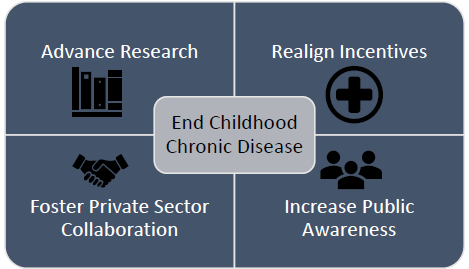
All of this may change when the final report is released, but here are my initial thoughts on its food sections.

First, the background: The first report, despite the hallucinated references, was a strong indictment of this country’s neglect of the health of our children. It stated the problems eloquently. It promised that the second report would state policies to address those problems.

As for this report: No such luck.

It states intentions, but when it comes to policy, it has one strong, overall message: more research needed.

Regulate?  Not a chance, except for the long overdue closure of the GRAS loophole (which lets corporations decide for themselves whether chemical additives are safe).

Everything else is waffle words: explore, coordinate, partner, prioritize, develop, or work toward.”

One good thing: the report mentions marketing to children, but only to “explore development of industry guidelines.”  Nothing about regulation.  This is too little too late.  We know what food marketing does to kids.  It’s way past time to stop it.

A few comments on specific issues mentioned.

  • “USDA will prioritize precision nutrition research…”  USDA?  NIH is already doing that, and it is the antithesis of public health research, the kind that really will make Americans healthier.
  • The report emphasizes color and other chemical additives (we knew it would), a definition (not regulation) of ultra-processed foods, and a potential front-of-pack label (unspecified).
  • It says it will modernize infant formula (really? how?), and will work to increase breastfeeding (again, how?).

And then there are the contradictions:

  • Improve hospital food, but the administration is taking money away from hospitals.
  • Teach doctors about nutrition (how?)
  • Prioritize “whole healthy foods” in nutrition assistance programs (but cut SNAP and WIC)
  • Expand EFNEP (but eliminate SNAP-ED)
  • Promote healthy meals in child care settings (also defunded)
  • Encourage grocery stores in low-income areas (how?)

How are they going to do this?  It doesn’t say.

Are there any teeth behind it?  It doesn’t look like this is anything more than voluntary (and we know how voluntary works with the food industry; it doesn’t).  None of this says how or has any teeth behind it.

And oh no!  MAHA boxes.  I’m guessing these are like what got given out—badly—during the pandemic. 

Resources

It is striking that the leaked Make America Healthy Again (MAHA) Strategy Report, like its AI-assisted predecessor, embodies much of the idiosyncratic beliefs about food and drugs of one person: Robert F. Kennedy, Jr. He might be right about food dyes, but the report’s recommendations to alter our vaccine framework, restructure government agencies, and promote meat and whole milk are going to promote disease, not health…

The report…seems to twist itself into knots to make it clear that it will not be infringing upon food companies….But we also need to judge the administration by what it does, not what it says. And the administration’s attacks on SNAP, Medicaid, the health insurance exchanges, and the FDA and USDA workforces are poised to make America sicker, hungrier, and more at risk from unsafe food.

May 21 2025

Concerns about food safety regulation (or the lack thereof)

[Personal note: my graduation address today at Hopkins has been rain-postponed to 1:00 EDT .  It will be streamed here.]

Food safety is always a difficult topic because nobody wants to talk about it.

  • We expect the food we buy to be safe (a quite reasonable expection, in my view).
  • Food companies, by law, are supposed to produce foods safely.
  • Regulators are supposed to make sure they do.

Any breakdown in rules and regulations causes problems.  Three troubling examples:

I.  Sentient Food: Federal Inspectors Found Antibiotics in Beef ‘Raised Without Antibiotics.’ They Took No Action

These letters, recently obtained by the advocacy group Farm Forward through a Freedom of Information Act request, reveal that the world’s largest meat producers — JBS, Cargill, and Tyson — raised cattle that tested positive for antibiotics prohibited under USDA-approved labels advertising the beef as free of antibiotics…These findings were announced last August, but the names of the companies which tested positive for antibiotics were not made publicly available until recently, as part of a new report released by Farm Forward questioning the validity of this popular label.

II.  Phyllis Entis: Manufacturer repeatedly shipped pet food after presumptive-positive pathogen test results

During the 2024 calendar year, Morasch Meats, Inc. (Portland, OR) sold dozens of batches of Northwest Naturals raw pet foods and pet treats after the finished products tested presumptive-positive for Salmonella or Listeria monocytogenes.

Instead of confirming the presumptive result as required by the test kit manufacturer, the company repeated the same rapid test on fresh samples. When the repeat test did not find the pathogen, Morasch released the production batch for sale.

III.  Food Safety News:   Intent or impact? New rules redefine food safety justice

On May 9, President Trump signed Fighting Overcriminalization in Federal Regulations, an executive order directing agencies like the FDA and USDA to limit criminal charges for food safety violations unless companies knowingly break the law. The executive order discourages criminal charges for unintentional violations…while deliberate acts, like falsifying tests, remain subject to prosecution…Critics, including consumer advocates, warn that the executive order, combined with reported cuts to FDA and USDA staff, could weaken deterrence against food safety violations.

Comment: When it comes to food safety, enforcement regulation is essential.  History tells us that unwatched food companies sometimes tend to let safety measures slide.  FDA and USDA food safety inspectors need to be on the job.  FDA inspectors have been cutUSDA staff cuts undoubtedly will affect meat inspections.   None of this bodes well for the safety of the US food supply.

Jan 24 2025

Weekend reading: Former President Biden’s food-and-farming legacy

OOPS: A reader alerted me that all links have been taken down by the new administration.

In his last weeks in office, former President Biden issued a Fact Sheet on the food system investments achieved by his administration. A reader, Ethan Wolf, sent in a link from the Wayback Machine. Fact Sheet on the food system investments achieved by his administration

The Fact Sheet divides the achievements into several categories.

  • Building new markets and income for farmers and ranchers
  • Modernizing the middle of the agriculture and food supply chain: food processing, aggregation, and distribution
  • Creating more fair and competitive markets
  • Improving food access, nutrition security and health
  • Enchancing food safety
  • Supporting breakthrough agricultural rewearch and innovation

To highlight just one—food safety:

Perhaps coincidentally, Lisa Held at Civil Eats published How Four Years of Biden Reshaped Food and Farming: From day one, the administration prioritized climate, “nutrition security,” infrastructure investments, and reducing food system consolidation. Here’s what the president and his team actually did.

Her categories are somewhat different:

  • Taking on Consolidation and Corporate Power, and Supporting Farmer Livelihood
  • Tackling the Climate Crisis
  • Regulating Pesticides and Other Chemicals
  • Focusing on Food Safety
  • Linking Hunger, Nutrition, and Health
  • Supporting Food and Farm Workers
  • Advancing Equity

Here’s my excerpted summary of her analysis of Taking on Corporate Power.

The lists go on and on.  Held’s only overall conclusion: “The impacts of many of those efforts will take years to reveal themselves, while other actions may be more quickly sustained or reversed in the second Trump administration.”

Comment

I did not know about many of the items listed here and I’m guessing you didn’t either.  My impression is that the Biden Administration tried hard to improve the food system in multiple ways, some publicized, some not.  But Held is right: we won’t know for a long time how much good all this did, but we are likely to find out soon whether the gains will be overturned by the new administration.  She will continue to write about such topics.  I will too.


Jan 9 2024

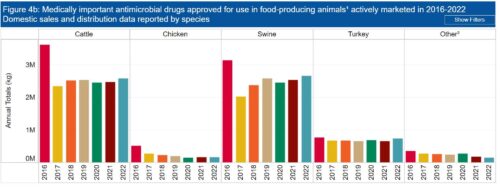
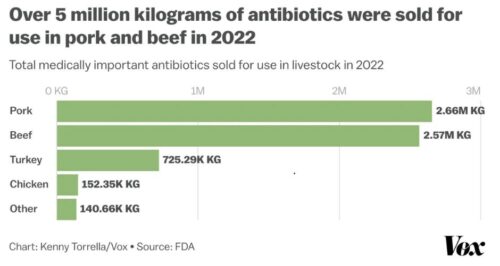
The FDA’s somewhat good news on antibiotic use in farm animals (if we believe it)

The FDA issued its most recent report on antibiotics late last year: 2022 Summary Report On Antimicrobials Sold or Distributed for Use in Food-Producing Animals, along with Antimicrobial Sales and Distribution Data 2013-2022.

It did this in response to public concerns about antibiotic use in food animals: if antibiotics are used at subtherapeutic doses, they might induce microbial resistance to drugs used to treat diseases in humans.

This is not a theoretical concern.  It’s a real problem.

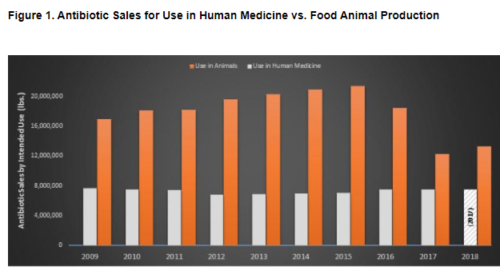
It’s also a problem because the vast majority of antibiotics were used as growth promoters or to prevent infections in animals crowded together—not to treat disease.

In 2014 or so, the FDA ruled that medically important antibiotics could no longer be used as growth promoters in farm animals.  That rule went into effect in 2017.

The FDA’s good news: the amounts of antibiotics used in farm animals has declined since then.

Are medically important antibiotics still used for non-therapeutic purposes?

The report says that since 2017, zero antibiotics are administered for growth promotion.

If you wonder whether this is really true (as I do), consider that $11.2 million kilograms of antibiotics were used in food animals in 2022.  This is a decrease from the 15.6 million kg used in 2015, but still a lot.

Of these drugs, 63% are administered in feed, and 31% in water.

All antibiotics still used as growth promoters are supposed to be drugs not used in human medicine.

I’m not the only skeptic on this one.  See:

I.  The Bureau of Investigative Journalism’s Antibiotics in agriculture: The blurred line between growth promotion and disease prevention.

In an investigation published today, the Bureau revealed how US farm animals are still being dosed with antibiotics vital to human health, despite efforts to curtail such usage and combat the spread of deadly superbugs. We also found that a regulatory loophole means that using antibiotics to make animals fatter – a process known as growth promotion – is technically still possible, despite this practice being banned in January 2017.

II.  Nature: Antibiotic use in farming set to soar despite drug-resistance fears. Analysis finds antimicrobial drug use in agriculture is much higher than reported.

III.  Vox: Big Meat just can’t quit antibiotics: Meat production is making lifesaving drugs less effective. Where’s the FDA?

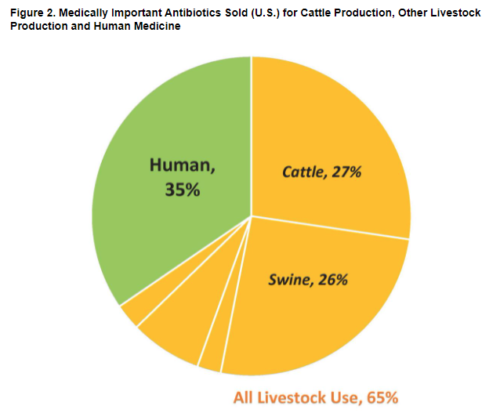
According to an analysis published in September by the Natural Resources Defense Council and One Health Trust, medically important antibiotics are increasingly going to livestock instead of humans. In 2017, the meat industry purchased 62 percent of the US supply. By 2020, it rose to 69 percent.

Does the FDA check?  It has guidance for industry on The Judicious Use of Medically Important Antimicrobial Drugs in Food-Producing Animals, but this guidance is non-binding.

Obviously, the FDA needs to do more.  Its officials told Vox:

Veterinarians are on the front lines and as prescribers, they’re in the best position to ensure that both medically important and non-medically important antimicrobials are being used appropriately…We cannot effectively monitor antimicrobial use without first putting a system in place for determining [a] baseline and assessing trends over time.

Vox reports: “The agency right now only collects sales data, and it’s been exploring a voluntary public-private approach to collect and report real-world use data.”

This is not reassuring.  The use of antibiotics in animal agriculture is a long-standing issue.  It requires political will, big time.

May 30 2023

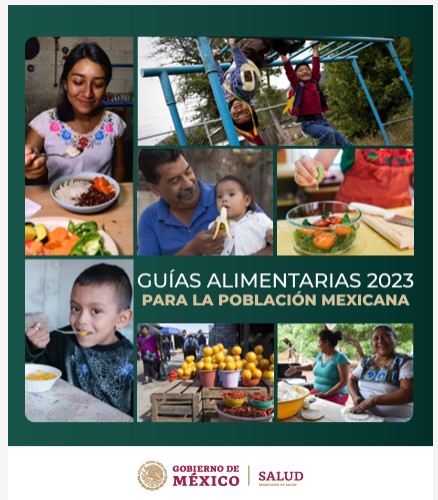
Mexico’s terrific new dietary guidelines. Yes!

Mexico has issued new dietary guidelines.

https://www.gob.mx/cms/uploads/attachment/file/826673/Gui_as_Alimentarias_2023_para_la_poblacio_n_mexicana.pdf

  1. Breastfeed babies for the first 6 months and then continue until age 2 along with other nutritious foods.
  2.  Eat more vegetables and fruits.
  3. Eat beans.
  4. Choose whole grains.
  5. Eat less beef and processed meats.
  6. Avoid ultra-processed foods.
  7. Drink water.
  8. Avoid alcohol.
  9. Be physically active.
  10. Enjoy meals with family and friends.

I’m looking forward to reading a case study on how the public health institute got these through the political process.

If people follow these guidelines, these industries will be in trouble:

  • Infant formula
  • Beef
  • Processed meats
  • Ultra-processed foods
  • Sugar-sweetened beverages
  • Alcohol

People will be healthier!  These industries will also be in trouble.

  • Pharmaceutical drugs
  • Private medicine
  • Insurance companies? (you might think they would benefit, but they make so much money on illness—this one is complicated)

I hope the new U.S. Dietary Guidelines will find these inspiring.

Jan 25 2022

Maybe a hint of good news about animal antibiotics?

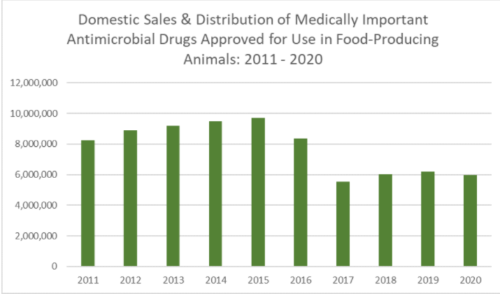
The FDA says use of medically important antimicrobial drugs in food animals decreased by 3% between 2019 and 2020  (For details, see the full report).

Is this good news or not.  Use is down from 2015-2016, but up from 2017.  As Wired puts it, “Antibiotic Use in US Farm Animals Was Falling. Now It’s Not.”

According to the Natural Resource Defense Council, use of antibiotics as growth promoters in food animals is still a big problem, with lots more going for use in animals than in humans.

Or, to be a bit more precise:

The Pew Foundation thinks much more needs to be done to limit use of antibiotics in food animals.

FDA: get on this please.

Nov 13 2020

Weekend reading (well, browsing): Harold McGee’s Nose Dive

Harold McGee.  Nose Dive: A Field Guide to the World’s Smells.  Penguin Press, 2020.Hardcover Nose Dive : A Field Guide to the World's Smells Book

Harold McGee, author of the astonishing On Food and Cooking, sent me a copy of his equally astonishing new book, this one an encyclopedia of the smells of everything—the “osmocosm.”

I am happy to have it.  He’s produced a life-changing book.  I will never think of smells in the same way again.

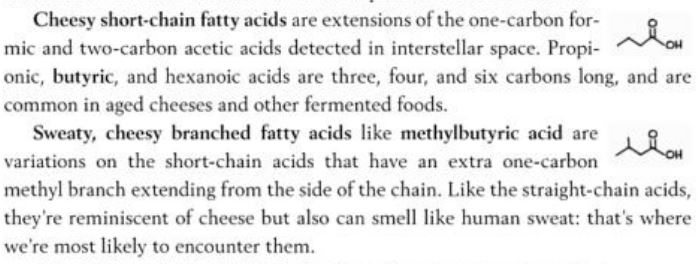
For starters, the book is brilliantly designed with elegant charts, key terms in bold, and chemical structures (yes!) right next to the terms in miniature on a light grey background, set off from the text but right there where they are needed.  Here’s an example from the pages that Amazon.com makes available.  This excerpt comes from a section on the smells of chemical compounds found in interstellar space (p. 19—and see my comment on the page number at the end of this post).

Interstellar space?  Well, yes.  Also animals, pets, and human armpits, along with flowers, spices, weeds, fungi, stones (they have bacteria and fungi on them), asphalt, perfumes, and everything else that smells or stinks—as well as foods, of course.

McGee must have had fun writing this.

It’s exactly becasue CAFOs [Concentrated Animal Feeding Operations] are offensive and harmful that the volatiles of animal excrement have been so well studied.  Crazily but appropriately, chemists borrow the terminology of top, middle, and base notes from the perfume worls (see page 477) to describe the smells of CAFOs.  The top notes, very volatile and quickly dispersed, are ammonia and hydrogen sulfide.  The more persistent middle notes include amines, thiols and sulfides, aldehydes and alcohols and ketones.  The constantly present base notes are the short-chain straight and branched acids, cfresol and other pehnolics, and skatole.  In a 2006 study of swine and beef cattle operations, barnyard cresol was identified as the primary offensive odor, and could be detected as far as ten miles (sixteen kilometers) downwind.  It’s probably the first long-distance hint I get of that I-5 Eau de Coalinga (p. 71).

But let me be clear: this is an encyclopedia, demanding close attention to the chemistry.  Sentences like this one come frequently: “The branched four-carbon chain (3-sulfanyl-2-methyl butanol) has its branch just one carbon atom over from the otherwise identical molecule in cat pee” (p.121).

But this blog is about food.  McGee’s discussion of food smells are riveting.  For example:

  • The standard basil varieties in the West today mainly produce varying proportions of a coupld of terpenoids, flowery linalook and fresh eucalyptol, and the clove- and anise-smelling benzenoids eugenol and estragole.  But when it comes to a dish in which basil stars—peto alla genovese, the Ligurian pasta sauce of pounded basil, garlic, nuts, and cheese—Italians are more particular (p. 255).
  • In 2014, I made a pilgrimage to a celebrated durian stall in the outskirts of Singapore and found that most of the half-dozen varieties I tried tasted of strawberries and a mix of fried onions and garlic.  I enjoyed them enough to smuggl one into my hotel room…After just an hour or two its royal presence filled the room and became unbearable.  I had no choice but regicide, and disposed of the body like coCanned sntraband drugs, flushing it in pieces down the toilet (p. 333).
  • The dominant note [in beef stews], described as “gravy-like,” came not from the meats, but from the onions and leeks!  The volatile responsible turned out to be a five-carbon, one-sulfur chain with a methyl decoration, a mercaptomethyl pentanol, MMP for short.  It is formed by a sequene of reactions, the first causaed by heat-sensitive onion enzymes, then ordinary chemical reactions that are accelerated by heat.  So its production is encouraged by chopping or pureeing these alliums (but not garlic) well before cooking them to let the enzymes do their work, the cooking slowly for several hours  (p. 513).
  • Canned sweet corn is dominated by seaside-vegetal dimethyl sulfide, acetyl pyrroline, and a corny thiazole (p. 519).
  • Swiss Appenzeller is notably strong in sweaty-foot branched acids (p. 567).

It should be clear from these excerpts that this is a reference work—a field guide—just as advertised.  If you read it, you will learn more than you ever dreamed possible about the volatile molecules that we can and do smell.

Nose Dive will go right next to On Food and Cooking on my reference shelf.

But uh oh.  How I wish it had a better index. 

For a book like this, the index needs to be meticulously complete—list every bold face term every time it appears—so readers can find what we are looking for.  This one is surprisingly unhelpful.

I found this out because I forgot to write down the page number for the fatty acid excerpt shown above.  I searched the index for most of the key words that appear in the clip: fatty acids, short and branched; butyric; methylbutyric; hexanoic; cheesy; intersteller space. No luck.  I had to check through all of the fatty acid listings and finally found it under “fatty acids, and molecules in asteroids, 19.”   Oh.  Asteroids.  Silly me.

I also forgot to note the page for the CAFO quote.  CAFO is not indexed at all, even though it appears in bold on the previous page, and neither does its definition, Concentrated Animal Feeding Operation.

McGee refers frequently to “Hero Carbon,” the atom basic to odiferous molecules.  I couldn’t remember where he first used “Hero” and tried to look it up.  Not a chance.

This book deserves better, alas.

Penguin Press:  this needs a fix, big time.

Tags:
Nov 15 2018

Pet food: a roundup of recent stories

I maintain an active interest in pet food, even though my books on the topic came out a few years ago

Here are some recent items:

  1. Pet food is big business ($63 billion last year).  It brings people into supermarkets and boosts sales.  [OK.  You already knew this, no?]
  2. Evangers, a pet food maker occasionally in trouble over ingredient and food safety problems has been caught with horse meat in its products. It says it doesn’t use horse meat, even though it has a license to use it.  It blames its beef supplier.Private label pet food brands are selling well.   They are cheaper.  For the record: all complete-and-balanced pet foods are required to meet the same nutritional standards and to support dog and cat reproduction, growth, and development (they are like infant formula in that regard).
  3. Food safety issues for humans also mean food safety issues for pets. The CDC is warning people not to consume certain turkey products because of illnesses caused by Salmonella. “Evidence collected by federal officials investigating the illnesses has revealed the outbreak strain in samples from live turkeys and many kinds of raw turkey products, including pet food.”
  4. Raw pet food  continues to raise food safety risks: Rad Cat Raw Diet has been recalled due to Listeria contamination.   A case of human Salmonella illness has been linked to a Darwin’s raw pet food.
  5. And the FDA announces the recall of Nutrisca dry dog food with levels of vitamin D so excessive that they made dogs sick.
  6. Mars Veterinary, the biggest manufacturer of pet foods, is working on some new products made from—get this—lab-grown mouse meat.  No, I did not make this up; I got it from Business Insider.
  7. Wild Earth, Inc., a biotech pet food startup, sells treats made with lab-cultured protein from the koji fungus, Aspergillus oryzae.
  8. The humanification of pet food, says The Atlantic, is nearly complete.
  9. Whole Dog Journal asks this burning question: Should you feed ice cream to your dog? (The short answer is no, but this gives me a chance to praise Nancy Kerns’ admirably sensible advice about dog feeding, care, and training).

You can see why I love writing about pet food.