by Marion Nestle

Currently browsing posts about: Bird flu

Dec 3 2025

Good news: milk pasteurization prevents spread of bird flu

A recent study finds pasteurization of milk to be an effective preventive measure against avian influenza in mice.

We found that milk pasteurization fully inactivated pandemic H1N1 and bovine H5N1 influenza viruses yet preserved hemagglutinin (HA) protein integrity. In mice, repeated oral exposure to inactivated virus did not alter mortality after H5N1 virus challenge.

This is excellent news.  It means that the risk of getting bird flu from pasteurized milk is extremely low.

Bird flu is increasingly widespread in dairy cattle.

The CDC says the risk to humans is low, but 71 cases have been observed so far, with one death.

The situation with bird flu is one more reason to expect bettter safety from pasteurized than raw milk.

The FDA continues to say that pasteurized milk is safer.  Its page on raw milk offers these links.

The FDA reports that from 1998 through 2018, there were 202 outbreaks linked to drinking raw milk, which caused 2,645 illnesses and 228 hospitalizations.

This is a lot or not, depending on point of view, but all were likely to have been prevented by pasteurization.

The Raw Milk Institute insists on the benefits of raw milk.

My assessment: there may be benefits, but they are marginal.  There are safer ways to improve immunity.

The risks of raw milk may be infrequent, but when it comes to milk, I’d rather play it safe.
Mar 5 2025

Bird flu, raw milk, and cats

Bill Marler forwarded his post about how some pet cats got bird flu from drinking raw milk or eating raw pet food.

He learned about this from a Los Angeles County Animal Health Alert: H5 bird flu confirmed in four domestic cats that consumed recalled raw milk, and in one cat that consumed commercially produced raw pet food.

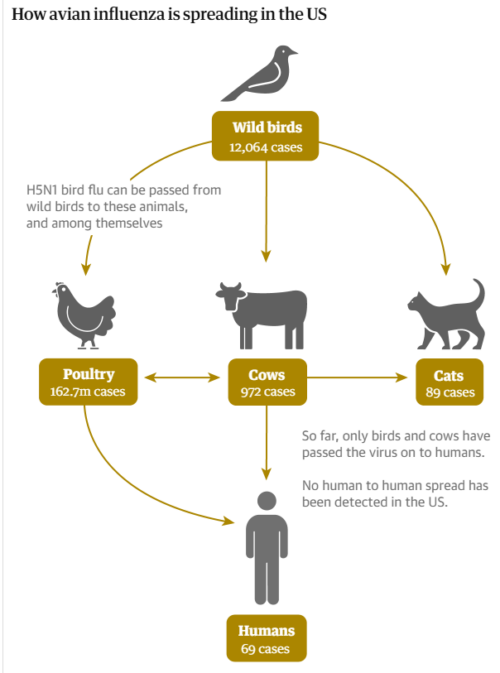
The Guardian explains how transmission works.

Pet Food Industry writes, Raw pet food linked to H5N1 infection, cat euthanizations: Officials found the cats all consumed the same brand of raw pet food before becoming ill.  Read more

Mother Jones asks: A Raw Milk Magnate Has Spent Years Fighting Public Health Agencies. Will RFK Jr. Take His Side?  (The article is about Mark McAfee, founder and CEO of Raw Farm, which sells the raw milk allegedly implicated in the death of cats.

Marler lists lawsuits over previous outbreaks—among humans—attributed to tRaw Farm milk.

Marler published a Parents’ guide to the safe use of raw milk.  His conclusion:

There is a movement in the U.S. to consume organic, locally grown, unprocessed, more nutrient-dense foods.

Some believe raw milk is more nutritious and provides the body “good bacteria.”

There are many other foods that contain “good bacteria” and are less risky than raw milk. Many stores carry pasteurized yogurt and kefir with probiotics that are very safe to feed children.

There are also high quality nutritional supplements that can be used to add probiotic bacteria into one’s diet.

For more information visit www.realrawmilkfacts.com.

Other resources

Phyllis Entis (aka FoodBugLady), who writes a newsletter about food safety, efoodalert.com, discusses bird flu in cats and includes a useful handout from the Washington State Department of Agriculture on the topic.


Mar 4 2025

Bird flu, egg prices, and what urgently needs doing

I was intrigued by this item from WattPoultry: Blame for high US egg prices is now a political pinataThe lack of understanding of basic economics is frustrating, but the misguided blame game over the cause of high egg prices presents an opportunity for change.  Read more

Everyone in the poultry industry knows that HPAI [Highly Pathogenic Avian Influenza] caused laying hen losses and reduced the supply of eggs, and this is why retail egg prices, which have always been demand inelastic, have reached historic highs…The political “crisis” over egg prices can be used to open eyes and ears to new ideas on how best to deal with HPAI. We are over three years into the current outbreaks and the situation is arguably worse than it has ever been with the virus found in nearly 1,000 dairy herds, dozens of species of wild mammals and, of course, in all sorts of waterfowl and other wild bird species.

The article suggests the urgent need for more funding for:

  • Research
  • Vaccines
  • Testing

These seem like minimal asks.  We need them all.

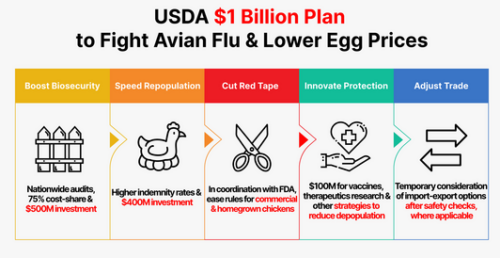
Here’s what the USDA is doing:  USDA invests up to $1 billion to combat avian flu and reduce egg prices.


Once again: Phone numbers for leaving comments:

  • The White House: 202-456-1111
  • U.S. House of Representatives:  202-225-3121  Website: http://www.house.gov
  • U.S. Senate: Telephone: 202-224-3121


Jun 22 2024

What do we need to know about bird flu?

[Oops.  This one did not get sent out, apparently.  Hope it works this time].

*****

The current bird flu pandemic is a huge worry, because the current strain, H5N1, is highly pathogenic .

Although there have only been 4 reported cases in humans since 2022, the strain has infected:

  • Nearly 100 million chickens .
  • 101 herds of dairy cattle.
  • Some number of cats

The CDC says: “Mammals can be infected with H5N1 bird flu viruses when they eat infected birds, poultry, or other animals and/or if they are exposed to environments contaminated with virus. Spread of H5N1 bird flu viruses from mammal to mammal is thought to be rare, but possible.”

Oh great.

The epidemiological fear, of course, is the more cattle affected, the more the virus can mutate (sound familiar?).

the personal fear is that the milk supply might contain active viruses.  Untreated milk does, and lots.

But the NIH says tests show that the virus is destroyed by standard Pasteurization methods.

The FDA says (as it always has): do not drink raw milk.

This seems like especially good advice at the moment.

I’m going to be tracking this closely.  Stay tuned.

Resources

Also

The industry-fun Council for Agricultural Science and Technology (CAST) is doing a webinar , Highly Pathogenic Avian Influenza (HPAI) and Its Impact on Food Production Industries.June 24 at 1 PM CST. Register for it here.