Currently browsing posts about: Caffeine

May 9 2013

Wrigley’s withdraws caffeinated gum out of respect for the FDA

The Associated Press says Wrigley’s will temporarily cease and desist trying to market caffeinated gum (see previous post).

The company said Wednesday that it has stopped new sales and marketing of Alert Energy Caffeine Gum “out of respect” for the agency…”After discussions with the FDA, we have a greater appreciation for its concern about the proliferation of caffeine in the nation’s food supply…”

Temporarily?

FDA Deputy Commissioner for Foods and Veterinary Medicine issued this statement:

On May 8, 2013, Wrigley (a subsidiary of Mars) announced its decision to pause production, sales, and marketing of Alert Energy Caffeine Gum. This announcement was made following a series of discussions with the FDA in which the agency expressed concerns about caffeine appearing in a range of new foods and beverages.

The FDA applauds Wrigley’s decision and its recognition that we need to improve understanding and, as needed, strengthen the regulatory framework governing the appropriate levels and uses of caffeine in foods and beverages. The company’s action demonstrates real leadership and commitment to the public health.

We hope others in the food industry will exercise similar restraint….

Congratulations to all concerned.  It’s good to see the FDA on the job.

For an instant explanation of what this is about, see the Wall Street Journal’s elegant illustration:

image


Apr 30 2013

Annals of marketing: Wrigley’s caffeinated gum comes to market

Wrigley, a subsidiary of Mars (M&Ms), announced its new caffeinated chewing gum yesterday in a full-page ad in USA Today.

In response, Michael Taylor,  the FDA Deputy Commissioner for Foods and Veterinary Medicine, issued an official comment:

The only time that FDA explicitly approved the added use of caffeine in a food was for cola and that was in the 1950s. Today, the environment has changed. Children and adolescents may be exposed to caffeine beyond those foods in which caffeine is naturally found and beyond anything FDA envisioned when it made the determination regarding caffeine in cola.

For that reason, FDA is taking a fresh look at the potential impact that the totality of new and easy sources of caffeine may have on the health of children and adolescents, and if necessary, will take appropriate action.

This is what the fuss is about:

Alert™ Energy Caffeine Gum - Mint

As Center for Science in the Public Interest (CSPI) points out, is this something we need?

While the FDA is busy investigating deaths linked (although not conclusively) to caffeinated energy drinks, CSPI has alerted the agency to the increasingly widespread addition of caffeine to foods.

The gum contains 40 milligrams of caffeine per piece, with 8 pieces per box.

Forty milligrams isn’t much but look what else is caffeinated these days: Frito Lay’s Cracker Jack’d snack, Kraft’s MiO Energy water enhancer, and jelly beans, waffles, maple syrup, popcorn, and  beef jerky.  These are in addition to the usual sources of caffeine: coffee, tea, and cola drinks.

Most people can manage small amounts of caffeine without sleep interruptions, but larger amounts are a worry.

Pediatricians discourage use of caffeine by children and adolescents who are highly sensitive to its effects: restlessness, irritability, insomnia, and sometimes worse.

CSPI points out that Wrigley’s used to position gum as a study aid and list caffeine consumption alongside snacking and studying late at night as “choices which can negatively affect [students'] scholastic performance, as well as their overall health.”

Now, the company is pushing caffeinated gum….

Anything to sell chewing gum, I guess.

Jan 21 2013

Energy drinks: the new frontier for food advocacy?

I am an avid follower of NutraIngredients-USA.com, a daily newsletter for the food industry.  Today, it collects its recent articles on energy drinks in one place.

The makers of energy drinks have managed to get away with positioning these products as healthier alternatives to regular soft drinks.

They also have gotten away with being able to add vitamins and minerals to them that the FDA would not permit in regular Coke or Pepsi.

Unfortunately for them, some manufacturers upped the caffeine to the point where it might be making people sick.  Illnesses among energy drink users have focused attention on these products.

Are energy drinks the new frontier for food advocacy?  I think so, and I’m guessing NutraIngredients-USA does too.

Nov 19 2012

Energy drinks, Cracker Jacks, and caffeine: enough already

People who consume caffeinated energy drinks may be dying right and left (Because of the caffeine?  The drinks?  Hard to say) but that isn’t stopping food manufacturers from adding it to everything: Cracker Jacks, jelly beans, Gummi Bears, brownies, mints, and maple syrup.

The FDA has just released its data on problems reported among users of three caffeinated energy drinks.

According to the New York Times,

The three products involved in the release — Rockstar Energy, 5-Hour Energy and Monster Energy — are all marketed as dietary supplements. Other energy drinks like Red Bull, NOS and AMP are marketed by their producers as beverages. There is not a mandatory reporting requirement for beverages, though makers can do so voluntarily.

In releasing the filings, the F.D.A. said it thought that even with the mandatory reporting requirement for dietary supplements, “only a small fraction of adverse events associated with any product is reported.”

…The records related to Monster Energy and 5-hour Energy came to light because they were released by the F.D.A. under the Freedom of Information Act.

The choice of labeling these products as foods or supplements deserves scrutiny.  By an act of Congress, dietary supplements do not have to meet the same standards for content and health claims as foods, and the FDA cannot do much to regulate them unless the products are demonstrably harmful.

Even though people died after drinking these products does not necessarily mean that the products caused the deaths.  Even this number of deaths could be a coincidence.

But earlier, the Times reported that

Since 2009, 5-Hour Energy has been mentioned in some 90 filings with the F.D.A., including more than 30 that involved serious or life-threatening injuries like heart attacks, convulsions and, in one case, a spontaneous abortion….

Some lawmakers are calling on the F.D.A. to increase its regulation of the products and the New York State attorney general is investigating the practices of several producers.

I looked up the Supplement Facts label for 5-Hour Energy.
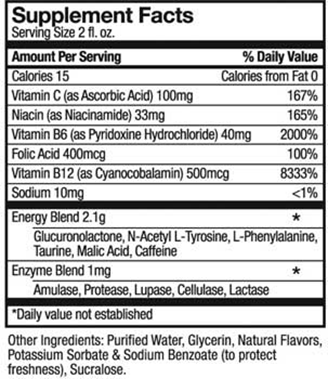
According to statements given to Beverage Daily, 5-Hour Energy says there isn’t any evidence that its products cause deaths.  Its shots contain no more caffeine than a cup of coffee, and do not contain herbal ingredients.

But the product label does not list caffeine content.  The FDA does not require companies to disclose caffeine levels.

It allows them to market the products as drinks or as dietary supplements. Monster Energy contains 240 mg caffeine in 24 ounces.  It has been associated with the deaths of five people so far.

The Times points out that healthy adults can consume large amounts of caffeine with no evidence of harm but that caffeine can be risky for people with underlying conditions like heart disorders.  How much is risky?  It’s hard to say.

Most adults know how much caffeine they can handle without getting shaky or sleep-deprived.  But kids don’t, necessarily.

Consumer Reports tested products and found that some energy drinks contained more than 240 mg per serving, but notes that packages sometimes contain more than one serving.

The FDA considers caffeine to be safe.  But in an opinion last updated in 2011, FDA’s Select Committee on GRAS Substances found that “it is inappropriate to include caffeine among the substances generally recognized as safe (GRAS). At current levels of consumption of cola-type beverages, the dose of caffeine can approximate that known to induce such pharmacological effects as central nervous system stimulation.”

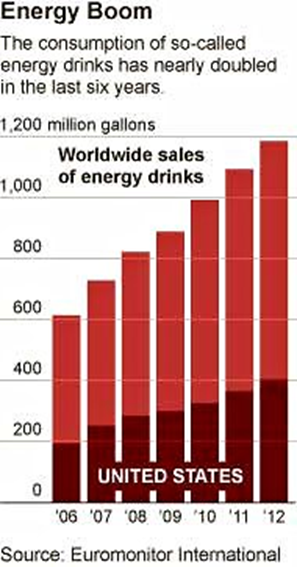
The Times notes that sales of energy drinks in the U.S. are booming, growing by about 16% last year and bringing in nearly $9 billion.
What to do?  A lawyer for the parent of one of the teenagers who died after drinking Monster Energy is urging the FDA to ban the drinks to minors.

The FDA should investigate the cases, for sure.

And how about adding amounts of caffeine to labels.  That seems like a no brainer while the investigations are in progress.

Nov 1 2012

Energy drinks: Why deregulation is not such a good idea

Concerns that highly caffeinated Monster Energy drinks might be responsible for the recent deaths of at least five young adults are, as I see it, a direct result of deregulation of food oversight.

Here’s my version of the history leading up to the present situation:

  • In 1994, Congress passed the Dietary Supplement Health and Education Act (DSHEA), which in essence deregulated dietary supplements, permitted them to be labeled and regulated as supplements, not foods, and removed much of FDA’s authority over their contents and health claims.
  • The dietary supplement industry, as I explain in Food Politics, wrote much of the key language of this law.
  • When the FDA tried to enforce its food rules for supplements, the courts ruled in favor of manufacturers on First Amendment grounds.
  • Because rules for supplements are less restrictive than those for foods, some manufacturers prefer labeling their products as supplements.
  • Monster Energy drinks are labeled as supplements, removing them from much of FDA’s authority.

The results of DSHEA, in this case, are explained by the New York Times:

But while the F.D.A. regularly makes adverse event reports about drugs and medical devices publicly available, it does not do so for dietary supplements like energy drinks. Because of that policy, consumers had no way of knowing of the complaints about Monster Energy drinks before incident reports were released by the F.D.A. in response to a formal Freedom of Information Act request.

Also, while supplement makers have been required since late 2007 to alert the F.D.A. to possible product-related deaths and injuries, Monster Beverage submitted just one such report to the agency over the last four years, agency officials said.

Most likely because of their high caffeine content, sales of energy drinks are rising rapidly, as shown in this graphic from the Times:

Booming sales means booming profits, and the makers of energy drinks are under pressure to cash in.  That sometimes means cutting corners or not always matching contents to labels.

For example, a Consumer Reports investigation of the caffeine content of energy drinks identified some discrepancies.

Caffeine levels per serving ranged from about 6 milligrams to 242 milligrams per serving—and some containers have more than one serving. The highest level was in 5-hour Energy Extra Strength; the lowest in the seemingly oxymoronic 5-hour Energy Decaf…By comparison, an 8-ounce cup of coffee has about 100 milligrams; a 16-ounce Starbucks Grande, 330 milligrams.

Five of the 16 products that list a specific amount of caffeine…had more than 20 percent above their labeled amount on average in the samples we tested. On the other hand, one…had caffeine about 70 percent below the labeled amount.

Consumer Reports noted one other key point: the FDA considers caffeine as GRAS (Generally Recognized As Safe) and does not require amounts to be listed on labels.

A representative of the Monster Beverage Corporation explained that his company does not list caffeine levels “because there is no legal or commercial business requirement to do so, and also because our products are completely safe, and the actual numbers are not meaningful to most consumers.”

Consumer Reports points out that Monster drinks—like those of 16 other products—warn against use by children, pregnant or nursing women, and people sensitive to caffeine, and recommend a daily limit.

Whether the Monster Energy drinks are really responsible for the reported deaths will not be easy to establish.  One victim, age 14, is said to have consumed two 24-ounce Monster drinks containing 240 mg caffeine each within a day or two.

That energy drinks are labeled as supplements ties the FDA’s hands in dealing with such products.

Here are some suggestions to consider:

  • Label energy drinks with standard Nutrition Facts panels.
  • Require amounts of caffeine to be stated on the label.
  • Limit the amount of caffeine that can be included in soft drinks.

Two Senators (Durban and Blumenthal)—not for the first time—are pushing the FDA to investigate.  Good idea.  I can only speculate about why the FDA isn’t responding, but I’m guessing that this issue, like so many others, is too controversial to take up during an election campaign.

Soon, please.

Apr 10 2012

Nutritionist’s Notebook: Caffeine Cravings

On Tuesdays, I answer questions about nutrition in NYU’s student newspaper, the Washington Square News.   These appear intermittently on the newspaper’s website.  Today’s is about caffeine.

Question: What kind of effect does caffeine have on our metabolism and general health? What is an appropriate amount of caffeine to have? And are certain sources of caffeine better than others? 

Answer: Caffeine is a mild upper. It perks up your central nervous system and makes you feel more alert, energetic and cheery. Caffeine is common in plants, but coffee, chocolate and tea have the most. The amount of caffeine depends on the type, amount used and brewing time, from 30 milligrams for a small cup of weak tea to more than 300 milligrams for some of the larger and stronger Starbucks drinks. When caffeine appears on the labels, you know exactly how much you are getting.

Energy drinks made for adults, like Red Bull, contain about 80 milligrams in an eight-ounce can. Coca-Cola, Pepsi-Cola and other soft drinks marketed to children have much less — 30 to 40 milligrams in 12 ounces.

People react to caffeine in different ways and, by this stage in your life, you undoubtedly know how much of it you can handle and at what time of the day you can handle it. If you take in more than your personal limit, you may feel nervous, shaky and sleepless. The more caffeine you drink, the more you become accustomed to it and the harder it is to give up. Some researchers think that the mix of sugar with caffeine is what makes some people feel addicted to soft drinks.

Perhaps it’s the caffeine in coffee that makes researchers want to find something wrong with it. I have a thick file of papers claiming that coffee raises the risk for heartburn, cancer, heart disease, infertility, ulcers and many other health problems, but the observed effects are small, inconsistent and unconvincing. When given as a drug, caffeine stimulates urine production and suppresses appetite, but the amounts in all but the strongest coffees are too low to produce such effects. If you get shaky when you drink caffeinated beverages, it’s time to stop.

—A version of this article appeared in the Tuesday, April 10 print edition. Marion Nestle is a contributing columnist. Email her questions at dining@nyunews.com.

Additional note on the food politics of caffeineSenatorDick Durbin (Dem-IL) has just asked the FDA to enforce its own rules on drink labeling.  Some makers of high-caffeine “sports” drinks are marketing them as dietary supplements to avoid having to adhere to FDA rules on how much can go into soft drinks.

Nov 14 2009

FDA “looking into” safety of caffeinated booze

The FDA announced today that it has sent letters to 30 makers of caffeinated alcoholic beverages warning them that caffeine is not approved as an additive to booze:

Under the Federal Food, Drug, and Cosmetic Act, a substance added intentionally to food (such as caffeine in alcoholic beverages) is deemed “unsafe” and is unlawful unless its particular use has been approved by FDA regulation, the substance is subject to a prior sanction, or the substance is Generally Recognized As Safe (GRAS).    FDA has not approved the use of caffeine in alcoholic beverages and thus such beverages can be lawfully marketed….The FDA noted that it is unaware of the basis upon which manufacturers may have concluded that the use of caffeine in alcoholic beverages is GRAS or prior sanctioned.  To date, the FDA has only approved caffeine as an additive for use in soft drinks in concentrations of no greater than 200 parts per million.  It has not approved caffeine for use at any level in alcoholic beverages.

The FDA asked the companies to provide evidence that the products are safe.  It also opened up a new web page on caffeinated alcoholic beverages.  This gives samples of letters, the list of manufacturers, and letters to FDA from attorneys general and scientists.  There is also a Q and A.  For example:

Q3. What happens if the industry doesn’t share its data in the next 30 days? What options are available to FDA?

A3. If FDA determines that the use of caffeine in an alcoholic beverage is not GRAS or subject to a prior sanction, FDA has a range of regulatory options available to it, from the issuance of a warning letter to seizure. It is the manufacturer’s continuing responsibility to ensure that the foods they market are in compliance with all applicable legal and regulatory requirements. FDA intends to exercise all options that are appropriate for the product in question.

As Michele Simon of the Marin Institute puts it, “It seems the sleeping giant has awaken!

Indeed it does.  You don’t think this counts for much?  Ask the makers of some of these drinks.  A couple of companies already have “voluntarily” removed the caffeine.  I’m willing to bet that others will soon follow?

Jun 13 2008

News: Wonderful new products!

The creativity of junk food makers never ceases to amaze. Try these.

Thanks to Michele Simon for sending information about Engobi chips, infused with caffeine, and lots of it–140 mg of caffeine along with its 220 calories in a 1.5 oz serving. That’s twice as much caffeine as you get in Red Bull!

And thanks to Jessica Anderson for reading her airline magazines and running across the “Hollywood Cookie Diet.” Eat cookies; lose weight. What could be better?

Aren’t you happy to know about these?