by Marion Nestle

Search results: USDA meat

Jan 7 2021

What Covid-19 is doing to meatpacking workers and communities

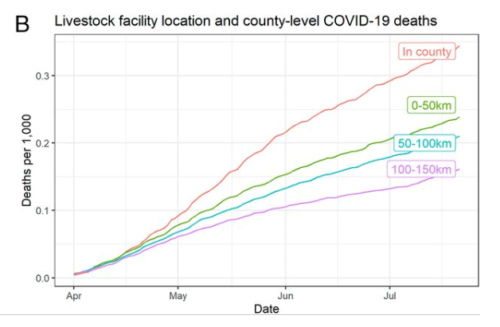
A scientific report in Proceedings of the National Academies titled Livestock plants and COVID-19 transmission,” demonstrates the impact of Covid-19 on workers in meat and poultry processing plants.

Our study suggests that, among essential industries, livestock processing poses a particular public health risk extending far beyond meatpacking companies and their employees. We estimate livestock plants to be associated with 236,000 to 310,000 COVID-19 cases (6 to 8% of total) and 4,300 to 5,200 deaths (3 to 4% of total) as of July 21….This study shows that meat and poultry slaughter plants were in fact vectors of the disease…Researchers found that poultry plants showed a significant relationship with COVID-19 cases, with pork plants showing the strongest relationship. Beef plants showed the strongest relationship with deaths from the illness.

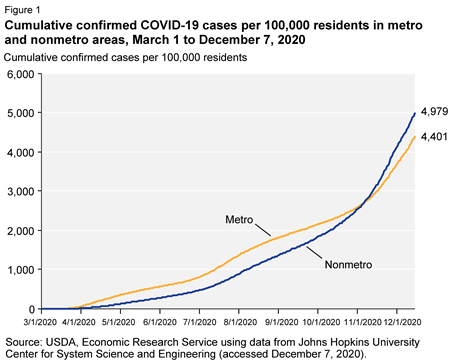
The USDA has done its own analysis: “The share of all COVID-19 cases in nonmetro [rural] areas has been growing since late March, increasing from 3.6 percent on April 1 to 15.6 percent on December 7.”

Among nonmetro counties, the highest COVID-19 case rates are found in farming-dependent and manufacturing-dependent counties. The high prevalence of COVID-19 in manufacturing-dependent counties is due partly to higher COVID-19 case rates in meatpacking-dependent counties (those in which 20 percent or more of employment is in the meatpacking industry), almost all of which are manufacturing-dependent counties.

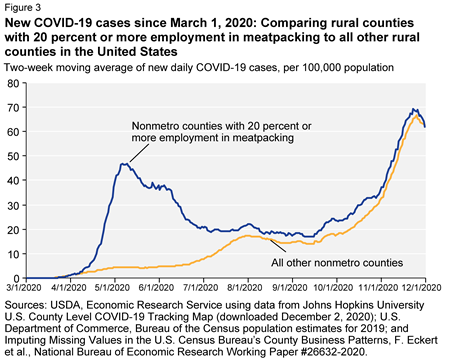
But another USDA report, specifically about the meatpacking industry, looks to me as though it is hiding what is happening in those plants.  It includes a chart indicating no special increase in cases among meatpacking workers.  No surprise, if meatpacking plants are epicenters that spread the infection to the local community (but the report doesn’t say that).

What it does say is this:

The two-week moving average number of new daily cases rose in meatpacking-dependent counties through the remainder of April, reaching a peak of nearly 50 cases per 100,000 by the end of the month. This two-week moving average was more than 10 times the prevalence seen in other rural counties. Even though cases in meatpacking-dependent counties started to decline in the month of May, they remained significantly higher compared to other rural counties, falling to just under seven times the number of average daily cases by the end of May.​…Even though meatpacking-dependent counties are dealing with a second wave, the surge in rural new cases does not appear to be driven by new outbreaks in the meatpacking industry. Meatpacking-dependent counties have maintained an almost identical pattern to other rural counties for a fifth straight month.

Confused?  Me too.  This looks like a whitewash.

Is this one result of the USDA’s moving the Economic Research Service out of Washington DC to Kansas City, a move clearly meant to—successfully—decimate the agency?

Politico asks: can the ERS move be reversed?  Not easily, alas.

It’s a good thing independent scientists and investigators are keeping an eye on this situation.

Leah Douglas of the Food and Environment Reporting Network (FERN) deserves much praise for tracking infections and deaths among farm and meatpacking workers.

Nov 5 2020

The latest on cell-based meat

USDA to launch rulemaking process for labeling of cell-cultured meat; ‘success will turn, in large measure, on the nomenclature used,’ says attorney: How should meat grown from cultured animal cells be labeled? In a joint FDA/USDA webinar, officials said they would work together to come up with joint principles to govern the labeling of products under their respective jurisdictions (FDA: seafood; USDA: livestock & poultry) before launching a rulemaking and comment process, although no firm timetable has yet been established…. Read more.

  • You can watch a video about regulation of these products here.
  • The joint framework for regulation is here.

FoodNavigator-USA.com has been collecting items on cell-based meats.  I’ve selected a few of interest.  For others, click here.

Oct 7 2020

The USDA’s food boxes: the saga continues

I cannot believe there is anything further to say about the Farmers to Families food boxes, the $4 billion USDA program that pays distributors to pick up dairy, meat, and produce, put it in boxes, and deliver the boxes to food banks, which then hand them out to people who need food.  My most recent post on the inclusion of a personal letter from President Trump in the boxes is here.

The USDA now says it has distributed 100 million of these boxes.

Politico’s Helena Bottemiller Evich reports  that the USDA now requires the private companies that collect, pack, and deliver the boxes “to also stuff the Trump letters into the package — an expansion of the controversial letter policy with just…days until the presidential election.”

The Counter’s Jessica Fu (to whom I owe an apology for spelling her name incorrectly the last time I quoted her) writes that “Religious groups distributing Covid hunger-relief boxes are praying with recipients, taping Bible verses onto flaps, and soliciting donations. Some of these practices may violate federal regulations.”

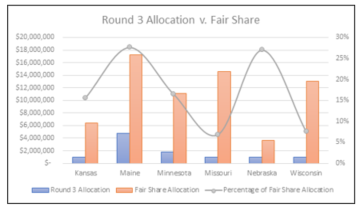
The Hunger Task Force says that the program is discriminatory: “Wisconsin has been underrepresented in all rounds of the program while Wisconsin’s hungry line up by the carload for assistance that has now been completely severed.”

New York legislators are also complaining.  They wrote a letter to USDA Secretary Sonny Perdue:

in the transition between the CFAP vendors selected for rounds two and three, miscommunication from USDA has left many food pantries in New York City suddenly without food, causing upheaval in the lives of those families who were relying on their local pantries for meals.  We understand that the new vendors selected for round three of this program were required to specify the counties or boroughs to which they would provide food. However, this has forced many nonprofits and food pantries who had relationships with vendors no longer serving their county or borough to scramble to find new partnerships, with no guidance from USDA, no overlap in service
provision, and nowhere to turn for help.

On the saga goes.  It would have made so much more sense—financially, logistically, and humanely—for the USDA to strengthen SNAP enrollments and benefits.  Some of this is happening anyway, but the long history of food banks tells us that they can never meet needs on an ongoing basis.  SNAP, imperfect as it is, still is a demonstrably better means of relieving food insecurity.

Sep 22 2020

Corporate capture in action: e-mails illustrate the meat industry’s role in keeping plants open despite Covid-19

I’ve written previously (see this one, for example) about the meat industry’s role in keeping plants open despite worker illnesses, but much about the industry’s pressures on government has been based on conjecture.  No more.

In another example of the value of the Freedom of Information Act (FOIA), two groups have obtained e-mails documenting these pressures.

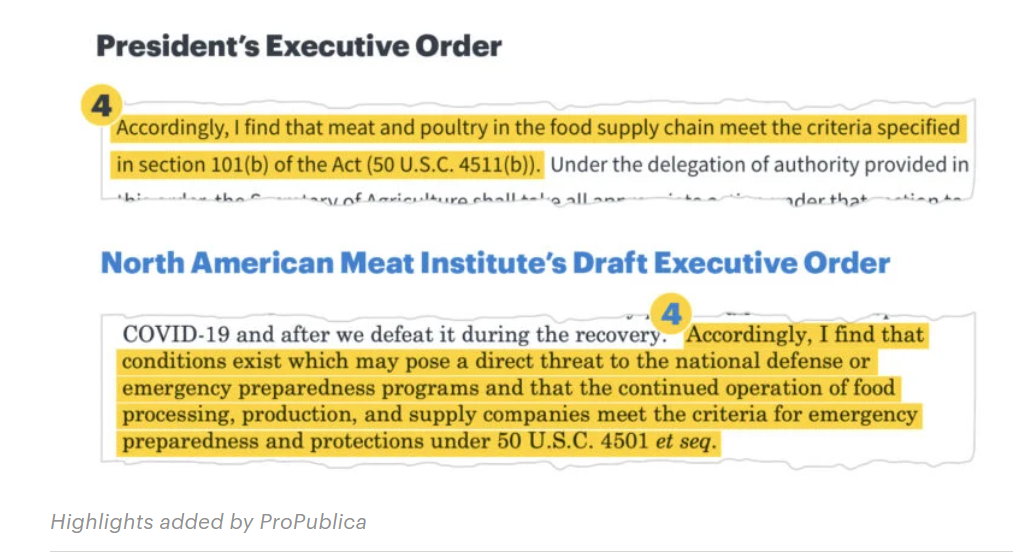
FROM PRO PUBLICA, September 14, 2020: “Emails Show the Meatpacking Industry Drafted an Executive Order to Keep Plants Open: Hundreds of emails offer a rare look at the meat industry’s influence and access to the highest levels of government. The draft was submitted a week before Trump’s executive order, which bore striking similarities.”

The e-mails indicate that the North American Meat Institute (NAMI), the trade association for the meat industry, essentially wrote President Trump’s executive order invoking the Defense Production Act, which forced plants to stay open and workers to continue working under unsafe and highly virus-transmissable conditions.

For example (and look on the site for #6, which does a longer and even more compelling comparison):

FROM PUBLIC CITIZEN, September 15, 2020: “The U.S. Department of Agriculture (USDA) and the meatpacking industry worked together to downplay and disregard risks to worker health during the pandemic, as shown in documents uncovered by Public Citizen and American Oversight through Freedom of Information Act (FOIA) requests.”

The documents show that:

  • The executive order signed by President Donald Trump regarding meatpacking plants, ostensibly invoking the Defense Production Act, was the result of lobbying by the North American Meat Institute, a meat-packing trade association, which prepared what appears to be the first draft of what would become the executive order;
  • The North American Meat Institute repeatedly requested that USDA Secretary Sonny Perdue discourage workers who were afraid to return to work from staying home;
  • Meatpacking plants asked the USDA to intervene on multiple occasions when state and local governments either shut them down over health and safety concerns or sought to impose worker health and safety standards; and
  • Smithfield Foods repeatedly requested that the USDA “order” it to reopen its meat processing plant in Sioux Falls, S.D. – despite no legal basis for such an order.

WHAT’S AT STAKE HERE?

Check out Leah Douglas’s ongoing count of Covid-19 cases among meatpacking workers.  Her figures as of September 18, include at least:

  • 804 meatpacking and food processing plants (496 meatpacking and 308 food processing) and 106 farms and production facilities have had confirmed cases of Covid-19.
  • 59,430 workers (42,606 meatpacking workers, 9,571 food processing workers, and 7,253 farmworkers) have tested positive for Covid-19.
  • 254 workers (203 meatpacking workers, 35 food processing workers, and 16 farmworkers) have died.

To state the obvious: corporate capture of government agencies and the presidency is not good for public health or American democracy.

Sep 15 2020

OSHA fines meat packers for Covid failures (sort of)

I have complained previously how Covid-19 has exposed corporate capture of the Occupational Safety and Health Administration (OSHA), the federal agency ostensibly responsible for ensuring “safe and healthful working conditions for working men and women.”

You don’t believe me?  Try this.

U.S. Department of Labor Cites Smithfield Packaged Meats Corp. For Failing to Protect Employees from Coronavirus: The U.S. Department of Labor’s Occupational Safety and Health Administration (OSHA) has cited Smithfield Packaged Meats Corp. in Sioux Falls, South Dakota, for failing to protect employees from exposure to the coronavirus. OSHA proposed a penalty of $13,494, the maximum allowed by law.

Or this.  U.S. DEPARTMENT OF LABOR CITES JBS FOODS INC. FOR FAILING TO PROTECT EMPLOYEES FROM EXPOSURE TO THE CORONAVIRUS: The U.S. Department of Labor’s Occupational Safety and Health Administration (OSHA) has cited JBS Foods Inc. in Greeley, Colorado, for failing to protect employees from exposure to the coronavirus. OSHA proposed $15,615 in penalties.

They have to be kidding.  We are talking here, according to Leah Douglas’s statistics, about how more than 2500 Smithfield employees and more than 2700 JBS employees have been confirmed with Covid-19.

If these are the maximum penalties (!), how about assigning them to every one of those cases.

The companies can certainly afford it: Smithfield had $13.2 billion in sales in 2019, and JBS had $51.7 billion.

Never mind, even that pittance penalty is too high for the meat industry to accept.

Furthermore, Smithfield is appealing the fine.  A representative said the fine is

“wholly without merit” because the company took”extraordinary measures” to protect employees from the COVID-19 virus. And during the pandemic, Smithfield took direction from OSHA, the Centers for Disease Control and Prevention (CDC), and U.S. Department of Agriculture (USDA).

Translation: “It’s not our fault.  It’s OSHA fault, the CDC’s fault, the USDA’s fault.

That’s not what the meatpacking workers’ union says.

Today [September 10], the United Food and Commercial Workers (UFCW) International Union, which represents1.3 million workersin meatpacking plants and other essential businesses, condemned the new U.S. Department of Labor fine on Smithfield Foods as completely insufficient in the wake of the company’s failure to protect meatpacking workers at its Sioux Falls, South Dakota which reported nearly 1,300 COVID-19 infections and at least four deaths among its employees. As the union for Smithfield workers at this plant, UFCW called today’s fine by the Trump Administration insulting and a slap on the wrist that will do nothing to help those already infected or prevent future worker deaths.

It issued a similar statement on the JBS fine.

The meat industry has rallied to the defense of its Big Meat members.  To wit: Meat Institute Issues Statement on OSHA Citation Related to COVID-19.  

The meat and poultry industry’s first priority is the safety of the men and women who work in their facilities [every time you read a statement like this, think of a red flag on the playing field—a warning that it means just the opposite]. Notwithstanding inconsistent and sometimes tardy government advice, (‘don’t wear a mask/wear a mask’/April 26 OSHA guidance specific to the meat and poultry industry) when the pandemic hit in mid-March, meat and poultry processing companies quickly and diligently took steps to protect their workers. Companies had to overcome challenges associated with limited personal protective equipment…Most importantly, as evidenced in trends in data collected by the Food and Environment Reporting Network and The New York Times, these many programs and controls once in place worked and continue to work. Positive cases of COVID-19 associated with meat and poultry companies are trending down compared with cases nationwide.

The Meat Institute actually has the nerve to cite Leah Douglas’s data to support its defense—this, while meat companies are refusing to provide accurate data.  (Even the union cites much lower figures despite its reports of workers being forced to stay on the lines without masks despite being ill or risk losing their jobs).

It details its arguments that all those illnesses and deaths are OSHA’s fault in yet another press release on September 14. 

I suppose we will now go through all this again for Tyson’s, where more than 10,000 workers have become ill.

Expect another of OSHA’s “slaps on the wrist” followed by the Meat Institute’s objections.

Sep 3 2020

Where are we on cell-based meat alternatives?

Let’s catch up on what’s happening with cell-based meat, so far still in development, regulated jointly by FDA (pre-harvest) and USDA (post-harvest), but not yet approved for human consumption.

I think I can wait.

Jul 1 2020

Tracking COVID-19 in meat-packing workers

Leah Douglas of the Food and Environment Reporting Network (FERN) is keeping an ongoing map of where COVID-19 cases are clustered among meat-packing workers.

The United Food and Commercial Workers International Union (UFCW), which represents 1.3 million workers, has these numbers for its members:

  • 29,000 infections
  • 238 deaths

Public Citizen reports that the USDA’s Inspector General’s latest report finds that the USDA used unreliable data and hid data from the public in order to allow higher line speeds in meatpacking plants.

The meat industry is defending against these charges.  See FoodManufacture.com’s “Coronavirus: meat industry in the firing line.”

But the U.S. is not alone in having appalling conditions in meatpacking plants, as FoodNavigator reports.  European meat-packing plants are just as bad, according to a report from the European Federation of Food, Agriculture and Tourism Trade Unions.

If anything good comes out of this pandemic, let’s hope it’s to do fix long-standing appalling conditions in meatpacking plants.

Need a movie?  Try Eric Schlosser’s and Richard Linklater’s Fast Food Nation from 2006.  It’s a fictionalized account of what happens in meatpacking plants, not much appreciated at the time it came out, but I bet it looks much more timely now.

Jun 30 2020

USDA’s food boxes: some feedback

Last week, I asked readers to tell me how the USDA’s Farmers to Families food box program looked on the ground.  I got a bunch of responses, but let me start with Andrew Coe’s op-ed in the New York Times, or, as he wrote me, his rant titled: “Free produce, with a side of shaming.”

The subheading: “Instead of beefing up the SNAP program during the pandemic, the government opts for a return to Depression-era food lines.”

The goal of the people on these lines?  “A food pantry that has cardboard containers stacked on the sidewalk in front.”

These are “U.S.D.A. Farmers to Families Food Boxes,” each holding 23 pounds of produce: apples, cantaloupes, potatoes, yams, oranges, iceberg lettuce, onions. When the men and women at last get to the front of the line, they are given one of these boxes to put in their shopping carts and take home. This food is supposed to help tide them over until they get a job, or until the next week, when they can line up again on the same sidewalk.

OK.  So my questions about this emergency—and highly unsustainable method for achieving the program’s concurrent goals, feeding the hungry and buying from farmers who don’t have any way to sell their products–are (1) is it providing decent food to those who need it, and (2) is it helping farmers who need help.

My correspondents provided some answers, although not enough to really know what is going on.

Two people sent me box labels:

One reader referred me to Instagram photos from #farmerstofamiliesfoodbox, and a Vermont public radio discussion of the boxes.

Another Vermont reader said that “The main contract was landed by a well-regarded local food service company – with the initial support of our agency of ag folks – and they’ve worked very closely with a number of other state, private and nonprofit groups to get a fair bit of regional and Vermont products – especially dairy – in the boxes.”  She referred me to an article about the program with this photo of a box with local dairy.

A California reader who works at a food bank said:

We had tons of food that volunteers bagged up individually. One big bag would get eggs, celery, potatoes, apples, nectarines, tangerines, and 1-2 bread products. When cars came to pick up their food, in addition to the bag above, which often had more than what’s noted there, they got a “regular” veggie farm box from Farm Fresh to You, a local CSA. It was all packed up and ready to go, delivered by a truck on a pallet.

I received a lengthy explanation from a food sourcing coordinator at a food bank in Colorado.  Here are some of her comments:

  • We’ve seen our distribution increase by 40% since March.
  • We secured a partnership with a large produce distributor in Missouri for produce boxes, and a regional milk distributor in Colorado. Deliveries from these vendors began on May 20.
  • They’ve addressed issues with box size, transportation and pallet structural issues, and cancelling loads or adding additional deliveries as we requested.
  • We are receiving 3.2 million pounds of CFAP product each month from these vendors, in the amounts and delivery schedule that we requested. This is a 50% increase over our pre-COVID monthly distribution numbers.

She talked about the problems they were having:

There was definitely a lot of confusion, miscommunication, and misinformation given to both food banks and the distributors by USDA. The program was touted to the food banks as being “truck to trunk”, with distributors delivering directly to distribution sites. However, after the vendors were awarded, the vast majority indicated that they…only had the capacity) to deliver to food bank warehouses with commercial dock doors and large amounts of storage.

When food banks attempted to push back and request funding from USDA or distributors in order to cover the substantial costs to them that this model would incur, the USDA told distributors that they could not subcontract with us. One vendor said that these requests amounted to “extortion” by food banks. [Our] Food Bank…ended up having to secure an additional warehouse, hire 5 staff, and rent 8 new vehicles in order to handle the amount of product we are receiving. The cost to us is about $100,000/month in order to take on the additional product. None of that cost is reimbursed by USDA, which is reimbursing the entire costs of procurement, packaging, and transportation for the distributors. Here’s a link to an article about those additional costs…. we’re fairly unique among food banks in being able and willing to incur those additional costs.

She sent a photo of what’s in the boxes, judging the quality as very high.

Does the program benefit small producers?

  • The milk distributor is a local company.
  • The onions and potatoes are also sourced from Colorado growers…[but] the Colorado growing season doesn’t kick into full gear until late June.
  • Our meat is coming out of Wisconsin…subcontracted with another distributor…so I don’t know where that meat comes from.
  • Many of our small farms who originally submitted bids for the program and were not awarded have not been included in produce sourcing by the distributors that were awarded.

Her conclusion: “While CFAP has definitely been a big lift for us to get up and running, and has had many stumbling blocks since its inception, the enormous amount of high-quality, very in-demand product that we’ve been able to distribute to our clients across Colorado and Wyoming has, in my mind, made the program a success for us.”

OK, so the program is working, as far as it goes, but at great cost.  I’m with Andy Coe on this one.  This is helping distributors more than farmers, and is demeaning to recipients.  There are much better ways to solve both problems.  If only we had the political will to take it on.

Addition

Jerry Hagstrom, of The Hagstrom Report, to which I faithfully subscribe, writes:

I don’t see any of your readers making the following points:

  1. The object of the box program was to find a way to make use of the foods–particularly fruits and vegetables but also pork, chicken and dairy– that were intended for restaurant and institutional use, much of which would spoil if a quick way was not found to use it. Increasing SNAP benefits would not address the problem of figuring out how to distribute food that was intended for restaurants and institutions. As I understand it many of the farmers and distributors engaged in that business do not have any relationship with grocery store distributional channels.
  2. The SNAP program requires applications and documentation before someone is approved for the program. That takes time. The box program has moved food fairly quickly.
  3. As far as I know, food banks do not ask people if they are low income. So people who are suddenly low income can go there and get food, which they cannot do so quickly through the SNAP program.
  4. It would seem to me the food box program was a short term solution, although I don’t know what the farmers and distributors that have been selling to the restaurants and institutions are supposed to do if that demand does not return quickly. Should they go out of business or should some system be found to keep them in business until demand picks up? Would that mean continuing the food box program?

These are worth considering.  But the real question, it seems to me, is how to develop a food assistance system that helps people who need food in a more efficient way, while helping farmers find outlets for what they produce that guarantee them a decent living.  We all need to be working on that.