by Marion Nestle

Currently browsing posts about: Climate change

Dec 5 2023

The COP-28 UN Climate Change Conference in Dubai—items

COP-28, the UN’s climate change conference is happening in Dubai, right now.

I’m trying to make sense of it.  For starters, the irony:

But food—the effects of agriculture on climate change (and vice versa) is on its agenda this year—a major big deal.

That’s why a coalition of farmers, communities, business, and philanthropy has issued a call to transform food systems.

Here’s my collection of food-related items.

I.  Food Tank’s Danielle Nierenberg is on the job: more than 30 Food Tank partnered events are scheduled.

Once again, four pavilions will be devoted to food systems: Food and Agriculture, led by our partners and friends at FAO, CGIAR, International Fund for Agricultural Development, and The Rockefeller Foundation; Food Systems, spearheaded by the European Union-backed program EIT Food and a variety of other groups including the Food and Land Use Coalition; Food4Climate, organized by a variety of partners—including youth voices—pushing for a more humane and sustainable food system; and the Sustainable Agriculture of the Americas Pavilion facilitated by IICA, bringing together the global north and south across the hemisphere.  You can read Food Tank’s coverage of the roadmap, which was announced last year, here.

IIFoodDive: Food system transformation on the menu at COP28

III.  Reuters: Countries urged to curb factory farming to meet climate goals

IV.  The lunch menu: The summit is featuries roughly two-thirds plant-based menu to highlight the link between greenhouse gas emissions and livestock.  But the meat industry is fighting  back.

V.  DeSmog: Big Meat Unveils Battle Plans for COP28

VI.  The Guardian: Plans to present meat as ‘sustainable nutrition’ at Cop28 revealed: Documents show industry intends to go ‘full force’ in arguing meat is beneficial to the environment at climate summit.

VII.  The Meat Institute

The Meat Institute and the Protein PACT for the People, Animals & Climate of Tomorrow will highlight animal agriculture’s commitments and progress toward global goals in multiple high-level engagements at the UN Climate Change Conference (COP28) in Dubai November 30-December 12. The Protein PACT has organized or assisted with inviting expert speakers for six panels across five COP28 pavilions, including:

  • December 5 panel in the Food Pavilion, co-organized by IICA and the International Livestock Research Institute (ILRI) on the topic of sustainable and healthy livestock production systems
  • December 6 panel in the IICA pavilion, organized by the ​​Canadian Alliance for Net-Zero Agri-food on the topic of achieving net zero in agrifood systems
  • December 8 panel in the IICA pavilion, organized by the Protein PACT on the topic of principles, practices, and proof for animal agriculture driving climate and food security solutions
  • December 9 panel in the IICA pavilion, co-organized by IICA and ILRI on the topic of innovation and investment in livestock systems for climate change adaptation and  mitigation

VIII.  International Dairy Federation & European Dairy Association side event: How Animal Source Food Nourishes The World In Times of Climate Change.

IX. Vox: There’s less meat at this year’s climate talks. But there’s plenty of bull.  Meat and dairy are driving the climate crisis. Why won’t world leaders at COP28 do anything about it?

X.  Food Navigator: on The Emirates Declaration.  Food is finally at the top table but measurable targets are missing.  Over 130 prime ministers and presidents have today signed the Emirates Declaration at COP28 – a first of its kind commitment to adapt and ‘transform’ food systems as part of action on the climate crisis…. Read more

Comment: The Emirates Declaration on Sustainable Agriculture, Resilient Food Systems and Climate Action is the firsr statement out of this meeting.  It doesn’t mention fossil fuels (the elephant in this particular room) or meat.  But it does propose:

1. Financial and technical support for sustainable solutions, capacity building, infrastructure, and innovations for farmers, fisherfolk, and other food producers.while conserving, protecting and restoring nature.

2. Promoting food security and nutrition.

3. Supporting workers in agriculture and food systems whose livelihoods are threatened by climate change.

4. Strengthening water management .

5. Conserving, protecting and restoring land and natural ecosystems, enhancing soil health, and biodiversity, and shifting from higher greenhouse
gas-emitting practices to more sustainable production and consumption approaches, including by reducing food loss and waste and promoting sustainable aquatic blue foods.

As for how and when?

To achieve these aims – according to our own national circumstances – we commit to expedite the integration of agriculture and food systems into our climate action and, simultaneously, to mainstream climate action across our policy agendas and actions related to agriculture and food
systems.

In the meantime, consider these:

What will it take to stop the impending disaster?  This has to be #1 on the advocacy agenda.

Mar 17 2023

Weekend reading: IPES Food

If you aren’t familiar with IPES Food, here is your chance.

IPES-Food – the International Panel of Experts on Sustainable Food Systems – is a diverse and independent panel of experts guided by new ways of thinking about research, sustainability, and food systems. Since 2015, IPES-Food has uniquely shaped the debate on global food systems reform, through policy-oriented research and direct engagement with policy processes.

The IPES Food panel is an impressive bunch, starting with its co-chairs, Olivier De Schutter, currently UN Special Rapporteur on extreme poverty and human rights, and Maryam Rahmanian, independent expert on agriculture and food.

Their two most recent reports:

I.  Smoke & Mirrors: Examining competing framings of food system sustainability 

This comes with a background report: Agroecology, Regenerative Agriculture, and Nature-Based Solutions: Competing framings of food system sustainability in global policy and funding spaces.

Together, these cover those key terms, their emergence and evolution, and the ways they are used in global policy and funding.

The report favors use of Agroecology:

Agroecology, and in some uses regenerative agriculture, offer a more inclusive and comprehensive pathway toward food system transformation because they connect social
and environmental aspects of sustainability, address the whole food system, is attentive to power inequalities, and draws from a plurality of knowledges emphasizing the inclusion of marginalized voices.

II.  Special Report: Debt & Food Crisis: Breaking the Cycle of Unsustainable Food Systems, Hunger and Debt

Unsustainable food systems, this says, are major drivers of “the debt crisis. Import dependencies, extractive financial flows, boom-bust commodity cycles,” leaving countries exposed to shocks and unable to invest in climate-resilient food production and food security.

The IPES panel calls for:

  • Debt relief and development finance
  • Reparation of historical food system injustices and the return of resources to the Global South.
  • Putting the interests of the world’s poorest countries and marginalized populations first.

The documents

IPES Food deals with Big Picture issues.  What they say is worth attention.

Nov 15 2022

What’s up with food systems at COP27?

COP27 is the term used to refer to the 27th annual United Nations Conference of the Parties of the UNFCCC [United Nations Framework on Climate Change Conference) taking place last week and this week in Sharm el-Sheikh, Egypt.

The New York Times has a COP27 explainer with a Q and A

This may be the 27th such conference, but it is the first to deal with the intersection of food production and consumption with climate change: how climate change affects agriculture and food systems and how agriculture and food systems affect climate change.

For the first time, several pavilions are devoted to food systems, this one specifically.

Food Tank is managing some of the programs at these pavilions.  Its president, Danielle Nierenberg, reports on them daily at this site

The official UN news site is here.

On November 12, agriculture was the theme of the day.   This is explained in a short video. 

Water was yesterday’s theme.

I’ve been trying to follow the events from Nierenberg’s comments and from the occasional article in the New York Times, for example, here (what the fights are about), here (videos of speeches), and here (protest and hunger strikes).

The Food4Climate pavilion’s YouTube channel for live streams and videos is here.

The Rockefeller Foundation is involved in COP27.  It sponsors a food and agriculture pavilion.

The Foundation also has produced a film, Food 2050.  The trailer is here.

I’m particularly interested in this film because Rupa Marya, who is attending the conference, says I’m in it and sent me this screen shot (I’m not in the trailer).

Will anything good come out of this COP27?  I’m inspired by this speech from the head of the World Health Organization.  Bringing these issues to public attention might help.

***********

For 30% off, go to www.ucpress.edu/9780520384156.  Use code 21W2240 at checkout.


Sep 9 2022

Weekend reading: State of the world’s food resources (hint: declining fast)

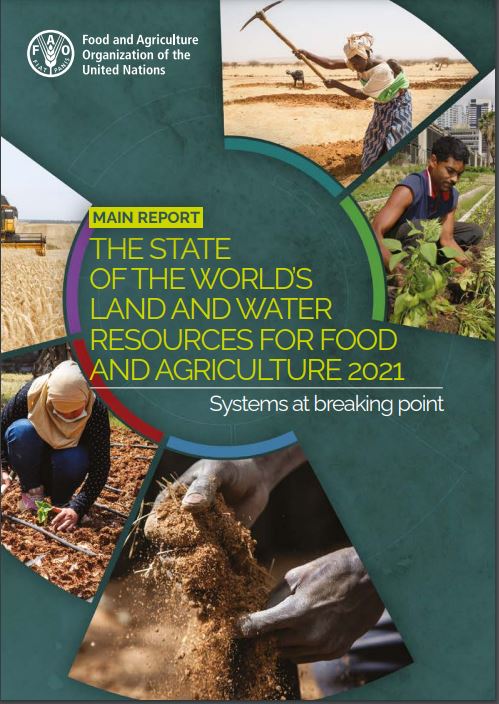
If you are up for a dose of reality, try this report from the Food and Agriculture Organization of the U.N.

It does not have much good news.  The key challenges:

  • Human-induced soil degradation affects 34 percent – 1 660 million hectares – of agricultural land.
  • More than 95 percent of our food is produced on land, but there is little room for expanding the area of productive land.
  • Urban areas occupy less than 0.5 percent of the Earth’s land surface, but the rapid growth of cities has significantly impacted land and water resources, polluting and encroaching on prime agricultural land that’s crucial for productivity and food security.
  • Land use per capita declined by 20 percent between 2000 and 2017.
  • Water scarcity jeopardizes global food security and sustainable development, threatening 3.2 billion people living in agricultural areas.

The remedy?  The report talks about technical solutions but also says: “Land and water governance must be more inclusive and adaptive, to benefit millions of smallholder farmers, women, youth and indigenous peoples.”

An important point to recognize is that many agents of change in the landscape remain excluded from the benefits of technical advances. This applies to disproportionately poorer and socially disadvantaged groups, with most living in rural areas. While technical solutions to specific land and water challenges may be within grasp, much will depend on how land and water resources are allocated. Inclusive forms of land and water governance will be adopted at scale only when there is political will, adaptive policymaking and follow-through investment.

If only.

************

Coming soon!  My memoir coming out in October.

For 30% off, go to www.ucpress.edu/9780520384156.  Use code 21W2240 at checkout.


Jun 29 2022

Regenerative agriculture and climate change: report

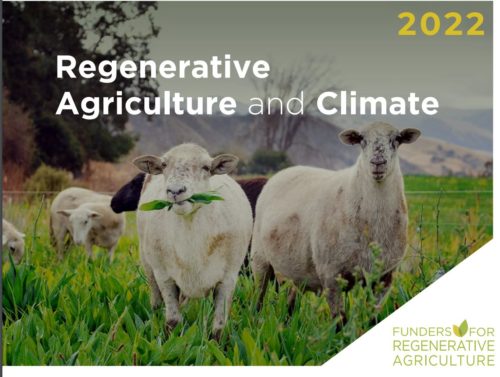
Urvashi Rangan of the Funders for Regenerative Agriculture (FORA) sent me the press release from this group’s report. 

From the press release:

We are very proudtodayto be publishing our first brief,RegenerativeAgriculture and Climate, which outlines how regenerative agricultureand livestock production can restore degraded land, reduce greenhouse gas emissions, and store carbon while producing nutritious food. The brief is clear that regenerative agriculture – including sustainable meat production – is a “shovel ready” climate solution that if scaled quickly could rapidly reduce greenhouse gas emissions and to remove carbon dioxide from the air. 

The report pulls together the arguments for the benefits of regenerative agriculture as a solution to climate change, deals with misconceptions about regenerative practices, and provides useful figures and references. 

The escalating climate crisis requires rapid action on two critical fronts: (1) a steep reduction in greenhouse gas emissions; and (2) the removal of carbon dioxide from the air and its safe, long-term storage.  Regenerative agriculture can do both. ..Using
photosynthesis and biology, it can restore and maintain the carbon cycle on land. Any amount of carbon dioxide (CO2) absorbed by trees, plants, and soils and subsequently stored has been removed directly from the atmosphere and will help alleviate climate change.  It can also reduce methane, a potent greenhouse gas, from livestock production.  

If you want to know more about regenerative agriculture—and why it matters—this is a great place to start.

Apr 29 2022

Weekend reading: The politics of protein

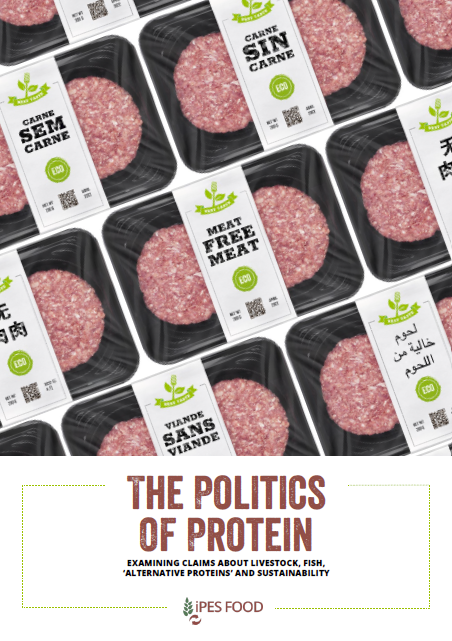
IPES-Food, the International Panel of Experts on Sustainable Food Systems, has a new report: The politics of protein: Examining claims about livestock, fish, “alternative proteins” and sustainability 

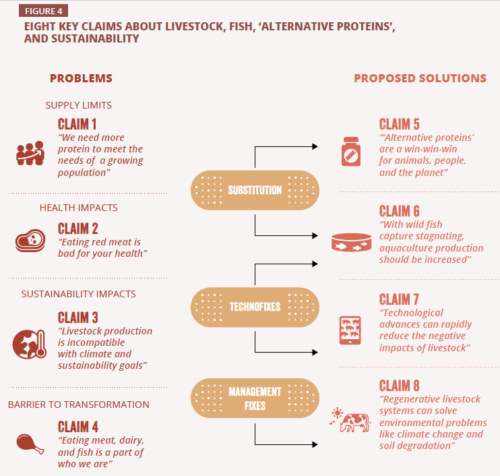
The report contains a deep analysis of the strengths and weaknesses of these eight claims.

The report’s argument is that the focus on protein is overblown.

For decades, the perceived need for more protein has led to distractions and distortions in development programs, flawed marketing and nutritional campaigns, and calls to increase the production and trade of meat, dairy, and protein-enriched foods.

Today, the evidence clearly shows that there is no global ‘protein gap’: protein is only one of many nutrients missing in the diets of those suffering from hunger and malnutrition, and insufficiency of these diets is primarily a result of poverty and access.

The report displays data to back up its arguments in attractive and easily understood charts.  Its conclusions are clearly marked.  Example:  part of the conclusion for Claim #5: Alternative proteins are a win-win.

In conclusion, there are too many uncertainties and data gaps, and too much variation between systems, to make a definitive statement on whether ‘alternative proteins’ are more environmentally sustainable than animal source foods as a whole. Bold and categorical claims about ‘alternative proteins’ being a ‘win-win-win’ are therefore likely to be misleading…The validity of claims about ‘alternative proteins’ (and the purported benefits of these products) ultimately comes down to how foods are produced, what food systems we consider to be desirable and viable, how we weigh up trade-offs ….

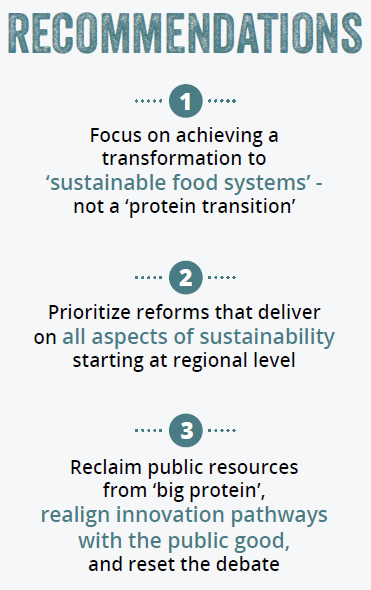
Sensibly, the report makes only three recommendations:

Comment:  I think this report is well done, well written, and well presented.   But here’s where this nutritionist gets cranky: Why title it Protein?  Protein is a nutrient, not a food.  Using protein to stand for foods that contain it is an example of “nutritionism,” the reduction of  the benefits of a food to its single components.

I had to search the report for an explanation of what IPES means by protein.  As far as I can tell, its writers assume you know what it means.  But sometimes the report refers to meat and protein, implying that meat means beef, and protein means protein-containing animal foods other than beef.  At other times, the report uses protein to include beef as well as poultry, fish, dairy, and insects.   But what about vegetables and grains?  They have protein too.  Legumes are particularly good sources; grains have nourished entire civilizations.

I realize that protein—a chefs’ term—is widely understood to stand for all foods, particularly from animals, that contain protein, but that’s nutritionally incorrect because basically every naturally occurring food contains some protein (OK, lettuce doeesn’t have much).

I wish everyone would find a better term, one that calls meat meat, if that’s what’s meant.

Apr 1 2022

Weekend reading: agriculture and climate change

The Intergovernmental Panel on Climate Change (IPCC) has released its 6th report.  

The news gets worse with each successive report.

Human-induced climate change is causing dangerous and widespread disruption in nature and affecting the lives of billions of people around the world, despite efforts to reduce the risks. People and ecosystems least able to cope are being hardest hit…The world faces unavoidable multiple climate hazards over the next two decades with global warming of 1.5°C (2.7°F). Even temporarily exceeding this warming level will result in additional severe impacts, some of which will be irreversible. Risks for society will increase, including to infrastructure and low-lying coastal settlements.

One paragraph (C.2.2) deals with the effects of agriculture on climate change, and the strength of the associations.

  • Effective adaptation options, together with supportive public policies enhance food availability and stability and reduce climate risk for food systems while increasing their sustainability (medium confidence).
  • Effective options include cultivar improvements, agroforestry, community-based adaptation, farm and landscape diversification, and urban agriculture (high confidence).
  • Institutional feasibility, adaptation limits of crops and cost effectiveness also influence the effectiveness of the adaptation options (limited evidence, medium agreement).
  • Agroecological principles and practices, ecosystem-based management in fisheries and aquaculture, and other approaches that work with natural processes support food security, nutrition, health and well-being, livelihoods and biodiversity, sustainability and ecosystem services (high confidence).
  • These services include pest control, pollination, buffering of temperature extremes, and carbon sequestration and storage (high confidence).
  • Trade-offs and barriers associated with such approaches include costs of establishment, access to inputs and viable markets, new knowledge and management (high confidence) and their potential effectiveness varies by socioeconomic context, ecosystem zone, species combinations and institutional support (medium confidence).
  • Integrated, multi-sectoral solutions that address social inequities and differentiate responses based on climate risk and local situation will enhance food security and nutrition (high confidence).
  • Adaptation strategies which reduce food loss and waste or support balanced diets (as described in the IPCC Special Report on Climate Change and Land) contribute to nutrition, health, biodiversity and other environmental benefits (high confidence).

Here are the documents:

The previous IPCC reports

Feb 2 2022

The ongoing debate about meat and dairy emissions

Every time I write anything about the effects of ruminants on greenhouse gas emissions, I am flooded with comments about cherry-picked data.  I’m not going to even try to sort that out, but I do find the studies interesting.

Here’s a report from the Institute for Agriculture and Trade Policy (IATP): Emissions Impossible Europe: How Europe’s Big Meat and Dairy are heating up the planet

Watch the video about it here.

Among the report’s findings:

  • Just 20 European meat and dairy companies combined produce the equivalent of more than half of the United Kingdom, France and Italy’s emissions, and exceed that of the Netherlands.
  • The same 20 companies’ total emissions rival those of fossil fuel giants…over half of Chevron’s (55%), 42% of ExxonMobil’s, 44% of Shell’s and of BP’s.
  • Their combined emissions are also equivalent to 48% of the coal consumed in the entire EU (2018)1 or more than 53 million passenger cars driven for one year.
  • Only four (Arla, Danone, FrieslandCampina and Nestlé) out of the 20 companies assessed report their total supply chain emissions…Only three (Nestlé, FrieslandCampina and ABP) have announced plans to reduce their total.

Plenty of groups object to these findings.  You can read about that here.

Addition:

If you haven’t seen it, take a look at this 15-minute video on Big Ag lobbying from the New York Times.