by Marion Nestle

Search results: Immunity

Sep 24 2021

Weekend reading: Immunity, Covid-19, and Generally Good Health

A reader, Philly Nassau, sent me the ingredient list of several “immune-boosting” supplements, in quotes because I am a supplement skeptic in general, and of immune supplements in particular (I favor eating healthfully and staying active).

Immune supplements claim to be “Nootropics and Brain Supplement for Memory, Brain Support, Clarity, Focus, Mood Boost, Anti Anxiety & Stress Relief.”  Nootropics?  These are defined as drugs or supplements capable of enhancing memory, concentration, or other cognitive functions and of preventing cognitive decline.  How I wish.

But first, the science.

  • Gut-microbiota-targeted diets modulate human immune status.  “The data highlight how coupling dietary interventions to deep and longitudinal immune and microbiome profiling can provide individualized and population-wide insight. Fermented foods may be valuable in countering the decreased microbiome diversity and increased inflammation pervasive in industrialized society.”
  • The Stanford press release on this paper. A fermented-food diet increases microbiome diversity and lowers inflammation, Stanford study finds.  Stanford researchers discover that a 10-week diet high in fermented foods boosts microbiome diversity and improves immune responses.
  • The New York Times account: How Fermented Foods May Alter Your Microbiome and Improve Your Health.  Foods like yogurt, kimchi, sauerkraut and kombucha increased the diversity of gut microbes and led to lower levels of inflammation.

Beyond eating healthfully and including fermented foods in the diet, here’s what’s being said about diet and immunity.

Jun 8 2010

FTC goes after Kellogg’s Immunity claim, but why?

The FTC has imposed new advertising restrictions on Kellogg because of the Immunity claim on Rice Krispies.  The company is not to make claims about “any health benefit of any food  unless the claims are backed by scientific evidence and not misleading.”

Under a previous order dealing with Frosted Mini-Wheats, Kellogg was not supposed to make claims about benefits to cognition on any of its cereals or snack foods unless the company could prove that the claims were backed by real science. This new decision extends that ruling to include any claim at all.

OK, but I’m confused about several aspects of this decision:

  • How come the FTC is doing this and not the FDA?  At some point years ago, regulatory responsibility was split between FDA and FTC.  Since then, the FDA regulates claims on food package labels, whereas the FTC regulates advertising claims.  I realize that food labels are a form of advertising, but it’s unusual and surprising for the FTC to get involved in FDA-regulated matters.
  • As FoodNavigator also wonders, why didn’t the FTC fine the company and, instead, write a harsh letter? [see update below]
  • Why is the FTC doing this?  Kellogg agreed months ago to withdraw its Immunity claim ( see my November 5 post about the withdrawal).  The Immunity boxes gradually disappeared from supermarket shelves and I haven’t seen one for a long time.

So what’s going on here?  Is the FTC getting serious about regulation (and about time, too)?  Or is FDA sitting back and letting the FTC do its enforcement work?

Could this be why the FDA hasn’t sent a warning letter to Mead-Johnson, the maker of the chocolate toddler formula with three health claims aimed at kids ages 1 to 3.  I posted about this product on April 26, but haven’t heard whether the FDA is doing anything about it.  Can the FTC be on this case but waiting for investigations to be completed before taking action?

Kellogg, it seems, is under fire on all fronts.  CSPI’s Margo Wootan sent me the recent decision by the Children’s Advertising Review Unit of the Better Business Bureau that Kellogg must stop advertising Pop-Tarts to kids:

CARU was concerned that the product packaging, which features berries and states “Made with Real Fruit” for several of Kellogg’s Pop-Tarts®  products that have fruit in their names, impliedly represents to children that the products contain substantial amounts of fruit.

In fact, according to CARU, Pop-Tarts contain less than 6% fruit and less than 2% of the fruit shown in the advertising. Kellogg claimed that its marketing was not aimed at kids, but lost that one.

It’s great that regulatory agencies like FTC and FDA (and voluntary agencies like CARU) are regulating but it’s hard to keep track of who is doing what.   Nothing to do but wait and see what happens next.  Stay tuned.

Update, June 8: CSPI’s Margo Wootan writes that FTC can’t impose fines because it does not have the authority to issue civil penalties.  Ted Mermin of Public Good Law concurs.  He says:

Companies fight hard to make FTC (and similar) orders as narrow as possible, in large part to avoid precisely the situation in which they are held responsible for violating an existing injunction/order.  Since (in the Commission’s view, at least) Kellogg hadn’t violated an existing order, the FTC did not have the authority to fine them without first going to the US Department of Justice to get DOJ to take the case (a matter of a 45 day delay, if DOJ takes it at all).  The burden of that delay (and of needing to get authority from DOJ in the first place) is precisely what is driving the congressional charge for enhanced FTC authority as part of the financial reform legislation.

If the House version of financial reform legislation had been in effect, the FTC would have had the authority to seek civil penalties (i.e., fines) and the outcome here might have been different.  As it was, the fact that Kellogg had stopped the practice…kept the Commission (at least the three commissioners in the “majority”) from focusing on any remedy other than injunctive relief–that is, a broadening of the existing order from the Mini-Wheats case, with the threat of that $16,000 per violation (and an expanded area of prohibited activity) running into the future.

Update, June 11: In an editorial titled “Snake oil for breakfast,” the New York Times explains why health claims matter so much.  If you can’t believe health claims, what part of the food label can you believe?:

Businesses have been making dubious claims about their products at least since the 17th century, when the British clergyman Anthony Daffy sold Daffy’s Elixir as a cure for scurvy as well as agues, gout, rheumatism, rickets, worms and other ailments. Hucksterism — no matter how implausible the claim — lives on…[for example] POM Wonderful claimed its pomegranate juice helps treat, prevent or cure hypertension, diabetes and cancer.  This might be par for the course for an era of swift-boating political ads and a torrent of television commercials plumping for myriad wonder drugs (sudden death may result). It leaves the consumer in a quandary: what part of the label can be believed?

Dec 1 2009

San Francisco attorney vs. Kellogg’s immunity claim

My latest column in the San Francisco Chronicle deals with the immunity health claim on boxes of Kellogg Cocoa Krispies (see previous posts).  I’ve been writing the column for the last year at irregular intervals of about once every three weeks.  Beginning in January 2010, it has its own slot and will appear on the first Sunday of the month.  Here’s this one:

Q: It’s great that San Francisco City Attorney Dennis Herrera put a stop to the absurd “immunity” claim on Kellogg’s Cocoa Krispies, but how do companies get away with this?

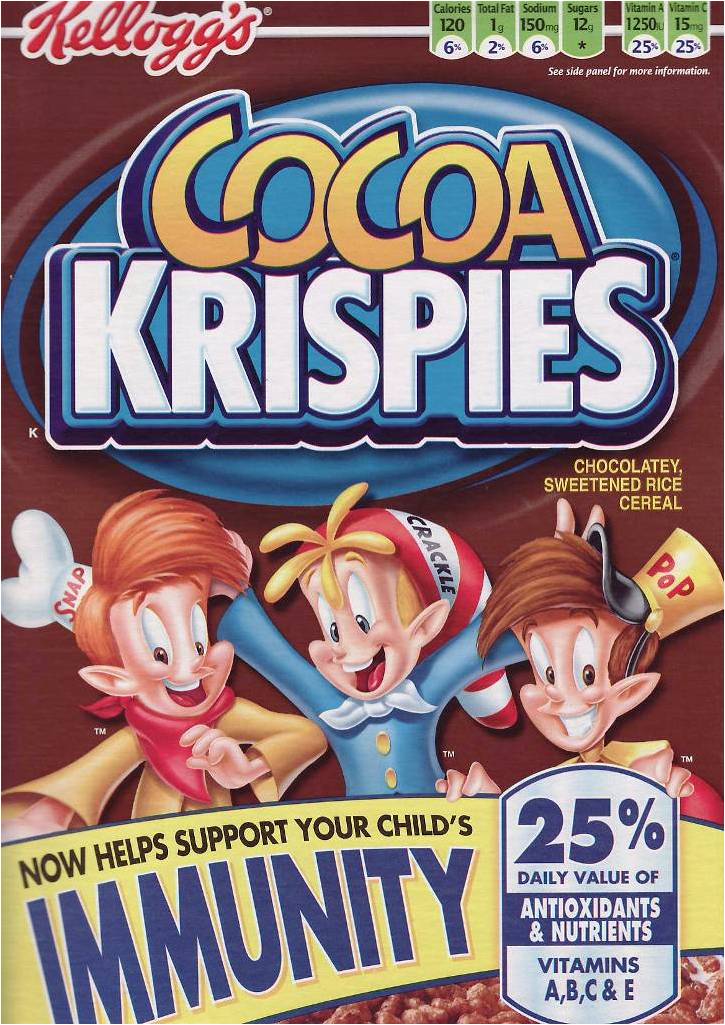
A: I confess; I’m a health-claims junkie. I snatched up the immunity-claiming box of Cocoa Krispies the minute I saw it in a supermarket last August. I consider it a treasure: “Now helps support your child’s IMMUNITY.”

How does Cocoa Krispies perform this miracle? The cereal contains 25 percent of the daily value of antioxidant vitamins A, B, C and E per serving instead of the old 10 percent. Vitamins, Kellogg points out, play an important role in immunity.

Of course they do. All nutrients are involved in immune function. But is it remotely possible that Cocoa Krispies might protect your child against colds or swine flu? I wish.

Antioxidants present an unparalleled marketing opportunity. Kellogg does not have to prove that its cereals are protective. Immunity claims fall into a Food and Drug Administration regulatory gray area. “Supports immunity” is a “structure-function” claim, so called because it promises to support a structure or function of the human body. However you might interpret such claims, they do not really promise to prevent, treat or cure disease.

Congress expressly authorized structure-function claims when it deregulated dietary supplements in 1994. But that law did not apply to foods. Food companies wanted to use these claims, too. At first the FDA balked. When faced with further legislation and court overturns, the FDA gave up. Now it merely says that structure-function claims on supplements must be truthful and not misleading. The FDA says nothing about structure-function claims on food products. It mostly looks away when they appear.

“Misleading” is inevitably in the eye of the beholder. Herrera turns out to be a skeptic.

“The Immunity claims,” he said, “may falsely suggest to parents that cereals like Cocoa Krispies are more healthy for their children than other breakfast foods … [and] mislead parents into believing that serving this sugary cereal will actually boost their child’s immunity.” Kellogg, he said, must produce the evidence or have the claim subject to “immediate termination or modification.”

Faced with this threat and with ridicule in the press, Kellogg wisely decided to phase out the immunity-labeled Cocoa Krispies packages. Consider them collectors’ items.

Much is at stake. Ready-to-eat cereals produce more than $8 billion a year in sales. Kellogg spent about $32 million in 2008 to promote Rice Krispies cereals, and $4 million of that amount went to advertise Cocoa Krispies alone.

Shoppers care about health. If cereals can be advertised with special health benefits, more boxes will fly off the shelves. Food companies consider health claims essential for marketing their products.

This explains why so many companies are adding omega-3 fats, probiotics and antioxidants to so many foods. These ingredients make foods “functional,” meaning that the foods contain something beyond their usual nutritional value. Although little evidence shows that functional foods make healthy people healthier, companies can use functional ingredients to make health claims, no matter how far-fetched. These days, functional foods are about the only processed foods with increasing sales.

Kellogg has plenty of company with functional ingredients and health claims. See, for example, the claims on Nestlé (no relation) Juicy Juice products targeted to toddlers. One product adds antioxidants to “help support immunity.” The other adds omega-3s to “aid brain development.”

Think about it: Will feeding your toddler a sugary juice product really make her smarter? Face it. You are not supposed to think about it. You are supposed to buy – and feel good about doing so.

Absent the FDA, Herrera stepped into the breach. He does not care whether the claims are on Kellogg cereals or Juicy Juice cartons. If companies make such claims, he insists that they produce the evidence for them.

This will not be easy to do. It is one thing to find evidence that specific nutrients are involved in immune function. It is quite another to show that people who eat sweetened cereals or juices containing such nutrients are healthier than those who do not.

That is why the European Food Standards Agency denied hundreds of company petitions for health claims. The agency cannot find much evidence for the health benefits of foods with added functional ingredients. Its decisions have put European food marketers into crisis. How are they supposed to sell products without health claims?

As I keep saying, health claims are about marketing, not health. If it were up to me, I would remove all health claims from food packages. Foods are not drugs. Health claims cannot help but mislead.

So let’s congratulate Herrera for filling a regulatory gap. His colleagues – and the press – are doing their job on this one. FDA: Get to work!

Nov 5 2009

Kellogg’s withdraws IMMUNITY claim!

Kellogg’s says it will phase out boxes of Cocoa and other Rice Krispies cereals with the IMMUNITY claim on them.

Withdrawn, November 4, 2009

Withdrawn, November 4, 2009

The Immunity claim falls into an FDA regulatory grey area.  It is a structure-function claim, meaning that the product is supposed to support a structure or function of the human body – not treat or cure a disease. If Cocoa Krispies were a dietary supplement, the claim would be completely legal because Congress authorized structure-function claims for supplements when it passed the Dietary Supplement Health and Education Act of 1994.

Over the years, food makers complained that if supplements could use such claims, they could too.  At first, the FDA issued warning letters to food companies using structure-function claims.  It stopped after the courts ruled that food companies could make claims for the health benefits of their products on First Amendment grounds.

Now FDA says structure-function claims are OK to use as long as they are truthful and not misleading.  Misleading, of course, is in the eye of the beholder.  Evidently, the San Francisco city attorney thought this claim was misleading and demanded the evidence to back it up.  USA Today wrote about this on the front page (I’m quoted in it).

Wisely, Kellogg’s is going to find another design for its Rice Krispies packages.  Consider this particular box a collector’s item.

The lesson: In the absence of FDA action, food marketing is allowed to run rampant, and city and state attorneys are doing the FDA’s job.  Good for them.  And let’s hear cheers for the power of the press.

Apr 27 2026

Happening today: Rally against glyphosate at the Supreme Court: The People vs. Poison

Farm Action has joined Vani Hari (the Food Babe) and other groups in this People vs. Poison rally.

Livestream it here.

The “poison” here is glyphosate, the potentially carcinoenic weed killer manufactured by Monsanto (now owned by Bayer) for use with genetically modified crops.

People vs. Poison says, “For decades they poisoned us for profit.  Now the people are fighting back”.

The rally is to let the Supreme Court know that there is widespread opposition to Monsanto’s position in the case, Monsanto v. Durnell.  The Court is hearing that case today.  As People vs. Poison explains,

Bayer – the foreign corporation that bought Monsanto – has paid over $10 billion to cancer victims linked to their weed killer Roundup (glyphosate). And there are still tens of thousands of cases pending.

Now Bayer wants to make sure they never have to pay again.

As described in The New Lede, 

Monsanto specifically is asking the Supreme Court to rule that under the Federal Insecticide, Fungicide, and Rodenticide Act (FIFRA), it cannot be held liable for failing to warn of a cancer risk if the Environmental Protection Agency (EPA) has not found such a risk exists and not required such a warning. FIFRA preempts any state requirements for such a cancer warning, the company argues.

Hundreds of groups have filed briefs on both sides of this case.

Trump’s Department of Justice filed one in support of Monsanto/Bayer.

Farm Action says

Monsanto, owned by Bayer, has mounted an aggressive campaign to secure immunity, leveraging its outsized market power to influence policymakers. The company faces thousands of lawsuits alleging its flagship product, Roundup, causes cancer. As Farm Action has documented, threats to pull Roundup from the market are a strategic pressure tactic, not a sign of impending crisis for the food and farm system…The coalition’s brief urges the Court to reject Monsanto’s argument and preserve the right to hold companies accountable when their products cause harm.

The rally is set for 9:00 this morning.  I will be interested to hear how it goes and whether the Supreme Court listens.

Commentary on what the rally is about

Apr 23 2026

Current events in agricultural chemicals

Pesticides, herbicides, and other agricultural chemicals in food are of great concern right now, and getting rid of them is high on the agenda of Make America Health Again (MAHA).

This will not be easy.  The chemicals pervade the food supply and Big Ag producers claim that cannot grow food without them.  We have already see how they forced MAHA to retreat on Roundup (glyphosate).

Here’s what’s been happening recently on the chemicals-in-food front.

I.  EWG’s Dirty Dozen: Spinach, it says, ” has more pesticide residues by weight than any other type of produce.”

II.  The Supreme Court case, Monsanto v. Durnell.

Senator Cory Booker has asked the Supreme Court to permit lawsuits against Roundup to proceed.

Vani Hari (aka the Food Babe) approves.


A coalition of groups represented by Center for Food Safety (CFS) has also filed a brief in this case.

For the past decade, state juries across the country have found Monsanto (now Bayer) guilty of failing to warn the public of the cancer risks of its flagship pesticide, Roundup, totaling billions of dollars in damages against the chemical giant. Monsanto is now using the Supreme Court case to seek immunity from any accountability for these harms.

Comment

It’s hard to know how serious a problem these chemicals pose for human health but they cannot possibly be good for us.  I do not want them in my food and drink and support all efforts to reduce their use.  Big Ag is fighting back, of course, which is why this case matters so much.  Let’s hope the Court rules against Monsanto/Bayer.

Feb 23 2026

MAHA hypocrisy in action: glyphosate

RFK Jr may have lied to the Senate about vaccines, but it is now evident that he also lied to his supporters about getting toxic chemicals out of the food supply.

Let’s start here: 

Well, it wasn’t his USDA (he’s Secretary of HHS), apparently.

Now we have President Trump’s executive order: PROMOTING THE NATIONAL DEFENSE BY ENSURING AN ADEQUATE SUPPLY OF ELEMENTAL PHOSPHORUS AND GLYPHOSATE-BASED HERBICIDES.

There is no direct one-for-one chemical alternative to glyphosate-based herbicides.  Lack of access to glyphosate-based herbicides would critically jeopardize agricultural productivity, adding pressure to the domestic food system, and may result in a transition of cropland to other uses due to low productivity.  Given the profit margins growers currently face, any major restrictions in access to glyphosate-based herbicides would result in economic losses for growers and make it untenable for them to meet growing food and feed demands.

Never mind the multiple independent research studies and judgment by cancer experts of the World Health Organization that glyphosate is potentially carcinogenic (see account in The New Lede).

Never mind that Bayer, which bought Monsanto and now owns glyphosate, just said it would put $7.5 billion into settling lawsuits over it.

Never mind that glyphosate is in everything, including bread.

Hypocrisy alert: RFK Jr now says he supports the president’s decision on glyphosate.

No wonder we are seeing fabulous satires like this one:

Resources

And now, RFK Jr’s defense posted on X:

Unfortunately, our agricultural system depends heavily on these chemicals. The U.S. represents 4% of the world’s population, yet we use roughly 25% of its pesticides. If these inputs disappeared overnight, crop yields would fall, food prices would surge, and America would experience a massive loss of farms even beyond what we are witnessing today. The consequences would be disastrous.

Disastrous for whom, exactly?

Dec 3 2025

Good news: milk pasteurization prevents spread of bird flu

A recent study finds pasteurization of milk to be an effective preventive measure against avian influenza in mice.

We found that milk pasteurization fully inactivated pandemic H1N1 and bovine H5N1 influenza viruses yet preserved hemagglutinin (HA) protein integrity. In mice, repeated oral exposure to inactivated virus did not alter mortality after H5N1 virus challenge.

This is excellent news.  It means that the risk of getting bird flu from pasteurized milk is extremely low.

Bird flu is increasingly widespread in dairy cattle.

The CDC says the risk to humans is low, but 71 cases have been observed so far, with one death.

The situation with bird flu is one more reason to expect bettter safety from pasteurized than raw milk.

The FDA continues to say that pasteurized milk is safer.  Its page on raw milk offers these links.

The FDA reports that from 1998 through 2018, there were 202 outbreaks linked to drinking raw milk, which caused 2,645 illnesses and 228 hospitalizations.

This is a lot or not, depending on point of view, but all were likely to have been prevented by pasteurization.

The Raw Milk Institute insists on the benefits of raw milk.

My assessment: there may be benefits, but they are marginal.  There are safer ways to improve immunity.

The risks of raw milk may be infrequent, but when it comes to milk, I’d rather play it safe.