by Marion Nestle

Search results: Coca Cola

Aug 26 2013

FDA study: Do added nutrients sell products? (Of course they do)

The FDA has announced that it will be studying the effects of nutrient-content claims on consumers attitudes about food products.

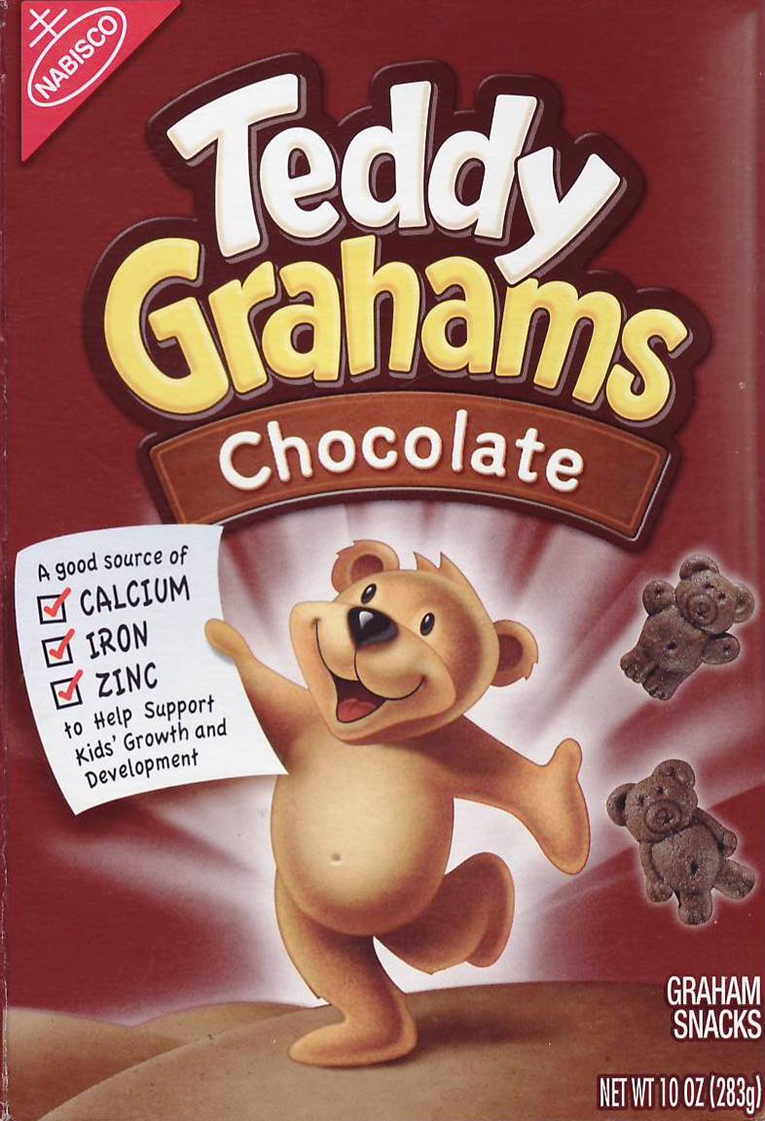
FDA does not encourage the addition of nutrients to certain food products (including sugars or snack foods such as [cookies] candies, and carbonated beverages). FDA is interested in studying whether fortification of these foods could cause consumers to believe that substituting fortified snack foods for more nutritious foods would ensure a nutritionally sound diet.

Here’s one of my favorite examples of what the FDA is talking about.

New Picture


I’m guessing the FDA’s new research project is a response to increasing pressure from food companies to be allowed to add nutrients to cookies, candies, and soft drinks.

Food marketers know perfectly well that nutrients sell food products.  The whole point of doing so is to be able to make nutrient-content claims on package labels.

The FDA has never been happy about the practice of adding nutrients to junk foods just to make them seem healthy.   Its guidance includes what is commonly known as the “jelly bean rule.”   You may not add nutrients to jelly beans to make them eligible to be used in school lunches.

But this does not stop food manufacturers—especially soft drink manufacturers—from trying.  Hence: Vitamin Water (now owned by Coca-Cola).

Plenty of research demonstrates that nutrients sell food products.  Any health or health-like claim on a food product—vitamins added, no trans fats, organic—makes people believe that the product has fewer calories and is a health food.

As I keep saying, added vitamins are about marketing, not health.

Aug 22 2013

Soda advertising: Bavaria

In the Munich subway, Marienplatz station, Coca-Cola ads feature bottles with common German (?) names on the labels, in this case Kevin, Tobias, and Sandra.

München-20130822-00049

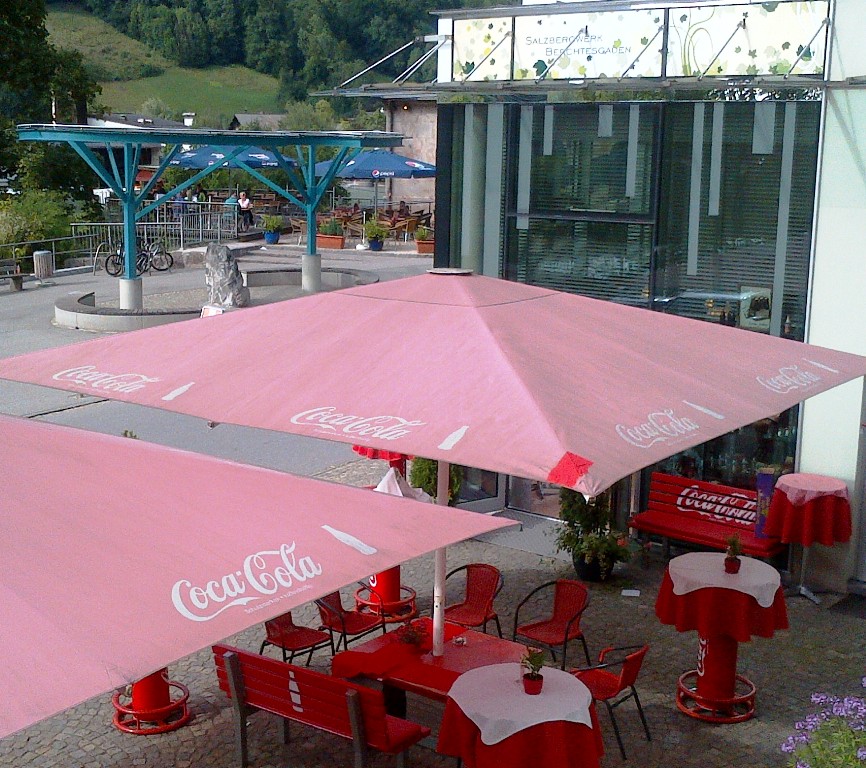
At the entrance to the tour of the salt mine in Berchtesgaden (definitely worth the visit), Coke (foreground) and Pepsi (far background) sponsor separate outdoor cafes.

IMG-20130821-00043

Jul 31 2013

Court turns down NYC 16-ounce soda cap; city will appeal

The  NY State Supreme Court, Appellate Division, has turned down the Bloomberg administration’s appeal (New York Statewide Coalition of Hispanic Chambers of Commerce v New York City Dept. of Health & Mental Hygiene).

The court’s decision in this case begins on page 22:

Like Supreme Court, we conclude that in promulgating this regulation the Board of Health failed to act within the bounds of its lawfully delegated authority. Accordingly, we declare the regulation to be invalid, as violative of the principle of separation of powers.

…we find particularly probative the regulation’s exemptions, which evince a compromise of social and economic concerns, as well as private interests. As indicated, the regulatory scheme is not an all encompassing regulation. It does not apply to all FSEs [food service establishments]. Nor does it apply to all sugary beverages. The Board of Health’s explanations for these exemptions do not convince us that the limitations are based solely on health-related concerns (pages 17, 18 of the decision).

OK.  So the city should have made the rule apply to all food service places and all sugary beverages.  Live and learn.

Mayor Bloomberg says the city will appeal:

Since New York City’s ground-breaking limit on the portion size of sugary beverages was prevented from going into effect on March 12th, more than 2,000 New Yorkers have died from the effects of diabetes. Also during that time, the American Medical Association determined that obesity is a disease and the New England Journal of Medicine released a study showing the deadly, and irreversible, health impacts of obesity and Type 2 diabetes – both of which are disproportionately linked to sugary drink consumption. Today’s decision is a temporary setback, and we plan to appeal this decision as we continue the fight against the obesity epidemic.”

The American Beverage Association is pleased.  It’s headline: “Hey New York – Your Beverage Is Still Your Choice!”

We are pleased that the lower court’s decision was upheld.  With this ruling behind us, we look forward to collaborating with city leaders on solutions that will have a meaningful and lasting impact on the people of New York City.

Even if the city loses the final appeal, the 16-ounce soda cap is the writing on the wall for soda companies.

Sales of full-sugar sodas have been falling for years and getting worse for both Coca-Cola and Pepsi.

Cutting down on the portion sizes of sugary drinks is still a really good idea.

Here’s what the news media say about it:

Jun 5 2013

Coke as a broker of peace and conflict

Coca-Cola as a peace broker

I don’t know what to make of Coca-Cola’s recent marketing strategies, as reported in the Washington  Post.   The ad,

“Small World Machines” starts with a relatively straightforward premise: India and Pakistan do not get along so well. It ends with the promise of peace: “Togetherness, humanity, this is what we all want, more and more exchange,” a woman, either Indian or Pakistani, narrates as the music swells. Sounds great. How do we get there? By buying Coke, of course.

The idea is to have two vending machines, one in Lahore and one in New Delhi, each with views of the other.  To buy a Coke, buyers have to cooperate.  Here are photos showing how it works.  And here’s how Coke explains it, with video and slides. 

As the Post explains, this may not be as far-fetched as it seems.

Sharing tasks and short-term, low-risk social interactions are classic conflict resolution tactics, including as a part of the civilian-to-civilian interactions sometimes termed “track two diplomacy.”  Indo-Pakistani tensions could use all the help they can get.

But the Post concludes with an update: 

Deputy foreign editor Karin Brulliard, a former Pakistan bureau chief, alerts me that, per the Wall Street Journal, Pepsi dominates the soda market there. Maybe that’s what’s been holding back peace?

This is not the first time that Coke markets its products as the key to world peace.  Those of you who are old enough might recall the “I’d like to teach the world to sing” video from 1990.

Coca-Cola as a conflict promoter

Who at Coke got the clever idea of producing personalized bottles with 150 popular names—in Israel, of all places?

Oops.  Forgot the 1.5 million Arabs who live there.

Alas, the campaign has caused a huge controversy in the Mideast.

Recall: All this is about selling Coke internationally.  Americans aren’t buying it so much anymore, so overseas it goes.

May 31 2013

Annals of public relations: the food industry vs. obesity

Yesterday was a blitz day for food industry public relations.

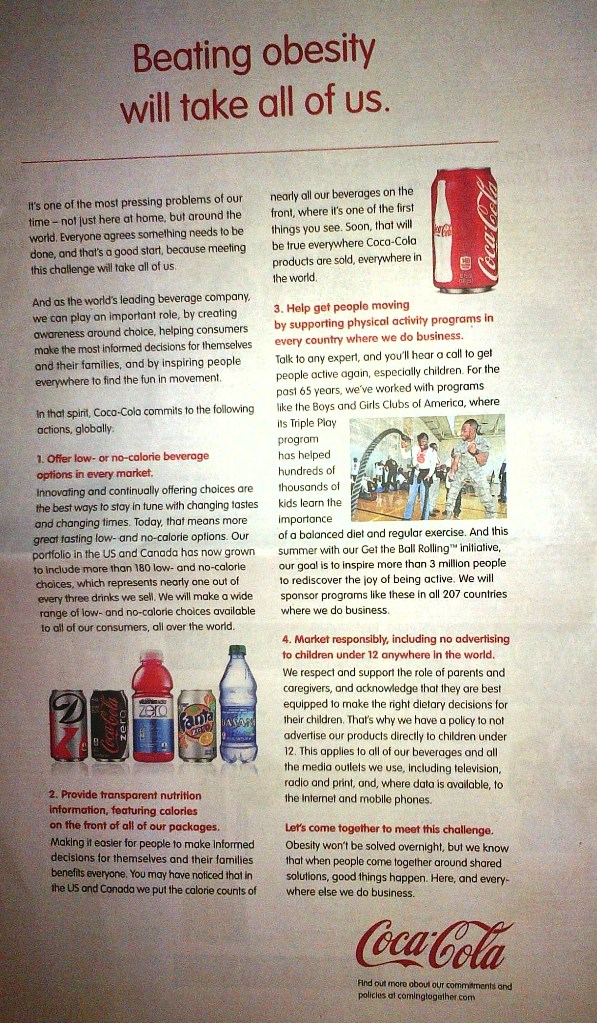
PR #1.  Coca-Cola placed a full-page ad in the New York Times: “Beating obesity will take all of us.”

Coke’s promises [with my comments]:

  • Offer low- or no-calorie drinks in every market [but focus advertising on the sugary ones].
  • Provide transparent nutrition information, listing calories on the front of all packages [but per serving, not total for the big ones]
  • Help get people moving [divert attention from the caloric effects of sodas]
  • Market responsibly, including no advertising to children under 12 anywhere in the world [I will believe it when I see it]

“Obesity won’t be solved overnight,” Coke says, but we know that when people come together around shared solutions, good things happen.” 

Like drinking less Coke? 

PR #2.  The food industry’s Healthy Weight Commitment Foundation issued a press release to say that its member companies have more than met their stated goal of reducing 1.5 trillion calories in the marketplace in the United States.   Indra Nooyi, HWCF Chair, Chairman and CEO of PepsiCo, said:

Our industry has an important role to play in helping people lead healthy lives and our actions are having a positive impact…We see continued opportunities to give consumers the choices they’re looking for and to work collaboratively with the public and non-profit sectors on initiatives that enable continued progress.

Really?  Where are the data?  On what basis does the group make this claim?  The press release says that the Robert Wood Johnson Foundation is doing a study but the results won’t be released until the fall.

Hence: Public relations.  As I noted in a previous post on this promise in 2010.

What are we to make of all this?  Is this a great step forward or a crass food industry publicity stunt?*  History suggests the latter possibility.  Food companies have gotten great press from announcing changes to their products without doing anything, and every promise helps stave off regulation.

Oops.  Forgot.  

Addition:  I forgot to post the accompanying report from the Hudson Institute about how low-calorie beverages are driving all the sales growth for soda companies, at least in the US.

Apr 23 2013

Marketing foods and drinks to kids in school goes on and on

I’ve just been sent a new report on the current status of marketing foods and beverages to children at school: Promoting Consumption at School: Health Threats Associated with Schoolhouse Commercialism.

This reportfrom the National Education Policy Center at University of Colorado, Boulder,  makes sobering reading.

As the press release explains,

In their quest for additional funding, many schools and school districts have allowed corporations to promote the consumption of sweetened beverages and foods of little or no nutritional value in school and in conjunction with school projects…corporations can seem philanthropic when they provide sponsored educational materials…to schools and teachers. These materials can be colorful and engaging, and may align with state and now Common Core standards, but they also present a worldview consistent with that of the sponsor.

If you think that the food companies are making good on their pledges to reduce marketing to kids, this report will make you think again.

Here are a few snippets:

  • Available data suggest that the total amount of money spent on advertising food and beverages to children, both in and out of schools, has decreased over the past few years.  However, any reduction in spending reflects at least in part a shift to less expensive, but more effective, alternative media advertising.
  • Food and beverage companies advertise in schools in multiple ways: (1) appropriation of space on school property, (2) exclusive agreements, (3) sponsorship of school programs, (4) sponsorship of supplementary educational materials, (5) digital marketing, (6) sponsorship of incentive programs, and (7) fundraising.
  • Teaching materials may not mention the sponsor but reflect the sponsor’s views, such as that all beverages count toward hydration.
  • Digital marketing to school kids is a deliberate strategy, as explained by a Coca-Cola executive:  “We’re especially targeting a teen or young adult audience. They’re always on their mobile phones and they spend an inordinate amount of time on the Internet.”
  • Health and wellness initiatives designed to promote physical activity and movement may appear to meet federal guidelines but “are problematic in that they shift the onus for obesity from the corporation’s responsibility to market healthy food to the consumer’s responsibility for making healthy choices.”

The report is a terrific summary of what’s happening with food marketing in schools, loaded with facts, figures, and references.  

In light of the evidence it provides, the report’s recommendation seems grossly understated:

Policymakers should prohibit advertising in schools unless the school provides compelling evidence that their intended advertising program causes no harm to children.

What’s missing from this report is a blueprint for action.

For that, you must go elsewhere, for example, to the Center for Science in the Public Interest, the Berkeley Media Studies Group, or the Rudd Center for Food Policy and Obesity.

Do you know of other good sources for taking action on marketing in schools?  Do tell.

Mar 29 2013

The Coke “chairs” ad: Stand up for Coke!

I’m indebted to Yoni Freedhoff for posting Coca-Cola’s latest anti-obesity initiative, this one in Spain.

Will Chairs conquer the world?  Not if you stand up for Coke!

“What if we stand up?” is the message.  OK, this is not an absurd idea, in theory.  As Mal Nesheim and I review in our book Why Calories Count, plenty of evidence supports the health benefits of standing and fidgeting, rather than sitting.  

But this ad comes from Coca-Cola, as part of its “4 commitments to fight overweight and sedentary lifestyle” campaign.

Why would Coke do this?  As BrandChannel says, “to get out ahead of the negative “sugary drinks” PR wave.”  It notes that Coke just signed a new bottling agreement in Spain, where it also launched “Happiness” ATMs as part of its global “ Open Happiness” campaign.

But in “Chairs,” gone is Coke’s role in promoting health. Sure, it’s meant to be funny but the substituted message is about how it’s the consumer’s fault for sitting down so much. Coke is implying that its a third, disintereted party and that consumers should take it up with their chairs (which, really, is another way of saying consumers should take it up with themselves). 

The ad follows others run in the U.S. and in the U.K.

What I love best about the Spanish ad is that it could have come right out of The Onion.   Its writers argued that the ferocious opposition to Mayor Bloomberg’s 16-ounce soda plan proves that Americans are willing to stand up for their beliefs.

Dr. Freedhoff points out another irony: Coca-Cola is in the business of selling chairs (who knew?).

Collectibles!

Mar 10 2013

Daily News Op-Ed: Bloomberg’s soda ‘ban’ should be only the beginning

My double-page op-ed in today’s New York Daily News:

Liberty from big soda: Why Bloomberg’s ‘ban’ should be only the beginning of a public health revolution


Barring any late legal surprises, Mayor Bloomberg’s 16-ounce cap on sugary sodas goes into effect on Tuesday, March 12. After that, restaurants, movie theaters, sports venues and food carts will not be permitted to sell extra-large portions of sugar-packed drinks.

Stay calm. This does not signal the end of democracy in America. This is not the nanny state gone out of control.

If we want Americans to be healthy, we are going to have to take actions like this – and many more – and do so soon. It’s long past time to tax sugar soda, crack down further on what gets sold in our schools, tackle abusive marketing practices, demand a redesign of labels – and extend the soda cap, no matter how controversial it may seem. This must be the beginning, not the end, of efforts toward a healthier America.

In short, we need a series of serious changes to make the healthy choice the easy choice. The soda size cap is a nudge in that direction. You will still be able to drink all the soda, and down all the sugar, that you want. The cap on soda size makes it just a tiny bit harder for you to do so.

That “tiny bit harder” is its point. If you have to order two sodas instead of one, maybe you won’t. If you have to add sugar to your coffee drink yourself, maybe you will only add one or two teaspoons instead of the 10 or more someone else put in there for you.

For a public health nutritionist like me, the soda size cap is a terrific idea. Unlike other foods, sodas are a unique target for intervention. They contain sugars – and sugar calories – but nothing else of nutritional value. They are candy in liquid form. Candy has a place in healthy diets, but a small one. So it should be for sodas.

It’s no surprise that people who drink large amounts of liquid candy have worse diets, are heavier, and have more health problems than those who do not. And it looks like the body doesn’t compute the calories from liquid sugars as accurately as it does for sugars in foods.

On top of that, big sizes make the problems worse. To state the obvious, larger portions have more calories. If an 8-ounce soft drink provides 100 calories, then a 16-ounce drink provides 200, a 32-ounce drink provides 400 and a 64-ounce drink provides 800.

But big sizes also have other effects. They induce people to eat and drink more than they would if given smaller portions. Big sizes confuse people into underestimating the number of calories consumed.

Most people eat whatever size is in front of them – the “default,” in public health-speak – and are content with that amount. So a reasonable goal of public health intervention is to change the default drink to a smaller size. Hence: Bloomberg’s 16-ounce size cap.

From my nutritionist’s perspective, a 16-ounce soda is still generous. Just one contains the equivalent of 12 packets of sugar. Just one provides 10% of the daily calorie needs of someone who typically eats 2,000 calories a day. Just one contains the upper limit of sugar intake that health officials recommend for an entire day. Once you down a 16-ounce soda, it’s best to stop right there.

You may find this hard to believe, but the original Coca-Cola was 6.5 ounces, smaller than any size available today. In the 1950s, Coke advertised its 16-ounce bottle as large enough to serve three.

Times have changed. The sizes of foods and drinks have expanded, and so have waistlines. This is no coincidence. On the basis of calories alone, larger portions are all you need to explain why Americans are putting on pounds.

City officials concerned about the health of their citizens, as those in New York most definitely are, want to do everything they can to prevent obesity and the illnesses that go with it. Their rationale is humanitarian, but also fiscal. Poor health is expensive for both individuals and society. You don’t believe that excessive weight is an issue? Just ask the military.

We can thank Big Soda – Coca-Cola, Pepsi and their trade association, the American Beverage Association – for the contribution of big sodas to weight gain. Soda companies have spent fortunes to create demand, to make drinking large amounts seem normal, to market sodas as essential for health and happiness and, these days, to fight Bloomberg’s soda cap and take the city to court over it.

Soda companies may make things you like to drink, but they are not social service agencies. Their job is to get you to buy more soda to satisfy the financial demands of investors. They are about business. They are not about fun or happiness or personal choice – and they certainly are not about health.

The soda industry may profess to care more about your well-being these days, but it ultimately will not do anything to promote health if doing so harms sales.

So-called “nanny-state” measures – like bans on driving while drunk, smoking in public places and, now, selling absurdly large sugary drinks – help to level the playing field. Such measures are about giving everyone an equal opportunity to live a safer and healthier life.

At the moment, it is up to you to make healthier choices, but that’s not easy in the face of relentless soda marketing. Governments have a responsibility to provide healthier environments for their citizens.

Here are some additional actions New York City should take, if only it were allowed to.

Close the loopholes. The city does not have jurisdiction over sales of sodas in convenience stores and supermarkets. The state does. Gov. Cuomo denied Mayor Bloomberg’s request to extend the size cap to those stores, not on principle but because he hadn’t thought about it. He should, right now. Let’s keep all sugary drinks to 16 ounces or less.

Fix the price differential. A 7.5-ounce can of soda costs twice as much per ounce as a two-liter bottle, and you can’t buy just one; it comes in an 8-pack. Price determines sales. If a 16-ounce soda costs a dollar, a 32-ounce soda should cost two dollars.

Tax sodas. Most people wouldn’t dream of eating candy all day, but soda companies have made it seem normal to drink sodas from morning to night. Raising the price of sodas would discourage sales, especially among young people most susceptible to marketing efforts and most vulnerable to weight gain. A one-cent tax per ounce should do the trick and raise plenty of needed revenue besides.

Remove vending machines from schools. Yes, the Beverage Association only puts “better-for-you” drinks in school vending machines, but sugar-filled sports drinks are still liquid candy. And kids should not have to pay for water in schools.

Restrict marketing of sodas to children. Soda companies market extensively to children and adolescents, especially those in low-income neighborhoods. Just look at billboards, celebrity photos on soda cans and Pepsi’s $50 million dollar deal with Beyoncé. They should not be permitted to market to kids this way. We already have restrictions on cigarette and alcohol marketing to kids. It breaks no new ground to add sodas to the list.

Don’t let SNAP (food stamp) benefits be used for sodas. Bloomberg tried this, but the federal Department of Agriculture said no. There is absolutely no reason that taxpayer-subsidized food assistance for low-income people should go toward junk with no nutritional value. He should try again.

Show full calories on the front of containers. The current way calories are tallied, in a measure called “calories-per-serving,” is confusing because the servings are unrealistically small and people don’t do the math. Soda cans already give the full calories in tiny type on the Nutrition Facts label, but I want to see the full calories in big type on the front.

Actions like these will evoke ferocious opposition from the soda industry, and it will spare no expense to make sure such things never happen. We would surely hear more and more howls of “nanny-state” from those who insist Bloomberg has led us to the brink of a public health police state. Polls say that many New Yorkers oppose the 16-ounce cap and would oppose measures like this, too.

But I can’t tell whether the opposition comes from genuine concern about limits on personal choice or because soda companies have spent millions of dollars to protect their interests and gin up histrionic, misinformed opposition.

Come Tuesday, the 16-ounce soda is the new default size in New York City. While waiting for the court decision and for politics to play out, why not give it a chance? Maybe it will help you live a healthier and longer life.