by Marion Nestle

Search results: Coca Cola

Apr 24 2026

Weekend reading: online marketing of soda and alcohol

Vital Strategies has issued two reports about digital marketing of soda and alcohol based on AI analysis of web content: Sick from Scrolling: Protecting the Next Generation from the Flood of Unregulated Social Media Marketing.

Soda and alcohol marketing is flooding social media at a scale that outpaces regulation—embedding brands into sports highlights, influencer content and viral moments that generate billions of impressions…The findings show this marketing is no longer confined to ads—it is woven directly into the content people watch and share every day, creating a constant stream of exposure that largely escapes oversight.

The reports and webinar

I. From Stadiums to Screens: Coca-Cola’s Sportswashing at the 2025 FIFA Club World Cup

Researchers found that 795 posts identified by Canary generated an estimated 3.6 billion impressions, highlighting the reach of FIFA sponsorship. Coca-Cola branding was amplified primarily through sports accounts, broadcasters and streaming platforms resharing match footage that captured brand logos embedded in the frame…Every highlight reel functioned as advertising, with clips circulating online indefinitely.

II. Exposing Alcohol’s Advertising Playbook: Digital Marketing in RESET Alcohol Initiative Countries

Alcohol marketing has undergone a dramatic transformation in the digital age, moving from traditional advertising to sophisticated, algorithm-driven strategies that target consumers with unprecedented precision…Researchers found that nearly 4,000 posts…generated an estimated 2 billion impressions, underscoring the enormous reach of online alcohol promotion.

III.  The Webinar on the reports

Comment

Marketing on the web is challenging to analyze and this report performs a great public service in illustrating its scope and reach—and also its merging into content making advertising and content difficult to distinguish.

Regulation, anybody?

Apr 3 2026

Weekend reading: AI’s analysis of soda and alcohol marketing on social media

Vital Strategies has just released two of its Canary platform reports based on use of AI.  Here’s its webinar.

The findings:

  • During the 2025 FIFA Club World Cup (June 14-July 13), Coca-Cola branding appeared in 795 social media posts, generating an estimated 6 billion impressions globally.
  • In March 2025 alone, digital alcohol marketing appeared in nearly 4,000 posts generating close to 2 billion impressions.
  •  79% of Coca-Cola-linked posts came from sports broadcasters, with branding visible in match highlights, celebrations and interviews, including those featuring child athletes such as the Powerade Ball Crew.
  • Alcohol brands amplified reach through influencers and major cultural moments like Carnival, partnering with celebrities such as Luísa Sonza and Anitta to reach tens of millions of followers via their social channels.

Why should we care?

Research shows that such marketing influences consumption. Children exposed to high volumes of digital marketing for unhealthy food and sweetened beverages may develop unhealthy habits for life. Alcohol advertising is linked to earlier initiation, binge drinking and increased consumption.

Two examples

  • In the Philippines, Red Horse Beer ads deployed cartoon imagery reminiscent of tobacco’s Joe Camel to appeal to younger audiences—despite carrying small-print “For 18 years old and above only” warnings.   Source: Red Horse Beer on Facebook
  •  San Miguel Flavored Beer—available in sweet flavors like apple and chocolate designed to mask the taste of alcohol—markets itself around music festivals through the language of friendship and self-expression, embedding the brand into youth identity and inviting attendees to make “#Sweeeet memories” with their “beshies.” Source: @sanmiguelbeerph on Instagram  

Bottom line: These reports provide further evidence for the need for marketing regulation and policies such as taxes on unhealthy products.

Dec 31 2025

A food politics round up of sorts

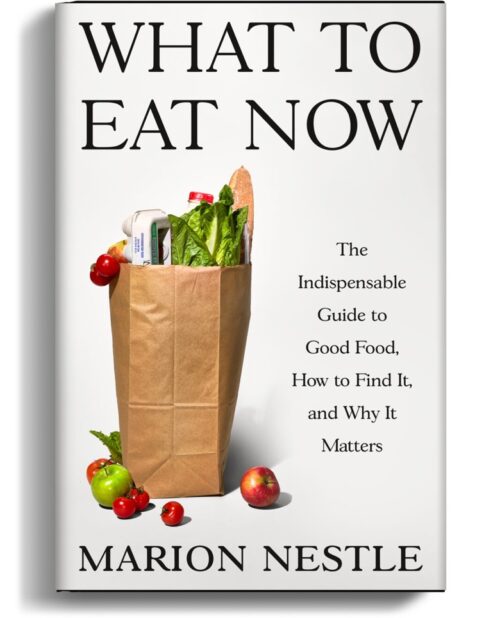
Alert to readers: Amazon.com displays listings for several more workbooks, study guides, and cookbooks purportedly based on my book, What to Eat Now (see previous post on this).  I did not write any of them.  Caveat emptor!

___________________________

From FoodDive: How MAHA transformed the food industry in 2025:  Lawmakers capitalized on anxieties around ultraprocessed ingredients to introduce new regulations, with companies choosing to reformulate or fight back.

To summarize:

  • Artificial food dyes: food companies voluntarily said they would get rid of them by the end of 2026 or 2027.  Will they?  We shall see.
  • Ultra-processed foods: The first MAHA report mentioned them 40 times.  By the second, the only issue was to define them, and RFK Jr said they might not even do that.
  • GRAS loophole: The FDA says it will require better evidence of safety before allowing new additives in food.
  • Seed oils: some food companies are replacing them with beef tallow or avocado oil.  How will this affect health?  It depends on the quality of the replacement.
  • High fructose corn syrup: Coca-Cola said it would replace it with cane sugar, no doubt at higher cost.  Since both sweeteners have the same sugars and calories, this switch is unlikely to make any difference to health.
  • School food: Whole milk is back.  Will this help children maintain healthy weight?  We shall see.
  • SNAP: 18 states are restricting sodas (some also restrict candy or desserts) from purchases using SNAP benefits.  Will this encourage SNAP recipients to buy less soda?  I hope states will collect data on this and other points.
  • Dietary guidelines: They are expected next week.  We shall see.

The food industry’s response?

So far, most of what is happening in the food arena is either still in the promise stage, voluntary, and unlikely to have much health benefit (See: A MAHA Check-Up: Is The United States Getting Healthier?)

All of what is happening with food must be understood in the context of the devastating destruction of America’s public health and scientific research systems.

MAHA’s work is focused on the dietary choices of individuals.

Any individual who tries to make healthful dietary choices is up against a food system designed for profit, not public health.

Diet matters to health, but healthy diets are not enough to prevent measles.

We need functioning public health systems: CDC, FDA, NIH.  We no longer have them.

Happy new year everyone.  Let’s hope the new year brings us peace, kindness, and public health.

Nov 13 2025

The 2025-2030 Dietary Guidelines: Some preliminary speculation

As I noted last May, I get asked all the time about what they will say, but have no inside information.  But this may be a good time to go over the clues.

The process

  • A scientific advisory committee reviews the research and writes a report.  This was released in December.
  • Unspecified (to date) people in USDA and HHS write the guidelines.

The promises

What they won’t say

  • They will not continue the tradition of “leftist ideology”  [I think this must mean plant foods]
  • They will not promote seed oils (RFK Jr prefers beef tallow).
  • They will not promote sugar; RFK Jr says sugar is poison.  [But declared a MAHA Win for Coca’ Cola’s replacement of high fructose corn syrup with cane sugar]
  • They won’t say anything about sustainability [anything about climate change is forbidden]

What they will be about

[According to Reuters] Kennedy said the new guidelines would change the kind of food served to military service members and children in schools, but gave no details on the new recommendations.

“If we want to solve the chronic disease crisis, we have to tackle obesity,” Kennedy said. “Obesity is the number one driver of chronic disease,” he said, adding that 50% of the adult U.S. population was obese or overweight, driving costs up for diabetes care and cardiac diseases.

What they might say

Beef

  • In its Plan to Fortify the Beef Industry, the USDA says the 2025–2030 Dietary Guidelines will “encourage protein as the foundation for every meal.”
  • In an announcement to ranchers, USDA quotes RFK Jr, “we are restoring whole foods as the foundation of the American diet and ending the decades-old stigma against natural saturated fat in beef and dairy products. We will strengthen America’s ranching industry so families can choose nutrient-dense, minimally processed foods.”

Dairy

In a news conference, officials gave some clues.

We are going to be there for the dairy industry…our agencies are about to release more dietary guidelines in the next several months that will elevate those products to where they ought to be…There’s a tremendous amount of emerging science that talks about the need for more protein in our diet, and more fats in our diet, and there’s no industry that does that better than this industry.

Speculation

When RFK Jr first talked about the new guidelines, he said they would ignore the scientific advisory committee report and would be simple, short (5 pages), easy to understand, and out by September.  I’m guessing that the conflict between the science and ideology is proving more difficult to resolve than anticipated.

The science continues to argue for a largely (but not necessarily exclusively) plant-based diet, reduced in meat and ultra-processed foods from current levels.  RFK Jr initially talked about the need to reduce intake of ultra-processed foods, but the second MAHA report merely asked for a definition.

This administration seems obsessed with protein, a nutrient already in excess in US diets.

If it wants to do something about obesity, it needs the guidelines to suggest ways to reduce calories.  Nobody has mentioned that word so far.

As I keep saying, I can’t wait to see what the new guidelines will look like.  Stay tuned.


Oct 29 2025

What I’m reading: MAGA vs. MAHA

From last week’s The Guardian: “Inside the Republican network behind big soda’s bid to pit Maga against Maha: A Guardian investigation finds the US soda and snack-food industries, threatened by RFK Jr’s movement to change Americans’ eating habits, have turned to a group of well-connected strategists, shadowy pollsters and ‘anti-woke’ influencers.”

The ongoing influence campaign is being spearheaded by the American Beverage Association with help from the Consumer Brands Association, two prominent trade groups in the food industry. Coca-Cola, PepsiCo and Keurig Dr Pepper, the three largest soft-drink corporations in the United States, as well as packaged-food conglomerates like General Mills, Kraft Heinz, Mondelēz and Nestlé, are among those that pay dues for the right to have a say in either or both of the trade groups’ strategies.

All three soda-makers identified the Maha efforts as significant threats to their bottom lines in their most recent annual reports, delivered to investors after Trump nominated Kennedy to be secretary of US Health and Human Services. Coke and Dr Pepper went as far as to suggest such risks would be compounded if unnamed “government officials” were to voice health concerns about their products.The three soda makers did not respond to questions about the lobbying effort.

The article goes on to explain the lobbying methods and paid influencer campaigns, at the federal level but also in states considering legislation on food dyes (which take care of many ultra-processed foods) and restrictions on sodas in SNAP.

Whether the MAHA food agenda is real or a smokescreen (see yesterday’s post), anything useful it tries to do will come up against this kind of concerted, well-funded effort, which may be why the second MAHA report backed off on so many issues.

Jul 22 2025

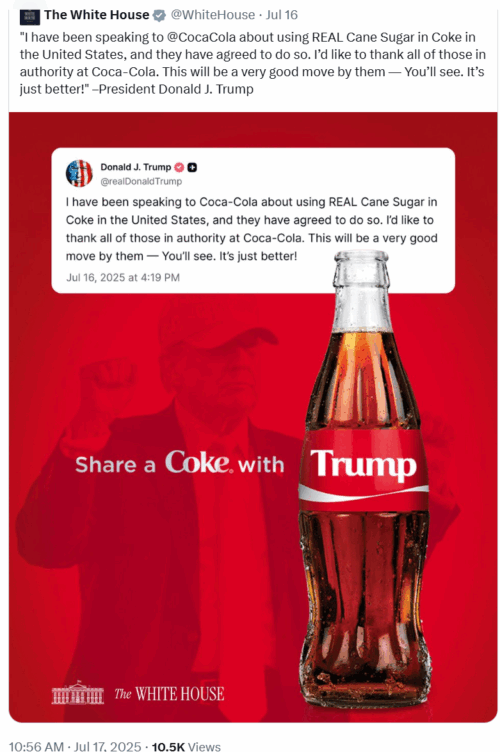
President Trump says sucrose is better than HFCS (both are glucose plus fructose)

The President of the United States says Coke should switch from high fructose corn syrup (HFCS) to cane sugar.

My response: this is nutritionally hilarious.

  • HFCS is glucose and fructose separated in liquid form.
  • Cane sugar (sucrose) is glucose and fructose bonded, but quickly split (so is beet sugar, but the President is not mentioning it).
  • Both HFCS and cane sugar are sugar(s).  Both provide about 4 calories per gram.
  • There may be people who can taste the difference, but when Coke found that nobody could tell the difference, it switched from sucrose to HFCS.

I’ve written about this previously, most recently in 2014: HFCS politics, continued. Endlessly.

Yes, HFCS is derived from genetically modified corn, but that doesn’t change the basic biochemistry, taste, or health effect.

Note: A 12-ounce Coke has 39 grams of either one.  It doesn’t matter which sugar is used; it’s too much to be consumed at one time.

At the time Coke switched to HFCS, it was much cheaper.  It is still cheapter but less so (because half of corn production is used to produce ethanol).

It will cost Coke more to replace HFCS with cane sugar or even beet sugar (which is identical to cane sugar).  So Coke is not exactly committing to doing this.

As Reuters reports, the switch would raise prices for consumers and be tough on US farmers too.

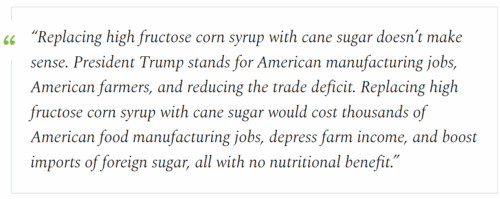
On this issue, I have to agree for once with the Corn Refiners Association.

This is one of those issues it will be enormous fun to watch.  Stay tuned.

Apr 23 2025

Annals of food marketing: What’s new in food product development.

I’ve been collecting items on new and emerging food products.  Enjoy!

And then,

It’s a brave new food world out there.  I wonder how cell-cultured dinosaur meat tastes…

Feb 13 2025

Brazil tax reform!

At the end of December, I received an email from Paula Johns, director of ACT Health Promotion in Brazil.

Today we are celebrating the approval of the tax reform in Brazil. This Tuesday, Dec 17th, the text was approved by the National Congress!!

The tax reform is a historic achievement for Brazil and we celebrate the fact that products harmful to health, such as tobacco, alcohol and sugary drinks, are included in the selective tax. We followed each stage of the discussion and saw the intense lobbying by the economic sector that profits from these products to weaken the selective tax proposal, but it was finally approved, as well as the tax-exempt basic food basket, with healthier products in accordance with the Brazilian Food Guidelines.

…Important to highlight that our National Congress is one of the worst we’ve ever had! To beat The Coca-Cola lobby there is quite an achievement! Wanted to celebrate with you. The inclusion of carbonated drinks in the selective tax now opens the door for a broader discussion about other categories of ultraprocessed foods in the revision that will happen in five years from now.

I also received a press announcement: “Historic Public Health Victory”: Vital Strategies Applauds Brazil’s Approval of Selective Tax on Tobacco, Soft Drinks, and Alcohol

The newly approved legislation includes annual tax adjustments for tobacco, soft drinks and alcohol in line with inflation. Additionally, it establishes an innovative basic food basket of healthy, sustainable products exempt from taxation. The tax reform also grants a 60% reduction in tax rates for horticultural and minimally processed products, nuts, oils, flours, and items from Brazil’s rich socio-biodiversity.  These measures will help ensure better access to nutritious food while discouraging consumption of unhealthy commodities.

…The specific tax rates for tobacco, alcohol, and soft drinks will be determined in 2025. To fully realize the public health benefits of this new tax structure, the levels of tax must be sufficient to reduce consumption. Vital Strategies, Brazil, will collaborate closely with partners to advocate for tax rates that prioritize public health. Setting these rates at levels that significantly reduce consumption of harmful products will protect communities from preventable diseases.

I tried to find more details, and hit upon Covington ‘s Brazil’s historic tax reform: a primer.  This lays out what will have to happen before implementation.  It says almost nothing about the public health taxes except this:

Key Change: the Selective Tax
In addition to the dual VAT (CBS/IBS), the reform establishes a new Selective Tax (IS) to regulate goods and services it characterizes as having significant negative health and environmental externalities. The IS will be charged on production, extraction, sale, or importation of these goods and services.

This will be interesting to watch.  Stay tuned!

Tags: ,