by Marion Nestle

Search results: walmart

Jul 14 2020

Recent items on food insecurity

With millions of people out of work, food insecurity is becoming a bigger problem than it has been. Some recent items:

From Politico: “Stark racial disparities emerge as families struggle to get enough food”

The last time the government formally measured food insecurity nationally was in 2018. At that time, about 25 percent of Black households with children were food insecure. Today, the rate is about 39 percent, according to the latest analysis by the Northwestern economists, which is set to be published this week. For Hispanic households with kids, the rate was nearly 17 percent in 2018. Today, it is nearly 37 percent.

From Northwestern, a new report: “Food Insecurity During COVID-19 in Households with Children: Results by Racial and Ethnic Groups

Disparities in food insecurity across racial and ethnic groups are large. Across the eight weeks for which CHHPS microdata are available covering April 23–June 23, 41.1% of Black respondents’ households have experienced food insecurity in the prior week, as have 36.9% of Hispanic respondents’ households and 23.2% of White respondents’ households.

From the Brookings Institution’s Hamilton Project: “About 14 million children in America are not getting enough to eat”

Accounting for the number of children in these households, I find that 13.9 million children lived in a household characterized by child food insecurity in the third week in June, 5.6 times as many as in all of 2018 (2.5 million) and 2.7 times as many than did at the peak of the Great Recession in 2008 (5.1 million). During the week of June 19-23, 17.9 percent of children in the United States live in a household where an adult reported that the children are not getting enough to eat due to a lack of resources.

From the Center on Budget and Policy Priorities: “Boosting SNAP: 5 Reasons Why Households Need More”

The Families First Coronavirus Response Act of March included much-needed measures to temporarily increase SNAP benefits for many households and let state SNAP agencies temporarily modify procedures…But these temporary benefits didn’t help everyone who needs them, and they aren’t enough to help families afford food, given the challenges that COVID-19 and the downturn have presented. Here are five reasons why the next relief package needs to include an additional boost in SNAP benefits:

From The Counter: “Covid-19 has increased online SNAP purchases twentyfold—and Amazon, Walmart have a lock on virtually all those sales”

The USDA has been pushing online food sales for SNAP recipients, and COVID-19 is accelerating the trend.  The Counter article explains that

more than 750,000 households had used food stamps benefits online as of late June. That’s up from just 35,000 in March….As of early July, 43 states are approved to accept SNAP benefits online, and 39 have the program up and running.

The Counter also notes:

One thing is certain: At this point, two big retailers stand to benefit from the explosion in online SNAP sales. In 34 of the 39 states, Amazon and Walmart are the only participating grocers. The reasons why are likely logistical.. Few independent grocers have the web infrastructure to display and update their inventory online, making Amazon and Walmart a kind of duopoly by default. Even fewer have enough staff to assemble complex orders and deliver them to people’s homes. By contrast, Amazon and Walmart have been investing heavily in grocery delivery for years.

Comment

No matter how useful they are, online deliveries cost more and SNAP does not pay delivery costs.  Online also requires a computer and broadband access.  Do SNAP participants have these things?

The 750,000 housaeholds using the online system constitute a small fraction of the 19 million households enrolled in SNAP.

We have a long way to go to solve problems of food insecurity in this country.
Jul 3 2020

Weekend reading: catching up on recent reports

Read these and you will be up to date on anything known about food systems in the age of COVID-19.

FAO and Hopkins Dashboard

This gives data on aspects of food systems—supply chains, food environments,  consumer behavior, diets and nutrition, and the effects of key drivers like climate change and income, 170 indicators in all—on the food systems of 230 countries and territories.  This is one-stop shopping for this kind of information.

“What struck us back in 2017 while working on the UN High Level Panel of Experts on Food Systems and Nutrition Report was the lack of accessible, organised, quality-checked information on food systems. Without that data, it’s difficult to identify the best evidence-based actions that could improve food systems,” said Johns Hopkins Global Food Ethics and Policy Program Director Jessica Fanzo. “It was really important to us, given the level of complexity and interconnections inherent to food systems, that the data be presented in a way that is easily usable – and that’s what the Dashboard does. Now decision makers have easy access to both data and to policy advice that is specific to their situations.”

Oxfam: “Exposed: How US supermarkets are failing their workers in a global pandemic”

Oxfam analyzed the formal policies of major US supermarkets during the first months of the pandemic, including Albertsons/Safeway, Costco, Kroger, Walmart, and Whole Foods/Amazon in five key areas: paid sick leave, hazard pay, protective gear, engagement with workers and worker representatives, and gender and dependent care. While all of these supermarkets stepped up some of their policies, none of them are doing nearly enough as they continue to make outsized profits on the backs of their low-wage workers.

Here are the Press release and the report.

CGIAR: Actions to Transform Food Systems Under Climate Change

Nothing short of a systemic transformation of food systems is required if we are to feed the world’s current and future population sustainably under climate change…we aimed to identify the high priority actions that we must collectively take now, for climate change adaptation and mitigation in food systems.  [Note: CGIAR was formerly the Consultative Group for International Agricultural Research, but now goes just by CGIAR]

Here is the report.

HLPE [High Level Panel of Experts] 15: Fooc Security and Nutrition: Building a Global Narrative Towards 2030.

Following the emergence of the COVID-19 pandemic, the HLPE was asked to urgently prepare an issues paper on the potential impact of the pandemic on global food security and nutrition for an extraordinary meeting of the CFS on 19 March 2020. The key findings and recommendations from this issues paper have been updated and included in this report…The current COVID-19 crisis is unprecedented in its global scale and the situation is changing rapidly, with many unknowns. It serves as a reminder of the fragility of the global food system and the importance of global coordination.

Here is the report.


May 28 2020

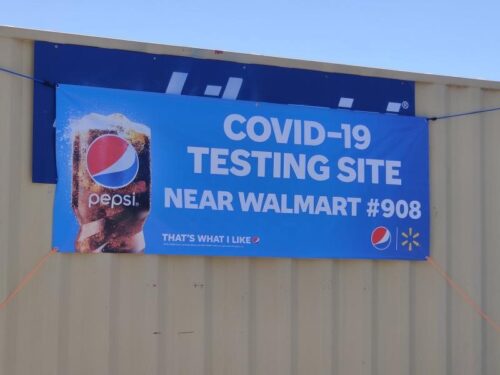
Tone deaf food company ads of the week: Are these for real? So it seems.

Here are two ads sent to me last week.  Both have now been taken down.

This one, according to reader Tony Vassallo (thanks!) comes from the Walmart Supercenter Store 908 at 8101 South John Young Parkway, Orlando FL.  I’m not the only one who thought this was in bad taste (sorry).   After a Twitter storm, Pepsi took it down.

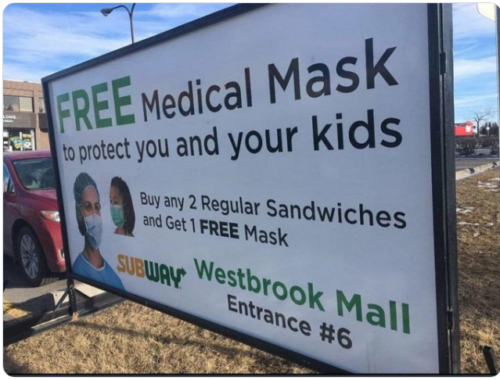
But what about this one?

I looked up Westbrook Mall: Calgary, Alberta.  This too caused an uproar.   The franchise owner apologized, explaining that he was struggling and hoped to generate business, and the sign is now gone, apparently.

Aug 27 2019

Corporations will focus on social values? Really?

The Business Roundtable’s Statement (and see B Corporation Statement below)

The Business Roundtable, an organization of corporations, issued a statement last week—in a two-page advertisement with all the signatures in the Wall Street Journal, no less—that got this New York Times headline: Shareholder Value Is No Longer Everything, Top C.E.O.s Say.

What?  This is some kind of joke, right?

I’ve been arguing for years that the Shareholder Value Movement, which forced corporations to single-mindedly focus on maximizing profits at the expense of every other societal value—attention to the welfare of workers, farm animals, public health, environmental protection—is responsible for just about everything that is wrong with our food system.

Corporations are now saying that they are committing to change that?

The Business Roundtable’s press release says that it is redefining the purpose of corporations to promote an economy that serves all Americans—customers, employees, suppliers, communities, and shareholders.   Here is its website with all the commitment info.

Its statement, signed by nearly 200 corporations, commits them to [with my comments]:

  • Delivering value to our customers [they aren’t already doing this?].
  • Investing in our employees. This starts with compensating them fairly and providing important benefits [this would indeed be a groundbreaking improvement].
  • Dealing fairly and ethically with our suppliers [they weren’t doing this either?].
  • Supporting the communities in which we work [another excellent idea].
  • Generating long-term value for shareholders [isn’t this what they’ve been doing to the detriment of everything else?]

This sounds good, but how do they plan to solve the central dilemma?  How do they intend to pay workers decent wages, improve the communities in which they operate, and stop damaging the environment—and still maximize benefits for shareholders?

No surprise, they don’t say.

Also, as the Times noted,

There was no mention at the Roundtable of curbing executive compensation, a lightning-rod topic when the highest-paid 100 chief executives make 254 times the salary of an employee receiving the median pay at their company. And hardly a week goes by without a major company getting drawn into a contentious political debate. As consumers and employees hold companies to higher ethical standards, big brands increasingly have to defend their positions on worker pay, guns, immigration, President Trump and more.

I looked for food corporations among the signers (sorry if I missed any):

  • Aramark
  • Bayer (it owns Monsanto)
  • Coca-Cola
  • Land O’Lakes
  • PepsiCo
  • Procter & Gamble
  • Walmart

This is a small list.  Where, for example, are Mars, Nestlé, and Unilever?

I see this as flat out public relations, a response to increasing public distrust of corporate America and demands for corporate accountability.

If the signers mean business, let’s see them deal with workers’ wages right away.

Otherwise, I’m not holding my breath

The B Corporation Statement

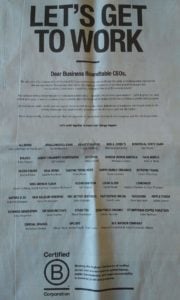
And here’s more.  Sunday’s New York Times carried this advertisement from Certified B Corporations “meeting the highest standards of verified social and environmental performance, public transparency, and legal accountability to balance profit and purpose.”

The ad is addressed to Business Rountable CEOs.

We are part of a community of Certified B Corporations who are walking the walk of stakeholder capitalism…We operate with a better model of corporate governance—benefit corporate governance—which gives us, and could give you, a way to combat short-termism and the freedom to make decisions to balance profit and purpose.

Among its food company signers are Ben & Jerry’s, Cabot Creamery Cooperative, Danone North America, King Arthur Flour, Sir Kensington’s, Stonyfield Organic, and Stumptown Coffee (there are others, as well).

I read this as a challenge: if the Business Rountable CEOs are serious about ensuring as B Corporations do, that “the purpose of capitalism is to work for everyone and for the long term,” why don’t they start by becoming B Corporations?

Until they do, the Business Roundtable statement is smoke and mirrors, to distract us from the damage the corporations are doing to our society and to our democratic institutions.

Jul 16 2019

Should Food Banks accept donations of Soylent?

I recently received an email from a public relations representative of Soylent, the company that makes those powdered meal replacements.  My NYU department once conducted a Soylent tasting. Our conclusion: it may meet nutritional requirements, but it tastes like uncooked pancake batter.

Soylent is pushing hard to get its products into your hands.

Hence the PR announcement that Soylent was donating 100,000 meal replacement packages to New York City’s Island Harvest Food Bank and City Harvest, “as part of their #SoylentForGood initiative.”

Donating Soylent to Food Banks?

Food Banks accepting donations of Soylent?

I had trouble getting my head around this so I wrote the PR person to check whether the donations were Soylent products or real foods and meals.

Soylent, of course.

Making sure that hungry people get fed is unarguably a Good Thing, but needs consideration about choice, dignity, the kind of society we want to live in, and, not least, food quality.

Soylent as a means to feed the hungry?

The mind boggles.


Tags:
Jun 6 2019

Food industry: efforts to fight hunger?

I keep saying that food companies are not social service or public health agencies and should not be viewed as such.  They are businesses, and everything they do must aim to promote sales and returns to investors.

BakeryandSnacks.com, an industry newsletter to which I subscribe, has collected several of its articles on the anti-hunger activities of its member companies.  Is this public health or public relations?  Read and decide.

May 15 2019

Online shopping for SNAP participants—the wave of the future?

The USDA recently announced a new pilot program for New York State participants in the Supplemental Nutrition Assistance Program (SNAP).  They will now be able to use their Electronic Benefit Transfer cards to buy foods online.

At first glance, this seems like a terrific idea for solving problems of limited access to healthy foods (“food deserts”), and it gives SNAP participants more options and easier access.   Yes!

But participants will have to pay service or delivery charges with their own money.  For this and other rules, see the SNAP Online Purchasing pilot webpage.  Will they end up paying more or less for foods?  We will have to see how the pilot plays out to know.

At the moment, one clear conclusion is the benefit to Big Retail.  Amazon and ShopRite will run the program in New York City.  Walmart will run it upstate.

Amazon, for example, is promoting this pilot project with a video.

Nevin Cohen, writing in Civil Eats, has the best analysis of this program I’ve seen so far.

For those who have worked for decades to make healthful food available in low-income communities, the pilot has the potential to be a game-changer, enabling them to shift attention from physical access to supermarkets to the economic inequality at the root of food insecurity. But if the SNAP pilot will actually make people healthier, six questions demand attention [his article discusses these in detail]:

1. Does Online Shopping Mean Healthier Choices?

2. Will Shopping at Home Make People Less Active and More Lonely?

3. Will Local Food Retailers be Able to Compete?

4. Will it Be Bad for Worker Health?

5. Will it Increase Environmental Health Problems?

6. Will it Create a Digital Food Divide?

SNAP, Cohen points out

is moving online, whether we like it or not, and ignoring the fact that in a few years some 40 million people will change their grocery shopping habits would be a serious mistake. As the physical barriers to food fall away for SNAP participants, it will be up to policymakers and the public health community to ensure that the food retail sector—virtual as well as brick and mortar—supports healthy diets and true access for all.


Jan 3 2019

FoodNavigator.com on what’s happening in the dairy industry

I think this collection of articles from FoodNavigator on the dairy industry is especially clear in revealing three notable trends: (1) the ongoing decline in milk consumption, (2) a more recent decline in yogurt consumption, and (3) an increase in production, availability, and marketing of dairy products high in fat.  Take a look:

 Special Edition: Dairy innovation

It’s been a challenging year for many dairy brands, with continued weakness in fluid milk and yogurt categories and growing competition from dairy-free alternatives. But there has been no shortage of innovation, spanning everything from ‘intentionally less sweet’ high protein yogurt launches to  whole milk and even ‘triple cream’ offerings as fat roars back in some parts of the category.

Tags: