by Marion Nestle

Currently browsing posts about: Food-guide

Aug 25 2026

PCRM sues government to cancel the 2025-2030 Dietary Guidelines

As anyone familiar with my work will know, I have made a career out of commenting on government dietary advice.  The Dietary Guidelines for Americans are particularly entertaining as quintessential examples of food politics in action, the latest ones in particular.

To summarize: They offered two excellent messages–Eat Real Food, and limit ultra-processed foods–but undermined them with unsubstantiated advice (double the protein), inconsistencies (eat more sources of saturated fat, but limit it to 10% of calories), omissions (salt, mentioned but no guideline), and errors (no, beef tallow is not a source of essential fatty acids).

And now the latest: The Physicians Committee for Responsible Medicine (PCRM) has sued to have the guidelines withdrawn and not used.

Guidelines Violated Federal Law Requiring Transparency, Balance, and Evidence…A “Secret Panel” of food-industry insiders handpicked by the Department of Health and Human Services and the U.S. Department of Agriculture illegally influenced the recommendations in the 2025-2030 Dietary Guidelines for Americans, argues a lawsuit the Physicians Committee for Responsible Medicine filed with the United States District Court for the District of Columbia on Aug. 19, 2026…“The government allowed the meat and dairy industries to ghostwrite the Dietary Guidelines,” said Physicians Committee President Neal D. Barnard, MD. “They put money in industry’s pocket and cholesterol in Americans’ arteries.”

PCRM is a Washington, DC-based group “dedicated to saving and improving human and animal lives through plant-based diets and ethical and effective scientific research.”

It particularly objects to the way the new guidelines and pyramid food guide prioritize meat and dairy foods.

Its lawsuit focuses on the unusually hasty and non-FACA [Federal Advisory Committee Act] process:

Instead of issuing Dietary Guidelines based on an internal review of the DGAC Report as had been the longstanding practice, Defendants, without any oversight or public  input, hastily assembled a handpicked panel of meat, dairy, and fad diet industry insiders (“Secret Panel”) for the purpose of attacking the FACA-compliant
DGAC Report and creating a substantially altered report entitled The Scientific Foundation for the Dietary Guidelines for Americans, 2025–2030….Although Defendants had previously vowed to “toss out the people who were writing the guidelines with conflicts of interest,” Defendants assembled a Secret Panel that was rife with conflicts of interest…Defendants then published Dietary Guidelines tha…embrace saturated fats, halve the recommended fruit and vegetable servings, remove daily alcohol intake limits, and promote fad diets.

PCRM says the 2025–2030 Dietary Guidelines pose dangers to

  • Children, whose school food programs must adhere to the Dietary Guidelines
  • Individuals with medical conditions who might follow the baseless medical advice incorporated into the Dietary Guidelines
  • Americans who are at risk for diet-related diseases, including obesity, diabetes, and cardiovascular disease, and might follow the scientifically unfounded Dietary Guidelines, which are designed to promote fatty, high-cholesterol products of industries with which the Dietary Guidelines’ authors are affiliated.

I can’t wait to see what happens with this one.  Stay tuned.
Jan 23 2019

Canada’s new food guide: a better version of MyPlate?

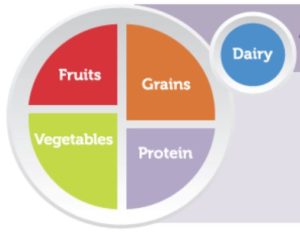
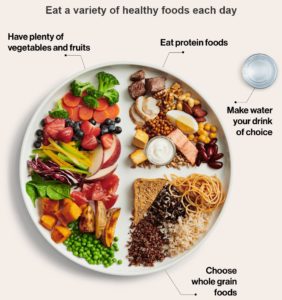
Here’s Canada’s new food guide:

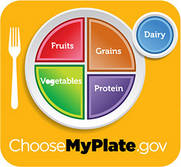
Doesn’t this look a lot like the USDA’s MyPlate?

Actually, the Canadian guide is better.  Even though it retains the annoying “Protein” section (we don’t eat protein; we eat foods containing protein and lots of other nutrients), it drops the dairy requirement.  Even better, it comes with mostly useful suggestions: [my comments]:

  • Be mindful of your eating habits
  • Cook more often
  • Enjoy your food [Yes!]
  • Eat meals with others
  • Use food labels
  • Limit foods high in sodium, sugars or saturated fat [alas, the usual switch from foods to nutrients when talking about eating less]
  • Be aware of food marketing [yes, but lots more on this please]

I can see why this has been greeted with some enthusiasm and less criticism than usual:

The documents


Mar 21 2018

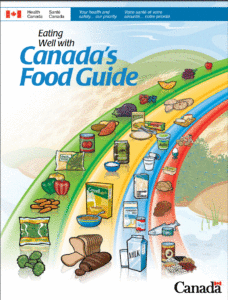
Canada’s food guide: proposed revisions

Canada’s food guide has been around since 2007.


Bill Jeffery, the executive director of the Canadian Centre for Health Science and Law (which publishes the Food for Life Report) has produced an annotated version of the food guide with proposals for fixing its major problems.

Critics viewed it as far too industry-friendly.

Here’s a graphic summary of the proposed revisions.

This is a great opportunity for Canada to produce a food guide that really does promote health.

Fingers crossed.

Oct 9 2017

Belgium’s new food pyramid

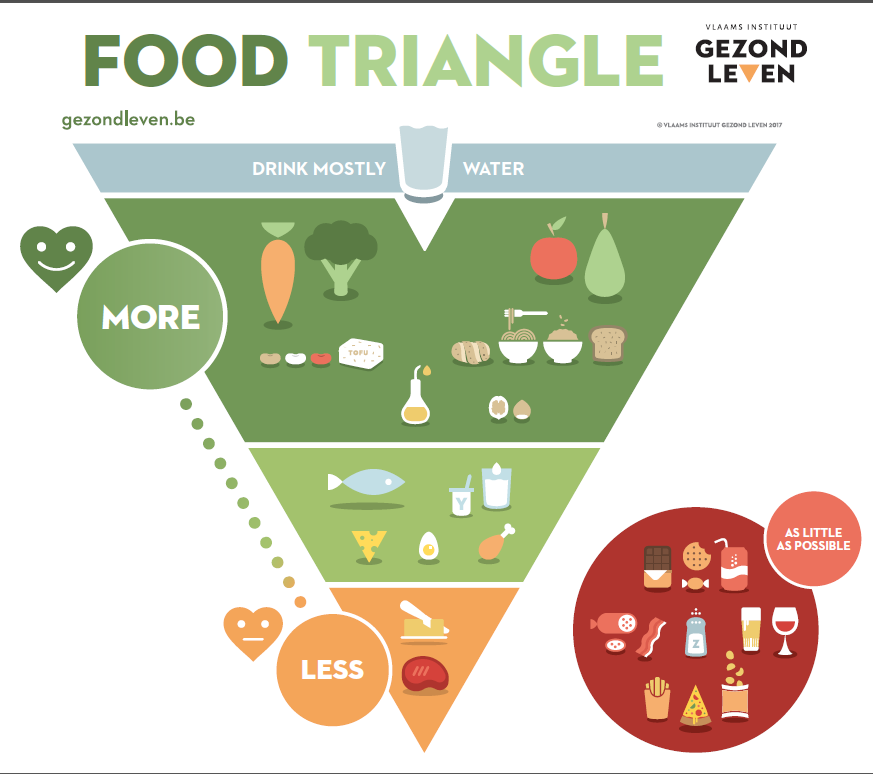
Belgium has produced a new food guide “pyramid,” upside down.  Its advice:

  • Drink water
  • Eat more fruits, vegetables, and grains
  • Eat less dairy and meat, particularly those high in fat
  • Eat a lot less junk food, sugary drinks, and alcohol

Nothing new here, really, except for making the advice so graphically clear.

As Quartz puts it, “the new food pyramid in Belgium sticks meat next to candy and pizza.”

USDA: take note.

Mar 29 2016

Some food guides are unafraid of sustainability

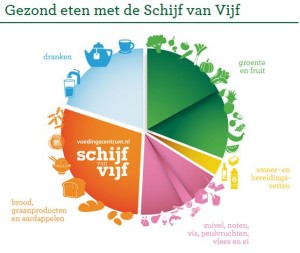
I’ve just heard about the new Netherlands food guide.  It emphasizes sustainability.  According to an article in National Geographic’s The Plate,

The Netherlands Nutrition Centre says  it is recommending people eat just two servings of meat a week, setting an explicit limit on meat consumption for the first time [but see added comment below].

Here’s what the Netherlands food guide looks like.

Capture

Google translator calls this a pyramid, and explains: “Moreover, the Pyramid helps you eat more environmentally friendly broadly.”

Ours, of course, looks like this.  I’m guessing the USDA is working on a new food guide in response to the 2015 Dietary Guidelines.  These do not mention sustainability at all—the S word.

f0bf4e4433

If you want to check out food guides m other countries, see FAO’s pages on food-based dietary guidelines.  You can search the site by regions and countries.  Fun!

Added comment: A reader from Amsterdam, who obviously speaks Dutch better than Google translator, and who also is well versed in the Dutch nutrition scene, writes:

Sustainability is indeed an important concern in the new Dutch food guide. However, the recommendation for meat is not ‘two servings per week’, but two servings of red meat and two servings of white meat (chicken), for a total of four per week. One serving is 100 gram or 3.5 oz. of meat. Diehards may add a third serving of red meat; 300 g of red meat (11 oz) plus 200 g of chicken (7 oz) per week is considered the absolute limit.

The fish advice has been reduced from twice to once a week because environmental concerns were thought to outweigh the small health benefit of a second weekly serving of fish.

Oct 18 2011

What is the Washington Legal Foundation?

The Washington Legal Foundation (WLF) placed an ad in yesterday’s New York Times.  

The Real Nutritional Guidelines

The ad continues:

Paternalistic plaintiffs’ lawyers, government officials, and professional activists are pecking away at consumers’ freedom of choice. They think we can’t manage our own lives, and through lawsuits, regulations, and taxes, they want to make our food choices for us—while profiting handsomely in the process. If we let these New Prohibitionists eat off our plates today, what other personal freedoms will they target tomorrow?

Help us defend consumer choice at EatingAwayOurFreedoms.org.

The website lists cigarette companies as clients:

The Washington Legal Foundation advocates for a free market economy, a common sense legal system, a transparent and accountable government, and a strong national defense. Our legal team shapes legal policy through aggressive litigation and advocacy at all levels of the judiciary and the policy-making arena.

Aggressive?  Clearly.

I’m not familiar with this group.  Could it possibly be connected to the Center for Consumer Freedom?

If you know anything about the WLF, do tell.

Addition, October 19: Thanks to readers for the enlightening comments.  One sent this document, in which WLF explains its mission.

If consumer protection were the real goal [of consumer advocates], then special interest ideologues would applaud businesses’ vigorous self-regulation of their advertising, and advocate viable, non-censorship solutions such as increased enforcement of underage drinking laws and more education on healthy food.

Instead of dumbing down America through activism, why not focus our efforts on real problems we face and produce drugs and vaccines to deal with pandemics, bioterrorism, and cancer. These are critical challenges that make the radical causes of self-anointed consumer advocates look petty and hopelessly irrelevant.

Reversing childhood obesity is a radical cause?  I’m for it!

Jun 17 2011

Baseball fans: a food plate just for you!

In case you missed it, here’s another contribution to food guides, this one from the Smack! sports section of the Chicago Tribune (June 5):

No comment needed.

Enjoy the weekend!

[Thanks to Yankees fans Sandy and John for sending]

Jun 9 2011

“A plate? For food? Americans don’t use plates.”

I know I said I was done with USDA’s MyPlate, but some of the later commentary is not to be missed.

Steven Colbert, for example, has an interesting take on it (that’s his quote):


And so does the pseudonymous “Ruth Bourdain” (no, I have no idea who she or he might be, but I wish I did):

There.  That looks better.