Currently browsing posts about: Natural

Jan 11 2013

The Leanwashing Index: Yes!

I was unfamiliar with the Leanwashing Index, but am delighted to learn about it.  EnviroMedia launched it in 2012 to discourage advertisers from using absurdities to push products.

EnviroMedia explains the inspiration for the Index: the appearance of the word “Superfood” on Lake Superior State University’s 38th annual List of Words to be Banished.

Here’s the 2013 Leanwashing list:

  • Natural
  • Made With
  • Whole Grains
  • Light
  • 100 Calorie

Away with all of them!  (I can think of plenty more.  Send your suggestions to the site.)

Here’s a prime example:

And while we are on the subject of whole grains, you might want to take a look at Colbert’s latest “Thought for Food.”

Enjoy the weekend!

Oct 4 2012

FTC issues advice on “eco” claims

The Federal Trade Commission (FTC), which is responsible for regulating advertising, has just revised its “Green Guide” to eco-labeling.

The FTC warns that

  • Explanations of specific attributes, even when true and substantiated, will not adequately qualify general environmental marketing claims if an advertisement’s context implies other deceptive claims.
  • Marketers [are] not to imply that any specific benefit is significant if it is, in fact, negligible.
  • If a qualified general claim conveys that a product is more environmentally beneficial overall because of the particular touted benefit, marketers should analyze trade-offs resulting from the benefit to substantiate this claim.

The FTC did this, according to the New York Times, to reduce the confusion caused by the proliferation of eco-labels.

In surveying consumers, the F.T.C. found that products that were promoted as “environmentally friendly” were perceived by consumers to have “specific and far-reaching” benefits, which, the government says, they often did not have.

“Very few products, if any, have all the attributes consumers seem to perceive from such claims, making these claims nearly impossible to substantiate,” the commission said.

No wonder the public is confused.  The Consumer Reports Greener Choices index of eco-labels goes on for pages, and the international EcoLabel index currently lists 432 icons and programs.

But the FTC guide says nothing about claims that a product is natural, organic, or sustainable.

“Natural” still has no regulatory definition.  Of Natural, the FDA says:

From a food science perspective, it is difficult to define a food product that is ‘natural’ because the food has probably been processed and is no longer the product of the earth. That said, FDA has not developed a definition for use of the term natural or its derivatives. However, the agency has not objected to the use of the term if the food does not contain added color, artificial flavors, or synthetic substances.

“Organic” is defined by the USDA through its National Organic Program.

“Sustainable” has no regulatory definition.

Will the FTC’s guide help alleviate confusion?  Perhaps, if companies follow it.


Aug 10 2012

Here we go again: what does “natural” mean?

I did an interview with Alexandra Zissu who asked me to define “natural” as applied to foods.  Here’s what I told her:

I think of “natural”–that most overused and deliberately misleading term–to mean foods as nature intended: no hormones, no antibiotics, no additives, no preservatives, no artificial colors or flavors, and only minimally processed (washing and cutting is OK, treating with nitrates or enzymes is not).

I’ve written about this issue in previous posts.  The FDA still hasn’t done anything to define the term for food labels.  I think it should.

What’s your definition?

Added question: Are GMO foods “natural?”  California courts say no.

Update August 11: Several people have written in to say the California ruling is as yet unsettled.  The website for what’s happening with Prop. 37 is here.  One reader writes:

The judge ordered that this text in the ballot materials:

In addition, the measure prohibits the use of terms such as “natural,” “naturally made,” “naturally grown,” and “all natural” in the labeling and advertising of GE foods. Given the way the measure is written, there is a possibility that these restrictions would be interpreted by the courts to apply to all processed foods regardless of whether they are genetically engineered.

Be changed so”all processed foods” reads “some processed foods.”

How this will be interpreted remains to be seen.


May 30 2012

Stevia and other “natural” sweeteners: are they?

FoodNavigator-USA.com did a special edition “Where next for natural sweeteners?”  “Special editions are collections of previously published articles on topics of interest to this newsletter’s food industry readers.

Why do this?  The holy grail of food technology is to find a no-calorie sweetener that tastes as good as sugar, has no bitter aftertaste, and can be marketed as “natural” because it’s extracted from plants. Examples: Stevia extracted from leaves Monk fruit sweetener.

As with high fructose corn syrup, not everyone considers these sweeteners to be natural since they have to go through chemical processing steps.

Stevia is extracted from leaves with ethanol.  Whether this process can be considered natural is currently under debate in Europe.  Some European regulators prefer “extracted from a plant source.”

Here are some of the articles.  For the complete collection, click here.

Monk fruit sweetener firm: ‘We hear daily that people are looking for alternatives to stevia’

It might not have garnered as much publicity as stevia, but monk fruit (luo han guo) “has found a niche within the all-natural market but will hit mass market sooner than stevia in this space”, according to one leading supplier… Read

Tate & Lyle: Monk fruit sweetener attracting most interest in dairy and beverages

Dairy and beverages are proving the most popular application areas for monk fruit sweetener Purefruit, says Tate & Lyle… Read

Different processes, lower cost, better taste: Is stevia still on track for mainstream success?Taste issues and high cost repeatedly have been raised as possible obstacles to widespread acceptance of stevia-derived sweeteners, but one of the many new suppliers entering the market claims that these are no longer the hurdles they once were… Read

Steviol glycosides are not ‘all-natural’, says new class action lawsuitA class action lawsuit filed in California this week argues that steviol glycosides should not be considered natural, owing to the “chemical processing” sometimes used to extract them from the stevia leaf… Read

Stevia buyers beware: There are some ‘awful’ extracts out there…

While traders “jumping in and out of the stevia marketplace” are disrupting prices and standards by peddling some “awful” extracts, high-quality stevia suppliers in it for the long-haul will ultimately prosper, according to one leading player… Read

Stevia in snacks and baked goods – stealth, competition, and potential

While stevia is beginning to take off in a number of baked goods and snack categories in the US, Asian and South American markets, some other emerging ‘natural’ sweeteners look ready to take it on in the segment, claims Datamonitor… Read

Naturally-positioned sweeteners to lead market growth: Report

The US alternative sweeteners market will grow by 3.3% a year to reach about $1.4bn in 2015 – and naturally positioned sweeteners like stevia and agave nectar will lead the way, claims a new report from market research organization Freedonia… Read

Mar 1 2012

What about that pesky “natural” on food labels?

FoodNavigator.com has issued a collection of its recent articles on “natural” and processing.  At issue is the meaning of “natural,” which many people perceive as equivalent to organic or healthy.  As I’ve said before, it isn’t.

Natural has no regulatory meaning.  The FDA merely says (note obfuscating double negatives):

From a food science perspective, it is difficult to define a food product that is ‘natural’ because the food has probably been processed and is no longer the product of the earth.

That said, FDA has not developed a definition for use of the term natural or its derivatives. However, the agency has not objected to the use of the term if the food does not contain added color, artificial flavors, or synthetic substances.

One thing is clear: “natural” sells food products.

Selling processed foods in a whole food world? Authenticity is key: Consumers increasingly are choosing whole and unprocessed foods – so is it the end of the line for processed food manufacturers? Not if they move with the times, say ingredient suppliers.

Who is driving the clean label agenda, and what does ‘clean’ really mean? Attempts to link clean-labeling policies with the healthy eating agenda have been so successful that research now shows shoppers equate ‘healthy’ with ‘natural’ or ‘minimally processed’ foods.

‘Natural’: The most meaningless word on your food label?  Consumers, the marketers all tell us, want foods that are ‘wholesome’, ‘authentic’, and above all ‘natural’, although few of them can articulate what this means.

‘Processed’ foods are often high in sodium – but what’s a processed food? About 75% of the sodium in our diets comes from processed foods. It’s a regularly cited figure – but what exactly is a ‘processed’ food? Consumers might be surprised.

Processing is a dirty word – but we’ll need more of it to feed the world. Processing has become a dirty word, but we are going to need more processing, not less, in order to feed a growing population, according to professor and head of food science at Penn State University John Floros.

FDA: get to work!

Nov 8 2011

Food politics semantics: the meaning of “natural”

Are you puzzled, annoyed, or irritated beyond belief by the word “natural” on food product labels?

FoodNavigator must think so.  It conducted an opinion survey on what to do about marketing foods as “natural”.

FoodNavigator asked: Do we [food companies] need a clearer definition of ‘natural’ for food marketing?

The response options:

  • Yes. The FDA should come up with a formal definition (63% checked this one)
  • Yes. The industry should develop voluntary guidance (20%)
  • No. The FDA’s 1993 guidance is sufficient (~1%)
  • No. The term is meaningless and manufacturers should stop using it (16%)

Hello FDA.  How about it?

The FDA has never defined “natural” for labeling purposes.  But it does have an answer to the question “what is the meaning of ‘natural’ on the label of a food,” one that requires self-cancelling nots (my emphasis):

From a food science perspective, it is difficult to define a food product that is ‘natural’ because the food has probably been processed and is no longer the product of the earth.

That said, FDA has not developed a definition for use of the term natural or its derivatives. However, the agency has not objected to the use of the term if the food does not contain added color, artificial flavors, or synthetic substances.

By this non-definition, High Fructose Corn Syrup is “natural” even though to make it, corn refiners must extract the starch from corn, treat the starch with an enzyme to break it into glucose, and treat the glucose with another enzyme to turn about half of it into fructose.

This is “natural,” according to the FDA, because the enzymes are fixed to a column, do not actually mix with the starch, and HFCS does not contain added colors or flavors.

In contrast, the USDA is way ahead and has defined what “natural” means for meat and poultry products.  “Naturally raised” means  no growth promoters, antibiotics, animal by-products, or fish by-products.

The USDA says meat and poultry products can be labeled “natural” if they are only minimally processed and don’t have any artificial flavorings, colorings, preservatives, or other additives.

As I’ve discussed previously, Horizon Organics now has “natural” milk that does not meet standards for organic certification.  It must hope that consumers can’t tell the difference.

To do something about this confusing situation, FoodNavigator reports that  the Natural Products Association (NPA) is developing standards for use of the word “natural” in food marketing.  This will be similar to the NPA’s Natural Seal Certification for personal home-care products.  NPA is doing this to “give consumers confidence that foods featuring the seal adhere to clear set of standards.”

NPA has not yet worked out the details but says some ingredients are unlikely to qualify:  those extracted with organic solvents, modified starch, high fructose corn syrup, and partially hydrogenated vegetable oils.

Oops.  What about GMOs?  NPA hasn’t decided yet, mainly because it is so hard to find soy products that are not GMO.

This situation is a mess and runs the risk of undercutting organic standards.  And we hardly need another certification system.

It’s time for the FDA to step in and give the food industry—and the public—some guidance about what counts as “natural” and what does not.

Jan 5 2011

Pepsi’s answer to “eat natural”: snackify beverages and drinkify snacks

Over the holidays, Pepsi announced two changes to its products.

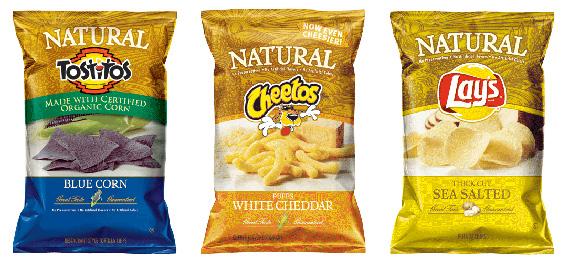
“All Natural” Frito-Lay: First, the company announced that half its Frito-Lay chips would now be made with “all natural” ingredients.

“Natural,” you may recall, has no regulatory meaning.  Companies pretty much get to define for themselves what the word means, provided what they say is “truthful and not misleading.”

By “natural,” Pepsi means removing MSG, artificial colors, and other chemical additives from some—but by no means all—chips and other snacks.  This is a good start, but Cheetos and Doritos?  Not a chance.

As to worries that the word “natural” is a calorie distractor and might encourage overeating, a Pepsi spokesperson said: “It’s meant to say: made with natural ingredients….It’s not meant to say: eat more.”  Really?  I’m not convinced.

Tropolis Squeezable Fruit: Next, Pepsi announced the latest innovation in kids’ products: Tropolis pouches of squeezable fruit.

I learned about Tropolis from a reporter at the Wall Street Journal, Valerie Bauerlein, who forwarded Pepsi’s press release:

Each fun-flavored 3.17 fl oz (90g) pouch provides a smooth blend of real squeezable fruit, is a good source of fiber, and offers 100 percent of the recommended daily value of vitamin C – all for less than 100 calories.

Tropicana Tropolis is made with no added sugars, artificial sweeteners or high fructose corn syrup; and no artificial flavors, colors or preservatives.

“Fun-flavored” is a euphemism for sugar.  The press release explains what’s not in the product.  So, what does it contain? It took some doing to find out, but it arrived eventually along with some further background information from Pepsi:

The issue is kids aren’t getting enough fruit, so Tropicana Tropolis is trying to help solve that problem in a fun, nutritious way…Studies show that families are not getting enough fruit and vegetables in their diets, and the health experts we talked to (registered dietitians and pediatricians) when developing Tropolis also raised this issue.

As you might imagine, I was not one of the experts they talked to.  Here are the ingredients:

  • Grape World: Apple puree, filtered water, banana puree concentrate, fibersol-2 fiber (maltodextrin), grape juice concentrate, apple juice concentrate, lemon juice concentrate, natural flavor and ascorbic acid (vitamin C).
  • Cherry World: Apple puree, filtered water, banana puree concentrate, fibersol-2 fiber (maltodextrin), apple juice concentrate, cherry juice concentrate, lemon juice concentrate, natural flavor and ascorbic acid (vitamin C).
  • Apple World: Apple puree, filtered water, banana puree concentrate, fibersol-2 fiber (maltodextrin), apple juice concentrate, lemon juice concentrate, natural flavor and ascorbic acid (vitamin C).

Translation: “Juice concentrates” is another euphemism for sugar.  You don’t believe me?  See the list of sugar euphemisms in the 2005 Dietary Guidelines (Table 14).

My translation: this is watery apple and banana sauce, artificially thickened, sweetened with fruit sugars, flavored with additives, and with added vitamin C.

As Valerie Bauerlein’s Wall Street Journal account explains,  this product is about expanding Pepsi’s profits in the “better-for-you” category as captured in a quotation that is sure to become a classic.

Ms. Nooyi [Pepsi’s CEO] has said she wants to build the nutrition business to $30 billion from $10 billion by 2020.…We see the emerging opportunity to ‘snackify’ beverages and ‘drinkify’ snacks as the next frontier in food and beverage convenience,” Ms. Nooyi said.

I ’m also quoted in her article (I did the interview while stranded in Miami trying to get back to snowbound New York):

Marion Nestle, a professor of nutrition at New York University, said that the fruit concentrates are simply sugar. “They start out with real food, so let’s give them credit for applesauce and mashed-up bananas,” but “the rest of it is sugar,” she said. “Kids would be better off eating an apple or a banana.”

PepsiCo said Tropolis should get kids to eat more fruit, which is what’s most important.

Tropolis raises my favorite food philosophy question: Is a “better-for-you” product necessarily a good choice?  Is this a good way to get kids to eat more fruit?

You decide.

Sep 14 2009

USDA to define “natural”

I can hardly believe it but the USDA is about to define what “natural” means for meat and poultry products (on the link, look for Docket No. FSIS-2006-0040A).

At the moment, the USDA has two definitions of “natural.”  Its Food Safety and Inspection Service says meat and poultry can be labeled “natural” if they are only minimally processed and don’t have any artificial flavorings, colorings, preservatives, or other additives.   But the USDA’s Agricultural Marketing Service has its own ideas.  It says “naturally raised” means the meat must come from animals raised with no hormone growth promoters, no antibiotics, and no animal by-products.  Hmm.  How about all of the above?

Let’s hear applause for the new USDA administration for taking this on.  OK FDA: now it’s your turn!

Page 1 of 3123