by Marion Nestle

Search results: USDA meat

Dec 1 2007

Should USDA and FDA be allowed to order recalls?

At the moment, these agencies do not have the authority to order companies making contaminated foods to recall the unsafe products. They have to ask for voluntary recalls. Why? Because meat companies much prefer recalls to be voluntary. Now, the Food Marketing Institute, which represents and lobbies for food companies of all kinds, has broken with meat trade associations on this issue. Recall authority, it says, might help restore flagging consumer trust in the food supply. I’m glad they finally figured that one out.

Dec 1 2007

USDA proposes to define “Natural”

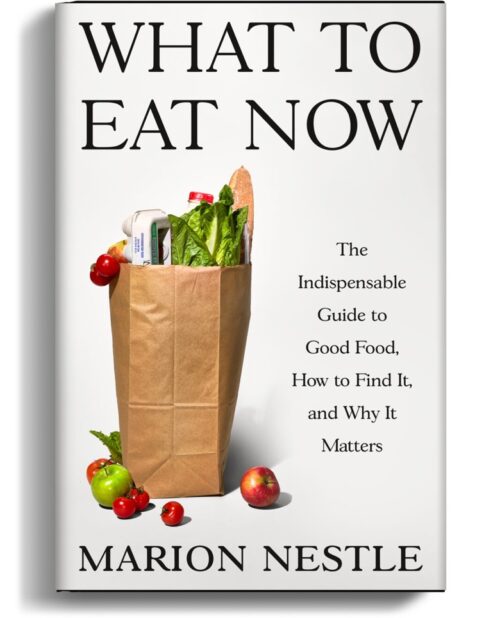
The Department of Agriculture, apparently concerned about consumer confusion over what “natural” meat might be, is proposing to define the term. Right now, “natural” means minimally processed plus whatever the marketer says it means, and nobody is checking (I devote a chapter of What to Eat to explaining all this). This proposal, as the USDA explains, would be a voluntary marketing claim (“no antibiotics, no hormones”). The proposal is open for comment until January 28. Want to comment? Do that at this site.

Tags: , ,
Oct 26 2007

USDA taking action on E. coli, and about time too

According to news reports, the USDA has just announced that it plans to hold companies accountable for producing safe beef. USDA safety officials say they are taking aggressive steps (see list) to reduce outbreaks from E. coli and other pathogens. As I keep saying, companies know how to produce safe meat, but need some encouragement (translation: enforcement) to do so. The USDA absolutely has the mandate to enforce food safety regulations and let’s hope it really does.

Oct 23 2007

Unsafe meat: now we know why?

So now we know (courtesy of the New York Times) why E. coli O157:H7 recalls are becoming more frequent: the meat industry isn’t following food safety rules. These rules were require meat and poultry producers to develop and monitor plans for producing safe food, and to test to make sure the plans are working. Two problems here: the companies aren’t bothering to follow the rules, and the onsite USDA inspectors aren’t bothering to enforce them. Standard food safety rules–HACCP and pathogen reduction–work really well, but only if designed, followed, and enforced to the letter and spirit. I keep asking: what will it take to get Congress to act on the food safety issue?

Aug 4 2026

Update on the Cyclospora outbreak: What to do?

States have reported upwards of 20,000 cases of Cyclospora-caused explosive diarrhea, some of them–but by no means all—traced to lettuce grown by Taylor Farms in Mexico and shipped to Taco Bell and, apparently, lots of other places.

The best way to keep track of all this—and it is a lot to keep track of—is to read food poisoning lawyer Bill Marler’s blog and Phyllis Entis (the bug lady) at e-FoodAlert.

I wrote about the system-failure issues raised by this Cyclospora outbreak last week.

This week, I want to talk about what to do about it.

I hate to say it, but for starters, do not eat bagged salads until this industry can get its act together and prevent human (for Cyclospora) and animal (for E. coli and Salmonella) waste from getting anywhere near irrigation water used for growing lettuce.

And maybe don’t eat lettuce at all.  You can buy whole heads, remove the outer leaves, wash what’s left, and hope for the best, but if Cyclospora is on that lettuce, it won’t wash off and is still risky.

We need to get the FDA and CDC back on the job to get producers to produce lettuce safely.  For this, I defer once again to Bill Marler.

Here is what they should have done and still could do today:

1.     Restore required Cyclospora reporting in FoodNet…FoodNet measures trends, it does not detect outbreaks. But it was narrowed eleven months before the largest Cyclospora outbreak this country has ever recorded, reinstating it costs almost nothing, and every letter Congress has sent asks for it.

2.    Make cyclosporiasis reportable in every state, not merely nationally notifiable. Those are two different things: notifiable means CDC asks for the case, reportable means state law requires it. The parasite does not observe the difference, and neither should the count.

3.    Publish one national number and update it. CDC currently maintains an outbreak page frozen at 1,947 since July 24 and a surveillance page reading 6,707, while the states themselves report 20,927. Pick a figure, define exactly what it counts, include probable cases, and refresh it on a schedule the public can rely on. An agency that will not publish the size of a problem cannot expect to be believed about the solution.

4.    Grant the citizen petition that has been sitting at FDA since Feb. 4. Stop Foodborne Illness asked the agency to adopt a policy of naming every company associated with a foodborne illness outbreak, recall or no recall. It requires no rulemaking; the Commissioner could grant it this week with a memorandum….

5.     Bring back the Microbiological Data Program, and this time give it a parasite target. The MDP was created under President Bush’s 2001 Food Safety Initiative and tested about fifteen thousand produce samples a year — bagged lettuce and spinach, cilantro, hot peppers, tomatoes, sprouts, melons — for roughly $4.5 million a year, and it accounted for something like eighty percent of all federal produce pathogen testing until it was zeroed out and shut down in December 2012….while we are at it add the parasite to CDC’s national wastewater surveillance network, which reaches roughly fifteen hundred sites and about half the country and does not look for this organism at all.

6.    Put the FSMA 204 traceability rule back on its original schedule instead of 2028. Susan Mayne, who has actually run lettuce tracebacks, said on national television this week that it would have been enormously helpful here, and that without it the same thing happens again next summer.

7.     Name Cyclospora in the pre-harvest agricultural water rule. The only numeric microbial criterion in Subpart E is generic E. coli, and FDA’s own guidance says fecal-indicator testing will not identify this parasite….

8.    Stand up the independent board Frank Yiannas has been asking for since 2025 — an NTSB for foodborne outbreaks, investigating across agency lines, publishing root cause and lessons, with no stake in the reputation of the agency whose work it is reviewing….the point is not to find fault; it is to find facts….

The point here is that our food supply needs to be a whole lot safer.  When food safety rules are in place, followed, and inspected to make sure they are followed, food poisoning incidents go down.

We saw that with meat safety in the 1990s.

Leafy greens have been a food safety problem for a long time.  It’s way past time to get that problem addressed.

____________________

Arriving Sept 8. For a 30% discount, pre-order here using code UCPSAVE30.

Jul 14 2026

Setting the record straight: Calley Means

Washington Post reporter, Tim Carman, contacted me for comment about a speech he heard made by RFK Jr’s top food advisor, Calley Means, in which Means made patently false charges about my work.  From Carman’s report, MAHA Mondays at the Great American State Fair miss one obvious problem:

Means suggested her research had been bankrolled by sugar and tobacco industries, the latter of which once owned major food companies. The industries “funded her to say that basically the base of our diet should be carbs,” Means said. He added that the report made Americans afraid of foods other than grains.

These charges surprised me for two reasons: (1) Anyone even remotely familiar with my work would know these statements could not possibly be true, and (2) I am not MAHA’s enemy. I support parts of its agenda, and am on record as calling for coalition-building around common objectives.

Means began making the false claims on June 30, when we were on a panel at the Aspen Ideas Festival, moderated by Corby Kummer.  You can watch the session here and make your own decision about how it went.

I would have let the whole thing go, except that Calley Means followed it up with his speech at the Great American State Fair on July 6.  Tim Carman sent me a transcript of Means’ remarks:

In the 1980s, a group called the Sugar Research Council paid her to do a lot of research. And they really funded her to say that basically the base of our diet should be carbs, and the base our diet to be grains, and we should fear fat. And really, we should fear a lot of natural foods in favor of grains. And her research, she claims credit for being the architect of the 1992 food pyramid. And I told her, when we talked last week, I think it’s actually demonstrable that the dietary guidance from the 1990s has been the most destructive public health document in modern history, because they put grains and carbs at the base of the pyramid. And they didn’t differentiate whole grains or refined grains. Why did they do that? That was directly prompted by the food industry, which at the time was the cigarette industry.

Carman asked: “Any of this true?”

Good grief no. Not only are these statements false; they are spectacularly false.

Let’s take them line by line.

Means: In the 1980s, a group called the Sugar Research Council paid her to do a lot of research.

False. In the 1980s, I was teaching nutrition to medical students at the University of California San Francisco (UCSF) school of medicine and running a nutrition education program funded by NIH and, later, by the John Tung Foundation.  To avoid conflicts of interest, I have a long-standing policy of not taking payments from food companies.  The policy is posted on this site here.

Means: And they really funded her to say that basically the base of our diet should be carbs, and the base our diet to be grains, and we should fear fat.

False.  Here, I think he must be referring to the Sugar Research Foundation (SRF) which funded researchers at Harvard who wrote a skewed review of diet and heart disease in the New England Journal of Medicine in 1967; the review downplayed sugar, and emphasized fat. The SRF’s role in this research was exposed in 2016 in JAMA Internal Medicine by Cristin Kearns, Laura Schmidt and Stanton Glantz: Sugar Industry and Coronary Heart Disease Research: A Historical Analysis of Internal Industry Documents.  I wrote the commentary on this study: “Food industry funding of nutrition research: The relevance of history for current debates.”  I also wrote about both pieces on this site.

Means: And really, we should fear a lot of natural foods in favor of grains.

False Here, I think, he must be talking about my role as managing editor of the 1988 Surgeon General’s Report on Nutrition and Health. The report summarized the research consensus of that time.

“Fats and cholesterol. Reduce consumption of fat (especially saturated fat) and cholesterol.  Choose foods relatively low in these substances, such as vegetables, fruits, whole grain foods, fish, poultry, lean meats, and low-fat dairy products.”

“Complex carbohydrates and fiber: Increase consumption of whole grain foods and cereal products, vegetables (including dried beans and peas), and fruits.”

The National Academies’ even more comprehensive report, Diet and Health: Implications for Reducing Chronic Disease Risk, made similar recommendations in 1989.

Means: And her research, she claims credit for being the architect of the 1992 food pyramid.

False. I have never claimed such responsibility; I had none. My only role in the 1992 pyramid was to work closely with a reporter for the New York Times, Marian Burros, to expose how the meat industry induced the USDA to suppress the pyramid when it was about to be released in 1991.  I devoted an entire chapter of my book, Food Politics, to providing the evidence for this.

Means: And I told her, when we talked last week, I think it’s actually demonstrable that the dietary guidance from the 1990s has been the most destructive public health document in modern history,

True.  This is what he said and, I assume, is what he thinks.

Means:  because they put grains and carbs at the base of the pyramid. And they didn’t differentiate whole grains or refined grains.

False. The USDA’s pyramid brochure said: “Choose a diet with plenty of grain products, vegetables, and fruits which provide needed vitamins, minerals, fiber, and complex carbohydrates, and can help you lower your intake of fat.”

It also says, “Here are some selection tips: ☛ To get the fiber you need, choose several servings a day of foods made from whole grains, such as whole-wheat bread and whole-grain cereals. ☛ Choose most often foods that are made with little fat or sugars. These include bread, english muffins, rice, and pasta… ☛ Baked goods made from flour, such as cakes, cookies, croissants, and pastries, count as part of this food group, but they are high in fat and sugars.”

Means: Why did they do that? That was directly prompted by the food industry, which at the time was the cigarette industry.

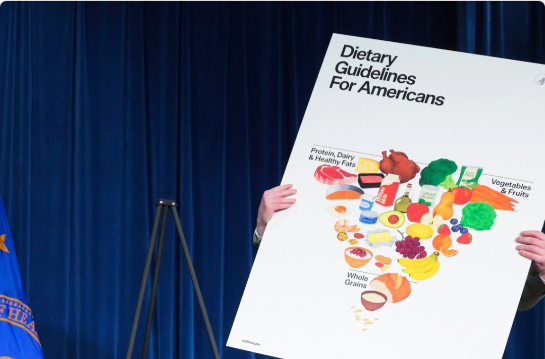
Misleading. Yes, the cigarette industry owned Kraft Foods and other food companies at that time, and taught those companies how to use the tobacco playbook to promote unhealthy products (as we only recently learned).  But the major food industry influences on dietary guidelines and food guides in the 1980s and 1990s were the meat and dairy industries, as I describe in Food Politics. As far as I can tell, they still are, as witnessed by the 2025-2030 guidelines and inverted pyramid.

But that’s not all.  Calley Means said on Instagram: “At @aspenideas, I spoke with @marionnestle – an architect of the 1990s U.S. Dietary Guidelines that led to an explosion of refined carbohydrates and ultraprocessed food in the American diet.”

Misleading again.  I was indeed a member (although hardly the architect) of the 1995 Dietary Guidelines Scientific Advisory Committee.  Here is what the 1995 guidelines said about grains.

“Most of the calories in your diet should come from grain products, vegetables, and fruits These include grain products high in complex carbohydrates—breads, cereals, pasta, rice—found at the base of the Food Guide Pyramid, as well as vegetables such as potatoes and corn. Dry beans (like pinto, navy, kidney, and black beans) are included in the meat and beans group of the Pyramid, but they can count as servings of vegetables instead of meat alternatives.”

Doesn’t this look a lot like what the 2025-2030 guidelines say about grains?  I think it does.

Yes, the 1995 guidelines did not say anything about reducing intake of ultra-processed foods.  How could they? The term was not coined until 2009.

So: Why on earth is Calley Means attacking my work?

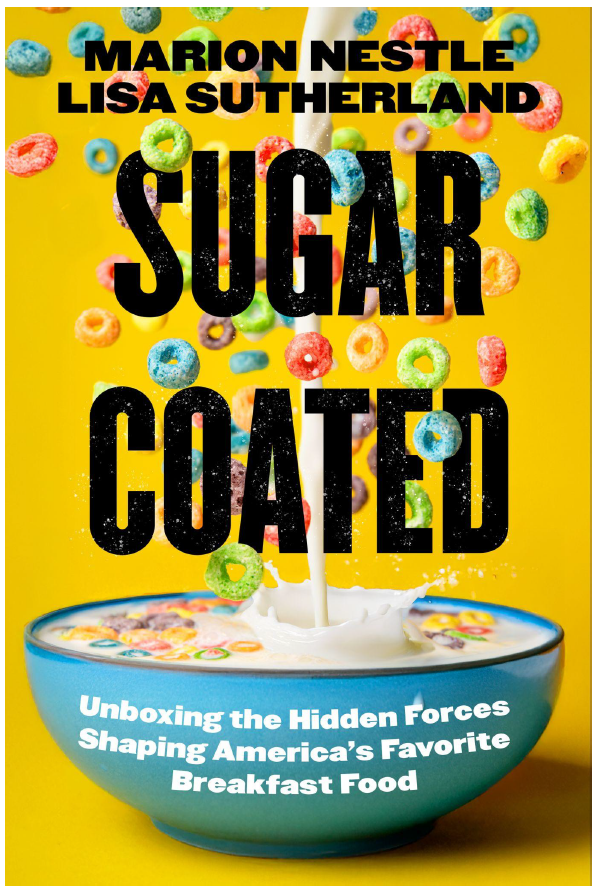
I can only speculate.  I see the underlying issue in our current food problems as the food industry having profits to stockholders as its primary fiduciary responsibility, as I have described for decades in my daily newsletter foodpolitics.com, and in my books, most notably,

In making false charges, could Calley Means possibly be attempting to deflect attention from the difficulties MAHA is confronting in implementing its agenda? (I will say more about that tomorrow).  Means seems to view me as an appropriate target for deflection.  Obviously, I disagree.

MAHA’s agenda appears to be running up against the pushback that inevitably happens when you do something that might threaten food industry profits. See, for example:

A final comment

Reasonable people can disagree about elements of nutrition policy. But reasonable people cannot invent a history that did not exist.

If Calley Means or anyone else believes that I have misrepresented the science or the historical record in my lengthy body of work, show me the evidence. I will be happy to consider it.

That’s how Gold Standard Science works.  Otherwise, it’s just name-calling.

Addition

I was just sent this link to Vanity Fair’s article about Calley Means.

_____________________

Pub date is September 8. Pre-orders through UC Press get a 30% discount. Use promo code UCPSAVE30.

Jun 9 2026

Food safety in peril: a post from Bill Marler

I don’t usually host guest posts here, but I read food safety lawyer Bill Marler’s blog and obtained his permission to reprint it.  It should be obvious why I thought you should read it.

The people who find foodborne outbreaks are being fired, defunded, and disbanded — and the bugs do not care.

For more than thirty years I have represented the families on the other end of a foodborne outbreak — the parents of children on dialysis with hemolytic uremic syndrome, the survivors of a contaminated hamburger or a bag of spinach, the people left planning funerals. I built a career holding companies accountable when the food safety system failed. I never imagined the federal government itself would become one of the things that fails. Over the past year and a half, it has.

The cuts this administration has made to the FDA, the CDC, and the USDA’s Food Safety and Inspection Service are not abstract budget lines. They are going to get people sick, and some of them are going to die. The cruelest part is that it is all being done under a banner that reads “Make America Healthy Again.”

Consider the FDA, which polices roughly 80 percent of our food. It lost nearly 3,900 employees in 2025 alone, part of an HHS purge of some 20,000 jobs. It began in February with what the agency’s own deputy commissioner for human foods called the “indiscriminate” firing of 89 people from the food program — after which he resigned, saying it was “fruitless” to continue. The administration fired so blindly that it had to scramble to rehire the official in charge of infant formula safety.

By March, HHS planned to cut a fifth of the FDA’s workforce, including more than 170 people from inspections and investigations. Understand what that means. In 2024 the FDA had all of 443 inspectors to cover more than 36,000 food facilities at home and abroad — against the roughly 1,500 it says it actually needs. We were already running on fumes. ProPublica found that foreign food inspections fell by nearly half in early 2025. We are importing more food than ever and looking at less of it.

Then there is the surveillance — the quiet, unglamorous detective work that is the entire ballgame in my world. By the time a family calls me, public health investigators have usually already connected a sick child in Ohio to a sick adult in Oregon and traced both to a single contaminated lot. On July 1, the CDC gutted that capacity, scaling its FoodNet surveillance network back from eight pathogens to two. It stopped actively tracking Campylobacter, Listeria, and four others. Listeria — the same pathogen that, in the Boar’s Head outbreak just last year, caused the deadliest listeriosis outbreak in over a decade. We are turning off the smoke detectors and telling ourselves the house won’t burn.

The USDA has done its part. Its inspection service shed hundreds of positions while line speeds at some slaughterhouses climb and inspectors step back — fewer people asked to catch more contamination moving faster. And in a move that should alarm anyone who believes in evidence, the department disbanded the two scientific advisory committees that had guided federal food safety policy for decades, one of them since 1971. Their combined cost was about $300,000 a year. One was, at the moment it was dissolved, reviewing how to keep Listeria out of deli meat. That work simply stopped. For good measure, FSIS withdrew its proposed rule to limit Salmonella in raw poultry — a pathogen that sickens more than a million Americans a year — after years of work.

I want to be fair. No one in Washington woke up wanting to poison a child, and the food safety system was underfunded long before this administration; I have said so under presidents of both parties. But you cannot fire the inspectors, blind the surveillance, suspend the lab testing, dismiss the scientists, and abandon the rule making all at once and still claim that food safety is a priority. Actions are what count, and these all point one direction.

Here is what three decades have taught me. Outbreaks do not announce themselves. They are found by people — inspectors who walk the plants, epidemiologists who connect the dots, technicians who confirm the strain. Take those people away and the outbreaks still come. We just find them later, after more children are on dialysis and more families are planning funerals instead of birthday parties. The bacteria do not care about budget cuts. They never have.

I have spent my life suing companies that put profit ahead of safety. If these cuts stand, I expect to be busier than ever. That is the worst thing I could possibly tell you.

Jun 3 2026

American Journal of Public Health series on Ultraprocessed Foods: My Editorial

The American Journal of Public Health has just published a series of papers on ultraprocessed foods to which I contributed this editorial.  These papers are released today as part of the launch of new initiative, FedUP! aimed at establishing policies to help reduce consumption of ultraprocessed foods and prevent their harm to health.

Press releases for the series and campaign are here and here (longer, more quotes).  

The other papers are on the AJPH webpage dedicated to this series; all are open access.

Here is the recording of the press conference.

Press coverage is here.

And here is my editorial.
The Politics of Ultraprocessed Foods: Dietary Guidelines for Americans

Marion Nestle, PhD, MPH

On January 7, 2026, the Trump administration’s Departments of Health and Human Services (HHS) and Agriculture (USDA) jointly released the 2025–2030 Dietary Guidelines for Americans. For the first time since they were established in 1980, these called for “a dramatic reduction in highly processed foods laden with refined carbohydrates, added sugars, excess sodium, unhealthy fats, and chemical additives.” The actual guideline, one of eight, says “Limit highly processed foods, added sugars, & refined carbohydrates.” 1

Although these statements do not use the term “ultraprocessed,” that is clearly what they mean. The guidelines are based on a commissioned scientific foundation report that refers repeatedly to ultraprocessed foods and cites major studies of their health effects.2 Those studies, largely observational, used the Nova classification system to divide foods into four categories based on their degree of processing: unprocessed or minimally processed (Nova 1), processed culinary ingredients (Nova 2), processed (Nova 3), and ultraprocessed (Nova 4).3 The scientific foundation report notes three reasons for avoiding the Nova 4 term: no consensus definition of “ultraprocessed” exists, defining refined starches and sugars as Nova 2 underestimates dietary intake of Nova 4 foods, and the Nova system classifies some nutrient-dense foods as ultraprocessed. On this basis, the guidelines use “highly processed” as a euphemism.

Even so, the very mention of processing in the US dietary guidelines must be considered an important forward step. In advising limits on highly processed foods, HHS and USDA reversed the decision made by the Biden administration’s Dietary Guidelines Advisory Committee (DGAC). That committee judged the category of ultraprocessed to be too ambiguously defined, and the observational evidence for its harm to health too subject to error, to warrant an “eat less” recommendation.4 I view this decision as overly cautious. Yes, observational studies can only demonstrate association, not causation, but of more than 100 studies of ultraprocessed diets and health, nearly all found such diets to increase risks for chronic disease and overall mortality.3

Furthermore, the DGAC excluded consideration of the one exceptionally well-controlled randomized clinical trial available at the time. The participants in that study were housed in a metabolic ward—they could not lie or cheat about what they were eating—and given a diet of either minimally processed or nutritionally comparable ultraprocessed foods. The study results were unexpected and dramatic; the participants consumed an average of 500 calories a day more on the ultraprocessed diet, without realizing it.5 The DGAC eliminated this trial from consideration because it had set criteria for inclusion that required studies to last longer and involve more participants.6 I thought the DGAC should have made an exception for this trial; metabolic ward studies are enormously expensive and few human volunteers are willing to be locked in one for more than a few weeks.

At issue is the preponderance of research; scientists can interpret it differently. The Trump administration’s commissioned research review found “robust and consistent adverse associations between HPF [highly processed food] consumption and a broad range of chronic health outcomes, often in a dose–response fashion,” and concluded that “the current evidence base provides a strong rationale for immediate action at the individual, population, institutional, and policy levels.”7 Many researchers and nutrition professionals, including me, agree with this assessment.8

This guideline is new, but most of the other 2025 dietary guidelines are consistent with long-standing scientific consensus on the benefits of eating more vegetables, fruits, and whole grains, and limiting intake of added sugars, sodium, and alcohol, although they call for greater restriction of sugars and less precise (vague) restriction of alcohol. The guidelines sharply diverge from consensus in recommending a doubling of protein—a euphemism for meat—and in not emphasizing plant foods more strongly. They promote greater intake of meat along with full-fat dairy, butter, and beef tallow, but inconsistently limit saturated fat to 10% of calories.1

The agencies’ fact sheet makes the politics explicit; it uses the word “evangelizing.” Its major point: previous governments have lied to you about dietary risks, and you need to take personal responsibility for what you eat. In doing so, the guidelines reject concerns about health equity—and, therefore, policies that might address social determinants of health—as deserving of consideration.9 Despite promises that the guidelines would be free of conflicts of interest, four of the nine writers of the research reviews report financial ties to meat and dairy industry groups, and three more disclose ties to other food industries.3 The conflicted interests and emphasis on animal-based foods make these guidelines appear to have been captured by the meat and dairy industries.10

I cannot determine whether these guidelines were influenced more by corporate capture or by the personal ideologies of the agency secretaries; they, after all, selected the individuals who wrote the research reviews and are responsible for what the guidelines say. I also do not know how even “highly processed” made it into the guidelines in the face of what surely must have been intense food industry opposition. The food industry, joined by some nutrition scientists, much prefers guidelines based on nutrient content: sugar, salt, fat. Doing so permits the few frequently cited nutrient-dense Nova 4 products—some whole wheat breads, yogurts, and power bars, and plant-based meats—to be considered processed, not ultraprocessed.

Critics of the ultraprocessed concept endlessly invoke the same arguments: there is no scientific consensus on the meaning of the term, and the concept risks undermining “established, evidence-based nutrition strategies,” thereby shifting “the focus away from the most important thing about food which is the nutrition aspect.”11 But thoughtful rebuttals to these arguments note that food misclassifications do not appear to change study conclusions; well-controlled clinical trials have now been repeated with similar, biologically plausible results; the mechanisms of action of ultraprocessed foods are under study; and even “healthy” ultraprocessed foods induce greater calorie consumption.2

Behind food industry arguments is the enormous profitability of ultraprocessed products. Indeed, the very purpose of ultraprocessing is profit maximization—using low-cost ingredients to create irresistible and long-lasting products—so much so that this goal is built into its Nova definition.2,9 The food industry’s objection to the inclusion of processing as a consideration in dietary guidelines comes down to this: eating less is bad for business.

The call for limits on ultraprocessed foods may be groundbreaking in US dietary guidelines, but in 2015, Brazil issued guidelines that included advice to “Make natural or minimally processed foods the basis of your diet.”12 Unlike US guidelines. these were based on the idea that healthy diets should derive from socially and environmentally sustainable food systems. This is a major conceptual difference from the US approach, which emphasizes personal responsibility above all others.

When individuals are deemed entirely responsible for their own dietary intake, government policies need focus only on education. If objections to the guidelines from the food industry have been mild so far, it is surely because its leaders know that education is not enough to change dietary behavior. They much prefer education to policies aimed at regulating product contents and marketing. But to really help people reduce intake of ultraprocessed foods, we need a wide range of policy options—taxes, subsidies, marketing, procurement, product placement13—aimed at making healthier foods more available, accessible, and affordable.

ABOUT THE AUTHOR

Marion Nestle is with the Department of Nutrition and Food Studies, New York University, New York, NY.

Correspondence

Correspondence should be sent to Marion Nestle, Department of Nutrition and Food Studies, New York University, New York NY 10003 (e-mail: marion.nestle@nyu.edu). Reprints can be ordered at http://www.ajph.org by clicking the “Reprints” link.

DOI: https://doi.org/10.2105/AJPH.2026.308530

CONFLICTS OF INTEREST

Marion Nestle earns honoraria from lectures and royalties from books about the politics of food.

REFERENCES

  1. US Dept of Health and Human Services and US Dept of Agriculture. Dietary Guidelines for Americans, 2025-2030.  Available at: https://cdn.realfood.gov/DGA.pdf.  Accessed April 4, 2026.
  2. US Dept of Health and Human Services and US Dept of Agriculture. The scientific foundation for the dietary guidelines for Americans, 2025–2030. Available at: https://cdn.realfood.gov/Scientific%20Report.pdf. Accessed March 4, 2026.
  3. MonteiroCA, LouzadaML, Steele-MartinezE, et al. Ultra-processed foods and human health: the main thesis and the evidence. Lancet. 2025;406(10520):2667–2684. https://doi.org/10.1016/S0140-6736(25)01565-X
  4. US Dept of Health and Human Services and US Dept of Agriculture. Scientific Report of the 2025 Dietary Guidelines Advisory Committee. Dec 2024. Available at: https://www.dietaryguidelines.gov/2025-advisory-committee-report. Accessed April 3, 2026.
  5. HallKD, AyuketahA, BrychtaR, et al. Ultra-processed diets cause excess calorie intake and weight gain: an inpatient randomized controlled trial of ad libitum food intake. Cell Metab. 2019;30(1):67–77.e3. https://doi.org/10.1016/j.cmet.2019.05.008
  6. LaMotteS. They’re up to 70% of the American diet. But the US has no policy on ultraprocessed foods. CNN Health. November 22, 2024. Available at: https://www.cnn.com/2024/11/22/health/ultraprocessed-food-us-dietary-guidelines-wellness. Accessed February 27, 2026.
  7. GoranM. Appendix 4.1. In: U.S. Dept of Health and Human Services and U.S.Dept of Agriculture. Impact of highly processed foods on multiple health outcomes: umbrella review of prior meta-analysis.The Scientific Foundation for the Dietary Guidelines for Americans: Appendices. Jan 7, 2026. Available at: https://cdn.realfood.gov/Scientific%20Report%20Appendices.pdf. Accessed April 3, 2026.
  8. BakerP, SlaterS, WhiteM, et al. Towards unified global action on ultra-processed foods: understanding commercial determinants, countering corporate power, and mobilising a public health response. Lancet. 2025;406(10520):2703–2726. https://doi.org/10.1016/S0140-6736(25)01567-3
  9. US Dept of Health and Human Services and US Dept of Agriculture. Fact sheet: Trump administration resets US nutrition policy, puts real food back at the center of health. January 7, 2026. Available at: https://www.hhs.gov/press-room/fact-sheet-historic-reset-federal-nutrition-policy.html. Accessed February 27, 2026.
  10. NevesFS, NilsonEAF, MendesLL, et al. The 2025–2030 US Dietary Guidelines: an analysis of scientific integrity and global health governance. Lancet Reg Health Am. 2026;56:101402. https://doi.org/10.1016/j.lana.2026.101402
  11. Food Navigator—Europe. Industry takes aim at Lancet’s deadly UPF report. November 20, 2025. Available at: https://www.foodnavigator.com/Article/2025/11/20/lancet-upf-report-sparks-industry-pushback-over-policy-and-evidence-gaps/#:~:text=Most%20question%20the%20scientific%20basis,clarity%20instead%20of%20damning%20reports. Accessed February 27, 2026.
  12. Brazil Ministry of Health. Dietary guidelines for the Brazilian population. 2015. Available at: https://bvsms.saude.gov.br/bvs/publicacoes/dietary_guidelines_brazilian_population.pdf. Accessed February 27, 2026.
  13. ScrinisG, PopkinBM, CorvalanC, et al. Policies to halt and reverse the rise in ultra-processed food production, marketing, and consumption. Lancet. 2025;406(10520):2685–2702. https://doi.org/10.1016/S0140-6736(25)01566-1