by Marion Nestle

Search results: the corporation not me

Aug 27 2019

Corporations will focus on social values? Really?

The Business Roundtable’s Statement (and see B Corporation Statement below)

The Business Roundtable, an organization of corporations, issued a statement last week—in a two-page advertisement with all the signatures in the Wall Street Journal, no less—that got this New York Times headline: Shareholder Value Is No Longer Everything, Top C.E.O.s Say.

What?  This is some kind of joke, right?

I’ve been arguing for years that the Shareholder Value Movement, which forced corporations to single-mindedly focus on maximizing profits at the expense of every other societal value—attention to the welfare of workers, farm animals, public health, environmental protection—is responsible for just about everything that is wrong with our food system.

Corporations are now saying that they are committing to change that?

The Business Roundtable’s press release says that it is redefining the purpose of corporations to promote an economy that serves all Americans—customers, employees, suppliers, communities, and shareholders.   Here is its website with all the commitment info.

Its statement, signed by nearly 200 corporations, commits them to [with my comments]:

  • Delivering value to our customers [they aren’t already doing this?].
  • Investing in our employees. This starts with compensating them fairly and providing important benefits [this would indeed be a groundbreaking improvement].
  • Dealing fairly and ethically with our suppliers [they weren’t doing this either?].
  • Supporting the communities in which we work [another excellent idea].
  • Generating long-term value for shareholders [isn’t this what they’ve been doing to the detriment of everything else?]

This sounds good, but how do they plan to solve the central dilemma?  How do they intend to pay workers decent wages, improve the communities in which they operate, and stop damaging the environment—and still maximize benefits for shareholders?

No surprise, they don’t say.

Also, as the Times noted,

There was no mention at the Roundtable of curbing executive compensation, a lightning-rod topic when the highest-paid 100 chief executives make 254 times the salary of an employee receiving the median pay at their company. And hardly a week goes by without a major company getting drawn into a contentious political debate. As consumers and employees hold companies to higher ethical standards, big brands increasingly have to defend their positions on worker pay, guns, immigration, President Trump and more.

I looked for food corporations among the signers (sorry if I missed any):

  • Aramark
  • Bayer (it owns Monsanto)
  • Coca-Cola
  • Land O’Lakes
  • PepsiCo
  • Procter & Gamble
  • Walmart

This is a small list.  Where, for example, are Mars, Nestlé, and Unilever?

I see this as flat out public relations, a response to increasing public distrust of corporate America and demands for corporate accountability.

If the signers mean business, let’s see them deal with workers’ wages right away.

Otherwise, I’m not holding my breath

The B Corporation Statement

And here’s more.  Sunday’s New York Times carried this advertisement from Certified B Corporations “meeting the highest standards of verified social and environmental performance, public transparency, and legal accountability to balance profit and purpose.”
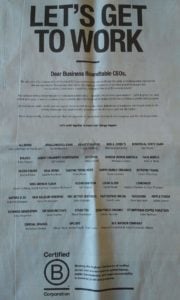
The ad is addressed to Business Rountable CEOs.

We are part of a community of Certified B Corporations who are walking the walk of stakeholder capitalism…We operate with a better model of corporate governance—benefit corporate governance—which gives us, and could give you, a way to combat short-termism and the freedom to make decisions to balance profit and purpose.

Among its food company signers are Ben & Jerry’s, Cabot Creamery Cooperative, Danone North America, King Arthur Flour, Sir Kensington’s, Stonyfield Organic, and Stumptown Coffee (there are others, as well).

I read this as a challenge: if the Business Rountable CEOs are serious about ensuring as B Corporations do, that “the purpose of capitalism is to work for everyone and for the long term,” why don’t they start by becoming B Corporations?

Until they do, the Business Roundtable statement is smoke and mirrors, to distract us from the damage the corporations are doing to our society and to our democratic institutions.

Jan 15 2019

Coca-Cola’s political influence in China: documented evidence

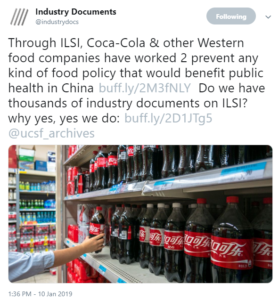
The BMJ (the new name for what was formerly the British Medical Journal) has just published a report by Susan Greenhalgh, an anthropologist and China specialist at Harvard, of how Coca-Cola, working through the International Life Sciences Institute (ILSI), got the Chinese government to focus its anti-obesity efforts on promoting physical activity rather than dietary changes.

Professor Greenhalgh documented industry influence on Chinese health policy through review of published work as well as interviews with key players in this drama.

A more thorough report of her investigation with details of her interviews was released at the same time by the Journal of Public Health Policy: “Soda industry influence on obesity science and policy in China.”  This report comes with extensive supplemental information about her methods and interview details (these explain why training in anthropology is useful for this kind of work and provides information not otherwise available).

For readers familiar with Coca-Cola’s funding of the Global Energy Balance Network (GEBN), this is a familiar story.

I tell the GEBN story in a chapter in my recently released book, Unsavory Truth: How Food Companies Skew the Science of What We Eat.

One surprise in writing that book was how often ILSI turns up in its pages.  ILSI positions itself as an independent “nonprofit, worldwide organization whose mission is to provide science that improves human health and well-being and safeguards the environment,” but it was founded by Coca-Cola and is largely supported by food and beverage companies.  It works in many countries to promote food-industry interests.

Greenhalgh’s articles thoroughly expose how this organization accomplishes its objectives.  If you would like to know more about it, UCSF Food Industry Documents Library can help, as I learned about from this tweet.

Greenhalgh’s investigation has received extensive press coverage.

I was particularly interested in the account by Crossfit’s Derek Fields and Russ Greene, which provides further documentation of the close connections between Chinese health agencies, ILSI, and programs funded by Coca-Cola.

Jul 25 2018

Eat less meat: more evidence from climate change and health

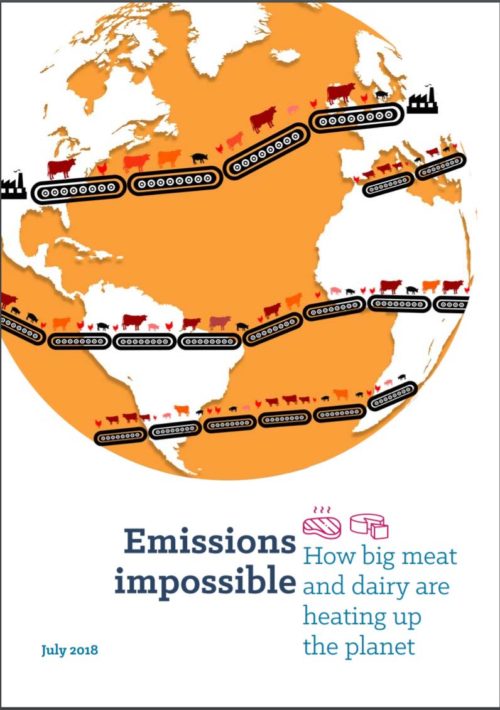
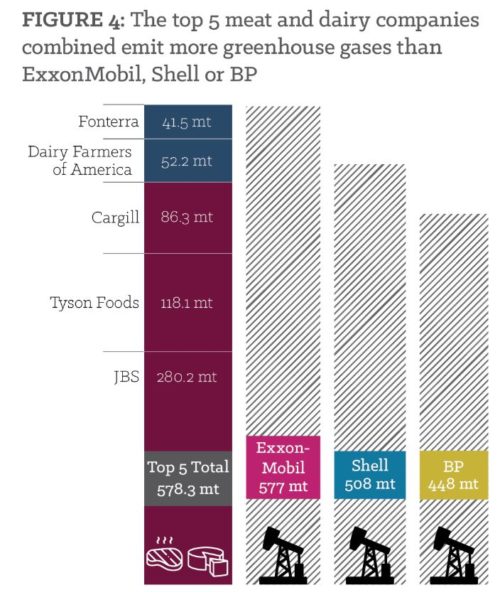
GRAIN and the Institute for Agriculture and Trade Policy (IATP) have issued a devastating report on the effects of meat and dairy production on climate change.


The report’s principal finding:

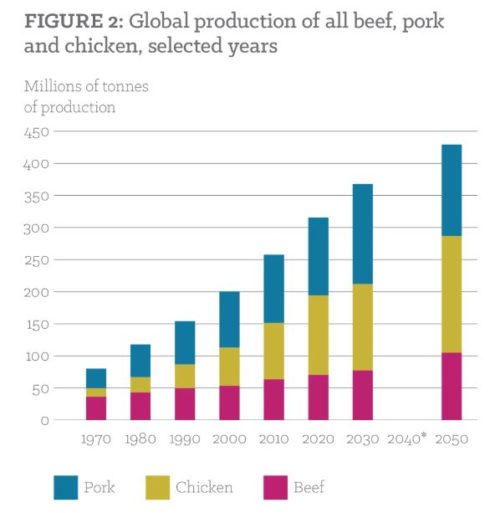
At issue are demands for growth in the meat and dairy industries.

The report explains:

Current industrial levels of production cannot be sustained, nor can growth models for meat and dairy remain unchanged. The paradox of the corporate business model based on high rates of annual growth versus the urgent climate imperative to scale back meat and dairy production and consumption in affluent countries and populations is untenable.

Its inevitable conclusion:

cheap meat and dairy comes at a high cost due to social, environmental and animal welfare problems that continue to be under-regulated. In addition, this production is only made possible because the corporations receive an indirect subsidy from taxpayers in the form of government-funded price supports that keep grain cheap.  

It is past time to regulate the industry and redirect the massive subsidies and other public expenditures that currently support the big meat and dairy conglomerates towards local food and farming systems capable of looking after people and the planet.

That’s the challenge.  The need to address it is urgent.  Let’s get to work.

Also see:

Meat consumption, health, and the environment.  Science July 20, 2018.  Authors: H. Charles J. Godfray, Paul Aveyard, Tara Garnett, Jim W. Hall, Timothy J. Key, Jamie Lorimer, Ray T. Pierrehumbert, Peter Scarborough, Marco Springmann, Susan A. Jebb.

This lengthy, extensively illustrated and referenced article covers much of the same territory but with greater emphasis on the health impact of meat consumption, and the amounts of water used in meat production, primarily from feed.

Jun 20 2018

Not-so-smart snacks for kids

I am ever indebted to Dr. Yoni Freedhoff, the Canadian obesity specialist, for keeping a sharp eye out for the more amazing ways food companies push junk foods.

Check out his Weighty Matters blog.  This particular post describes the “Smart Snacks” for kids endorsed by the Alliance for a Healthier Generation, founded by the American Heart Association in partnership with the Clinton Foundation and the Robert Wood Johnson Foundation.

Check out Freedhoff’s selection of “Smart” items drawn from Amazon’s more complete list of Alliance-endorsed items.  Here is his first example (but don’t miss the others):

These are all junk foods tweaked to make them slightly less junky, thereby raising the questions I always like to ask in these situations: Is a slightly better-for-you product necessarily a good choice?

I’ve written about the Alliance’s partnerships previously.  As Freedhoff explains,

In case you’re not familiar with it, the Alliance For A Healthier Generations is the name given to the partnership program founded between the American Heart Association, The Clinton Foundation, and The Robert Wood Johnson Foundation with pretty what at first glance looks like pretty much every food industry corporation on earth…[this] is a partnership with the food industry whose job is to promote sales, not to protect health.

Freedhoff asks:

How is it possible that the American Heart Association, The Clinton Foundation, and The Robert Wood Johnson Foundation would describe a child washing down a bag of Doritos or a Pop-Tart with a can of Diet Coke as them consuming a Smart Snack?

The American Heart Association should not be a participant in this Alliance.  The “Smart Snacks” program’s endorsement by the Alliance covers these particular products but, by extension, the rest of those companies’ products—and the companies that make them.

Oct 25 2017

Farewell to GIPSA and bad news for family farmers

Last week, the USDA withdrew its Farmer Fair Practices Interim Final Rule (a.k.a. the GIPSA—Grain Inspection, Packers & Stockyards Administration—rule).

The USDA announced this rule at the end of 2016 with great fanfare but, as I explained last April, then delayed it under pressure from the meat and poultry industries.  Now those industries have succeeded in getting rid of it.

The official explanation?  “Serious legal and policy concerns related to its promulgation and implementation.”

Oh, please.

According to last year’s USDA, the new rules would have leveled “the playing field for farmers by proposing protections against the most egregious retaliatory practices harming chicken growers.”  Without this rule, family farmers have little defense against the mean and unfair practices of meat packers and poultry dealers.

Senator Chuck Grassley (Rep – Iowa) minces no words: The USDA is “just pandering to big corporations. They aren’t interested in the family farmer…The USDA is the U.S. Department of Agriculture, not the U.S. Department of Big Agribusiness.”

Told by Agri-Pulse of USDA’s decision to withdraw the rule, Sen. Grassley said he “violently opposed USDA’s decision to withdraw the rule:

If they would know how some of these people are treated that contract with these big multi-corporations, they wouldn’t be withdrawing that,…They’re just pandering to big corporations. They aren’t interested in the family farmer…Everybody thinks draining the swamp is firing a whole bunch of congressmen and a whole bunch of bureaucrats; it’s changing the culture of the bureaucracy…This is a perfect example of a swamp that’s being refilled by withdrawing these rules.

What happens now?  More than 200 agriculture groups signed a letter to key ag-state lawmakers asking for more market transparency and anti-trust protections.

Will such calls grow?  I certainly hope so.

For further reading

May 4 2016

Big Ag forces firing of long-time Farm News cartoonist

I love cartoons (witness Eat, Drink, Vote: An Illustrated Guide to Food Politics) and was appalled when I read this tweet:

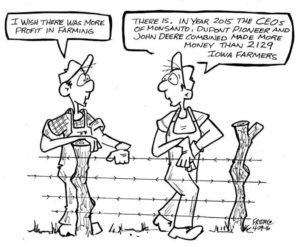
Here’s the offending cartoon:

In a Facebook post the cartoonist, Rick Friday, explained:

I am no longer the Editorial Cartoonist for Farm News due to the attached cartoon which was published yesterday. Apparently a large company affiliated with one of the corporations mentioned in the cartoon was insulted and cancelled their advertisement with the paper, thus, resulting in the reprimand of my editor and cancellation of It’s Friday cartoons after 21 years of service and over 1090 published cartoons to over 24,000 households per week in 33 counties of Iowa.

I did my research and only submitted the facts in my cartoon.

That’s okay, hopefully my children and my grandchildren will see that this last cartoon published by Farm News out of Fort Dodge, Iowa, will shine light on how fragile our rights to free speech and free press really are in the country.

The Des Moines Register explains further:

The CEOs at the ag giants earned about $52.9 million last year, based on Morningstar data. Monsanto and DuPont, the parent of Johnston-based Pioneer, are large seed and chemical companies, and Deere is a large farm equipment manufacturer.

Profits for the three companies, all with large operations across Iowa, also have declined as farm income has been squeezed. After peaking in 2013, U.S. farm income this year is projected to fall to $183 billion, its lowest level since 2002.

US Uncut adds more details:

Friday received an email from his supervisor at Farm News, informing him that he would be fired, citing he was “instructed” by a superior to not accept another cartoon from Friday. The supervisor told Friday that “in the eyes of some, Big Ag cannot be criticized or poked fun at.”

It also published Friday’s cartoons based on his firing.  Here’s one:

Friday has done other cartoons like this.  It’s not surprising that he has corporate advertisers upset.

How to help? Consider a quick note to Farm News about how badly Americans need a free, independent press to discuss farm issues.

Here’s the publisher’s contact information:

Larry Bushman
lbushman@messengernews.net

(Thanks to Daniel Bowman Simon for keeping me up on such things.)

Addition, May 5: Friday’s view of all this.

Aug 29 2014

Global Nutrition Report: How US Citizens Can Hold Government Accountable for Preventing Malnutrition

Lawrence Haddad, senior researcher at the International Food Policy Research Institute (IFPRI), invited me to comment on how to strengthen accountability in the fight against malnutrition in the United States.

This is a contribution to the Global Nutrition Report, a project chaired by the Governments of Malawi and the UK as an outcome of the 2013 Nutrition for Growth Summit in London.

My comments are in response to this specific question:

Q.  How can citizens of the United States hold their government accountable for preventing and reversing malnutrition?

A.  This question has no easy answer.  To begin with, we see practically no cases of severe undernutrition among U.S. citizens, in the sense that it occurs in the developing world.  Only rarely, do adults or children exhibit overt clinical signs of vitamin or mineral deficiency, let along acute malnutrition.  Instead, in America we talk about “food insecurity,” defined by government agencies as consistent, dependable, legal access to enough food on a daily basis to support active healthy living.

The U.S. Department of Agriculture (USDA) monitors the extent of food insecurity among the population in two ways.  It counts the number of individuals who apply and qualify for participation in the Supplemental Nutrition Assistance Program (formerly known as Food Stamps), and it collects data from surveys and publishes the results in annual reports on Household Food Security.  By both measures, nearly 15 percent of the U.S. population is judged to be food insecure—one out of every six adults.  Nearly six percent of the population is considered to be severely food insecure and, therefore, at risk of malnutrition but not necessarily displaying clinical signs.

Americans who qualify as food insecure are more likely than average to be poor, single parents, African-American or Hispanic, and living either in large cities or in rural areas.  They also, paradoxically, are more likely to be overweight or obese.  An explanation for the lack of clinical signs of malnutrition and of overweight is that nearly 60 percent of those considered food insecure participate in one or more of the three largest federal food and nutrition assistance programs (SNAP, the Special Supplemental Program for Women, Infants, and Children or WIC, and National School Lunch Program.  An unspecified percentage also obtains free food from privately run charitable food banks or soup kitchens. As the USDA likes to explain, its 15 domestic food and nutrition assistance programs “form a nutritional safety net for millions of children and low-income adults” and account for more than 70 percent of USDA’s annual budget.

What the USDA says less about is the quality of that food.  SNAP has minimal limitations on what can be purchased with benefits, and retailers lobby hard to make sure program participants can continue to buy cheap, high-calorie foods and beverages.  WIC, in contrast, permits purchase of a limited number of foods meeting certain nutrition standards.  Recently, school meals have been required to meet nutrition standards, but these too are under lobbying pressure by food companies.

Because of the high cost of these programs—SNAP alone costs taxpayers $80 billion a year—arguments about what to do about food insecurity come down to matters of money.  They only rarely focus on ways to ensure that even the poorest Americans get enough food to eat, let alone healthy food.  Accountability, therefore, must confront the views of many congressional representatives that assistance programs represent “nanny-state” government and induce dependence among recipients.

Given this situation, American anti-hunger advocates are limited in what they can expect to accomplish in the current political era.  As one sympathetic Congressman, Jim McGovern (Dem-MA) once explained, hunger does not resonate with Congress.  Because the government already monitors food insecurity, the next steps must aim to get it to do something about the problem.  This means reducing poverty and income inequities (which in part means reducing educational inequities, providing a stronger safety net for single parents and those living in cities and rural areas, and reaching out to the 40 percent of people who qualify as food insecure but receive no federal food or nutrition assistance benefits.  It also means bringing anti-hunger and anti-obesity together to support healthier food options for low-income Americans.

All of this will cost money at a time when the interest of Congress in food assistance is only as a means to cut benefits.  This, in turn, means that the only way to fix the hunger problem in the United States is to change election campaign laws so that individuals who care about such issues have a chance of being elected.   Recent decisions of the Supreme Court in Citizens United and in McCutcheon make it clear that it favors no or insignificant limits on campaign contributions for corporations or wealthy individuals.    The one bright spot is the national movement that has emerged to obtain a raise the minimum wage, especially for restaurant and farm workers.  Most recipients of federal food assistance are employed, but at wages too low to bring them out of poverty.  Paying living wages would solve most problems of food insecurity in America.


Apr 1 2014

Call for ideas: Do government policies promote obesity? How?

Nicholas Kristof of the New York Times recently devoted a column to an analysis of who really gets welfare in the United States.  He listed policies that favor not only the wealthy, but the fabulously wealthy:

  • Subsidies for private airplanes via tax write-offs and deductions
  • Tax deductions for private yachts
  • Tax deductions for hedge funds and private equity
  • Bank rescues
  • Incentives to operate locally

His column reminded me of one written in 2005 by Sean Faircloth, then a Maine State representative, “Six ways government promotes obesity and what to do about it.”

No government, Faircloth said, could have devised more effective policies for reducing physical activity and promoting junk food.  Taxpayers, he pointed out:

  • Subsidize oil companies and cars to the detriment of trails and sidewalks.
  • Make it impractical to get basic information in foods and restaurants (menu labeling regulations: where are you?).
  • Give large corporations free reign to market to children.
  • Allow soda and snack-food companies to market products in schools (USDA is trying to change this).
  • Direct billions in subsidies toward processed foods while neglecting fresh produce.
  • Promote high-calorie foods in programs for poor people.

I thought this was an interesting way of thinking about obesity policy and over the years have added these:

  • Allowing marketing costs to be deducted from taxes as business expenses
  • Bans on lawsuits against food companies
  • Ambiguous and obfuscating dietary guidelines (e.g. SoFAS in the 2010 edition)

No doubt there are others.

Can you think of any others?  Thanks.