What is likely to be the effect of yesterday’s Supreme Court decision on food politics? Nothing good.
The decision to overturn limits on corporate campaign contributions will affect every aspect of society, food included. I have long argued that campaign contributions are one of two major sources of corruption in government (the other is the way Wall Street requires corporations to report growth every 90 days).
If we want our congressional representatives to make decisions in the public interest, their election campaigns must be publicly funded. When corporations fund campaigns, representatives make decisions in the corporate interest. It’s that simple.
Those of us who care about creating a good, clean, fair, and sustainable food system will have to work harder now. But I can’t think of any more important work to do to protect our democratic institutions.
The Federal Trade Commission is the third agency dealing with food policies, this time advertising. As I’m fond of saying, the FTC is not exactly a consumer protection agency. Its main purpose is to make sure that businesses stay competitive. In 1978, under the leadership of Michael Pertschuk, the FTC made a valiant attempt to regulate food marketing to children. That disaster, which I have discussed in previous posts, kept the FTC from doing anything about marketing to kids – until recently.
On December 15, it is holding a forum on food marketing to children in Washington, DC. Here’s the agenda and information about registration. They will also do a webcast linked to that site.
But that’s not all the FTC is doing. It had so much fun trying to get information from food companies about their marketing-to-kids practices that it is trying the same thing with quick service and fast food restaurants. The FTC says it is seeking “Information from those companies concerning, among other things, their marketing activities and expenditures targeted to children and adolescents and nutritional information about the companies’ food and beverage products marketed to children and adolescents.” This sounds easy, if a bit confusing, but my guess is that the FTC will have to pull teeth to get it.
In the meantime, a few comments have already been filed in response to the notice. The ones from industry are predictable: too expensive! Too difficult! My guess is that they have this information readily available but are embarrassed to reveal it. Why? It undoubtedly will show that the companies spend the most money on the junkiest (and most profitable) products.
Michael Pertschuk, by the way, is still going strong. In June, he wrote an article on the FTC for The Nation. His article has much to say about the way the FTC is operating these days and is well worth a look. As he explains, the FTC was
created in 1914 during the Progressive Era, [and] was endowed with a potent authority for promoting competition and consumer protection that it has never fully used. This includes investigative authority over virtually all businesses, backed by subpoena power and the capacity to demand reports of data that corporations would rather withhold from public view…For the first time in decades, the Senate and House authorizing and oversight committees and the judiciary committees are pressing the agency to act more aggressively on the consumer-protection and competition fronts and are prepared, as needed, to strengthen its enforcement powers….But Congress needs to take action to unleash the FTC’s full potential. First, it remains a small agency with broad and complex responsibilities and cumbersome procedural burdens, especially in rule-making. Here, the FTC’s champions in Congress can make certain that Congress supplies more resources and streamlines the FTC’s authority. The agency also has a chronic problem of setting priorities: wherever it turns, there are corporate malefactors, large and small, deserving of prosecution.
But read the whole thing and see whether you think his optimism is justified. Better yet, go to the workshop on the 15th!
This page is somewhat disorganized in that I now put occasional print, audio, and video interviews, which used to be separated, together by year. The section at the very end is called Controversies; it is where I post letters from critics. Scroll down to find whatever you are looking for. Media interviews and reviews for specific books are on the page tabs for that book. For old podcasts and videos of presentations, look under Appearances and scroll down for Past Appearances; in recent years, I’ve been putting them in the chronological list here.
Interviews, media appearances, and lectures: print, audio, and video (the ones for which I have links)
Nov 28 This video about sugar in soft drinks was just posted on Twitter (X) but its YouTube listing says 7 years ago, when I was on a Fulbright in Mexico in 2017.
Jan 17 Podcast interview with Kathlyn Carney, Connecting the Dots. Lisen on Spotify or Apple Podcast
Jan 16 LA Times guide to Japanese subscription snack boxes (Video Part I). Part II is Jan 23 (same clip?)
Jan 14 The Franklin Institute’s Ben Franklin Birthday celebration. My talk comes first. Others are from Eric Oberhalter and honoree Wendell Berry. Use passcode $H81iALu
Jan 15 Two short answers to questions at FAO’s Regional Office in Santiago, Chile. Video 1: on what governments can do about childhood obesity. Video 2: on food choices in an unhealthy food environment.
July 5 Goldberg R. Food Citizenship: Food System Advocates in an Era of Distrust. Oxford University Press. Chapter 1. Health and Nutrition: Interview with Marion Nestle:1-13. Video online
July Carter J. Interview with Marion Nestle. In: Food for Thought: Feeding the People, Protecting the Planet. Aspenia [Aspen Institute Italia] 2015;67:101-105.
July Carter J. Intervista a Marion Nestle. Come cambiano le politiche alimentary. In: Fame Zero: Rinascimento agricolo. Aspenia [Revista di Aspen Institute Italia] 2015;69:198-202.
January 10 Video interview on Star Talk, co-hosts Neil DeGrasse Tyson and Eugene Mirman, with Anthony Bourdain, about the science of cooking (sort of).
May 21 Print interview with Revital Federbush for an Israeli women’s magazine, mostly about dairy foods I’m told (it’s in Hebrew, which I cannot read, alas).
November 19 Interview with Al Jazeera for a Fault Line program on “Fast food, fat profits: obesity in America (my 10 seconds starts at about minute 15).
September 16 Speech at Columbia University conference on Global Food Systems: Their Impact on Nutrition and Health for All on panel on Advanced Technologies, Food Safety and the Role of Local and Organic Food Production (video)
November 12 Panel discussion on the farm bill, Wagner School of Public Service, Puck Building (Lafayette at Houston), 2nd floor. Here is Wild Green Yonder’s take on it.
February 6, 2008 Biologique Foods radio, two podcast interviews with TJ Harrington in Bloomington, MN, one on food politics and the other on what’s in your food.
Interview with Laura Flinders (and Arun Gupta and Peter Hoffman), Grit TV. It’s on how to eat well without going broke, and starts with a Monty Python clip on Spam 11/26/08
September 5, 2007 Scientific American Podcast with Steve Mirsky. Because I am a Paulette Goddard professor at NYU, he sends along an article he wrote about Einstein’s experience with the gorgeous movie star.
NPR Science Friday, panel on the farm bill with Michael Pollan and Sandor Ellix Katz 8/10/07
Are you responsible for your own weight? Balko R. Pro: Absolutely. Government has no business interfering with what you eat. Brownell K, Nestle M. Con: Not if Blaming the Victim Is Just an Excuse to Let Industry off the Hook. Time June 7, 2004:113.
Bottled water is the target of environmental campaigns in the U.K as well as the U.S. My namesake, the Nestlé Corporation, appears to be under particular attack. Acording to the British government, tap water “requires 300 times less energy than bottled water and does not create bottled packaging waste.” I wonder how the company plans to rebut that argument.
Beef and pork are notable exceptions to these laws. And that may help to explain why President Trump signed a proclamation last month that will allow the duty-free importation of about 660 million pounds of inexpensive beef.
If American consumers knew where that beef was coming from, they might not want to eat it.
As he explains, this beef is trimmings, possibly stored frozen for years, intended to be added to ground beef to adjust the fat content.
He lists the food safety scandals around such trimmings.
China rejected two shipping containers of beef from Uruguay after finding residue of an anti-parasitic drug in the meat.
China rejected beef from Argentina reportedly because it tested positive for a banned antibiotic that can cause serious blood disorders.
Brazilian federal police raidednearly 200 meatpacking plants after allegations that government inspectors and politicians were being bribed to allow the sale of contaminated beef.
As for why President Trump allowed this, against the wishes of the US beef industry:
“Regime Change,” the recent book by the Times reporters Maggie Haberman and Jonathan Swan, contains an interesting clue: a White House meeting last November between President Trump and Joesley Batista, whose family controls JBS…Mr. Batista gained the White House meeting last November, Ms. Haberman and Mr. Swan wrote, because of his friendship with Melania Trump. In addition, a JBS subsidiary had donated $5 million to Mr. Trump’s second inauguration, the largest gift from any individual or corporation.
The one thing that makes a hamburger safe is 160°F, measured with a thermometer. Buy from your butcher if you want to know where your beef came from. Then cook it to 160 anyway.
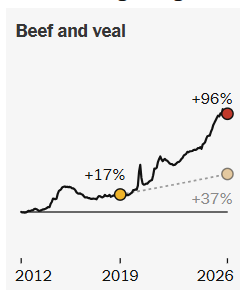
And then, of course, there’s what’s happening to beef prices. You might feel better about this if you knew the beef was raised here and was safe.
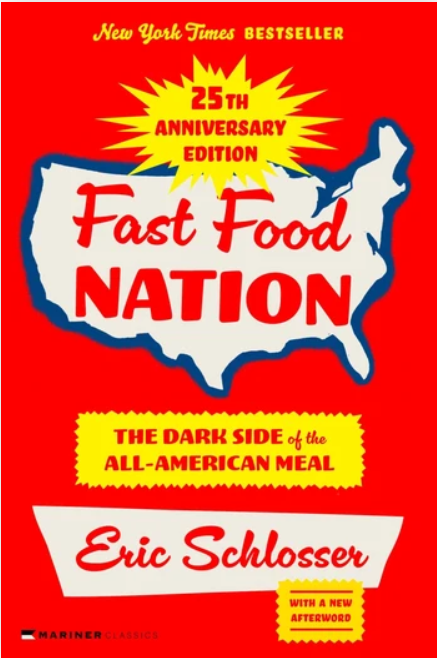
It’s hard for me to believe it’s been 25 years since this book first appeared, but 25th anniversary editions of my Food Politics and Michael Pollan’s Omnivore’s Dilemma are also in the works.
The book is about the beef industry and what it does to the animals, packing house workers, the environment, and human health.
Eric Schlosser wrote a new Afterword for this edition.
Here are two excerpts.
As of this writing…highly pathogenic avian influenza (H5N1) has not yet caused a deadly epidemic among human beings. Pasteurization kills H5N1 in milk, and the virus hasn’t yet mutated to become for contagious or more lethal. But H5N1 has become endemic among wild birds, chickens, turkeys, and dairy cattle in the United States, allowing a continual mixture of its genes. A bird flu epidemic that kills millions of people may never emerge from America’s factory farms—or it may next week, next month, next year. The industrialization of livestock, the transformation of sentient creatures into commodities, and the absence of government oversight have created an efficient system for creating dangerous new pathogens. As this book argued twenty-five years ago, that’s the price we pay for cheap meat. That price doesn’t appear on the menu. (p. 312)
Economists often use the four-firm concentration ratio as a measure of the competition in a market for goods and services. When four companies gain a combined market share of 40 percent or higher, an oligopoly has formed. The prices offered to suppliers, the prices charged to consumers, and the wages paid to workers are no longer determined mainly by market forces. A handful of companies have gained control of the market. Effective government regulation becomes more difficult, as state and federal agencies readily become “captive” to the corporations they’re supposed to oversee. Today, four companies control about 60 percent of the worldwide market for seeds and 61 percent of the market for pesticides. Four companies control about 70 to 90 percent of the worldwide trade in grain. Four companies are responsible for processing about 70 percent of America’s hogs and 85 percent of its cattle.
This book kicked off the food movement 25 years ago. If you haven’t read it, now is the time. We need it more than ever.
As should be obvious, I have had a hugely fortunate life.
I was born into a poor family but came of age during the now-understood-to-be-unique period between the end of World War II and the election of Ronald Reagan. Then, a university education was essentially free; I paid $32 per semester in fees to the University of California Berkeley. Housing was affordable; the first house I bought cost $14,500. Anyone with a modest academic salary could expect to lead a solid middle-class life. And for women, doors were beginning to open.
I was in graduate school in the early 1960s, a time when we thought we were changing the world. We were going to end the war in Vietnam, end poverty, obtain civil rights, get equity for women, protect the environment, end injustice, curb corporate power. We could see these changes happening. The future was going to be better, and for everyone.
That was my normal. I had no idea how unusual that 30-year period would turn out to be, or how powerful the backlash against it.
I was lucky enough to find work—teaching, writing, speaking—that I found deeply engrossing, stimulating, and rewarding. I still do.
As for my ability to continue to do these things? Good nutrition, of course, And even more luck.
My book, Food Politics, turns 25 next year and I recently submitted a new Preface and Afterword for its 25th anniversary edition (forthcoming, February 2027).
Here is how I ended the Afterword:
I am often asked how I remain hopeful in the light of the food industry’s power to control and corrupt government. My answer: the food movement. I see its effects everywhere. Healthier foods are more widely available than when Food Politics first appeared. Increasing numbers of people, old and young, care about food issues and want to improve the food system. Every place I travel, I see more schools serving healthier and better-tasting meals, more farmers’ markets, more young people wanting to farm, more concern about humane farm animal production, more backyard chickens and urban gardens, and more attention to local, seasonal, and sustainable food. Most gratifying, more people understand the politics. A quarter century ago, I could not use the word “capitalism” in class or lectures without turning off the room. Now when I talk about food system problems, someone invariably challenges me: “but aren’t you talking about capitalism?” Yes, I am, and late-stage capitalism at that.
When my NYU department started food studies programs in 1996, we were virtually alone.[i] Today, colleges and universities host food programs and courses in practically every department and unit, all teaching students how to think critically about—and engage in—the country’s most pressing economic, political, social, and health problems. Food issues are a lens into those problems. They are high on the agendas of local, state, national, and international governments. The media cover agriculture, food, and nutrition extensively and, as a reporter once told me, command so much national attention that food issues constitute a Full Employment Act.
I especially see hope at the grassroots level. Many communities are engaged in efforts to improve school meals, reduce childhood obesity, align agricultural production with health goals, and make healthier food more available and affordable for all. Advocates are increasingly learning and following well-established strategies for achieving social change. To the extent they do, they have a good chance at success.[ii]
Today’s challenge is to take advocacy to the national level. If I could wave a magic wand, here is what I would do to make healthy food choices more available, accessible, affordable, and desirable—the default—and not only in the United States.
Conduct ongoing national education campaigns to promote healthful choices.
Refocus agricultural production subsidies on food for people rather than feed for livestock animals and ethanol and diesel fuel for cars and airplanes.
Increase taxes on unhealthful foods and support lower prices for healthful foods.
Restrict marketing of unhealthful foods and promote marketing of healthful foods.
Enact a universal basic income program so everyone can afford to eat healthfully.
Enact a universal school meals program—with adequate funding—so all children have access to healthful breakfasts and lunches.
Overturn Citizens United and get money out of politics.
Reform Wall Street to require corporations to provide benefits to their workers, communities, and society as well as to stockholders.
These ideas may sound like pie in the sky, but I deeply believe that setting goals—even those that seem highly unattainable—is a useful public health strategy. Unrealistic goals can educate, expand expectations, promote critical thinking, motivate action, attract resources, and encourage accountability. Sometimes, with skill and luck, they can even be achieved.[iii] Efforts to create better and more equitable food systems are prime expressions of democracy in action—of the people, by the people, for the people. They are well worth engagement, advocacy, and activism, and deserve everyone’s support.
Notes
[i] Bentley A, Parasecoli F, Ray K, eds. Practicing Food Studies. New York: NYU Press, 2024.
[ii] Bobo KA, Max S, Bobo K, et al. Organizing for Social Change: Midwest Academy Manual for Activists. New York: Seven Locks Press, 2001.
[iii] Eyal N, Sjöstrand M. On knowingly setting unrealistic goals in public health. Am J Public Health 2020;110(4):480–484. doi: 10.2105/AJPH.2019.305428.
I am outraged by the Cyclospora outbreak. It has sickened thousands of people so far (>16,000?), and made some of them very sick.
Cyclospora is different from other foodborne pathogens. It comes from human waste and cannot be removed by washing (although that helps some) or killed by chlorine. It can only be removed by microfiltration or killed by heat or, maybe, ultra-violet radiation.
It needs to prevented from getting into irrigation water.
Lettuce producers have known about the Cyclospora hazard for more than a decade. They have not acted, and neither has the government.
This outbreak is remarkable, not only for the large number of people affected, but also because of the inadequate, delayed, and chaotic oversight and response.
The DOGE-decimated CDC only issued its first health advisory two weeks after cases were reported, provides much less information than it used to, and is way behind on its tracking.
Yes, Cyclospora is hard to investigate. Symptoms do not occur for days or weeks after eating contaminated food. This means the evidence was eaten or destroyed long before anyone got sick.
Food Safety Rules
Everyone who produces food is supposed to assess the production procedures for places where contamination can occur, take steps to prevent contamination at those places, monitor to make sure the steps were taken, and test to make sure the procedures are working. The FDA is supposed to inspect to make sure all his is happening.
If vegetable producers took appropriate steps, contamination risks would be much lower.
But if there is no federal oversight, no inspection, and no punishment for producing unsafe food, producers won’t bother.
They particularly will not bother to test the irrigation water. Producers hate testing. If they find something, they have to issue recalls. These are complicated and expensive.
The fact that lettuce from one farm or one shredding facility could possibly have sickened thousands demonstrates the dangers of concentrating food production among a few large corporations. But the risks of corporate power run even deeper. Taylor Farms and other large produce corporations have long exerted political power to weaken food safety regulations, contributing to crises like this one. Taylor Farms representatives even met with the White House last week in an effort to distance the company from the outbreak…Recent budget cuts to federal and state health agencies further diminish the government’s ability to hold corporations accountable and protect consumers…
This will be a moderated discussion with Debbie Stabenow, who will receive the Carver-Carson award that evening, for members of the Carver-Carson Society.