by Marion Nestle

Search results: tobacco

Apr 3 2026

Weekend reading: AI’s analysis of soda and alcohol marketing on social media

Vital Strategies has just released two of its Canary platform reports based on use of AI.  Here’s its webinar.

The findings:

  • During the 2025 FIFA Club World Cup (June 14-July 13), Coca-Cola branding appeared in 795 social media posts, generating an estimated 6 billion impressions globally.
  • In March 2025 alone, digital alcohol marketing appeared in nearly 4,000 posts generating close to 2 billion impressions.
  •  79% of Coca-Cola-linked posts came from sports broadcasters, with branding visible in match highlights, celebrations and interviews, including those featuring child athletes such as the Powerade Ball Crew.
  • Alcohol brands amplified reach through influencers and major cultural moments like Carnival, partnering with celebrities such as Luísa Sonza and Anitta to reach tens of millions of followers via their social channels.

Why should we care?

Research shows that such marketing influences consumption. Children exposed to high volumes of digital marketing for unhealthy food and sweetened beverages may develop unhealthy habits for life. Alcohol advertising is linked to earlier initiation, binge drinking and increased consumption.

Two examples

  • In the Philippines, Red Horse Beer ads deployed cartoon imagery reminiscent of tobacco’s Joe Camel to appeal to younger audiences—despite carrying small-print “For 18 years old and above only” warnings.   Source: Red Horse Beer on Facebook
  •  San Miguel Flavored Beer—available in sweet flavors like apple and chocolate designed to mask the taste of alcohol—markets itself around music festivals through the language of friendship and self-expression, embedding the brand into youth identity and inviting attendees to make “#Sweeeet memories” with their “beshies.” Source: @sanmiguelbeerph on Instagram  

Bottom line: These reports provide further evidence for the need for marketing regulation and policies such as taxes on unhealthy products.
Mar 13 2026

Weekend reading: the debate about ultra-processed foods

In a previous post, I wrote about the series of papers on ultra-processed foods published in The Lancet (I am a co-author on papers II and III)

As might be expected, the papers generated a fair amount of discussion and debate.  The Lancet has now published five letters raising issues about the series, along with a letter of response (which I signed).

Here are the letters:

I.  Ultra-processed foods in research and policy.  David Ludwig argues that the Nova classification of food procesing is imprecise and ideological.

II.  Ultra-processed foods in research and policy:  Dirk Jacobs and Rafael Sampson say the papers look like a campaigning platform to shut down criticism and reject expertise out of hand.

III.  Ultra-processed foods in research and policy:  Gunter Kuhnle says the papers give “insufficient attention to the central methodological challenge of this field: the assessment of UPF intake itself,” a concern because “most of the evidence against UPF relies on observational data.”

IV.  Ultra-processed foods in research and policy: Tatiana Campos and Aintzane Esturo, representing the International Fruit and Vegetable Juice Association, disagree with the classification of reconstituted fruit juices as ultra-processed; they say the juices should be classified as unprocessed or minimall processed (Nova 1, not Nova 4).

V.  Ultra-processed foods in research and policyLilian dos Santos Raha,  Patrícia Chaves Gentil, Gisele Ane Bortolini, Felipe Silva Neves, and Bruna Pitasi Arguelhes point to actions in Brazil that offer “a blueprint for translating these recommendations into binding regulation.”

And here is Ultra-processed foods in research and policy – Authors’ reply   (full text)  Note: I am a co-author.

We thank the authors for their comments and interest in our Series on ultra-processed foods (UPFs) and human health.
We acknowledge David S Ludwig’s concern about the limits of any single classification system. The Nova framework does not replace nutrient science, but adds a complementary layer focused on food processing as a determinant of dietary patterns. Foods, nutrients, additives, and food matrices all matter, and the second Series paper explicitly proposed that all regulations should combine criteria on crucial nutrients with markers of food ultra-processing, rather than treating processing as a stand‑alone metric. Importantly, nationally representative surveys from multiple countries show that the dietary contribution of ultra-processed foods (UPFs) is the main driver of nutrient-imbalanced diets. For example, in the USA, 92·4% of diets excessive in added sugar, saturated fat, energy density, and insufficient in fibre are attributed to UPF consumption. UPFs, therefore, function not as an ideology but as structural drivers of dietary nutrient imbalance, as well as of other determinants of ill health including overeating, exposure to harmful additives and contaminants, snacking, and other harmful eating patterns. Nova explains dietary patterns in ways that nutrient-centric models alone cannot. Critiques based on isolated UPF products overlook the logic of dietary displacement and the relevant counterfactual: fresh and minimally processed foods and cooked meals. We have recently explained why UPF subgroup analyses suggesting differential health effects are conceptually and methodologically flawed, undermining the credibility of nutrition science and risking policy misinterpretation.
Rafael Sampson and Dirk Jacobs of FoodDrinkEurope characterise the UPF industry and industry-funded scientists as impartial brokers of evidence and argue that proposals to limit corporate influence go too far. FoodDrinkEurope’s membership includes many of the world’s largest UPF manufacturers and lobby groups, and the organisation is within a broader network of corporate interest groups that have actively promoted misinformation about Nova and the evidence on UPFs. Based on decades of evidence from food, tobacco, alcohol, and fossil fuel research, we question the credibility of industry-funded science when commercial imperatives conflict with public health goals. Transparency alone is insufficient. The empirical literature shows that disclosure does not neutralise bias, nor prevent the strategic use of funding to manufacture doubt, delay regulation, and frame debate in industry-favourable terms. Safeguards against conflicts of interest are pro-science, not anti-science. Editors exclude conflicted reviewers, governments restrict lobbying, and ethics committees limit funding sources for precisely these reasons. Food and nutrition research should be no exception.
We agree with Gunter G C Kuhnle that evidence on the harms of UPFs was generated using dietary instruments not designed to capture Nova groups. However, exposure misclassification is likely non‑differential in regard to outcomes, and therefore bias associations towards the null. As dietary tools for assessing food consumption aligned with Nova are adopted, associations strengthen rather than weaken. Misclassification has a greater effect on UPF subgroup analyses than on UPF-pattern analyses. Aggregating all UPFs partly mitigates food‑level measurement error, whereas attempting to distinguish fine subgroups with imperfect instruments amplifies instability, multiple testing, and false positives.
Tatiana Campos and Aintzane Esturo argue that reconstituted fruit juices should be treated as minimally processed. These products differ in matrix integrity, intrinsic fibre, and typical consumption patterns. Concentration, storage, reconstitution, and flavour restoration involves losses and reformulation that place these products beyond minimal processing. Some UPFs might perform better than others in specific comparisons, and relative harms might be modest in narrow contrasts. Policy, however, cannot be built on marginal cases. The relevant issue is displacement at scale: when reconstituted juices replace fresh fruit or freshly prepared juices, dietary quality deteriorates.
Gisele Ane Bortolini and colleagues illustrate how Nova can be operationalised in real-world policy. Brazil’s National Food Basket shows that processing criteria can coexist with nutrient standards, procurement rules, fiscal instruments, and broader food‑system policies. This directly addresses Ludwig’s concern that Nova is too imprecise for regulation. In practice, it has enabled coherent, multisectoral action adapted to national context rather than a universal, one‑size‑fits‑all template.
The global shift towards ultra-processed dietary patterns is a preventable driver of chronic disease, and effective policy action should prioritise protecting and restoring diets based on fresh and minimally processed foods and cooked meals. We continue to welcome any scientific inquiry related to the Series that might contribute to strengthening food policies for all.

Competing Interests

The Lancet Series on ultra-processed foods and human health was supported by funding from Bloomberg Philanthropies through a contract with Deakin University and subcontracts between Deakin and the University of Melbourne, University of Sydney, and University of São Paulo. The funder had no role in the study design, data collection, data analysis, data interpreta-tion, or writing of the Series. CAM was part of the team that developed the NOVA food classification system. BMP declares funding from the Eunice Kennedy Shriver National Institute of Child Health and Human Development, the National Institute on Aging, and Bloomberg Philanthropies, and has consulted for Resolve to Save Lives and the World Bank. PB reports funding from an Australian Research Council Future Fellowship awarded by the Australian Government, and from a Sydney Horizon Fellowship awarded by the University of Sydney. All other authors declare no competing interests.  [Note: I was advised not to include mine, since I do not accept funding from food and beverage companies with interests in this topic.  I do, however, earn honoraria for lectures and royalties from books about the politics of food].
References
1. Scrinis, G ∙ Popkin, BM ∙ Corvalan, C ∙ et al. Policies to halt and reverse the rise in ultra-processed food production, marketing, and consumption. Lancet. 2025; 406:2685-2702
Lancet. 2025; 406:2667-2668
Dec 10 2025

San Francisco’s lawsuit against food companies

San Francisco’s city attorney has sued major food companies for marketing ultra-processed foods (UPF) that make people sick.

The lawsuit: COMPLAINT FOR: VIOLATION OF CALIFORNIA UNFAIR COMPETITION LAW AND PUBLIC NUISANCE

The arguments

I. UPF are dangerous: “No reason exists to believe that humans can fully adapt to these products.”

II.  UPF-like tobacco and illegal drugs–are addictive.

  • UPF cause compulsive use in the same ways as other addictive substances
  • UPF are psychoactive substances
  • UPF are reinforcing

III. Defendants designed UPF to be addictive to drive sales and profits.

IV. Defendants have created a public health crisis, especially for children.

V.  Defendants have deliberately targeted kids (harmful dyes, aggressive marketing, disproportionate targeting).

VI.  Defendants actively conceal the dangers of UPF.

VII.  UPF have contributed to a public health crisis in San Francisco.

This one will be fun to watch,

Resources

Dec 9 2025

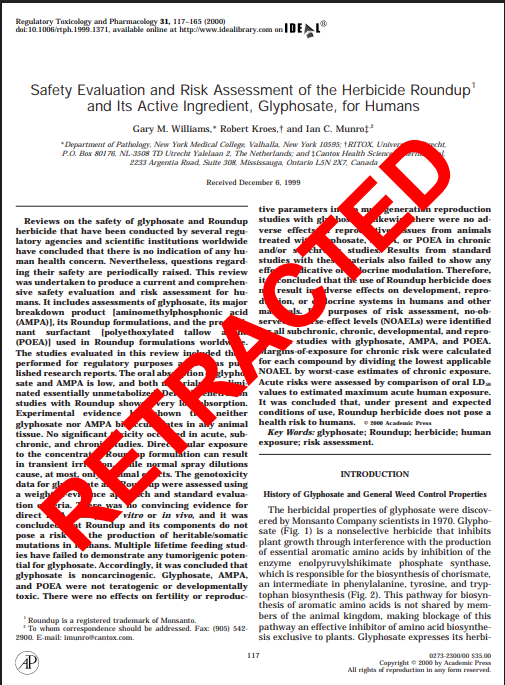
Better late than never: Journal retracts glyphosate study.

There was much fuss last week about the retraction of this highly significant paper about the safety of glyphosate (Roundup), the Monsanto weed killer widely used with genetically modified crops.  As has been suspected for years, it was ghostwritten by Monsanto on cherry-picked data.

The original paper: Safety evaluation and risk assessment of the herbicide Roundup and its active ingredient, glyphosate, for humans. Regul Toxicol Pharmacol. 2000 Apr;31(2 Pt 1):117-65.  doi: 10.1006/rtph.1999.1371.  

Its conclusion: “Roundup herbicide does not pose a health risk to humans.”

The authors thanked Monsanto for generous provision of data.  The acknowledgments did not disclose funding or conflicts of interest.

The retraction notice includes several remarkable statements.

  • The article’s conclusions regarding the carcinogenicity of glyphosate are solely based on unpublished studies from Monsanto.
  • The authors did not include multiple other long-term chronic toxicity and carcinogenicity studies, that were already done at the time of writing their review in 1999.
  • Litigation in the United States revealed correspondence from Monsanto suggesting that the authors of the article were not solely responsible for writing its content. It appears from that correspondence that employees of Monsanto may have contributed to the writing of the article without proper acknowledgment as co-authors.
  • The apparent contributions of Monsanto employees as co-writers to this article were not explicitly mentioned as such in the acknowledgments section.
  • Further correspondence with Monsanto disclosed during litigation indicates that the authors may have received financial compensation from Monsanto for their work on this article, which was not disclosed as such in this publication.

The retraction points out that the article “has been widely regarded as a hallmark paper in the discourse surrounding the carcinogenicity of glyphosate and Roundup…[and] had a significant impact on regulatory decision-making regarding glyphosate and
Roundup for decades.”

Yikes.

Much of this was discovered as a result of litigation.  Do not miss this analysis by Alexander Kaurov and Naomi Orestes: The afterlife of a ghost-written paper: How corporate authorship shaped two decades of glyphosate safety discourse.  Environmental Science & Policy Volume 171, September 2025, 104160

Litigation in 2017 revealed that Monsanto ghost-wrote an influential 2000 review defending the safety of glyphosate…In all domains, citations predominantly appear without caveats, even after the ghost-writing was exposed.
And here is Paul Thancker in his Disinformation Chronicle: Eight Years After I First Exposed Fraudulent Monsanto Paper, Corrupt Journal Retracts It.
 I wrote an in-depth investigation of this study and the journal that published it, Regulatory Toxicology and Pharmacology, eight years ago, revealing that the society behind the journal, ISRTP, was run by a tobacco consultant and held their meetings in the offices of Keller and Heckman, the chief law firm in DC for the chemical industry.
Thacker says the retraction is no cause for celebration.  The study remains the basis of a National Academies report assuring the safety of GMO crops using glyphosate.
In short, a National Academies staffer seeking a job in the biotech industry picked panelists with ties to biotech companies to write an influential report that alleged no harms in GE agriculture … and that report just happened to be littered with studies published in Reg Tox Pharm—industry’s favorite journal.

And here’s what Retraction Watch has to say: “Glyphosate safety article retracted eight years after Monsanto ghostwriting revealed in court”

The safety of glyphosate, the active ingredient in Roundup, is hotly debated and currently under review at the U.S. Environmental Protection Agency. The International Agency for Research on Cancer, part of the World Health Organization, in 2015 declared glyphosate “possibly carcinogenic.”…Three papers about glyphosate on which Williams was an author received an expression of concern and lengthy corrections in 2018 because the authors didn’t fully disclose their ties to Monsanto or the company’s involvement in the articles.

As always, I am grateful to The Hagstrom Report for collecting links to documents and press accounts.  I’ve added some to its list.
Oct 3 2025

Weekend reading: WHO’s new report on non-communicable diseases

The World Health Organization’s declaration on prevention of non-communicable diseases (NCDs—heart disease, type 2 diabetes, etc) was in the news this week (its source is here).

First, because of what it says and does not say:

These things are miserable to read.  You have to start with the “recognizes.” Here are two:

Recognize also that the main modifiable risk factors of noncommunicable diseases are tobacco use, harmful use of alcohol, unhealthy diets, physical inactivity and air pollution and are largely preventable and require cross-sectoral actions;

Recognize also that obesity is driven by multiple factors, including the unaffordability and unavailability of healthy diets, lack of physical activity, sleep deprivation, and stress;

But after all that, the declaration merely suggests [my comments]:

(i) promoting increased availability and affordability of nutritious food and information on healthy eating including through promoting efficient, inclusive, resilient and sustainable agrifood systems [how?]

(ii) improving policies and taking measures to reduce industrially-produced trans-fatty acids to the lowest level possible and reduce excessive levels of saturated fats, free sugars and sodium [by what means?]

(iii) providing nutritional information to consumers, such as through front-of-pack labeling;

(iv) putting in place public food procurement and service policies for healthy diets;

(v) protecting children from the harmful impact of food marketing, including digital marketing [How?  By what means?]

(vi) protecting, promoting and supporting optimal breastfeeding practices, including by regulating the marketing of breastmilk substitutes [at last, regulation] and

(vii) promoting adequate physical activity, including sports and recreation, and reducing sedentary behavior, including through
increasing access to public spaces.

What’s missing here?  Policy!

Whatever.  All of this could be moot.

Second, because the U.S. will not sign on to the declaration

The reasons are quite different.

HHS Secretary Robert F. Kennedy Jr, oddly since he wants to Make America Healthy Again, objected to the declaration.  He says he cannot “support W.H.O. policies that…promoted abortion and “radical gender ideology.”  This too is odd because neither is mentioned in the declaration.

He is also quoted as saying,

More specifically, we cannot accept language that pushes destructive gender ideology…Neither can we accept claims of a constitutional or international right to abortion. The WHO cannot claim credibility or leadership until it undergoes radical reform. The United States objects to the political declaration of non communicable diseases.

Again, odd because MAHA has a political agenda to end NCDs.

But I am more concerned about the failure of WHO to propose stronger measures.  Earlier drafts, apparently, contained stronger language.

Third, because conflicts of interest could be involved

What’s going on here?  Could this have something to do with it? Alarm as WHO accepts increasing amount of dark money from donors.

The WHO Foundation, according to Who funds the WHO Foundation? A transparency analysis of donation disclosures over the first 3 years of its operation, takes large donations from corporate and philanthropic groups and individuals without revealing who they are.

Oh dear.

Resources

Aug 7 2025

Dubious product of the week: alcohol-based noodles?

I could hardly believe it when I saw this item: Taiwan state distillery taps food market with alcohol-based instant noodles.   Taiwan’s state distillery has diversified into the food industry with alcohol-based instant noodles, blending beverage expertise with ready-to-eat innovation… Read more

The Taiwan Tobacco and Liquor Corporation (TTL)’s

most well-known products are Taiwan Beer which is considered an icon in Taiwanese culture and also the most popular beer locally; as well as traditional Chinese Hua Tiao wine.

The latter has been used in TTL’s instant noodle innovation to create its viral TTL Hua Tiao Chicken Noodles, which incorporate not only significant Hua Tiao wine content but also Chinese herbs and meat chunks.

“These are not your average instant noodles – Hua Tiao wine elevates the noodles to another level, as it is traditionally known for its antioxidant content as well as benefits for digestion and blood circulation….”We already have the alcohol in production, and we are indeed well-known for our liquors, so it made a lot of sense to us.”

I’ll bet.

I suppose young people will have to be carded to be allowed to eat it.  Whatever.  You can’t make this stuff up!


What to Eat Now: The Indispensable Guide to Good Food, How to Find It, and Why It Matters.

Forthcoming November 11, 2025

For Information and Pre-Orders, click here


Tags:
Jul 25 2025

Weekend reading: The collapse of the FDA—a National Tragedy

The New York Times Magazine has published an astonishing investigative report about the FDA, totally worth reading: Inside the Collapse of the F.D.A.  How the new health secretary, Robert F. Kennedy Jr., is dismantling the agency.

She begins with RFK Jr’s opening salvo on Twitter (X):

FDA’s war on public health is about to end,” Kennedy wrote. “This includes its aggressive suppression of psychedelics, peptides, stem cells, raw milk, hyperbaric therapies, chelating compounds, ivermectin, hydroxychloroquine, vitamins, clean foods, sunshine, exercise, nutraceuticals and anything else that advances human health and can’t be patented by Pharma. If you work for the FDA and are part of this corrupt system, I have two messages for you. 1. Preserve your records, and 2. Pack your bags.

Her major point:

It was easy to paint the F.D.A. as a supervillain (an aggressive suppressor of sunlight, vitamins and exercise, to borrow Kennedy’s language), in part because the truth was so much more complex.

What’s impressive about this piece is its dealing with the complexities.  Here’s the critical one.

On the one hand, the agency’s regulators have a truly enormous remit: Which drugs, medical devices, food, pet food, dietary supplements, tobacco products and cosmetics we can buy — one in every five dollars we spend, by official estimates — comes down to the decisions they make. On the other hand, the agency itself is profoundly under-resourced…In fact, its federal budget is roughly the size of the budget of the local school district in Montgomery County, Md., where it is based.

I could go on quoting but everyone should read this piece to realize what is at stake in the current destruction of the FDA—a lot.  We need the FDA, and we need it to be much, much stronger, not weaker.

I want to add one point not discussed in the article: unlike the other agencies in the U.S. Public Health Service, which get their funding from congressional health committees, the FDA gets its funding from congressional agriculture committees.  This dates back to 1906 when the forerunner of the FDA was created as part of the USDA.   When the FDA was transferred to the forerunner of Health and Human Services, its funding remained with agriculture committees, which could not care less about its functions.

The article is long.  If you don’t want to read the whole thing, here are the take-home lessons:  What to Know About the Collapse of the F.D.A. 


Tags:
Jun 24 2025

MAHA: Let the lobbying begin

Politico reports: White House invites 46 farm, food groups to discuss MAHA report

The MAHA report, as I’ve written, could have enormous implications for food system businesses.  The problems it describes with the health of America’s children call for policies that could reduce profits for companies that, for example, produce seed oils, food products with color additives, and ultra-processed foods in general.

The secretaries of HHS and USDA have promised to soon issue dietary guidelines to reduce intake of such foods.

Food companies making products targeted by such views are unlikely to be happy with the report.  If past history is any indication, they will lobby for exceptions, exemptions, and delays, and will insist that the proposed measures have no scientific basis (which some indeed do not), violate the First Amendment, and will cost jobs—the playbook that worked for such a long time for the tobacco industry.

The Politico report is behind a paywall, but Helena Bottemiller Evich obtained a list of who has been invited and writes the details in FoodFix: White House holds flurry of industry meetings in wake of MAHA drama. 

Her list shows separate meetings for fruit and vegetable producers and trade groups, and those for meat and dairy, restaurants, grocers, beverage companies (Big Soda), commodity groups, and Big Ag.

Oh to be a fly on those walls.

It’s hard for me to believe that this administration will do anything to reduce business interests, and early indications are that RFK Jr is merely calling for companies to take voluntary actions, and individuals to take personal responsibility—neither of which is likely to have any chance of Making America Healthy Again.

I look forward to seeing what they do with the dietary guidelines and the next MAHA Commission report on policy—both expected by the end of the summer, apparently.  Stay tuned.