by Marion Nestle

Search results: tobacco

Jan 28 2019

New Lancet report: The Global Syndemic: Uniting Actions to Address Obesity, Undernutrition, and Climate Change

The Lancet has been busy.  Last week, it published a blockbuster report on the need for worldwide dietary changes to improve human health and that of the environment.  I posted about this EAT-Forum report on Friday.

Now, The Lancet releases yet another report, this one taking a unified approach to dealing with the three most important nutrition issues facing the world: Malnutrition (undernutrition), obesity, and the effects of our food production and consumption system on the environment and climate change—for which this report coins a new term: The Global Syndemic.
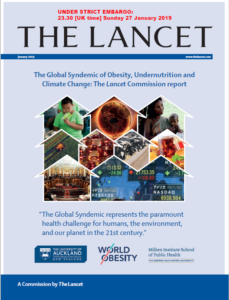
This report breaks new ground in identifying the food industry as one of three main barriers to ending this “Syndemic.”  I’ve added the numbers for emphasis.

  • Powerful opposition by [1] commercial vested interests, [2] lack of political leadership, and [3] insufficient societal demand for change are preventing action on The Global Syndemic, with rising rates of obesity and greenhouse gas emissions, and stagnating rates of undernutrition.
  • New social movement for change and radical rethink of the relationship between policymakers, business, governance and civil society is urgently needed.
  • The Commission calls for a global treaty to limit the political influence of Big Food (a proposed Framework Convention on Food Systems – modelled on global conventions on tobacco and climate change); redirection of US$5 trillion in government subsidies away from harmful products and towards sustainable alternatives; and advocacy from civil society to break decades of policy inertia.

Wow.  This is telling it like it is—at long last.  From the press release:

  • A key recommendation from the Commission is the call to establish a new global treaty on food systems to limit the political influence of Big Food.
  • The food industry’s obstructive power is further enhanced by governance arrangements that legitimise industry participation in public policy development, and the power that big corporations have to punish or reward governments by relocating investment and jobs.
  • Regulatory approaches to product reformulation (eg. salt and sugar reduction), labelling and marketing to children are needed because industry-led, voluntary approaches have not been effective.

Yes!

The documents

The press

▪ The Guardian
The Times (London)
Irish Farmers Journal

Additional press, posted January 30

Newswires (syndicated in international outlets):

UK:

US:

Rest of world:

Jan 24 2019

Palm oil politics: corporate effects on health

The World Health Organization is about to publish a report on how the palm oil industry is promoting obesity and chronic disease as well as environmental degradation as integral parts of its business model.

The draft report gets right to the point.

We highlight the industry’s mutually profitable relationship with the processed food industry and its impact on human and planetary health, including detrimental cultivation practices that are linked to respiratory illnesses, deforestation, loss of biodiversity and pollution. This analysis illustrates many parallels to the contested nature of practices adopted by the alcohol and tobacco industries.

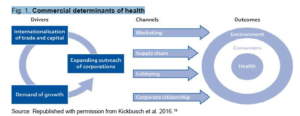
The research behind the report supports the analytical framework for examining industry’s effects on health.

The report documents how the palm oil industry, working with the food industry, acts to maximize profits at the expense of health and the environment, through marketing, supply chain management, lobbying, and corporate “citizenship.”

The report calls for

  • More research on the effects of palm oil on health
  • Actions to mitigate industry influences to protect producers and sellers from needed regulations
  • Use of the Sustainable Development Goals to aid these actions

You don’t get why palm oil raises health and environmental concerns?  Read this.  Now.


Aug 22 2018

Trump’s trade war with China: the retaliation lists

I have been trying to track what’s happening in our current tariff war with China.  Politico Morning Agriculture helps a lot, but even so keeping up with the rounds of retaliatory tariff impositions is challenging.

Here is our “second tranche” list of Chinese imports subject to tariffs.

The Chinese are retaliating by imposing tariffs on US agricultural exports.  They publish their lists in Chinese, obviously, meaning that we non-speakers must depend on Google Translate [and see note at end].

Fortunately, CNN Money has published a partial list in English of US goods hit by Chinese Tariffs

Poultry
— Frozen beef
— Fresh or cold pork
— Dried, smoked or salted pork belly
— Frozen chicken nuggets
— Frozen whole duck

Fruit and vegetables
— Farming potatoes
— Mushrooms
— Truffles
— Apples
— Cherries
— Avocados

Dairy products
— Butter
— Cream
— Yogurt

Fish
— Frozen red salmon
— Frozen mackerel
— Frozen yellowfin tuna

Seafood
— Frozen squid
— Lobster
— Canned shark fin
— Octopus
— Sea urchins

Tobacco
— Tobacco cigarettes
— Tobacco cigars

Pet food
— Canned cat food
— Canned dog food

Beverages
— Whiskey
— Modified ethanol
— Non-frozen orange juice with less than 20% sugar

Its list leaves out baked goods, for example, items of great concern to BakeryAndSnacks.com.

A group called Farmers for Free Trade has launched an advertising campaign, “Tariffs Hurt the Heartland.

This is a mess and clearly not good for US agriculture.  President Trump, as I noted earlier, has promised $12 billion in relief.  The administration has not said where that money—which in any case will not be nearly enough—is coming from.

Does anyone know where that money will be taken from?  Which budget line?

Note on Google Translate

A reader writes:

Small correction: the annexes you linked in the newsletter should be titled “Annex XX: List of XX% additional tariff items for the United States. pdf ”

Have you wondered why Canada is dragged into this? =)

In Mandarin the character for “additional” is the same as the abbreviated reference to Canada. It’s not surprising that Google Translate failed to catch this.

Tags:
Aug 13 2018

Jury rules Roundup carcinogenic, Monsanto malicious: awards $289 million to plaintiff

The Guardian’s account of the verdict: Monsanto ordered to pay $289m as jury rules weedkiller caused man’s cancer

Dewayne Johnson, a 46-year-old former groundskeeper, won a huge victory in the landmark case on Friday, with the jury determining that Monsanto’s Roundup weedkiller caused his cancer and that the corporation failed to warn him of the health hazards from exposure. The jury further found that Monsanto “acted with malice or oppression”…Johnson’s case was particularly significant because a judge allowed his team to present scientific arguments. The dispute centered on glyphosate, which is the world’s most widely used herbicide…During the lengthy trial, the plaintiff’s attorneys brought forward internal emails from Monsanto executives that they said demonstrated how the corporation repeatedly ignored experts’ warnings, sought favorable scientific analyses and helped to “ghostwrite” research that encouraged continued usage.

Here’s what this is about:

(1)  The carcinogenicity of Roundup (glyphosate)

In 2015, the World Health Organization’s International Agency for Research on Cancer (IARC) ruled that glyphosate, the weed killer used with genetically modified crops, is “probably carcinogenic to humans.”  Glyphosate’s maker, Monsanto (now merged with Bayer) did not like this decision and went to work casting doubt on the science.  As IARC explains and documents:

Following the classification of glyphosate in March 2015 as probably carcinogenic to humans (Group 2A) by the IARC Monographs Programme, IARC has been the target of an unprecedented number of orchestrated actions by stakeholders seeking to undermine its credibility. In the interest of transparency, IARC has documented some of these instances, and our responses can be found on the Agency′s Governance website.

(2) What’s at stake for Monsanto

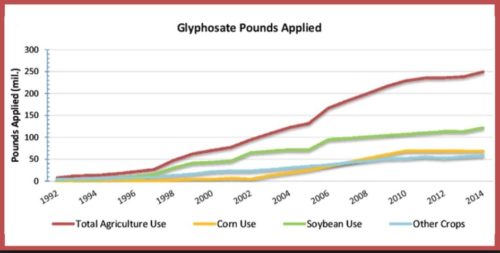
Glyphosate is used in incomprehensibly huge amounts.  The organic advocate, Charles Benbrook, published statistics on its use in 2016.  Monsanto’s published a rebuttal to Benbrook’s paper, but did not dispute his figures; instead, it argued only glyphosate is safe.  Benbrook’s data show that 250 million pounds of glyphosate were applied to US crops in 2014 (by another source, worldwide use was 825,804,000 kilograms, or more than 1.8 billion pounds that year).

(3) What’s at stake for the plaintiff, Dewayne Johnson

As the San Francisco Chronicle’s account explains:

Johnson was a groundskeeper and pest-control manager for Benicia schools from 2012 until May 2016. His job included spraying glyphosate, in the high-concentration brand called Ranger Pro, from 50-gallon drums 20 to 30 times a year for two to three hours a day.

He testified he wore protective clothing, including a sturdy jacket, goggles and a face mask, but said he couldn’t fully protect his face from wind-blown spray. And twice, he told the jury, he got drenched with the herbicide, once when a spray hose became detached from a truck that was hauling it, and another time when a backpack container he was carrying leaked.

After the first drenching in 2014, he said, he got rashes on his skin that did not respond to treatment. Welts and lesions soon appeared on his legs, arms, face and eyelids. His first cancer diagnoses came soon afterward.

(4)  The evidence for the jury’s decision

Through discovery during the trial, documents came to light exposing Monsanto’s efforts to discredit the science linking glyphosate to cancer.

U.S. Right to Know (USRTK) has performed an extraordinary public service by posting the key documents in the case on its website.  There, you can find links to an astonishing number of federal court and discovery documents, exhibits, news reports, and commentary.

Also worth reading: Stacy Malkin’s Secret Documents Expose Monsanto’s War on Cancer Scientists (July 12)

Monsanto was its own ghostwriter for some safety reviews,” Bloomberg reported, and an EPA official reportedly helped Monsanto “kill” another agency’s cancer study. An investigation in Le Monde details Monsanto’s effort “to destroy the United Nations’ cancer agency by any means possible” to save glyphosate.

(5) What this means: Comment from USRTK’s Carey Gillam

Monsanto and its chemical industry allies have spent decades actively working to confuse and deceive consumers, farmers, regulators and lawmakers about the risks associated with glyphosate-based herbicides. As they’ve suppressed the risks, they’ve trumpeted the rewards and pushed use of this weed killer to historically high levels. The evidence that has come to light from Monsanto’s own internal documents, combined with data and documents from regulatory agencies, could not be more clear: It is time for public officials across the globe to act to protect public health and not corporate profits.

(6) What happens next?

Monsanto will appeal, of course; its owner, Bayer, continues to insist that glyphosate is safe.  Press accounts say that hundreds, if not thousands, of more such cases are in the pipeline, a situation similar to that faced by the tobacco industry before that industry gave up and settled.  Will Bayer do so as well?  I’m guessing not without a fight.

Jul 2 2018

Big Soda strong-arms California: no more soda taxes for 12 years. Shame!

In 2017, Jennifer Pomeranz and Mark Pertschuck published an article in the American Journal of Public Health titled State Preemption: A Significant and Quiet Threat to Public Health in the United States.

How right they were.

Last week, California Governor Jerry Brown signed a law banning new soda tax initiatives in the state until 2030, thereby preempting local initiatives planned and in progress.

How did this happen?

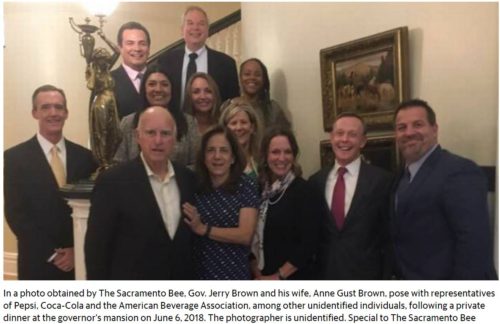
Raw, overt power politics (my emphasis throughout).  The Sacramento Bee shows how it’s done.

The Hill explains that this bill was a compromise.

The measure was a last-minute compromise to stop an initiative circulated by the beverage industry that would make it more difficult to raise state and local taxes in California.  “Mayors from countless cities have called to voice their alarm and to strongly support the compromise which this bill represents,” Brown wrote in a signing message.

Big Soda’s tactic: use California’s ballot initiative process to put forth a measure requiring a two-thirds majority to pass any new tax legislation.  Brown and those mayors must have assumed it would pass (anything to prevent new taxes).  Brown said he would agree to a 12-year moratorium on new soda taxes if the soda industry would withdraw the measure.  It did, and he signed.

In explaining the so-called “compromise” (in quotes because this was blackmail), US News quotes state senator Scott Wiener (Dem-San Francisco):

This industry is aiming a nuclear weapon at government in California and saying, ‘If you don’t do what we want we are going to pull the trigger and you are not going to be able to fund basic government services.”

In other words, the beverage industry held the state hostage. Like the Sacramento Bee, I’d call this a shakedown.

The Sacramento Bee also called it extortion—a power play by the American Beverage Association that:

appears to be working as intended. As the deadline for signing the state budget approaches this week, a developing trailer bill attached to it would give Big Soda a 12-year ban on local soda taxes in exchange for dropping a ballot initiative that would threaten the finances of cities throughout California. Who says extortion doesn’t pay?

The New York Times explains the “stunning” preemption:

Now the beverage industry has a new approach. Instead of fighting the ordinances city by city, it is turning to states, trying to pass laws preventing any local governments from taxing their products.

The reactions have been fierce.

Nancy Brown, CEO of the American Heart Association says, “We’ve seen some cynical moves to protect profits, but this soda tax ban is a new low.”   The American Heart Association issued a statement:

The bill—a last-minute, backroom deal negotiated and written in secret by beverage industry lobbyists and their allies—is a significant step backwards in the ongoing effort to reduce overconsumption of sugary drinks.

“This is one of the worst pieces of legislation I have seen in more than 30 years spent fighting for better health for kids and families,” said Nancy Brown, CEO of the American Heart Association. “We could not be more disappointed to see this bill, taken straight from the tobacco industry playbook, pass.”

The LA Times said “Shame on California lawmakers for caving in to the soda industry.”

Salon explains:

There’s a lot at stake for America’s biggest soda companies. Carbonated soft drinks – such as Coke, Fanta, Sprite, and Fresca – make up two-thirds of Coca-Cola’s production, and U.S. soda sales earned the company more than $10 billion in 2015. And PepsiCo’s soda sales – including Pepsi, 7Up, and Mountain Dew – still account for one-quarter of the company’s $38 billion in North American sales, despite a shift toward healthier products. But soda consumption fell to its lowest point in 31 years in the U.S. in 2016, according to Fortune, and Coca-Cola concedes that sweetened beverage taxes “are hurting Coke’s business.”

I’ll end with this quote from the New York Times:

Bill Monning, the Senate majority leader, was one of a handful of Democrats who voted against the bill. He called its passage “unprecedented” and said it would stop cities and counties “from being able to take steps to protect the health of their residents”…“It’s a sad day for democracy in California,” he said. “But ever the optimist I think that the outrage of Big Soda blackmailing the state legislature and the people of California is going to boomerang.”

Let’s make sure that happens.

And while we are at it, don’t let this happen in your state.  If the soda industry threatens to mess with state elections, tell your representatives and governor to resist.  California public health advocates: keep the pressure on.  Advocate for bans on sodas everywhere you can: schools, hospitals, workplaces, government offices.  Expose what the industry is doing to protect its profits at the expense of public health.  Don’t give up.  Courage!

For the record, here’s where to find out more about this shameful episode.

Jun 4 2018

US vetoes any mention of soda taxes in WHO committee report on preventing noncommunicable (chronic) disease

The AP reports that the reason the WHO committee on preventing noncommunicable diseases (NCDs) did not recommend soda taxes is that the US representative vetoed the idea.

The Trump administration has torpedoed a plan to recommend higher taxes on sugary drinks, forcing a World Health Organization panel to back off the U.N. agency’s previous call for such taxes as a way to fight obesity, diabetes and other life-threatening conditions.

The move disappointed many public health experts but was enthusiastically welcomed by the International Food and Beverage Alliance — a group that represents companies including Coca-Cola, PepsiCo. and Unilever.

The WHO committee’s report appeared in The Lancet last week.  About soda taxes, it said:

The Commissioners represented rich and diverse views and perspectives. There was broad agreement in most areas, but some views were conflicting and could not be resolved. As such, some recommendations, such as reducing sugar consumption through effective taxation on sugar-sweetened beverages and the accountability of the private sector, could not be reflected in this report, despite broad support from many Commissioners.

It did not include soda taxes in its tax recommendation:

Implement fiscal measures, including raising taxes on tobacco and alcohol, and consider evidence-based fiscal measures for other unhealthy products.

This omission is striking in view of WHO’s strong previous positions on the need to reduce NCDs as part of the agency’s Sustainable Development Goals for 2030, and on reducing sugars and taxing sodas as a means to achieve those goals:

Again a US veto?  Recall the infamous incident in 2003 when the US blocked the agency from recommending a reduction in sugar intake.

The US should not be holding WHO hostage to public health measures.

WHO should not be caving in to US threats.

NCDs are the major cause of worldwide death and disability and we need worldwide efforts to prevent them.  This calls for cooperation, not blackmail.

Shame.

Mar 28 2018

The NIH’s dubious partnership in industry-funded alcohol research

Last week, New York Times reporter Roni Rabin wrote how the National Institutes of Health (NIH) solicited funding from alcohol companies to fund—and, distressingly, participate in the design of—a study of the effects of moderate drinking on heart disease risk.

This is not the first time Ms. Rabin has written about this study.  In July, she described the study and its funding.

Since then, she has apparently been busy filing FOIA requests and conducting further interviews.  These reveal that the NIH actively solicited industry funding and input into this trial.

The [NIH] presentations gave the alcohol industry an opportunity to preview the trial design and vet the investigators. Indeed, the scientist leading the meetings was eventually chosen to head the huge clinical trial.

They also made the industry privy to pertinent details, including a list of clinical sites and investigators who were “already on board,” the size and length of the trial, approximate number of participants, and the fact that they could choose any beverage. By design, no form of alcohol — wine, liquor or beer — would be called out as better than another in the trial.

But it gets worse.  Boston University professor Michael Siegel tells his personal story of dealings with NIH’s National Institute of Alcohol Abuse and Alcoholism (NIAAA)

On January 16, 2015, I was called into the office of the Director of NIAAA and was essentially reprimanded for conducting NIAAA-funded research that was detrimental to the alcohol industry…At the meeting, I was told that I would never again be funded to conduct research on alcohol marketing, regardless of how highly my research proposal was scored by the scientific review panel.

Let me be clear: research ethics require funders to have no involvement in research design, conduct, or interpretation, lest they exert undue influence on the results.

Julia Belluz (Vox) put this study in context.  She describes how

The NIH is now investigating whether the researchers violated federal policy by soliciting donations, and they’re appointing outside experts to review the design of the study. We don’t yet know the full story, and there’s surely more to uncover.

Anheuser Busch InBev, Heineken, Diageo, Pernod Ricard, and Carlsberg helped pay $67.7 million of the $100 million government study, which is currently underway. And even more troubling is that if you were a patient looking to enroll in the trial through the online clinical trials registry, you’d have no way of knowing about the industry’s involvement because that funding is not disclosed there.

Although I do not have much to say about the alcohol industry in my forthcoming book, Unsavory Truth: How Food Companies Skew the Science of What We Eat, I mention of this study as an example of how other industries skew research and also how pooling industry research funds is insufficient protection against conflicted interests (alcohol companies agreed to contribute 67.7% of the funding).

It’s good that the NIH has decided to investigate this dubious government-industry partnership, which so clearly seems aimed at marketing, not public health.

Mar 2 2017

Don’t we need a millennium development goal for social rank?

Yes, says Martin Tobias’s must-read commentary in The Lancet.

The commentary cites a paper in the same issue arguing that low social rank, meaning “powerless to determine your own destiny, deprived of material resources, and limited in the opportunities open to you,” has a profound effect on lifestyle and life chances.  Its authors base these views on a study of 1·7 million adults followed up for mortality (all cause and by cause) for an average of 13 years.

Even with use of a crude categorisation of social rank based on occupation (professional, intermediate, and unskilled), the study was able to quantify the social gradient in mortality: an approximately 20% increase in risk per unit decrease in rank.

Tobias’ commentary recommends evidence-based strategies to minimize the impact of social hierarchy on health:

Invest in children

  • Early childhood development enrichment programs

  • Intensive parent support (home visiting) programs

  • Enrollment of all children in early childhood education

Get the welfare mix right

  • Regulate markets as necessary

  • Implement income transfer policies that redistribute resources (ie, progressive tax and benefit regimes)

  • Optimize balance between targeted and universal social protection policies through benefit design that minimizes both undercoverage and leakage

  • Eliminate child poverty through monetary and non-monetary support for families with dependent children

Provide a safety net

  • Provide income support or tax credits

  • Provide social housing

  • Subsidize childcare

  • Provide free access to health care (especially preventive services)

Implement active labor market policies

  • Provide job enrichment programs

  • Democratize the workplace (involve employees in decision making)

  • Provide career development and on-the-job training

  • Provide fair financial compensation and intrinsic rewards

  • Promote job security

  • Discourage casualization of the workforce

Strengthen local communities

  • Foster regional economic development

  • Promote community development and empowerment

  • Encourage civic participation

  • Create mixed communities with health-enhancing facilities

Provide wrap-around services for the multiply disadvantaged

  • Coordinate services across government and NGOs

  • Provide intensive case management when necessary

  • Foster engagement of the targeted families and individuals

Promote healthy lifestyles

  • Strengthen tobacco control and addiction services

  • Improve the diet of poor families (eg, through subsidizing fruit and vegetables, community gardens, purchasing co-ops, school meals)

  • Provide green space and subsidized sport and recreation facilities

Ensure universal access to high quality primary health care

  • Subsidize practices serving high need populations

  • Provide additional nursing and social worker support for practices in disadvantaged areas

  • Assist patients with clinic transport and childcare

  • Provide services free at point of use

  • Provide conditional cash transfers (to increase demand for clinical preventive services)

The paper is open access.  Spread it around.  Pick the recommendation you think most important, and get to work!

Tags: