by Marion Nestle

Search results: tobacco

Dec 20 2016

Industry-funded study says advice to eat less sugar is based on bad science (surprise)

I haven’t posted an industry-funded study for a while, but here’s a good one.  This is a systematic review published in the Annals of Internal Medicine attacking dietary advice to eat less sugar on the grounds that such advice is not scientifically justified.

This one doesn’t pass the laugh test.

What are dietary guidelines supposed to do?  Tell people to eat more sugar?

This review is particularly peculiar:

  • It was funded by the International Life Sciences Institute (ILSI), a food-industry front group.
  • Two of the four authors consult for ILSI, and one of the two is on the scientific advisory board of Tate & Lyle, the British sugar company.
  • The authors admit that “given our funding source, our study team has a financial conflict of interest and readers should consider our results carefully.”  No kidding.
  • It was published by a prestigious medical journal.  Why?
  • It is accompanied by an editorial that thoroughly demolishes every single one of the authors’ arguments.

I can understand why ILSI wanted this review.  Many of its funders make sugary foods and drinks.  They would like to:

  • Cast doubt on the vast amounts of research linking excessive sugar intake to poor health.
  • Discredit dietary guidelines aimed at reducing sugar consumption.
  • Head off regulatory attempts to tax or label added sugars.

In funding this study, ILSI is following the tobacco industry playbook to the letter.  Strategy #1 is to cast doubt on the science.

When the 2015 Dietary Guidelines came out with a recommendation to restrict sugar intake to 10% of calories or less, the Sugar Association called it“agenda-based, not science-based.”  The Annals review says international sugar guidelines do not “meet criteria for trustworthy recommendations and are based on low-quality evidence.”

I detect a theme here.

But I ask again: what are dietary guidelines supposed to do?  We cannot lock up large numbers of people and feed them controlled amounts of sugar for decades and see what happens.  Short of that, we have to do the best we can with observational and intervention studies, none of which can ever meet rigorous standards for proof.  So this review is stating the obvious.

Take a look at the accompanying editorial.  After destroying each of the flawed premises of this review, it concludes:

Industry documents show that the F&B [Food & Beverage] industry has manipulated research on sugars for public relations purposes….Accordingly, high quality journals could refrain from publishing studies on health effects of added sugars funded by entities with commercial interests in the outcome. In summary, our concerns about the funding source and methods of the current review preclude us from accepting its conclusion that recommendations to limit added sugar consumption to less than 10% of calories are not trustworthy. Policymakers, when confronted with claims that sugar guidelines are based on “junk science,” should consider whether “junk food” was the source.

I don’t ever remember seeing a paper accompanied by an invited editorial that trashes it, as this one did, but this incident suggests a useful caution.

Whenever you hear that something isn’t “science-based,” look carefully to see who is paying for it.

The press coverage

Oct 26 2016

Follow up on my WikiLeak: the Australia connection

Marcus Strom of the Sydney Morning Herald in Australia did a follow up to my post, “I’ve been WikiLeaked!”

Recall that a Coca-Cola representative took notes at a talk I gave in Australia and passed them up the chain of command where they got hacked as collateral damage from the ones obtained from Hillary Clinton’s campaign manager, John Podesta.

The notes advised ongoing monitoring of my activities in Australia but also of research conducted by Dr. Lisa Bero, in whose group I was working for a couple of months early this year.

The article begins: 

Coca-Cola has been exposed having a secret plan to monitor research at Sydney University that examines how private companies influence public health outcomes in areas such as obesity.

In a leaked internal email, a paid consultant to Coca-Cola South Pacific writes that a “key action” for the global soft-drinks manufacturer is to “monitor research project outcomes through CPC [Charles Perkins Centre] linked to Lisa Bero’s projects”.

Future monitoring should include planned research on “treatment and prevention of obesity, diabetes and cardiovascular disease”, the email says.
Professor Bero, who works at the university’s Charles Perkins Centre, studies the integrity of industry-sponsored research and how it is used to influence public policy. While in the US, she worked to expose the influence of tobacco companies on health debates. Those methods are now being used to examine how companies like Coke seek to influence public health outcomes.

The reaction: See letters printed in response (you have to scroll way down to find them)

Roberto Mercadé, President of Coca-Cola South Pacific, wrote to object that Coke is not secretly monitoring academics; its monitoring is entirely public:

Readers of the article “Revealed: Coke’s plan to monitor academic” (Herald, October 22-23) may have been left with the impression that Coca-Cola South Pacific somehow engages in the “secret” monitoring of academics at the University of Sydney. Put simply, we don’t. We make no secret of the fact that we keep abreast of research in the health and wellbeing sector, as you would expect of any food or beverage company. The important work being done by the university on the integrity of industry-sponsored research is among the many fields important to us. Finally, in the article the word “monitor” was also used out of context and distorted to mean something other than what it is – our ongoing engagement with academics and experts in health and wellbeing.

Steve Harrison, Balmain

It’s no great surprise that Coca Cola is panicked by research into the cause of diabetes. The consumption of sugar and processed foods looks more and more like a major reason for diabetes, many cancers and other serious diseases. In turn, the company, the food industry and drug companies will all be in big financial trouble when the penny drops that a diet of fresh food is the basis for good health.

If a fraction of the money spent on seeking cures was used to educate people to cut processed food and sugar from their diet we would be a much healthier society. We went through a very similar process with Big Tobacco some years ago, although that was on a smaller scale.

In the words of Hippocrates: “Let food be thy medicine and medicine be thy food.”

Ivan Head, Camperdown

The score? Coke, Zero: Professor Bero, one.

Tags:
Oct 12 2016

WHO takes action against sugary drinks, urges taxes

The World Health Organization took two actions yesterday to encourage people to cut down on consumption of sugar-sweetened beverages.

It issued a report urging national governments to consider taxes: “Taxes on sugary drinks: Why do it?  

Governments can take a number of actions to improve availability and access to healthy foods and have a positive influence on the food people choose to consume. A major action for comprehensive programmes aimed at reducing consumption of sugars is taxation of sugary drinks. Just as taxing tobacco helps to reduce tobacco use, taxing sugary drinks can help reduce consumption of sugars.

It defines sugar drinks as products that contain added sugar, corn or fruit-juice concentrates and include carbonates, fruit drinks, sports drinks, energy and vitamin water drinks, sweetened iced tea, and lemonade.

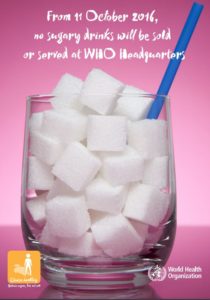
It also took immediate action to remove sugary drinks from its Geneva headquarters

The agency explained this action:

The move signifies how seriously WHO is taking its leadership role in implementing policies to improve public health…By implementing this policy WHO is setting a positive example for Member States, other organizations and visitors…WHO vending machines, restaurants and coffee shops will continue to sell water, fizzy water, and unflavoured milks with different fat contents, teas and coffees, and beverages with non-sugar sweeteners (such as diet and zero calorie drinks). Sugar packets for use with tea and coffee will continue to be served.

These actions are getting plenty of attention.

The Guardian pointed out that:

Battle lines are being drawn in Colombia, where a consumer movement is pressing the case for a sugary drinks tax and the industry is fighting back…Last month, the Asociación Educar Consumidores – the consumer organisation which, like its Mexican equivalent, has backing from Bloomberg Philanthropies in the US – produced an educational video to be broadcast on television, warning that drinking too many sugary drinks can lead to diabetes and other diseases.

But after a complaint from Postobón, the Colombian beverage giant, the government’s regulatory agency charged with consumer protection banned any showing of the video on TV, saying it was inaccurate and could confuse the public.

Michael Bloomberg, now a global ambassador for WHO issued a statement.

A growing number of cities and countries – including Mexico – are showing that taxes on sugary drinks are effective at driving down consumption. The World Health Organization report released today can help these effective policies spread to more places around the world, and that will help save many lives.

The International Council of Beverages Associations (ICBA) issued a statement:

ICBA is disappointed that this technical committee’s report advocates the discriminatory taxation solely of certain beverages as a ‘solution’ to the very real and complex challenge of obesity. We strongly disagree with the committee’s recommendation to tax beverages, as it is an unproven idea that has not been shown to improve public health based on global experiences to date.

Healthy Food America says the soda industry has spent $30 million to fight soda taxes, just this year.

WHO has just given its blessing to soda taxes.  Will countries respond?  How much more is the soda industry willing to spend to stop taxes?

Stay tuned.

Other accounts:

Oct 5 2016

Some thoughts about SNAP: declining enrollments and legal issues

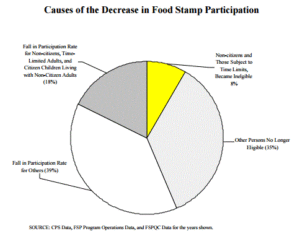
Let’s start with the USDA’s latest figures on SNAP participation.  Enrollment is down by a couple of million which could be good news (people have jobs that pay enough to make them ineligible) or bad news (elibility runs out).

The USDA issued a report in 2001 explaining the reasons.


As the report explains:

The large decrease in the number of food stamp participants is due to both a decrease in the number eligible for food stamps and a decrease in the rate at which eligible persons participate. The decrease in the participation rate played a slightly more important role, explaining 56 percent of the fall in the number of participants. The decrease in the number of eligible persons explains 44 percent of the fall in the number of participants.

Next, let’s look at the article in the New York Times on attempts to improve the quality of foods that can be purchased with SNAP benefits.

There have been manymanymany calls for the food stamp program to promote more healthful diets. Many states have requested waivers allowing for restrictions on what benefits can buy (some items, like alcohol, tobacco and household supplies, are already prohibited). Further restrictions have been rejected by the Department of Agriculture, which administers this welfare program.

The article is based on a study trying incentives for buying fruits and vegetables, restrictions on junk foods, and a combination of both.   The study concluded:

A food benefit program that pairs incentives for purchasing more fruits and vegetables with restrictions on the purchase of less nutritious foods may reduce energy intake and improve the nutritional quality of the diet of participants compared with a program that does not include incentives or restrictions.

the study was accompanied by an editorial calling for a trial of mixed incentives and restrictions.

But, as Daniel Bowman Simon tells me, the law only allows the USDA to do incentives.  By law, it cannot do additional exclusions.  This is because Congress says what retailers can and cannot sell to SNAP recipients:

As written in 7 U.S. Code § 2012, section (k)

“Food” means (1) any food or food product for home consumption except alcoholic beverages, tobacco, hot foods or hot food products ready for immediate consumption….

It looks to me as though excluding soft drinks, for example, would require Congress—not the USDA—to change this definition or let states do so.

Daniel wonders why USDA doesn’t make this clear.  Me too.

I’m told that three states have requested waivers and that the USDA is considering them.  How?  I don’t know, but stay tuned.

NOTE:  Several readers filed corrections on this post and I thank them.  I have revised it accordingly.

Tags: ,
Aug 22 2016

Catching up on soda politics

My book, Soda Politics, came out not quite a year ago but so much has happened since then that it’s been hard to keep up with everything that’s happening in campaigns to discourage consumption of sugar-sweetened beverages.

Fortunately, Healthy Food America’s Casey Hinds puts out a daily roundup of sugar and soda news (you can sign up for it and HFA’s other materials here).

A few recent items of particular interest:

USA Today’s editorial, “soda taxes fall flat

More effective ways already are being used to change people’s diets. The best use of government authority is to empower people with the information they need to make healthier choices.

The editorial comes with a poll, still up.  You can vote on it here.  At this moment only 183 votes have come in, 51% strongly in favor of the editorial opinion.

Jim Krieger of Healthy Food America did a counterpoint

The time has come to tax sugary drinks like we tax tobacco. The analogy is powerful: As with tobacco, rock-solid evidence shows habitual use harms health. Sugary drinks are a prime culprit in rampant health problems — diabetes, obesity, and heart, dental and liver disease – that cut lives short and drive up health care costs.  Tobacco taxes have reduced smoking, while raising money to make lives better. Taxing sugary drinks would do the same

This too has a poll on which you can still vote.  Only 92 votes have come in, and only 38% strongly agree.

Americans don’t like taxes.  Even so, either this issue doesn’t generate much interest or it’s just August and too hot to think about such things.


The beverage industry spent $10.6 million to oppose Philadelphia’s soda tax initiative

The soft drink industry does not like taxes and seems willing to put fortunes into opposing them.

The Philadelphia City Council passed the tax anyway.  I keep thinking of all the good things nearly $11 million could do for public health.

Melbourne’s The Alfred Hospital reduces sugary drink consumption

The hospital did an experiment to see if they could shift the mix of drinks purchased from sugary to less sugary.  They did this by increasing the price of sugary drinks and hiding them under counters.  Sales of sugar-sweetened beverages sales fell by 36,500 drinks in a year.

I don’t get it.  Why not just stop selling them altogether?

That’s it for this August Monday.  Stay cool.  More to come.

Addition, August 23

A reader from New Zealand writes to say that “all of its hospitals no longer sell sugary sodas and some are also beginning to remove juice and artificially sweetened beverages due to their acidic nature and detrimental impact on oral health.”

May 5 2016

More on corporate funding of nutrition research: exchange of letters

In January this year, JAMA Internal Medicine published my Viewpoint on corporate funding of nutrition research: science or marketing.

Richard Kahn, former chief scientist and medical officer of the American Diabetes Association, wrote a letter in reply (see below for more about him**).  The journal published his letter, along with my response, in its current issue.  Here’s what I said.

In Reply Dr Kahn requests evidence that nutrition research funded by food companies is of lesser quality than studies funded by independent agencies or performed by investigators with nonfinancial conflicts of interest. Concerns about such issues are relatively recent; few published studies address them directly. Instead, concerns about industry sponsorship of nutrition research derive from comparisons with the results of studies of funding by tobacco, chemical, drug, or medical device companies. This research typically finds industry-sponsored studies to report results more favorable to the products of the sponsor than studies not funded by industry. It identifies subtle rather than substantive differences in the quality of this research; industry-funded studies are more likely to underreport unfavorable results and interpret neutral results more positively.1 When results are negative, they are less likely to be published.2

Between March 2015 and March 2016, I identified 166 industry-funded nutrition research studies and posted and discussed them on my blog.3 Of these, 154 reported results favorable to the interest of the sponsor; only 12 reported contrary results. The few studies systematically examining the influence of industry funding on nutrition research tend to confirm results obtained from other industries. For example, a systematic review comparing industry-funded and nonindustry-funded trials of probiotics in infant formula reported no association of funding source with research quality. Industry-funded studies, however, seemed more likely to report favorable conclusions unsupported by the data.4

Dr Kahn states that sponsored studies often specify that the funder had no role in the study. Only recently have some journals required such statements, and I am unaware of research on the extent of this practice or authors’ adherence to it. Among the 166 industry-funded studies that I reviewed, few disclosed involvement of a sponsor.

Dr Kahn asks whether industry funding is any more biasing than career self-interest or intellectual passion. Unlike industry funding, self-interest and passions are intrinsic to every scientist who conducts research, are a matter of public record, cannot be eliminated, and have not been shown to consistently bias research results in the same ways as industry funding.5 Fortunately, nutrition societies and research institutions are developing policies to manage financial relationships with industry.6 Such policies hold promise for preventing financial conflicts of research in nutrition research.

1. Lundh  A, Sismondo  S, Lexchin  J, Busuioc  OA, Bero  L.  Industry sponsorship and research outcome. Cochrane Database Syst Rev. 2012;12:MR000033. PubMed

2. Rising  K, Bacchetti  P, Bero  L.  Reporting bias in drug trials submitted to the Food and Drug Administration: review of publication and presentation. PLoS Med. 2008;5(11):e217. PubMed   |  Link to Article

3. Nestle  M. Food Politics Blog. https://foodpolitics.com/. Accessed March 2, 2016.

4. Mugambi  MN, Musekiwa  A, Lombard  M, Young  T, Blaauw  R.  Association between funding source, methodological quality and research outcomes in randomized controlled trials of synbiotics, probiotics and prebiotics added to infant formula: a systematic review. BMC Med Res Methodol. 2013;13:137. PubMed   |  Link to Article
5. Bero  L.  What is in a name? Nonfinancial influences on the outcomes of systematic reviews and guidelines. J Clin Epidemiol. 2014;67(11):1239-1241. PubMed   |  Link to Article 
6. Charles Perkins Centre. Engagement with Industry Guidelines 2015. University of Sydney, 2015. https://intranet.sydney.edu.au/perkins/research-support/engaging-with-industry.html. Accessed March 2, 2016.
**Richard Kahn is infamous in my circles for supporting the positions of the sugar and soda industries while with the American Diabetes Association and now.  I wrote about what he said in an interview with Corporate Crime Reporter in my book What to Eat (pages 355-356).  Recently, The Russells (of CrossFit) had a lot more to say about Kahn’s ongoing opposition to public health measures.
Apr 15 2016

Food politics: Mexico then and now

I’m in Mexico City doing talks for El Poder del Consumidor, the advocacy group in part responsible for Mexico’s soda tax.  I had some time to be a tourist yesterday afternoon and got to see the Diego Rivera murals at the Palacio Nacional.

These are enormous, and stunning.  They deal with the history of Mexico in conflict and in peace.  Look closely, and you see Rivera’s deep respect for Mexico’s traditional food culture.

Along the corridor flanking the main mural, for example, is a painting above a plaque listing what the world owes Mexico—corn, obviously—but also beans, tobacco (oops), chocolate, hemp, and tomatoes.

IMG_20160414_1542552

Other panels also deal with corn—in this one, production.

IMG_20160414_1544228

Another shows how corn is used.


IMG_20160414_1547490

The corner panel at the end of the corridor is devoted to chocolate.

IMG_20160414_1548210

Along the way, quieter panels display the harvest of fruits and vegetables.

IMG_20160414_1543548

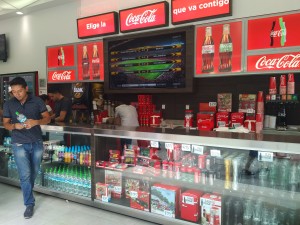
Leave the Palacio, cross the Zócolo, and you come to the Coca-Cola bar and toy store.IMG_20160414_1500139

A brief look at Mexico’s food culture, then and now.

Aug 19 2015

Coca-Cola’s sponsorship of favorable research: the saga continues

When the New York Times published an article describing Coca-Cola’s financial sponsorship of university researchers who de-emphasize the role of sugary drinks in raising the risk of obesity and type 2 diabetes, it kicked up a storm.

USA Today’s editorial board said:

It isn’t that companies pay scientists to put out false research. It’s that companies fund the work of scientists who happen to be doing research that spurs consumers to look away from science that hurts corporate interests.

Soft drinks are far less dangerous than cigarettes, but GEBN’s website, tweets and videos come right out of Big Tobacco’s playbook, brought into the digital era. Its leaders have done research in the past under about $3 million in grants given to their universities.

USA Today also printed a response by a Coca-Cola spokesman:

A recent New York Times article created confusion about our support of research and non-profit organizations, stating we want people to think that only exercise matters and not diet — but nothing could be further from the truth. We have always operated under the fact that a healthy, balanced diet and regular exercise are key ingredients for a healthy lifestyle.

That said, we need to do a better job of being even more transparent about the research we fund, the non-profit organizations we support and the way we publicly share this information. And we will.

Yesterday, Senator Richard Blumenthal sent letters to the University of Colorado, West Virginia University, and the University of South Carolina urging them to  clarify the nature of the University’s relationship with projects funded by Coca-Cola and to review the academic integrity of such grant agreements.

I believe your university must determine whether this research is in effect promoting a predisposed and biased agenda, rather than reflecting the impartiality and objectively (sic) expected from a public academic institution.

Years of litigation with tobacco companies were necessary to fully expose the tragic public health consequences when companies lie about the hazards of the products they sell.  I am deeply concerned that we may force future generations to relive this history if corporate-sponsored studies devoid of scientific integrity are permitted once again to deceptively downplay and conceal the dangers of a product consumed on a mass scale.

Do not underestimate Senator Blumenthal’s ability to deal with food companies.  He, you may recall, was responsible for withdrawal in 2009 of the ill-conceived Smart Choices program during his stint as Connecticut’s attorney general.

I’m still waiting for the Global Calorie Balance Network to issue its promised statement.  Stay tuned.