by Marion Nestle

Search results: tobacco

Mar 18 2015

Dietitians in turmoil over conflicts of interest: it’s about time

My e-mail inbox is filled with items about the Academy of Nutrition and Dietetics (AND, formerly the American Dietetic Association).  Its “seal of approval” on Kraft cheese singles (as discussed in an earlier post) was embarrassing—so embarrassing that it was discussed by Jon Stewart: “The Academy is an Academy in the same way this [Kraft Singles] is cheese” (the clip starts at 4:37).

The Onion also had some fun with this.

But now there is even more about how food companies buy the opinions of dietitians.

Candice Choi writes about how Coca-Cola pays dietitians to promote its drinks as healthy snacks (for an example of one of the paid posts, click here).  She explains that the dietitians

wrote online posts for American Heart Month, with each including a mini-can of Coke or soda as a snack idea. The pieces — which appeared on nutrition blogs and other sites including those of major newspapers — offer a window into the many ways food companies work behind the scenes to cast their products in a positive light, often with the help of third parties who are seen as trusted authorities.

Ms. Choi quotes a Coca-Cola spokesman:

“We have a network of dietitians we work with,” said Sheidler, who declined to say how much the company pays experts. “Every big brand works with bloggers or has paid talent.”

Other companies including Kellogg and General Mills have used strategies like providing continuing education classes for dietitians, funding studies that burnish the nutritional images of their products and offering newsletters for health experts. PepsiCo Inc. has also worked with dietitians who suggest its Frito-Lay and Tostito chips in local TV segments on healthy eating.

These are individual actions.  But at last the dietetic membership is objecting to the Academy’s partnership with Kraft.

  1. They have started a Change.org petition to #RepealTheSeal.
  2. The President of the New York State AND chapter (NYSAND), Molly Morgan, sent out a note in support of the petition.

Thank you to the many of you that have expressed your concern and disappointment about the Academy of Nutrition and Dietetics partnership with Kraft. This issue has been reviewed carefully by the NYSAND Board of Directors and the entire board is in support of actively taking steps to share our members concerns. Below are the action steps that NYSAND is taking:

–       Last week (March 11, 2015) the NYSAND Sponsorship Task Force recommendations were received and yesterday (March 16, 2015) at the March NYSAND Board of Directors meeting the Sponsorship Task Force recommendations were reviewed. Please stay tuned for more updates and note that a motion will be forth coming this week for the board to take the next step in addressing sponsorship for NYSAND.

–       Today (March 17, 2015) a letter was sent to the Academy president and emailed to several Academy leaders expressing the views that our members have shared and that as an Affiliate we are not comfortable responding with the talking points provided by the Academy on this issue.

–       Dietitians have started a petition, “Repeal the Seal”; NYSAND will be sharing this on our Affiliate Facebook and Twitter pages and encourages all members who share the concern to sign the petition as well. CLICK HERE to sign the petition.

3.  The AND national CEO, Patricia M. Babjak, sent out this letter to members, also on March 17:

Let me begin by apologizing for the concerns caused by the education initiative with Kraft. The Academy and the Foundation are listening. As a member-driven organization, the Academy’s staff and leadership hear your concerns and welcome your input.

Unfortunately, recent news articles misstated a collaboration as a Kids Eat Right “endorsement” of Kraft Singles, and that it represents a “seal of approval” from Kids Eat Right, the Foundation, or the Academy. It is not an endorsement. It is not a seal of approval. We understand this distinction is of little consequence to many Academy members who are concerned with the perception. We are working on a solution.

In addition, we are working to establish a joint, member-driven Member Advisory Panel. This Panel will work closely with both Boards to:

  • Establish dialogue with members
  • Gather input and give feedback on member issues
  • Make specific recommendations

Recognizing sponsorship as a significant issue of concern among members, the House of Delegates leadership team, who also serve on the Board of Directors, scheduled a dialogue on sponsorship for the upcoming virtual House of Delegates meeting, May 3. We encourage all members to reach out to your delegates and share your thoughts on the benefits of, concerns about and suggestions for the sponsorship program. The Academy and Foundation Boards are looking forward to your input.

Applause to members who are speaking out.

As I said in an interview with TakePart:

The food companies have learned from tobacco and drugs and other industries like that how to play this game…Let’s confuse the science, let’s cast doubt on the science, let’s shoot the messenger, let’s sow confusion.

But since everyone has to eat, the food industry has been given a pass on its pay-to-play practices….

The capital N news…is that dietitians are fighting back at last.

I hope they join Dietitians for Professional Integrity and insist that the leadership respond to their concerns.

AdditionA dietitian sends this communication from the Executive Board of the California Dietetic Association to members about the Kraft situation:

We would like to direct your attention to what the California Dietetic Association (CDA) has done to address our own issues surrounding sponsorship. We heard your concerns regarding CDA Annual Conference sponsorship and we have listened. We voted and McDonalds was not invited as a sponsor in 2015. This decision has impacted our finances; however, we believe it was important to respond to our member feedback. In addition, an ad hoc committee approved by the CDA executive board, reevaluated the sponsorship guidelines. The new sponsorship policy will be posted soon on www.dietitian.org.

Mar 12 2015

New Scientist: Cigarettes get plain packets – will junk food be next?

Here is the online version of my commentary in New Scientist, March 14, 2015:24-25.

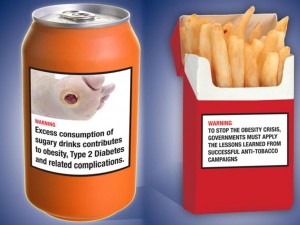
I submitted an illustration with it, which the editors did not use.  It’s from the Ontario Medical Association.

OMA

Cigarettes get plain packets – will junk food be next?

The tobacco industry is fighting moves to sell cigarettes in plain packs by claiming food manufacturers will be hit next. Will they?

ANTI-SMOKING advocates will be delighted. MPs have today voted in favour of introducing uniform packaging for cigarettes in the UK. That plain wrappers will undoubtedly further reduce smoking, especially among young people, is best confirmed by the tobacco industry’s vast opposition to this government measure and positive evidence from Australia, the first country to adopt it.

Along with lobbying and appeals to the World Trade Organization, the tobacco industry, when under attack, inevitably wheels out well-worn arguments about the nanny state, personal freedom, lack of scientific substantiation, and losses in jobs and tax revenues.

So to perk up its tired and thoroughly discredited campaign, the tobacco folks have added a new argument. Requiring plain wrappers on cigarettes, they say, is a slippery slope: next will be alcohol, sugary drinks and fast food. This argument immediately raises questions. Is it serious or just a red herring? Should the public health community lobby for plain wrappers to promote healthier food choices, or just dismiss it as another tobacco industry scare tactic?

Let me state from the outset that foods cannot be subject to the same level of regulatory intervention as cigarettes. The public health objective for tobacco is to end its use. So for cigarettes the rationale for plain wrappers is well established. Company logos, attractive images, descriptive statements, package colours and key words all promote purchases. Plain wrappers discourage buying, especially along with other measures such as bans on advertising, smoke-free policies, taxes and health warnings.

Australia’s pioneering law specified precise details of pack design, warning images and statements. The result: cigarette brands all look much alike. Most reports say plain packaging boosts negative perceptions of cigarettes among smokers and increases their desire to quit. Australia expects plain packaging to further reduce its smoking rate, which, at 12.8 per cent, is already among the world’s lowest. Along with the UK, New Zealand and Ireland are well on the way to adding plain packaging to their anti-smoking arsenal. More nations are considering it.

Which is all bad news for the tobacco industry. So it ramps up the slippery slope argument, hoping the food industry will support its fight against plain wrappers. It cites examples such as the regulation of infant formula in South Africa, where pictures of babies on labels are forbidden; that’s a big problem for the Gerber food brand – Gerber’s company logo is a smiling baby.

But those peddling the slippery slope idea ignore the fact that the health message for tobacco is simple: stop smoking. But beyond tobacco, it is more complex. For alcohol it is a little more nuanced: drink moderately, if at all. For food it is much more nuanced. Food is not optional; we must eat to live. Nutritional quality varies widely. Foods are spread across a spectrum from unhealthy to healthy, from soft drinks (no nutrients) to carrots or fish (many nutrients). Most fall somewhere in between. What’s more, an occasional soft drink is fine; daily guzzling is not. So the advice is to choose the healthy and avoid or eat less junk, both in the context of calorie intake and expenditure.

Is there any evidence that plain packaging for unhealthy foods would reduce demand? Research has focused on marketing’s effect on children’s food preferences, demands and consumption. Brands and packages sell foods and drinks, and even very young children recognise and desire popular brands. When researchers compare the responses of children to the same foods wrapped in plain paper or in wrappers with company logos, bright colours or cartoon characters, kids invariably prefer the more exciting packaging.

But the problem is deciding which foods and beverages might call for plain wrappers. For anything but soft drinks and confectionery, the decisions look too vexing. Rather than having to deal with such difficulties, health advocates prefer to focus on interventions that are easier to justify – scientifically and politically.

We know that some regulations and market interventions –analogous to, if not the same as those aimed at smoking cessation – are essential for reducing the damage from harmful products. If not plain packaging, then what? Studies suggest small benefits from a long list of interventions such as taxes, caps on portion size, front-of-package traffic-light labels, nutrition standards for school meals, advertising restrictions, and elimination of toys from fast food meals and cartoons from packaging. Rather than dealing with the impossible politics of plain wrappers on foods, health advocates increasingly favour warning labels.

These first appeared on cigarette packs in the 1960s and have been considered for food products since the early 1990s. Heart disease researchers suggested that foods high in calories and fat should display labels such as: “The fat content of this food may contribute to heart disease.” More recently, health advocates in California and New York proposed warning labels on sugary drinks. The Ontario Medical Association takes a similar view: “To stop the obesity crisis, governments must apply the lessons learned from successful anti-tobacco campaigns.” It has mocked up examples of warnings on foods.

Although no warning label law has passed so far, such messages are the logical next step in promoting healthy food choices, in the same way that plain wrappers are the next logical step for all cigarette packages. Health advocates should recognise the slippery slope argument for the typical tobacco ploy that it is.


Mar 11 2015

Study documents sugar industry influence on dental research in the 1960s and 1970s

A new study in PLoS Medicine provides documentary evidence of sugar industry manipulation of research on dental caries in the 1960s and 1970s.

The paper is a formal presentation of an article in Mother Jones (which I wrote about in a previous post).

The researchers are at UCSF, which sent out a press release:

A newly discovered cache of industry documents reveals that the sugar industry worked closely with the National Institutes of Health in the 1960s and ‘70s to develop a federal research program focused on approaches other than sugar reduction to prevent tooth decay in American children.

The archive of 319 industry documents, which were uncovered in a public collection at the University of Illinois, revealed that a sugar industry trade organization representing 30 international members had accepted the fact that sugar caused tooth decay as early as 1950, and adopted a strategy aimed at identifying alternative approaches to reducing tooth decay.

These approaches, as the article explains, involved encouraging the NIH to do research on mitigating or preventing tooth decay, which is fine in theory, but in practice distracted the dental research community from trying to discourage sugar consumption.

The analysis showed that in the late 1960s and early 1970s, the sugar industry funded research in collaboration with allied food industries on enzymes to break up dental plaque and a vaccine against tooth decay. It also shows they cultivated relationships with the NIDR and that a sugar industry expert panel overlapped by all but one member with the NIDR panel that influenced the priorities for the NIH tooth decay program. The majority of the research priorities and initial projects largely failed to produce results on a large scale, the authors found.

Understandably, the Sugar Association is not pleased.  Here is what the Sugar Association told Time Magazine:

It is challenging for the current Sugar Association staff to comment directly on documents and events that allegedly occurred before and during Richard Nixon’s presidency, given the staff has changed entirely since the 1970s. However, we are confused as to the relevance of attempts to dredge up history when decades of modern science has provided answers regarding the role of diet in the pathogenesis of dental caries… A combined approach of reducing the amount of time sugars and starches are in the mouth, drinking fluoridated water, and brushing and flossing teeth, is the most effective way to reduce dental caries.

As Stan Glantz pointed out in his blog post, “This sounds similar to the statement from Brown and Williamson Tobacco put out in 1995 in response to our first papers based on tobacco industry documents.”

Distracting researchers from focusing on underlying causes is a strategy perfected by the tobacco industry and copied widely by other industries making potentially harmful products, as shown clearly in the just released film, Merchants of Doubt (a must-see).

Jan 28 2015

WHO versus noncommunicable (chronic) disease: where’s the sugar target?

The World Health Organization (WHO) released two reports within the last week aimed at preventing noncommunicable diseases.  Although the second is all about reducing sugar intake, the first report is about everything but.

1.  The Global Status Report on Noncommunicable Diseases, 2014.* 

The WHO press release points out that the report calls for:

more action to be taken to curb the epidemic, particularly in low- and middle-income countries, where deaths due to NCDs are overtaking those from infectious diseases. Almost three quarters of all NCD deaths (28 million), and 82% of the 16 million premature deaths, occur in low- and middle-income countries.

How?  By working to achieve 9 targets:

  • Target 1: A 25% relative reduction in risk of premature mortality from CVDs, cancer, diabetes, chronic respiratory diseases.
  • Target 2: At least 10% relative reduction in the harmful use of alcohol, as appropriate, within the national context.
  • Target 3: A 10% relative reduction in prevalence of insufficient physical activity.
  • Target 4: A 30% relative reduction in mean population intake of salt/sodium.
  • Target 5: A 30% relative reduction in prevalence of current tobacco use in persons aged 15+ years.
  • Target 6: A 25% relative reduction in the prevalence of raised blood pressure or contain the prevalence of raised blood pressure, according to national circumstances.
  • Target 7: Halt the rise in diabetes and obesity.
  • Target 8: At least 50% of eligible people receive drug therapy and counselling (including glycaemic control) to prevent heart attacks and strokes.
  • Target 9: An 80% availability of the affordable basic technologies and essential medicines, including generics, required to treat major NCDs in both public and private facilities.

Don’t dietary sugars have something to do with diabetes and obesity?  How come no specific target?  This is especially odd in light of the second report.

2. Guideline: Sugars Intake for Adults and Children [see updated, revised publication released March 2015]

The WHO makes three recommendations about intake of added (“free”) sugars:

  • A reduced intake of free sugars throughout the lifecourse (strong recommendation).
  • Reducing the intake of free sugars to less than 10% of total energy intake (strong recommendation).
  • A further reduction of the intake of free sugars to below 5% of total energy intake (conditional recommendation)

Why no target for sugar reduction to 10% of energy  in the first report?

The omission is glaring.  Could politics be involved?  It’s hard to think of any other explanation.

WHO needs to speak with one voice on NCD targets, guidelines, and recommendations.

* Along with the NCD target report, WHO also released:

**Thanks to Dr. Karen Sokal-Gutierrez for alerting me to the lack of a sugar target.

Sep 23 2014

No, the U of California does NOT forbid faculty to express opinions about the soda tax

Last Friday, I received a phone call from Todd Kerr, the publisher of The Berkeley Times, a community newspaper in Berkeley, CA.  He was preparing a story on the Berkeley soda tax and could not find University of California (UC) faculty who were willing to speak with him.

They were, they told him, under a gag order from the president’s office not to talk to reporters about the soda tax.

I can understand his frustration.  I spoke or e-mailed about 10 people with knowledge of this issue and only two would allow me to quote them for attribution.

For starters, the idea of a gag order seems contrary to current practice.

But the rumor is serious and deserves investigation.

I sent out queries to try to find out if the rumor could have any basis in fact.

Mr. Kerr kicked off the process by giving me the names of the three faculty members he said had refused to speak with him about the soda tax.

I was able to track them down.  Here is what they told me (not for direct quotation or attribution):

  • Source #1: Mr. Kerr had asked scientific questions outside the respondent’s area of expertise.
  • Source #2: Mr. Kerr stated that his paper does not take a stance on issues, so HE can’t write for or against the tax.  This respondent’s understanding is that Berkeley faculty members can state opinions on any voting matter as long as they do not claim to speak for the university.
  • Source #3: University counsel advised this respondent that faculty can say what they want as private citizens, but not as UC employees.  This source’s understanding is that state employees are not permitted to work to alter the conduct or outcome of matters on which the public is voting.  And, if the food industry were to sue a faculty member for something said in the course of an election campaign, the university would not provide legal resources or defense.

Source #3’s comments especially demanded further inquiry.  I did some more consultation of UC faculty, legal staff, and professional staff.

UC policy on political speech is governed by state law

As one source explained, there is no gag order on faculty.  There are, however, state statutes that limit the University’s ability to take positions on ballot measures that are before the voters (be sure to look at the Webinar slide show).  These state in a Q and A:

May a University employee endorse a ballot measure in his/her private capacity and identify himself/herself by University title?

Yes. A University official may allow use of his/her name and title for identification purposes in the same manner as others who sign an endorsement. An express disclaimer of University endorsement is required only where the context might reasonably cause confusion as to whether the endorsement is made in an official or unofficial capacity.

My queries eventually landed in the Office of the President of the UC System.  Steve Montiel, Media Relations Director, one of only two people in all of this who was willing to be quoted by name, said:

All University of California employees, including faculty, have the right to express their personal opinions about any matter of civic importance, including ballot measures. Consistent with state law, however, longstanding University policy prohibits university resources from being used to oppose or support a ballot measure. Only the UC Board of Regents can take a public position on a ballot measure, and it has done so in the past.

I also consulted Michele Simon (the second quotable) about state policy.  She notes that this is standard policy for institutions receiving state funding.  UC is a state school and, therefore, is not allowed to use state funds to take political positions.

She reminded me that at Stanford, a private institution, Henry Miller of the conservative Hoover Institute violated Stanford’s no-position policy on ballot measures when he did a TV ad opposing Proposition 37, the GMO labeling initiative, using his Stanford affiliation.

When we learned of the ‘No on 37 ‘ commercial, we immediately asked to have it changed so it would be in compliance with Stanford policies,” said Debra Zumwalt, the university’s vice president and general counsel. “While everyone at Stanford is entitled to espouse whatever political view he or she may choose, we do not allow people affiliated with Stanford to take a political position in a way that could imply that it is Stanford’s position.”

In my own experience, UC’s policy also sounds like standard practice.  When the Sugar Association threatened me with a lawsuit (see documents under Controversies at the bottom of the Media pages), that’s pretty much what NYU lawyers told me.  If I said something libelous, I would be responsible for the legal consequences.  Luckily, the Sugar Association never sued.

So—how did this rumor get started?  

Here’s what I learned.

A group of faculty advocating for the soda tax asked to meet with university legal counsel for advice about how to protect themselves and the university against potential lawsuits filed by, for example, the American Beverage Association (ABA), which has been especially aggressive in fighting the tax.  The ABA’s actions reminded them of the cigarette industry’s fight with the UC system over the tobacco control archives now housed at UCSF.

Some of the legal advice to faculty—if you speak at a soda tax rally, represent yourself as an individual,not a representative of the university, and do so on your own, not the university’s time—can be interpreted as restrictive even if it is not meant as such.

UC’s policy on academic freedom

Please note that UC, since the time of the Free Speech Movement, has developed a clear policy on academic freedom:

…academic freedom depends upon the quality of scholarship, which is to be assessed by the content of scholarship, not by the motivations that led to its production. The [policy]…does not distinguish between “interested” and “disinterested” scholarship; it differentiates instead between competent and incompetent scholarship. Although competent scholarship requires an open mind, this does not mean that faculty are unprofessional if they reach definite conclusions. It means rather that faculty must always stand ready to revise their conclusions in the light of new evidence or further discussion. Although competent scholarship requires the exercise of reason, this does not mean that faculty are unprofessional if they are committed to a definite point of view. It means rather that faculty must form their point of view by applying professional standards of inquiry rather than by succumbing to external and illegitimate incentives such as monetary gain or political coercion. Competent scholarship can and frequently does communicate salient viewpoints about important and controversial questions [my emphasis].

My translation: if faculty opinions about the soda tax are based on research—and plenty of research is available to back up the rationale for and potential efficacy of such a tax (see Rudd Center and Bridging the Gap)—faculty not only have the right but also have the responsibility to express opinions about them.

UC faculty: get out there and support the tax!

And wish the FSM a happy 50th anniversary.

 

May 27 2014

Olivier de Schutter finishes tenure as UN Special Rapporteur on the Right to Food

Olivier de Schutter must be finishing up his six-year term as the United Nations Special Rapporteur on the Right to Food.

His final report to the U. N. Human Rights Council

Objectives such as supplying diverse, culturally-acceptable foods to communities, supporting smallholders, sustaining soil and water resources, and raising food security within particularly vulnerable areas, must not be crowded out by the one-dimensional quest to produce more food,

In a speech to the annual summit of the World Health Organisation (WHO), Reuters reports: 

Unhealthy diets are now a greater threat to global health than tobacco. Just as the world came together to regulate the risks of tobacco, a bold framework convention on adequate diets must now be agreed, he said.

De Schutter, who has held his post of special rapporteur on the right to food since 2008 and earlier headed the Paris-based International Federation of Human Rights, reports to the U.N. Human Rights Council in Geneva.

In 2005, a U.N. convention on tobacco control aimed at reducing deaths and health problems caused by the product went into force after long negotiations under the umbrella of the WHO.

In a report to the rights council in 2012, de Schutter said a similar accord on food should include taxing unhealthy products, regulating food high in saturated fats, salt and sugar, and “cracking down on junk food advertising.”

That report also called for an overhaul on the system of farm subsidies “that make certain ingredients cheaper than others”, and for support for local production “so that consumers have access to healthy, fresh and nutritious foods.”

De Schutter  reports that public procurement can and should be used to ‘buy justice’ in food systems (also see press release):

“Public procurement represents a rare opportunity to support more nutritious diets and more sustainable food systems in one fell swoop,” he said, as he released his final publication as UN Special Rapporteur on the right to food.

Recalling that OECD countries spend an average of 12% of GDP on public procurement, and developing countries only slightly less, he identified five principles for using public procurement to support the realization of the right to food:

  • Source preferentially from small-scale food producers and help them to access tenders
  • Guarantee living wages and fair prices along the food supply chain
  • Set specific requirements for adequate food diets
  • Source locally whenever possible and impose sustainability requirements on suppliers; and
  • Increase participation and accountability in the food system

De Schutter has done honorable work as Special Rapporteur and his role in this position will be missed.

Feb 11 2014

Room for Debate: CVS to stop selling cigarettes

The New York Times Room for Debate blog asked me to comment on What other unhealthy products should CVS stop selling?

Here’s my response: Next, Cut the Soda and Junk Food.

Good for CVS! Cigarettes are in a class by themselves. The evidence that links cigarette smoking to lung cancer and other serious health problems is overwhelming, unambiguous and incontrovertible. So is the evidence that the mere presence of cigarettes is sufficient to create demand, especially among young people.

When the anti-cigarette smoking movement began, the issues were simple: stop people from starting to smoke and get people who smoked to stop — by making it difficult, uncomfortable and expensive for smokers to continue their habit. The ultimate goal? Put cigarette companies out of business. This, of course, has been politically impossible, not least because cigarette companies pay such high taxes.

If CVS wants to promote health, it could increase sales of healthy snacks, and stop selling sugary foods and drinks.

Although there are many parallels in company marketing practices, food is not tobacco. For all tobacco products, the response is simple: stop. Food is more complicated. We must eat to survive. A great number of foods meet nutritional needs. The evidence that links a particular food product to health is often uncertain. This is because each food is only one component of a diet that contains many foods in a lifestyle that might involve other factors that affect health: activity, alcohol, drugs, stress and let’s not forget genetics.

With that said, if CVS really wants to promote health, it could consider increasing its sales of fruits, vegetables and healthy snacks, and stop selling sodas, ice cream, chips and other junk foods. Those foods may not have the same bad effect on health as tobacco, but eating too much of them on a regular basis is associated with weight gain, obesity and the conditions for which obesity is a risk factor, like Type 2 diabetes and heart disease. If CVS wants to counter obesity, dropping soft drinks is a good place to start. They have scads of sugars, and kids who drink them regularly take in more calories, are fatter and have worse diets than kids who do not.

Jan 10 2014

Action on Sugar to the food industry: reduce sugar now!

A group of public health experts based mainly in Britain have announced a new anti-sugar campaign.

Called Action on Sugar, it is modeled on Great Britain’s campaign to get the food industry to gradually reduce salt in processed foods—voluntarily.  That campaign is considered to have led to a reduction of 25% to 40%.

Action on Sugar’s objective: Reduce sugar in packaged foods by 20% to 30% over the next 3 to 5 years.

Action on Sugar is a group of specialists concerned with sugar and its effects on health. It is successfully working to reach a consensus with the food industry and Government over the harmful effects of a high sugar diet, and bring about a reduction in the amount of sugar in processed foods. Action on Sugar is supported by 18 expert advisors.

As one of the experts put it, “Everywhere, sugary drinks and junk foods are now pressed on unsuspecting parents and children by a cynical industry focused on profit not health”—just like the tobacco industry behaves.

You have to love the British press:

New Picture

Enjoy the weekend!


Tags: