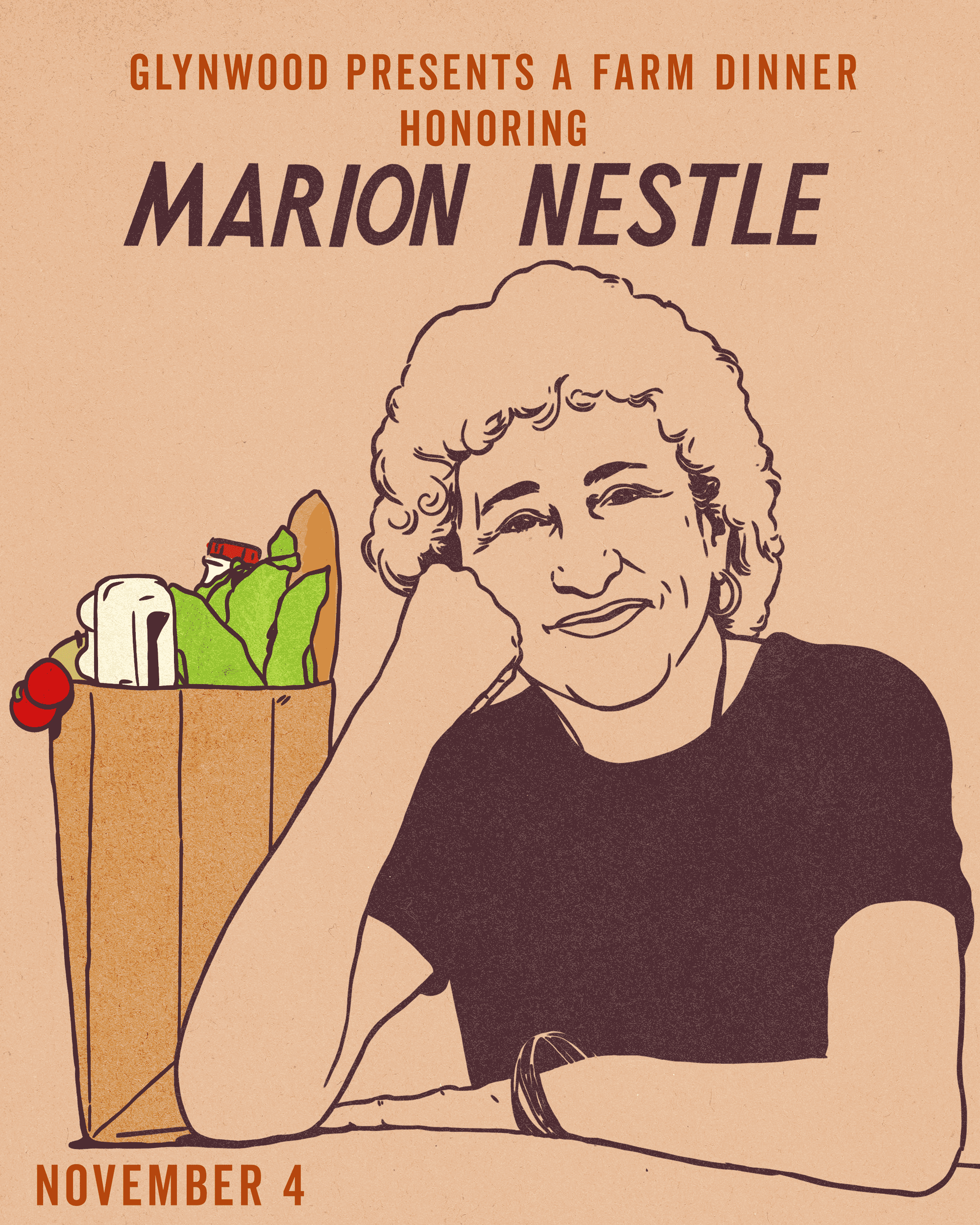
by Marion Nestle

Currently browsing posts about: School-food

Apr 9 2026

New school food rules on the horizon?

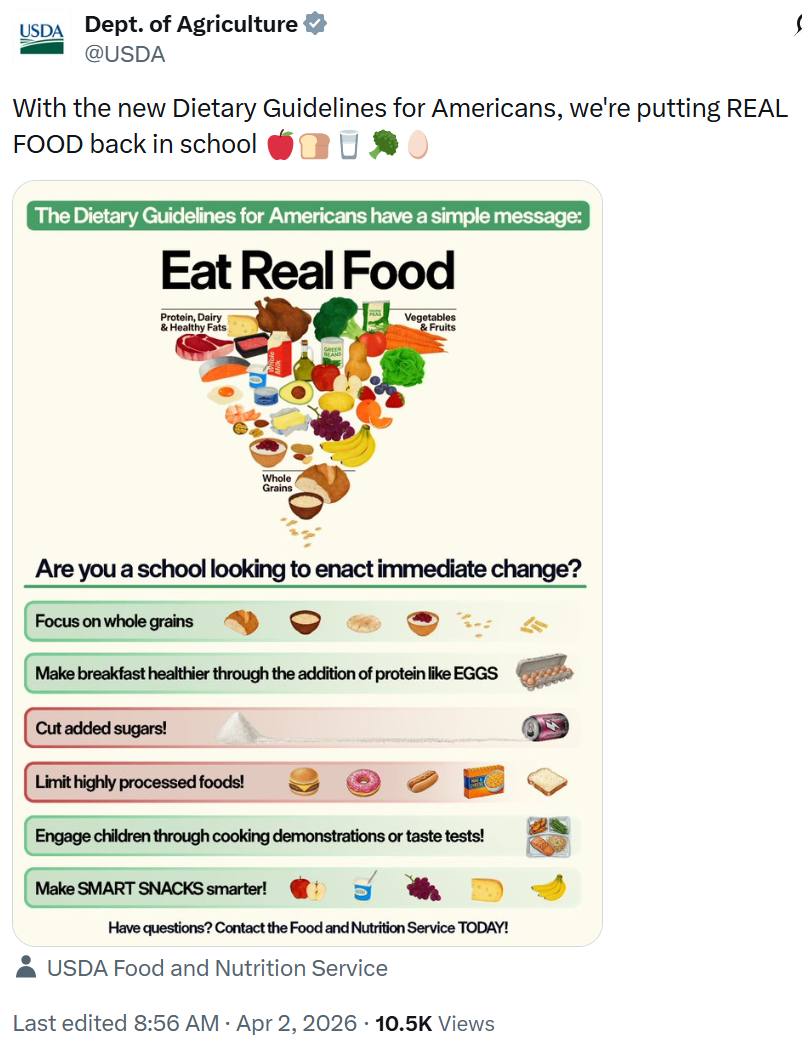
The new MAHA dietary guidelines could mean that changes are coming to school meals.  Or so the USDA says.

While waiting for the USDA to issue new rules, various groups are urging specific improvements.

United We Eat, a coalition of MAHA-supporting groups, urges the USDA Secretary to get busy Aligning School Meal Standards with the MAHA Mandate to Protect Children’s Health.  It is especially concerned about the poor quality of meat served in school meals (something I hear a lot about from school food service directors).

These processed animal products often contain additive heavy formulations, including preservatives
such as nitrites and nitrates, which health authorities have associated with increased colorectal cancer risk in processed meats, as well as other processing agents such as sodium phosphates that raise broader nutritional concerns and kidney damage….Beyond the concerns with processed meat, majority of all animal proteins served in schools are sourced from industrial supply chains that rely on routine antibiotic use, growth-promoting drugs including ractopamine, and feed grown with significant pesticide inputs.

Another coalition, this one of nearly 200 food service professionals, school districts, and other groups, is pressing for plant-based meat alternatives in the protein group.

The Dietary Guidelines for Americans, including those released in January, have long recommended diversifying protein intake across plant and animal sources. Yet in practice, school menus remain heavily dominated by animal-based proteins. A forthcoming analysis of a sample of 45 school district menus from November 2025 found that, excluding nut butter and jelly sandwiches, fewer than one in ten school lunch entrée offerings utilized plant-sourced protein to fulfill the M/MA requirement. More than 90% of school lunch entrees contained animal-sourced proteins…a plant protein subgroup within the Meats/Meat Alternates category would provide a clear, practical framework to diversify protein intake, increase fiber consumption, and improve inclusivity within child nutrition programs.

USDA ought to be issuing new school food rules soon.  I can’t wait to see what they are.  In the meantime, this is a good time to weigh in.

Mar 25 2026

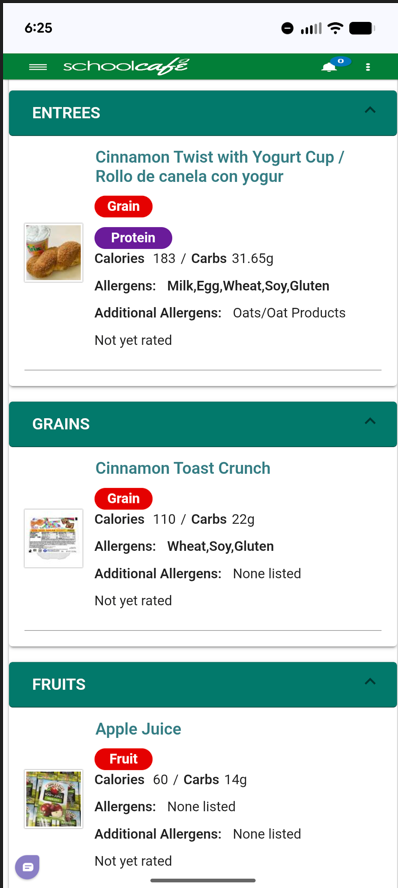
USDA school food rules allow plenty of ultra-processed snacks

A reader, Jennifer Windh, has done some serious investigation of loopholes in USDA’s school food rules that allow lots of ultra-processed snacks to be sold a la carte (“competitive foods”) outside of the USDA’s school meals program.

USDA’s nutrition tandards also apply to competitive foods: Smart Snacks in Schools.

The final rule for these standards, effective as of 2016, sets requirements or limits for whole grains, saturated and trans fat, sugar, sodium, and calories.

This sounds good, but as Jennifer Windh found out, even though snacks are required to be either 50% whole grain or have as a first ingredient fruit, vegetable, dairy product, or protein, the rules allow for plenty of loopholes.

She summarizes the findings of her investigation in The Smart Snacks Loophole: How Junk Food Companies Target America’s Students in School.

One reason for the loophole is the generous sugar standard: “Acceptable food items must have ≤35% of weight from total sugar as served.”

She points out the irony of Robert F. Kennedy, Jr’s visit to an elementary school where cooks make healthy meals from scratch (parents protested his visit because of his stance on vaccination, not food).

This school, she notes, offers plenty of loophole snacks.

She is particularly concerned about the loophole for ice cream.  For this, she has analyzed sales in 12 Houston area school districts: Ice Cream at School.

Schools usually sell ice cream at the same time they serve the main meal. There is no adult present who encourages students to eat their lunch before eating dessert. As expected, most children eat their ice cream first! This spoils their appetite for the more nutritious foods on their tray. School lunch periods are short, children eat slowly, and there are many distractions as students socialize with their friends. As a result, some students eat their ice cream first and then throw the rest of their lunch away.

There is so much money to be made from school meals that sellers of ultra-processed foods are happy to reformulate their products to meet USDA nutrition standards and get their products in through the loopholes.

Obviously, the standards could use some tightening.

The big question: Will USDA tighten the loopholes when it issues new school food standards to reflect the new dietary guidelines?  Recall:  These emphasize eat real food and reduce intake of highly processed foods.

Stay tuned.

Feb 6 2026

Weekend reading: Food education standards

Food and nutrition education is hard to come by these days.  As Laura Reiley wrote in Civil Eats,

The end of SNAP-Ed leaves underserved communities with even fewer resources.  The One Big Beautiful Bill Act eliminated the program in July, giving program administrators 90 days to dismantle a nationwide network of nutrition classes and outreach efforts.

You would think that educating SNAP recipients about choices and cooking methods would be good for everyone, but no such luck.

Some groups are trying to fill the gap.  Alex DeSorbo-Quinn, the Executive Director of Pilot Light Chefs, sent me a press release 

 Pilot Light today announced the release of its updated Food Education Standards, the first-ever comprehensive framework for integrating Food Education into PreK-12 classrooms. The revised standards build on five years of real-world implementation by educators across the United States and expand access to include PreK students for the first time.

The 2025 edition of the Food Education Standards:

  • Incorporate greater diversity in food system expertise, ensuring all students see themselves reflected in Food Education.
  • Reflect best practices in teaching and learning based on five years of classroom implementation.
  • Include competencies tailored to PreK students for greater accessibility and early childhood engagement.

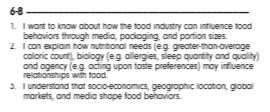
Here’s an example of competency #4: Food behaviors are influenced by external and internal factors for grades 6-8 (I can’t get the resolution higher, sorry):

The standards come with suggestions for activities designed to meet them.

For anyone teaching K-12, this ought to be useful.

It also should be useful to anyone who has a K-12 kid.

Oct 22 2025

Texas elementary schools are selling ice cream in competition with school lunches (OK, USDA-approved, but still)

A reader in Texas, Jennifer Windh, wrote me about food practices in her kid’s suburban Houston elementary school.  She reports:

Many elementary school cafeterias are selling students ice cream and other junk food for lunch. This is happening in my school district and several nearby, and I suspect it’s fairly widespread. This is particularly ironic given RFK Jr’s recent visit to the state to celebrate the passage of “Make Texas Healthy Again” legislation — a core aspect of which was student nutrition and physical education!

From her observations, “It is shocking to see the cafeteria sell 5 and 6 year olds ice cream for lunch.”

As she explains, kids go through the lunch line and get their meals.

Then, the cashier asks “Would you like a snack?” Most students grunt and point to an ice cream item on the picture menu posted on the sneeze guard next to the register, and the cashier sets the selected item on their tray.  The kids go sit down, and immediately rip open and eat their ice cream.  They do not eat their entree or fruit or vegetables first. Of course not! They are six years olds.

Ten minutes into the lunch period, a staff member announces that any students who packed lunch may go buy snacks, and up go another set of kids to buy ice cream, which they then take back to their seat and slowly enjoy for the rest of the lunch period, ignoring whatever other foods their parents packed for them. At the end of the meal, kids throw away tons of untouched or half eaten entrees, fruit, vegetables, and milk, but only empty ice cream wrappers.

In her report on the ice cream sales, she notes:

  • Students do not have to eat lunch first, or eat any lunch at all.
  • There is no limit on the number of ice creams students can buy.
  • Students can buy ice creams for their friends.
  • Parents are not informed about these purchases.

Note that kids getting free or reduced-price meals will not be able to do this unless they also have parental contributions to lunch money account.

Here’s what they cost, according to the a la carte price list.

What on earth is going on here?

Try this.

Despite this graph, Jennifer Windh writes that she “submitted a public information request and learned that our district (Tomball ISD) sold just over $301,000 last year in a la carte ice cream items to students in grades K through 6.”

Wow!  Deja vu.

This reminds me so much of the soft drink pouring rights contracts I wrote about in 2000 in Public Health Reports.  These were contracts between soda companies and schools to promote exclusive sales of their drinks in elementary, middle, and high schools (later, protests got them out of elementary schools at least).  The payments for these contracts put schools in the position of pushing kids to buy as much soda as possible, regardless of how they might compete with nutritious school meals.  As I said in that article,

The quality of “competitive” foods sold outside the cafeteria has long been a source of concern to nutritionists and school food service directors, as these foods often are higher in fat, sugar, and sodium than is desirable and students consume them instead of the more nutritious foods provided by federally supported school meal programs.

So where is the USDA in all of this?

USDA has rules for “competitive” snacks sold outside the school meals programs: “Smart Snacks in Schools.”  All snacks must meet nutritional standards, as this example does (for others, see Hershey Ice Cream Promotional Materials).

There are time-and-place restrictions, as shown in Guidelines for Competitive Foods by State.  Let’s look at Texas (my emphasis):

The Texas Public School Nutrition Policy prohibits elementary schools from serving competitive foods (or provide access to them through direct or indirect sales) to students anywhere on school premises throughout the school day. This includes school stores, fundraisers and vending machines. Elementary schools may allow one nutritious snack per day under the teacher’s supervision. Middle schools may not serve competitive foods from 30 minutes before the start of the first lunch until 30 minutes after the last lunch. High schools may not serve or provide access to competitive foods during meal periods in areas where reimbursable meals are served and/or consumed. FMNV, including carbonated beverages, are not allowed to be provided to students until after the end of the last scheduled class. In 2013, the Governor passed into a law a bill limiting sanctions for schools that sell FMNV.

Under USDA rules, these ice creams meet nutrition standards.  I’m not sure they meet either the letter or the spirit of the time-and-place rules.  In any case, they undermine the purpose of school meals and for that reason alone schools ought to firmly restrict their sales.

Texas school food advocates: get to work!

Oct 14 2025

California defines ultra-processed foods and bans them from school meals—by 2035 (!)

California’s governor, Gavin Newsom, has just signed the bill, “Pupil nutrition: restricted school foods and ultraprocessed foods of concern: prohibition.

This bill prohibits ultra-processed foods in federally funded school meals (K-12, breakfast and lunch), as well as competitive foods sold as snacks.

This means that

From the midnight before to 30 minutes after the end of the official schoolday, at each school, the only competitive foods that may be sold to a pupil are fruit, vegetable, dairy, protein, or whole grain rich food items; foods with a fruit, vegetable, dairy, protein, or whole grain item as its first ingredient; or combination foods containing at least one-quarter cup of fruit or vegetable.

These foods must also meet the following standards:

(1) Not more than 35 percent of its total calories shall be from fat. [This does not apply to individually sold portions of nuts, nut butters, seeds, seed butters, reduced-fat cheese or part-skim mozzarella cheese packaged for individual sale, eggs, fruits, vegetables that have not been deep fried, seafood, or a dried fruit and nut and seed combination.]
(2) Less than 10 percent of its total calories shall be from saturated fat. [This does not apply to reduced-fat cheese or part-skim mozzarella cheese packaged for individual sale, eggs, nuts, nut butters, seeds, seed butters, or a dried fruit and nut and seed combination.]
(3) Not more than 35 percent of its total weight shall be composed of sugar, including naturally occurring and added sugar. [This does not apply to fruits, vegetables that have not been deep fried, or a dried fruit and nut and seed combination.]
(4) Contains less than 0.5 grams of trans fat per serving.
(5) Contains not more than 200 milligrams of sodium per item, package, or container sold to a pupil.
(6) Contains not more than 200 calories per individual food item.
And then, beginning December 31, 2027, competitive foods may not contain color additives:
(A) Blue 1
(B) Blue 2
(C) Green 3
(D) Red 40
(E) Yellow 5
(F) Yellow 6
This is terrific, but don’t hold your breath.  The timeline:
  • June 1, 2028: The State Department of Public Health adopts regulations.
  • July 1, 2029: Schools begin to phase out restricted school foods
  • July 1, 2032: Vendors cannot offer restricted foods.
  • July 1, 2035: bill fully implemented.

Really?  Ten years to make this happen?  A lot can happen in that time….

Press reports

Sep 25 2025

California legislature passes bill banning ultra-processed foods from schools—and defining them

So many readers have sent me notices about California’s Senate having unanimously passed a bill banning ultra-processed foods from schools—and defining what they are—that I just have to write about it.

The bill is here.  The legislative analysis is here.

Two things about this bill are noteworthy.

I.  The bill defines ultra-processed foods. 

An ultra-processed food:

Contains one or more of the following

  • Surface-active agents
  • Stabilizers and thickeners
  • Propellents, aerating agents and gases
  • Colors and coloring adjuncts
  • Emulsifiers and emulsifier salts
  • Flavoring agents and adjuvants
  • Non-nutritive sweeteners [D-sorbitol, erythritol, hydrogenated starch hydrolysates, sucralose, isomal, lactitol, luo han fruit concentrate, maltitol, steviol glycosides, thaumatin, xylitol)

And contains one or more of:

  • Saturated fat at 10% or more of calories
  • A ratio of mg sodium to calories of more than 1:1
  • Sugars at 10% or more of calories

II.  The bill summarizes existing California laws related to school food.  These:

  • Ban foods containing brominated vegetable oil, potassium bromate, propylparaben, red dye no. 3.
  • Provide free breakfasts and lunches to all students.
  • Restrict foods sold outside the schools meals to those that are reasonably healthy.
  • Limit fat, saturated fat, sugar, sodium, and calories in competitive foods.
  • Restrict competitive beverages to drinks to those that are reasonably healthy
  • Prohibit several synthetic color additives.

Comment: The bill has yet to be signed by the governor.  I hope he does.

Press accounts


Sep 17 2025

USDA resuscitates farm to school program, sort of

The USDA issued an announcement last week: Secretary Rollins Announces Reinvigorated Farm to School Grants Supporting American Farmers and Children.   And here’s her video announcement.

I love the way the USDA uses Orwellian language (meaning the opposite of what it says).

New this year, USDA reimagined the Farm to School Grant program, implementing several improvements, including streamlining the application, removing barriers to innovation, and emphasizing partnerships to give small family farms the best chance at success.

“Yesterday at the MAHA Report announcement, alongside Secretary Kennedy, we announced one of the key actions USDA has already taken to contribute to making our children healthy again – Farm to School Grants. These initiatives are one of the best ways we can deliver nutritious, high-quality meals to children, while also strengthening local agriculture,” said Secretary Brooke Rollins. “These grants will open new doors for small family farms, expand access to healthy food in schools, and inspire the next generation of Great American Farmers. Under President Trump’s leadership, USDA is proud to streamline this program, so it works better for families, farmers, and communities across our nation. Putting America’s Farmers First starts with putting our children first.”

Yes, but.

Somehow, Secretary Rollins failed to mention that the Trump Administration cancelled the $1.13 billion farm-to-school program announced last December.

It’s great that USDA is bringing back this program, a win-win for farmers and schools.

But “up to $18 million” falls far short–16%—of what was meant to be invested in such programs, but cancelled.

Reinvigorated?  Maybe.

Hence Orwellian.

Jun 17 2025

MAHA: the research agenda revealed

FDA has announced a joint research initiative with NIH

Under the new Nutrition Regulatory Science Program, the FDA and NIH will implement and accelerate a comprehensive nutrition research agenda that will provide critical information to inform effective food and nutrition policy actions to help make Americans’ food and diets healthier. The initiative will aim to answer questions such as:

  • How and why can ultra-processed foods harm people’s health?
  • How might certain food additives affect metabolic health and possibly contribute to chronic disease?
  • What is the role of maternal and infant dietary exposures on health outcomes across the lifespan, including autoimmune diseases?

This sounds terrific —and I’m all for all of this.

An article about it in JAMA, of all places, raises some concerns.  It quotes Jerry Mande,

The bad news, he noted, is that the announcement may follow a recent pattern within the federal government of unveiling an initiative but providing few details on how it will be executed. The April press conference held by the HHS and the FDA on eliminating synthetic food dyes is one such example, in his view.

It also quotes me as noting that the announcement is short on detail and even shorter on timeline.

The food industry is in a difficult position…Ultraprocessed foods are among their most profitable, and food companies consider the ability to market to children to be essential to their business models. They could voluntarily start making and marketing healthier products and reducing unhealthy ingredients, but experience tells us that they won’t do this unless forced.

MAHA has now issued requests for proposals on two initiatives.

I.  A Research Study of Contaminants in School Meals

This pilot study supports a comprehensive, FDA-led initiative aimed at evaluating the toxicological safety and nutritional quality of meals served in all schools that actively participate in the National School Lunch Program (NSLP), including both public and nonprofit private schools…Schools must be equipped to engage in structure intervention activities and collaborate with a partner to support the transition to minimize the use of foods commonly considered ultra-processed.

The goals of this funding opportunity

  1. Identify contaminants (e.g., heavy metals) present in school meals.
  2. Promote whole food offerings and minimize the use of foods commonly considered ultra-processed,
  3. Measure potential changes in contaminant levels and nutritional content pre- and post-intervention.

Yes, let’s give kids real foods in school, preferably and whenever possible cooked from scratch.  But,

  • Are heavy metals a problem in school meals?  What other contaminants are of concern?  Why?
  • How are schools to increase whole food offerings when the administration has cancelled the farm-to-school program?
  • Will schools be given the additional funds needed to pay for whole foods and the staff to cook them?

The offer is for grants of about $2 million each.  The timeline for submission is short (check the links for how to submit and by when).

The FDA sent further information to applicants.

It also sent an FAQ.

Comment: I have a nagging suspicion that what this is really about is a push to substitute “cleaner” products for current products used in schools.  This is a concern because so many of the people now associated with HHS sell “clean” products and, no doubt, would love to sell them in schools.  Substituting one product for another will not solve the single major problem faced by school meal programs: lack of adequate funding for personnel, equipment, and fresh food.

II.  Take Back Your Health Campaign

Purpose:  The purpose of this requirement is to alert Americans to the role of processed foods in fueling the diabetes epidemic and other chronic diseases, inspire people to take personal responsibility for their diets, and drive measurable improvements in diabetes prevention and national health outcomes.

Scope: The U.S. Department of Health and Human Services (HHS) will launch a series of bold, edgy national campaigns with innovative messaging to inspire and empower Americans to reclaim control over their health. This initiative will challenge individuals to adopt disciplined, lifelong habits—centered on eating real food, physical fitness, and spiritual growth—to build a healthier, stronger nation.

As Stat News puts it, HHS plans ‘bold, edgy’ campaign on ultra-processed foods and diabetes. 

The campaign, estimated to cost between $10-20 million, will urge Americans to shift their behaviors and see health wearables as ‘cool’.  The call for pitches was posted on the evening of June 12, with a swift deadline of June 26. It asks not only for “daring, viral messaging to motivate behavior change” but for campaigns that specifically “popularize technology like wearables as cool, modern tools for measuring diet impact and taking control of your health.” Surgeon general nominee Casey Means’ health tech company, Levels, uses continuous glucose monitors and lab testing to help people track their health.

Comment: Oh dear.  Personal responsibility.  Never mind that the MAHA Commission report clearly identified environmental factors as responsible for epidemic chronic disease.  Neither of these initiatives gets at changing the “toxic” food environment.  To really do that, MAHA would need to stop food industry marketing of ultra-processed foods, especially to children.  And to get at other environmental causes of poor health, especially for children, it would need to take on the cigarette industry, the gun lobby (guns are a leading cause of kids’ deaths), and the industries that dump chemicals into the water and food supplies.

I’m totally for educating people about healthy diets, eating real food, and physical fitness.  But education is not enough to change behavior.  Education has to be backed up by policy.

Where’s the policy?  For that, we must wait for the next MAHA Commission report, due out in August.  Stay tuned.