by Marion Nestle

Currently browsing posts about: School-food

Jun 13 2025

Weekend reading: Scratch Cooking in Schools

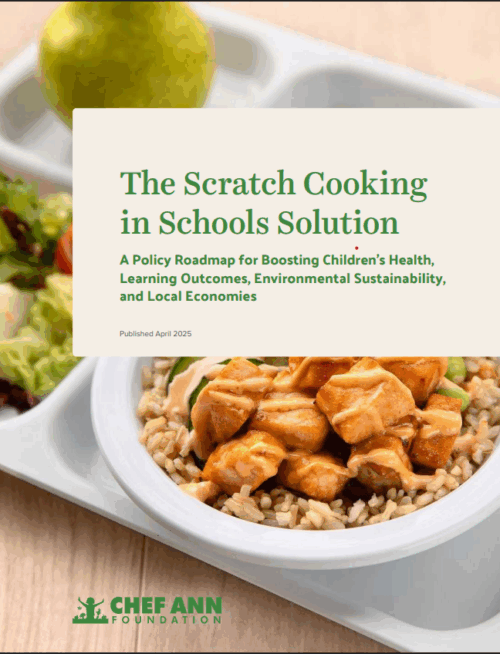
The Chef Ann [Cooper] Foundation has issued This report.

The report, while recognizing obstacles, explains why scratch cooking matters so much.

To protect and improve children’s health — and to access cascading academic, environmental, and economic benefits — schools must serve students more minimally processed meals cooked from scratch. While most schools want to serve their students more scratch-made meals, their ability to do so is significantly limited by systemic labor, financial, and infrastructure barriers, as well as public perceptions that devalue the critical role school food professionals play in suppporting the well-being of our nation’s children.

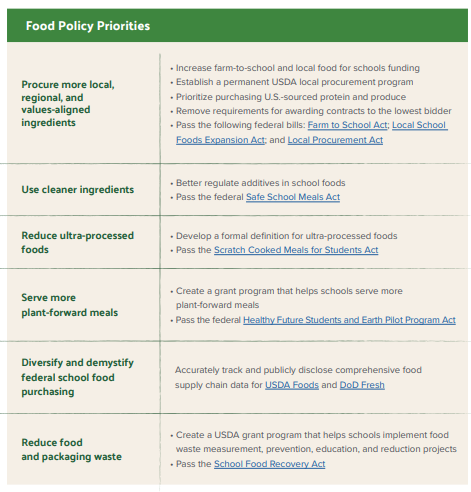
Its food policy priorities are well worth attention, especially now when the Make America Healthy Again (MAHA) movement is focusing on schools.

Let’s hope the MAHA leadership takes a good look at this report.  Thanks Chef Ann!

________________

Published this week!  Information is here.  Get 15% off with this code: FSGPIC15

Jun 11 2025

California is considering banning ultra-processed foods from schools: Really.

The California Assembly has passed a bipartisan bill banning harmful ultra-processed food in schools

California is one step closer to becoming the first state in the nation to ban unhealthy ultra-processed foods in public schools under bipartisan legislation approved today by the state Assembly. AB 1264, introduced by Assemblymember Jesse Gabriel, directs the California Office of Environmental Health Hazard Assessment (OEHHA) to define ultra-processed foods and identify particularly harmful ones to be phased out of schools by 2032. The legislation is co-sponsored by Consumer Reports and the Environmental Working Group.

Whether this will go any further remains to be seen.  The bill sets an ambitious agenda:

The bill defines ultra-processed foods as those that contain one or more certain functional ingredients, including colors, flavors, sweeteners, emulsifiers, and thickening agents. OEHHA would be required to identify ultra-processed foods considered particularly harmful based on whether peer-reviewed evidence has linked the substance to cancer, cardiovascular disease, metabolic disease, developmental harms, reproductive harms, obesity, Type 2 diabetes; whether the substance is hyper-palatable or may contribute to food addiction; and whether the food has been modified to be high in fat, sugar and salt.

I assume this has to go to the Senate and be signed by the governor, so at the moment this is still wishful thinking.

I hope it passes, not least because I can’t wait to find out how its authors think the state will go about identifying the specific foods blocked from schools.

In the meantime, it will be fun to watch the lobbying.

________________

Published this week!  Information is here.

Apr 25 2025

Weekend reading: The Cato Institute on cutting school food

Here is one of the most wrong-headed reports I’ve read in a long time. Cutting School Food Subsidies

The US Department of Agriculture runs a large array of farm and food subsidy programs. The school lunch and breakfast programs are two of the largest, which together with related school food programs will cost federal taxpayers an estimated $35 billion in 2025. Thirty million children, about 58 percent of students in public schools, receive school food benefits. The original goal of the school lunch and breakfast programs was to tackle hunger, but the main nutrition problem for children today is not inadequate calories but excessive consumption of unhealthy foods and obesity. Hence, subsidizing school food is an outdated use of federal dollars. Congress should repeal school food programs to reduce budget deficits and hand power back to the states. State and local governments should decide what sort of school food policies to adopt for their own residents.

Oh great.

I have a completely different take on this.

School meals are demonstrably healthier that a lot of food offered to kids these days.  The biggest problem with school meals is that they don’t serve enough children.  During the pandemic, when school meals were universal, kids and their families did better.

If the problem with school meals is too much unhealty food, the remedy is straightforward: make the meals healthier and give schools enough money to do that.

Fortunately, some states require universal school meals.  They all should do that.

The Cato report should be understood for what it is: an attempt to cut budget for social programs.

Mar 28 2025

Weekend reading: Serving the Public

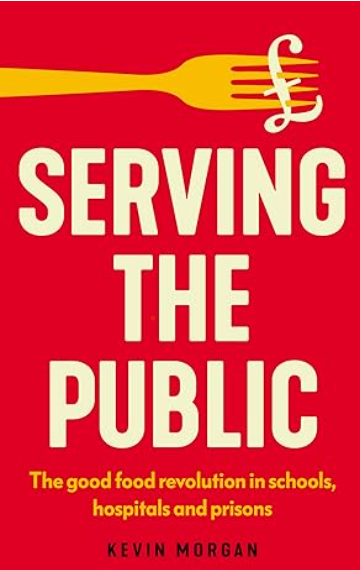
Kevin Morgan.  Serving the public: The good food revolution in schools, hospitals and prisons.  University of Manchester Press, 2025.  

I did a blurb for this book:

In Serving the Public, Kevin Morgan describes the political, economic, and social causes of appallingly unhealthful and disrespectful institutional feeding programs in schools, hospitals and prisons, and the human and societal consequences of such programs, in both theory and practice.  His book provides compelling examples and arguments for why and how we can–and must–do better.

Much of the book describes situations in the UK—Morgan is a professor at the University of Cardiff in Wales—but he also draws on U.S. examples (and cites my work).  Here is why he thinks public nutrition matters.

But perhaps the main danger of personalised nutrition apps…is that they fuel the neoliberal belief that access to a healthy diet is a personal and private matter at a time when it is more imperative than ever to affirm the public duty of care that governments owe their citizens, especially poor and vulnerable citizens. Why is it more imperative than ever to affirm this public duty? Because the multiple crises of food insecurity, hunger and a host of diet-related diseases, to say nothing of the existential threats from climate change, are becoming more pronounced in the low-income countries of the Global South as well as in the high-income countries of the Global North.

And here’s another major point:

It is hard to exaggerate the significance of food in prisons. Our diet affects our physical, mental and emotional wellbeing whoever we are and wherever we live. But eating assumes even more importance for prisoners as they may be confined to a cell for twenty odd hours a day – even during mealtimes – and meals help to punctuate a day that otherwise consists of hours of mind-numbing tedium. Eating in prison is a unique experience because prisoners have limited capacity to choose what, where and when they eat, with the result that they lose control over key aspects of their health, their self-esteem and even their sense of identity.

I don’t usually think about these issues, remote as they are from my daily experience.  It’s good to be reminded of the importance of institutional food and why we should do all we can to make it better.


Jul 19 2024

Weekend reading: Transforming School Food Politics–a gift to readers

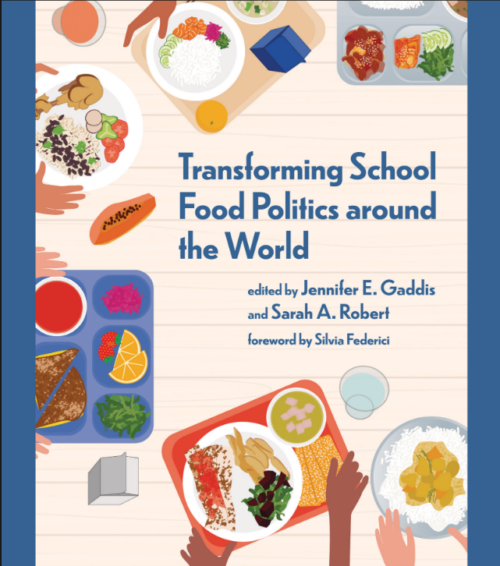
Jennifer E. Gaddis and Sarah A. Robert.  Transforming School Food Politics Around the World.  MIT Press, 2024 (322 pages)

This is an edited volume describing programs and policies to improve school food in the United Sttates, but also Japan, Canada, Peru, Finland, India, Brazil, and South Korea.

Every country does school food its own way.  Only three countries—India, Brazil, and South Korea—have universal school meals, although some U.S. states do too (one chapter explains how states managed it).

Overall, the chapters explain what school food advocates are doing and what works.

If you are interested in school food advocacy, this book is your Bible.

It is especially so because it is Open Access.  You don’t believe this?  Here is a link to a pdf of the entire book.

Even more, the authors wrote a guide to the book with chapter-by-chapter discussion questions, activities, and other resources useful for college classes and practitioner book clubs.  This too is Open Access: here is the link to the study guide.

Enjoy!  And use!

Apr 30 2024

USDA updates school nutrition standards

Last week, the USDA issued new rules for the nutrient content of school meals and also child care programs.

These apply to sugar and sodium (nutrients), whole grains (ingredient or food),  and milk (food).

The New York Times report on this cut right to the chase

The Agriculture Department announced on Wednesday that it had finalized the regulation it had first proposed in February 2023, having weakened several provisions after feedback from food companies, school nutrition professionals and over 136,000 public comments.

The Update to the standards describes the changes and compares them to USDA’s original proposals.

  • Sugars: For the first time (I’m not kidding), the USDA set limits on sugars, starting with breakfast cereals (6 grams per ounce), yogurt (12 grams per 6-ounce serving), and milk (10 grams per 8-ounce serving).  This allows chocolate and other flavored milks if companies get the sugar down to 10 grams.
  • Sodium: beginning July 2027, sodium will be reduced by 15% for lunch and 10% for breakfast from current limits (USDA proposed 3 consecutive reductions of 10% over the next five years.
  • Whole grains: no change from current standard (USDA proposed that 80% of grains be whole).
  • Milk: Allows flavored fat-free and low-fat.

Comment: The sugar rule is an improvement, even though products still are sweetened.  The weakening of the sodium proposal is troubling.  We badly need to reduce sodium in processed and restaurant foods and need federal leadership for doing so.  USDA caved to political pressure here.  The USDA has a long history of captivity by Big Ag.  Now it looks captured by Big Food.

The food industry complaint is that its products won’t meet these standards.  The school food complaint is that the standards are too hard to meet, the kids won’t eat the food, and it will be wasted.

I have a lot of sympathy for school foodservice.  It’s the only thing going on in schools that has to be self-supporting, and school food programs are hugely underfunded.  And lots of schools don’t have kitchens to must rely on food products rather than real food.

But from what I’ve observed, two kinds of skills are needed for successful school meal programs: the ability (1) to prepare and serve edible healthy food, and (2) to get the kids to eat it.  I’ve seen every permutation.

  1. Good food, kids eat it
  2. Good food, kids won’t eat it
  3. So-so food, kids eat it
  4. So-so food, kids won’t eat it

Whenever I hear “the kids won’t eat it,” I wonder where the adults are. From what I’ve seen, if adults care that kids are fed, the kids will eat the food—not all, necessarily, but most.

School food is not just about the food.  It’s about the interactions of school food personnel, teachers, and the principal with the kids.  If the adults think it important and necessary to feed kids healthy food, the program has a good chance of success.  The new USDA standards are a step in the right direction but still have a way to go.

Wouldn’t it be nice if we had food standards rather than nutrition standards?  How about mandating numbers of servings of real foods instead of worrying about grams of sugar and milligrams of sodium.

A thought,

Additional Resources

Oct 27 2023

Weekend reading: School food in Mexico

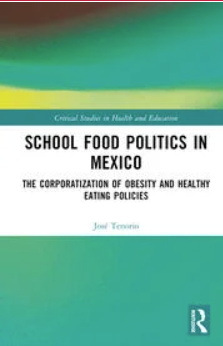
José Tenorio.  School Food Politics in Mexico: The Corporatization of Obesity and Healthy Eating Policies.  Routledge, 2023.  

I was asked for a blurb for this one:

From first-hand observations and deep research, José Tenorio makes it clear that school food in Mexico is about much more than feeding hungry kids; it’s about how food corporations have taken advantage of social inequalities to replace native food traditions with less healthful but profitable products.  School food politics, indeed!

This book may seem specialized, but it is a useful case study in the politics of school food—not confined to the United States, apparently.

Mexico leads the way in efforts to promote healthier diets.  It has  excellent dietary guidelines.   It also has warning labels on food products (see my post on these), soda taxes, a ban on trans fats, and other measures.

Mexico’s schools do not provide meals for kids in schools.  They sell foods at canteens.

The country set nutrition standards for foods sold in schools in 2011, but compliance is not great.

Public health and food advocacy groups support laws to ban unhealthy foods and drinks from schools.  Despite formidible industry opposition, this may actually happen.

This book provides evidence for why it should.

Sep 26 2023

Some good news about school food

A lot of good stuff is going on about school food these days.  Here are five items.

I.  Universal school meals:

Massachusetts has become the 8th state to authorize universal school meals for kids in public schools.

Five of the eight states that have passed universal school meal programs did so this year. Minnesota and New Mexico enacted their policies in March, with Vermont following in June,  Michigan in July and now Massachusetts.  [Others are underway; here’s a current list]

II.  The USDA’s Healthy School Meals Incentives

III.  Water-in-schools initiatives

A new study just out: “Effectiveness of a School Drinking Water Promotion and Access Program for Overweight Prevention” finds drinking water associated with healthier weights.

  • The US News and World Report article on the study.
  • A short video of study findings is available in English and Spanish
  • National Drinking Water Alliance article
  • Water First resources are available here

IV.  Plant-based school meals

Another study, Plant-Based Trends in California’s School Lunches, produced these findings:

  • 68% of districts offer plant-based options daily or weekly, a 54% increase since 2019.
  • Plant-based entrees increased by 16% (but account for only 8% of entrées offered).
  • Districts are serving higher quality, whole plant-based entrees.

But then things get complicated:

  • Processed meat entrees account for 18% of all entrées offered, an increase of 11% since 2019.
  • More the half (57%) of all offerings on school menus contain cheese, and some of these are highly processed and include meat (e.g., pepperoni pizza).

California has a School Food Best Practices Fund for purchasing high-quality plant-based offerings, along with locally grown, minimally processed and sustainably grown food.

V.   School Nutrition policies and practices

A new study, “School Nutrition Environment and Services: Policies and Practices That Promote Healthy Eating Among K-12 Students,” says these interventions work:

Providing school nutrition professionals with professional development

  • Improving the palatability of school meals
  • Offering taste tests
  • Pre-slicing fruit
  • Providing recess before lunch
  • Offering incentives for trying healthier options
  • Providing access to drinking water

Comment:  Yes on universal school meals.  Everyone should be working on states to pass this legislation.  As for what works in schools, these interventions are well within the possible.  Get to work!