by Marion Nestle

Search results: Complaint

Dec 12 2016

Food-Navigator-USA’s special edition on food labeling and litigation

This is one of FoodNavigator-USA’s special edition collections of articles on similar themes, in this case food labeling and lawsuits over labeling issues.  These are a quick way to get up to speed on what’s happening from a food industry perspective .  FoodNavigator introduces this collection:

Food and beverage companies have faced a tsunami of false advertising lawsuits over the past five years. But how big of an issue is this for the industry, who has been targeted, and what strategies are working, both for plaintiffs and defendants in these cases? In this special edition, we also look into labeling issues and trends, from healthy, Paleo and grass-fed claims to NuTek’s potassium salt petition.

Oct 12 2016

WHO takes action against sugary drinks, urges taxes

The World Health Organization took two actions yesterday to encourage people to cut down on consumption of sugar-sweetened beverages.

It issued a report urging national governments to consider taxes: “Taxes on sugary drinks: Why do it?  

Governments can take a number of actions to improve availability and access to healthy foods and have a positive influence on the food people choose to consume. A major action for comprehensive programmes aimed at reducing consumption of sugars is taxation of sugary drinks. Just as taxing tobacco helps to reduce tobacco use, taxing sugary drinks can help reduce consumption of sugars.

It defines sugar drinks as products that contain added sugar, corn or fruit-juice concentrates and include carbonates, fruit drinks, sports drinks, energy and vitamin water drinks, sweetened iced tea, and lemonade.

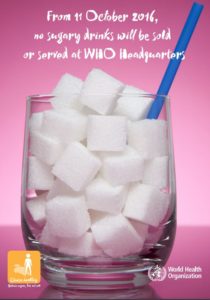
It also took immediate action to remove sugary drinks from its Geneva headquarters

The agency explained this action:

The move signifies how seriously WHO is taking its leadership role in implementing policies to improve public health…By implementing this policy WHO is setting a positive example for Member States, other organizations and visitors…WHO vending machines, restaurants and coffee shops will continue to sell water, fizzy water, and unflavoured milks with different fat contents, teas and coffees, and beverages with non-sugar sweeteners (such as diet and zero calorie drinks). Sugar packets for use with tea and coffee will continue to be served.

These actions are getting plenty of attention.

The Guardian pointed out that:

Battle lines are being drawn in Colombia, where a consumer movement is pressing the case for a sugary drinks tax and the industry is fighting back…Last month, the Asociación Educar Consumidores – the consumer organisation which, like its Mexican equivalent, has backing from Bloomberg Philanthropies in the US – produced an educational video to be broadcast on television, warning that drinking too many sugary drinks can lead to diabetes and other diseases.

But after a complaint from Postobón, the Colombian beverage giant, the government’s regulatory agency charged with consumer protection banned any showing of the video on TV, saying it was inaccurate and could confuse the public.

Michael Bloomberg, now a global ambassador for WHO issued a statement.

A growing number of cities and countries – including Mexico – are showing that taxes on sugary drinks are effective at driving down consumption. The World Health Organization report released today can help these effective policies spread to more places around the world, and that will help save many lives.

The International Council of Beverages Associations (ICBA) issued a statement:

ICBA is disappointed that this technical committee’s report advocates the discriminatory taxation solely of certain beverages as a ‘solution’ to the very real and complex challenge of obesity. We strongly disagree with the committee’s recommendation to tax beverages, as it is an unproven idea that has not been shown to improve public health based on global experiences to date.

Healthy Food America says the soda industry has spent $30 million to fight soda taxes, just this year.

WHO has just given its blessing to soda taxes.  Will countries respond?  How much more is the soda industry willing to spend to stop taxes?

Stay tuned.

Other accounts:

Aug 12 2016

Sugar politics: weekend roundup

I can hardly keep up with news about sugar these days.  Here are a bunch of items that I thought worth notice.

Healthy Food America has produced a Sugar Advocacy Toolkit

Now is the time to act. Scientific evidence of the harm caused by added sugars is strong and growing. News stories have begun sounding the alarm. Some Americans are getting the message that sugar is unhealthy and are cutting back, but consumption remains high along with health impacts associated with overconsumption.

Corporate Europe Observatory has produced a report, A Spoonful of Sugar: How the food lobby fights sugar regulation in the EU.  Here’s how:

  • Lobbies for trade treaties that help undermine or overturn food regulations
  • Challenges regulation through legal threats, complaints, and deregulation drives
  • Works towards corporate capture of regulatory bodies
  • Emphasizes physical activity to avoid legislative action
  • Sponsors scientific research
  • Champions weak voluntary schemes
  • Lobbies aggressively and spends huge sums to combat effective regulation

Good news: A textual analysis of sugar industry influence on the World Health Organization’s 2015 sugars intake guideline shows that WHO mostly resisted the lobbying (here’s the entire paper).

There was little change between draft and final versions of the WHO sugars intake guideline 2015, following industry consultation. The main change was linked to emphasizing the low quality of the evidence on sugar’s adverse effects. Guideline development appeared relatively resistant to industry influence at the stakeholder consultation stage.

Britain’s Food and Drink Federation issued reformulation guidelines for small- and medium-sized businesses on how to reduce sugar and label sugars.

How’s this for a headline: Food lobby rigs EU sugar laws while obesity and diabetes spiral out of control.

Another headline: Big Sugar’s Fanjul Family Hosting Miami Fundraisers for Both Clinton and Trump This Year [The Fanjuls have long been equal opportunity funders]

From The Hagstrom Report

House Agriculture Committee Chairman Michael Conaway, R-Texas, Senate Agriculture Committee ranking member Debbie Stabenow, D-Mich., and Alexis Taylor, a high ranking Agriculture Department official, all committed themselves to the future of the U.S. sugar program today as industry officials and analysts talked about the struggles that beet producers and cane refiners are experiencing in the midst of imports from Mexico and the controversy surrounding genetically modified foods [Comment: recall that US sugar prices are higher than world market prices because of tariffs and quotas, and that every attempt to drop these measures has failed under lobbying pressures].

KIND bars are the first to label added sugars.  

As Grub Street puts it, all food companies are scrambling to reduce their sugars.

It will still be two years before nutrition labels have to get seriously transparent about their sugar content, yet it looks like the countdown is already starting to make Big Food squirm. Added sugar is both omnipresent in Americans’ diets and actively loathed for that very reason. So in May, when the FDA announced new labels had to disclose the number of grams, experts’ hunch was that many products were about to suddenly become a lot less sweet. This prediction was pretty spot-on, if Bloomberg’s new report on Kind is any indication: The snack-bar-maker just became the first company to start voluntarily labeling sugar content, and — surprise, surprise — there’s a lot less sugar in there.

Kind has launched a new website detailing nutrition information

Enough for now.  More to come.  Have a sweet weekend.


Tags:
Jul 25 2016

USDA finalizes school food rules: Applause!

Last week, the USDA sent out a press release announcing the last four Final Rules for school meals under the Healthy, Hunger-Free Kids Act (HHFKA) of 2010:

The press release summarizes USDA’s view of what’s most beneficial in these policies:

You probably won’t want to read all the fine print.  Fortunately, others have done just that.

Bettina Siegel at The Lunch Tray

  • Wellness policies will be required to prohibit on-campus marketing of foods and drinks that fail to meet the Smart Snacks nutritional standards.
  • Whether companies can market “copycat” snacks in schools (Smart Snacks-compliant versions of junk food available in supermarkets) is left up to local districts.
  • Also left to local districts are policies about incentive programs, such as Box Tops for Education or fast food coupons passed out to kids for reading books.
  • School wellness policies will be required to set nutritional standards for foods and drinks offered to kids at classroom parties or by teachers as treats, but districts can determine the actual policies.
  • Schools will be allowed to sell hard-boiled eggs, low-sodium canned vegetables, and peanut butter and celery.

Her bottom line:

With the finalization of these four rules, the historic work of the Obama administration in improving children’s school food environment is now complete. But, of course, we’re already one year overdue for the next CNR [Child Nutrition Reauthorization], a process which could easily roll back or weaken these reforms – many of which have already been overtly threatened by House Republicans.

CSPI’s Take on What’s New

  • Local wellness policies must address marketing of foods and drinks that do not meet the Smart Snacks standards.
  • Local wellness policies must involve the public and school community and produce an annual progress report.
  • Local wellness policies must designate a school official for compliance and undergo administrative review every 3 years.
  • School districts must update goals for nutrition promotion, nutrition education, physical activity, and school wellness activities based on evidence-based strategies.

CSPI says the new rules mean local wellness policies can and should:

  • Shift unhealthy school fundraisers to profitable healthy food or non-food fundraisers
  • Ensure that school celebrations support healthy eating and physical activity
  • Use non-food rewards
  • Provide ample opportunities for physical activity, quality physical education, and recess

My comments

Nutritionism: Many of the complaints about USDA’s nutrition standards derive from their focus on single nutrients—fat, salt, sugar—rather than on foods. Boiled eggs weren’t allowed because of their fat and cholesterol content, but copy-cat snack foods were.  If the standards applied to minimally processed whole foods, they would make more sense. USDA now has to take comments on whether to eliminate the standard for total fat from Smart Snacks because of the egg issue and the confusing nature of current research on saturated fat (also a problem resulting from studying one nutrient at a time).

Politics:  Regardless of how trivial some of these rules may appear, USDA’s school food standards must be considered an extraordinary achievement.  Against all odds—unrelenting opposition from companies that supply junk food to schools, Congress, and, weirdly, the School Nutrition Association—the new rules will improve the nutritional quality of school meals and snacks, at least most of the time.  School districts with officials who care deeply about improving the food served to kids now have a mandate to do so.  Those who don’t will have a harder time doing a bad job.  Applause to USDA for bringing the rules to closure.  May they survive the next round of lobbying.


Jun 9 2016

CSPI and Public Citizen sue the FDA over absurd delays in regulating the safety of—oysters!

The Center for Science in the Public Interest (CSPI) has sued the FDA for ignoring its 2012 petition to prevent illnesses and deaths caused by eating raw oysters from the Gulf of Mexico contaminated with toxic Vibrio vulnificus.

The lawsuit, filed jointly with Public Citizen, asks the FDA to set standards to make sure these bacteria are “nondetectable in oysters and other molluscan shellfish sold for raw consumption.”

The FDA is supposed to respond to the complaint by July 25.

This issue goes back a long way.  I wrote about it in 2011 in the context of a Government Accountability Office (GAO) report, Food Safety: FDA Needs to Reassess Its Approach to Reducing an Illness Caused by Eating Raw Oysters.

Vibrio vulnificus bacteria are considered “flesh-eating;” they kill half the 30 or so people who eat contaminated raw oysters.   Treating the raw oysters before allowing them to be sold kills the bacteria.  California requires this and nobody eating California oysters gets sick from Vibrio.  As I wrote in 2011:

In 2001, the oyster industry trade association, the Interstate Shellfish Sanitation Conference (ISSC), promised the FDA that this industry would substantially reduce Vibrio infections in oysters within seven years through a program of voluntary self-regulation and education aimed at high-risk groups. If this program failed to reduce the infection rate, the ISSC agreed that the FDA could require oysters to be treated after harvesting to kill pathogenic Vibrio.

So what happened?  Late in 2009, the FDA said it would issue rules, but backed off under pressure from the oyster industry and friendly state officials.

Despite years of warnings and promises that it obviously has no intention of meeting, the Gulf oyster industry has been able to stave off FDA regulations for 15 years at the cost of about 15 preventable deaths a year.

CSPI and Public Citizen are trying the legal route.  I hope it works.

Jan 12 2016

The latest in food politics: yogurt wars!

You’ve heard of cola wars?  Try yogurt.

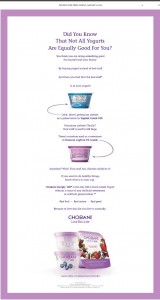
Here’s Chobani’s opening salvo from the New York Times on January 10, and Stephanie Strom’s account of it:

Capture

The ad says:

Did you know that not all yogurts are equally good for you?…

Look, there’s potassium sorbate as a preservative in Yoplait Greek 100.  

Potassium sorbate.  Really.  That stuff is used to kill bugs.

There’s sucralose used as a sweetener in Dannon Light & Fit Greek.  

Sucralose?  Why?  That stuff has chlorine added to it!…

Chobani simply 100 is the only 100-Calorie Greek Yogurt without a trace of any artifical sweeteners or artificial preservatives.

Shades of The Food Babe!

Will yogurt wars help Chobani’s bottom line?

According to Politico Pro

Chobani has taken its dispute over yogurt ingredients with rival Dannon to court, filing a lawsuit Friday that asks a federal judge to declare that claims made in its advertisements “do not constitute false, misleading, disparaging, or deceptive statements”…Chobani’s lawsuit, filed in the U.S. District Court for the Northern District of New York, follows a letter sent by Dannon on Jan. 7 asking Chobani to discontinue the advertisements.

General Mills, which owns Yoplait, has also sued on the grounds that Chobani’s claims are false and misleading (here are General Mills’ complaint and supporting memo).

And here’s Chobani’s response.

We shall see.

Update, January 29

The Court ruled that Chobani cannot criticize its rivals’ ingredients but can promote its products as natural.  The case is Chobani LLC v The Dannon Company, 3:16-cv-00030, filed in the Northern District of New York on January 8; and 0:16-cv-00052-MJD-BRT filed in the US District Court District Of Minnesota on Jan 10.

Chobani’s press release puts a positive spin on the ruling (sent via e-mail):

Chobani Continues to Fight the Good Fight 

Continues to inform consumers about what’s in their cup

NORWICH, N.Y., Jan. 29, 2016 /PRNewswire/ — Chobani, LLC, (“Chobani”), maker of the #1 Greek Yogurt Brand in America, said today that, while it awaits its day in court, it will continue its mission to call on food makers to use only natural ingredients. Chobani will respect the Court’s preliminary decision as it continues its campaign to provide consumers with more information about natural ingredients versus artificial ingredients. As part of the ruling, the Judge said Chobani is free to continue to spread its message about the value of selecting natural ingredients.

“This is not a marketing campaign, it’s a mindset campaign, and it outlines the difference between using only natural ingredients versus artificial ingredients,” said Peter McGuinness, Chief Marketing and Brand Officer, Chobani. “While we’re disappointed by the preliminary ruling, we’re committed to continuing the conversation and it’s good to see big food companies like General Mills starting to remove artificial ingredients from some of their products, like their cereals. In the end, if we can give more people more information while helping other food companies make better food, everyone wins.”

Chobani launched its Chobani Simply 100 Greek Yogurt campaign on January 6, 2016, to help people make more informed decisions about their food choices. Chobani still believes that highlighting the difference between natural and artificial ingredients, specifically sweeteners and preservatives, is important.

Chobani is committed to making high quality Greek Yogurt with simple, authentic, and only natural ingredients, such as fresh milk from local farmers and wholesome fruit. Chobani Simply 100 Greek Yogurt is the only nationally distributed brand of reduced calorie Greek Yogurt that does not contain artificial sweeteners or artificial preservatives.


Tags:
Jan 7 2016

The 2015 Dietary Guidelines, at long last

The 2015 Dietary Guidelines are out.

Picture1

They are now online in a version that takes up dozens of screens with annoying drop-down boxes.  It’s hard to navigate, and if it’s searchable, I can’t figure out how (OK, it’s searchable but doesn’t work all that well).

First the good news.  These Dietary Guidelines—for the first time—attempt to focus on foods and dietary patterns:

Previous editions of the Dietary Guidelines focused primarily on individual dietary components such as food groups and nutrients. However, people do not eat food groups and nutrients in isolation but rather in combination, and the totality of the diet forms an overall eating pattern.

They almost succeed in this mission.  The Guidelines say:

  • Follow a healthy eating pattern across the lifespan [Pattern].
  • Focus on variety, nutrient density, and amount [Pattern].
  • Limit calories from added sugars and saturated fats and reduce sodium intake [Oops: Nutrients].
  • Shift to healthier food and beverage choices [Pattern].
  • Support healthy eating patterns for all [Pattern].

A healthy eating pattern, they say:

  • Includes foods from various groups [Pattern].
  • Limits saturated fats, trans fats, added sugars, and sodium [Oops: Nutrients].

As for (Oops) Nutrients:

  • Less than 10% of calories from added sugars [this is new, but consistent with many other reports such as the one from WHO]
  • Less than 10% of calories from saturated fats [in the Guidelines since 1990]
  • Less than 2,300 mg sodium [no change from 2010]

Why Oops?  Because these Dietary Guidelines, like all previous versions, recommend foods when they suggest “eat more.”   But they switch to nutrients whenever they suggest “eat less.”

In the 2015 Dietary Guidelines,

  • Saturated fat is a euphemism for meat.
  • Added sugars is a euphemism for sodas and other sugar-sweetened beverages.
  • Sodium is a euphemism for processed foods and junk foods.

If the Guidelines really focused on dietary patterns, they wouldn’t pussyfoot.  They would come right out and say:

  • Eat less meat [OK, they do but only under the euphemism of “protein” and only for males. “Some individuals, especially teen boys and adult men, also need to reduce overall intake of protein foods (see Figure 2-3) by decreasing intakes of meats, poultry, and eggs and increasing amounts of vegetables or other underconsumed food groups.”  But what about processed meats?  Not a word that I can find.
  • Cut down on sugary drinks [OK, it says “drink water instead of sugary drinks,” but good luck finding that statement without knowing where it is].
  • Eat less processed and junk food.

Why don’t they?  Politics, of course.

Recall that Congress weighed in with an Appropriations Bill that called for an investigation of the scientific basis of the Guidelines and granted $1 million to the National Academy of Medicine to take them over.

Recall also that the secretaries of USDA and HHS said that the Guidelines would not say anything about sustainability as a rationale for advising eating less meat.

So let’s count the 2015 Guidelines as a win for the meat, sugary drink, processed, and junk food industries.

Other concerns, nutritional and otherwise:

  • Calories: The Guidelines deemphasize calories.  They dropped the information about food sources of calories from the 2010 edition, even though calorie balance remains a—if not the—major public health nutrition problem (an Appendix gives calorie needs).
  • Portion sizes: the best way to control calorie intake is by eating smaller or moderate portions. If the Guidelines talk about portion size, it must be well hidden.
  • Cholesterol: the recommendation to limit cholesterol has been dropped, but the document says, confusingly, that “this change does not suggest that dietary cholesterol is no longer important to consider when building healthy eating patterns. As recommended by the IOM, individuals should eat as little dietary cholesterol as possible while consuming a healthy eating pattern.”  Could the dropping of the limit have anything to do with egg-industry funding of research on eggs, the largest source of dietary cholesterol, and blood cholesterol?  The Physicians Committee for Responsible Medicine has just filed a lawsuit on that very point.
  • Protein: My pet peeve.  The Guidelines use this as yet another euphemism for meat.  “Protein” lumps meat together with seafood, poultry, eggs, nuts, seeds, and soy.  But grains and dairy also have protein, so using this term makes no nutritional sense and obfuscates the message to eat less meat.
  • Seafood: the document recommends 8 ounces a week of seafood high in omega-3s but low in methylmercury. That pretty much means salmon and sardines (anchovies are too salty).

I might have more to say when I can look at a document that is easier to read.

Full disclosure: I was a peer reviewer on an earlier version of this document.

Documents and commentary

Nov 17 2015

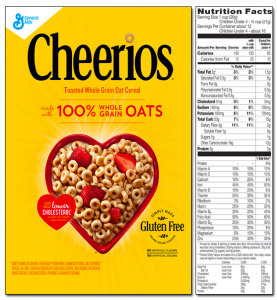
Cheerios for Protein?

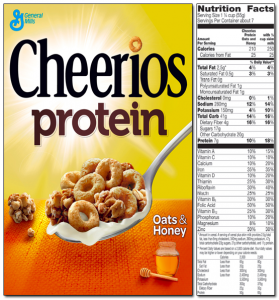
I laughed when I first saw the Cheerios box advertising Protein.  Protein is hardly an issue in U.S. diets—most Americans consume twice what they need—so this is clearly a marketing ploy.

Center for Science in the Public Interest (CSPI), however, was less amused.  Its scientists did the math and compared the protein to the amount in regular Cheerios.  They also looked at serving sizes.

  • Cheerios Protein: Protein 7 grams, Serving Size 55 grams
  • Cheerios regular: Protein 3 grams, Serving Size 28 grams

Hmm.  Not much difference, is there?

CSPI filed a formal complaint.

General Mills falsely and misleadingly markets Cheerios Protein to children and adults as a high protein, healthful alternative to Cheerios. In fact, Cheerios Protein has only a smidgen more protein per serving than Cheerios, or 4 grams, which is only 5% of the average American daily protein intake. Most of that 4 grams is attributable to differences in serving sizes: Cheerios Protein has a bigger, 55 gram serving size, whereas Cheerios uses a 27 gram serving size. Two hundred calories’ worth of Cheerios Protein has a mere 7/10th of a gram more of protein than 200 calories’ worth of Cheerios.

Even worse, they looked at sugars.

  • Cheerios Protein: 17 grams sugars
  • Cheerios regular: 1 gram

As CSPI puts it:

Rather than protein, the principal ingredient that distinguishes Cheerios Protein from Cheerios is sugar. Cheerios Protein has 17 times as much sugar per serving, as Cheerios, which General Mills does not prominently disclose. 8. General Mills charges a price premium for Cheerios Protein.

Oops.

Buzzfeed has a good discussion of this.

Caveat emptor (I seem to be saying this a lot lately).