by Marion Nestle

Search results: single food agency

Apr 24 2013

FDA vs EWG: Report on antibiotic-resistant superbugs in meat oversimplified, misleading?

Earlier this month, the Environmental Working Group (EWG) issued a report on antibiotic-resistant bacteria in meat: Superbugs Invade American Supermarkets.
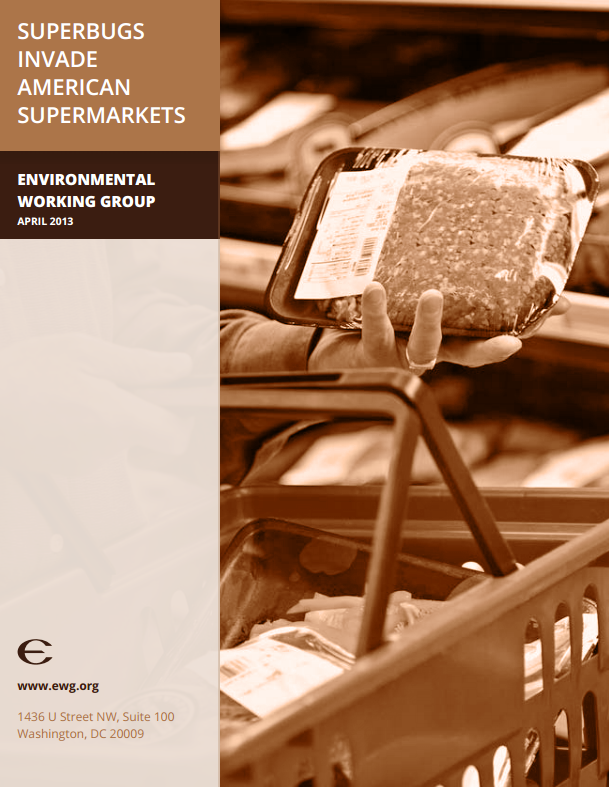
Its message:

Consumers have a right to know that federal scientists are finding antibiotic-resistant bacteria on retail meat in high percentages.

The report must have struck a nerve.  The FDA has now posted a rebuttal on its website, along with the agency’s interpretation of data in the 2011 Retail Meat Annual Report of the National Antimicrobial Resistance Monitoring System (NARMS).

The EWG, says FDA, “oversimplifies the NARMS data and provides misleading conclusions.”

The FDA particularly objects to EWG’s use of the term “superbugs.”

We believe that it is inaccurate and alarmist to define bacteria resistant to one, or even a few, antimicrobials as “superbugs” if these same bacteria are still treatable by other commonly used antibiotics.

The FDA says the NARMS data show:

  • No fluoroquinolone resistance in Salmonella from any source (the drug of choice for treating adults with Salmonella).
  • Resistance to trimethoprim-sulfonamide is also low (0% to 3.7%).
  • Fluoroquinolone resistance in Campylobacter has remained essentially unchanged since it was banned for use in poultry in 2005.
  • Macrolide antibiotic resistance in retail chicken isolates remains low (this is the drug of choice for treating Campylobacter)
  • Multidrug resistance is rare in Campylobacter except that gentamicin resistance increased from 0.7% in 2007 to 18.1% in 2011.
  • Resistance to third-generation cephalosporins, which are used to treat salmonellosis, increased in Salmonella from chicken (10 to 33.5%) and turkey (8.1 to 22.4%) from 2002 to 2011.  FDA has already taken action by prohibiting certain extra-label uses of cephalosporins in cows, pigs, chickens and turkeys.

The EWG’s response to the FDA’s rebuttal:

This is the best the agency can do?

It has been failing to protect the public health on this issue for 40 years, only recently issuing a voluntary guidance to scale back on the worst antibiotic abuses.

What are we to make of this dispute?

Beyond questions about how best to frame antibiotic resistance, some facts are clear.

  • Most antibiotics in the United States are used as growth promoters for raising meat animals, not as treatment for infections in animals or people.
  • Frequent use of antibiotics selects for and promotes the growth of antibiotic-resistant bacteria.
  • Infections with antibiotic-resistant bacteria are difficult to treat, and sometimes very difficult to treat.

It would be better for public health to end the use of antibiotics as growth promoters.

The FDA’s current stance on use of animal antibiotics appears to be more about protecting the meat industry than about protecting public health.

While waiting for the politics to get better (and this might be a long wait), the EWG has some tips for avoiding antibiotic-resistant bacteria in meat.  I can’t think of a single good reason not to follow these recommendations, except that they place the burden of avoiding antibiotic-resistant bacteria on you rather than on the meat industry.

That’s why EWG’s advice to Be Vocal makes especially good sense:

Be vocal: 

  • When you’re eating out: ask if the meat was raised without unnecessary antibiotics. 
  • „At the doctor’s office: don’t press for unnecessary antibiotics. 
  • With your friends: share this tip sheet or a wallet guide with them. 
  • „Make your voice heard: Go to ewg.org/antibioticsaction to find out how you can help preserve the effectiveness of antibiotics [Try www.ewg.org–the link given here doesn’t seem to work].

Aug 3 2011

Where did the 2,000 calorie diet idea come from?

I’m in the midst of working on the copy-edited manuscript of my forthcoming book with Malden Nesheim Why Calories Count: From Science to Politics (University of California Press, March 2012) and spending every minute I have on it.  So I’m going to take some shortcuts on the blog this week and deal with some questions I’ve been asked recently.

One is right on the topic of the book:

Q.  Could you address the 2,000 calorie a day number (both its history and speculate on how an individual can arrive at a more personalized amount)? Short of metabolic testing (and I read conflicting opinions on that, too), it seems rather difficult to figure out how much I should be eating.

A.  Nothing could be easier, and here’s a preview of the kind of thing that will be in this book (with footnotes, of course):

If you look at  a food label, you will see ingredient contents compared to a 2,000-calorie average diet: “Percent Daily Values are based on a 2,000 calorie diet. Your daily values may be higher or lower depending on your calorie needs.”

Here’s the history of where that came from:

The FDA wanted consumers to be able to compare the amounts of saturated fat and sodium to the maximum amounts recommended for a day’s intake—the Daily Values.  Because the allowable limits would vary according to the number of calories consumed, the FDA needed benchmarks for average calorie consumption, even though calorie requirements vary according to body size and other individual characteristics.

From USDA food consumption surveys of that era, the FDA knew that women typically reported consuming 1,600 to 2,200 calories a day, men 2,000 to 3,000, and children 1,800 to 2,500. But stating ranges on food labels would take up too much space and did not seem particularly helpful. The FDA proposed using a single standard of daily calorie intake—2,350 calories per day, based on USDA survey data. The agency requested public comments on this proposal and on alternative figures: 2,000, 2,300, and 2,400 calories per day.

Despite the observable fact that 2,350 calories per day is below the average requirements for either men or women obtained from doubly labeled water experiments, most of the people who responded to the comments judged the proposed benchmark too high. Nutrition educators worried that it would encourage overconsumption, be irrelevant to women who consume fewer calories, and permit overstatement of acceptable levels of “eat less” nutrients such as saturated fat and sodium. Instead, they proposed 2,000 calories as:

  • consistent with widely used food plans
  • close to the calorie requirements for postmenopausal women, the population group most prone to weight gain
  • a reasonably rounded-down value from 2,350 calories
  • easier to use than 2,350 and, therefore, a better tool for nutrition education

Whether a rounding down of nearly 20 percent is reasonable or not, the FDA ultimately viewed these arguments as persuasive. It agreed that 2,000 calories per day would be more likely to make it clear that people needed to tailor dietary recommendations to their own diets. The FDA wanted people to understand that they must adjust calorie intake according to age, sex, activity, and life stage. It addressed the adjustment problem by requiring the percent Daily Value footnote on food labels for diets of 2,000 and 2,500 calories per day, the range of average values reported in dietary intake surveys.

 As to how many calories you personally need, I think they are too difficult for most people to count accurately to bother.  The bottom line: If you are eating too many, you will be gaining weight.   

The best advice I can give is to get a scale and use it.  If your weight starts creeping up, you have to eat less.

The book will go into far more explanation of such issues but for that you will have to wait until March.


Dec 2 2010

The latest on the GM front: sugar beets and apples

I haven’t seem much comment on what’s happening with Center for Food Safety v. Vilsack, a suit to prevent planting of genetically modified (GM) sugar beets because USDA allowed them to be grown without filing an Environmental Impact Statement (EIS).

This is kind of after-the-fact because Monsanto’s GM sugar beets have been planted widely for the last five years and now comprise 95% of the sugar beet crop in the U.S.

As the Center for Food Safety explains,

The court outlined the many ways in which GE sugar beets could harm the environment and consumers, noting that containment efforts were insufficient and past contamination incidents were “too numerous” to allow the illegal crop to remain in the ground. In his court order, Judge White noted, “farmers and consumers would likely suffer harm from cross-contamination” between GE sugar beets and non-GE crops. He continued, “the legality of Defendants’ conduct does not even appear to be a close question,” noting that the government and Monsanto tried to circumvent his prior ruling, which made GE sugar beets illegal.

No surprise, Monsanto is appealing and is likely to be joined by the government in the appeal.  Food Safety News quotes a Monsanto spokesman:

With due respect, we believe the court’s action overlooked the factual evidence presented that no harm would be caused by these plantings, and is plainly inconsistent with the established law as recently announced by the U.S. Supreme Court,” said David Snively, general counsel for Monsanto, in a news release….The issues that will be appealed are important to all U.S. farmers who choose to plant biotech crops…We will spare no effort in challenging this ruling on the basis of flawed legal procedure and lack of consideration of important evidence.”

Food Safety News also reports that a Washington state apple grower has petitioned USDA to allow it to market a GM apple engineered to resist browning.

But wait.  I’m confused.  Isn’t the FDA supposed to be the agency that approves the planting of GM foods?

This sent me right to the FDA site that summarizes GM varieties that are permitted to be planted (“completed consultations“).  I see papayas and cantaloupe on the list, but not a single apple variety.

How can this company market a GM variety of apples if the FDA hasn’t approved it?  Can anyone explain what’s going on here?  Thanks.

Update December 3:  A judge in San Francisco ordered GM sugar beets planted on 256 acres to be destroyed.  USDA is appealing.  And now everyone is worried about sugar shortages.  Oh dear.

May 13 2010

White House Task Force on Obesity reports in

This report, Solving the Problem of Childhood Obesity Within A Generation, is a terrific summary of where we stand today on childhood obesity (“the challenge we face”) and what to do about it. The report wants to reduce rates of child obesity to where they were before all this started:

That means returning to a childhood obesity rate of just 5% by 2030. Achieving this goal will require “bending the curve” fairly quickly, so that by 2015, there will be a 2.5% reduction in each of the current rates of overweight and obese children, and by 2020, a 5% reduction.

This seems so modest that it might actually be achievable.

Like most such plans, this one has way too many recommendations, in this case, 70 (the summary table starts on page 89).  These are divided up in categories.  For example:

Recommendations for early childhood

  • Educate and help women conceive at a healthy weight and have a healthy weight gain during pregnancy
  • Encourage and support breastfeeding
  • Prioritize research into chemicals in the environment that may cause or worsen obesity
  • Educate and support parents in efforts to reduce kids’ TV and media time
  • Improve nutrition and physical activity practices in child nutrition programs.

For empowering parents and caregivers:

  • Government should work with local communities to promote the 2010 Dietary Guidelines for Americans and the 2010 food pyramid.
  • USDA and FDA should work with the food and beverage industry to develop standard nutrition labels for packages.
  • Restaurants and vending machines should display calorie counts of all items offered.
  • The food and beverage industry should extend its voluntary self-regulation to restrict all forms of marketing to children. If this does not happen, federal regulation should be considered
  • Media and entertainment companies should limit licensing of popular characters to healthy food and beverage products
  • Insurance plans should cover services needed to help prevent, assess, and care for child obesity.

For healthier food in schools

  • Update federal standards for school meals and improve the nutritional quality of USDA foods provided to schools.
  • Increase funding for school meals.
  • Encourage schools to upgrade cafeteria equipment to support healthier foods. Example: Swap deep fryers for salad bars.
  • Connect school meal programs to local growers and encourage farm-to-school programs.
  • Improve nutritional education in schools and make it more available.
  • Increase the use of school gardens to educate about healthy eating.
  • Promote healthy behaviors in juvenile correction facilities.

For improving access to healthy foods

  • Launch a multi-agency “Healthy Food Financing Initiative” to make healthy foods more available in underserved urban and rural communities.
  • Encourage local governments to attract grocery stores to underserved neighborhoods
  • Encourage facilities that serve children (e.g., hospitals, recreation centers, and parks) to promote healthy foods and beverages.
  • Provide economic incentives to increase production of healthy foods such as fruits, vegetables, and whole grains.
  • Evaluate the effect of targeted subsidies on purchases of healthy foods through nutrition assistance programs.
  • Study the effects of state and local sales taxes on calorie-dense foods.

For increasing kids’ physical activity

  • School programs should stress physical activity as much as healthy nutrition.
  • State and local school programs should increase the quality and frequency of age-appropriate physical education taught by certified PE teachers.
  • Promote recess for elementary school students and activity breaks for older students.
  • Federal, state, and local agencies should partner with communities and businesses to extend the school day in order to offer physical activity programs.
  • The EPA should assist communities building new schools to place them on sites that encourage walking or biking to school.
  • Increase the number of safe playgrounds and parks, particularly in low-income communities.
  • Encourage entertainment and technology companies to continue developing new ways to engage kids in physical activity.

Good ideas, but there are some things I’m not so crazy about here.  The plan seems awfully voluntary and let’s be pals and all work together. Voluntary, as evidence demonstrates, does not work for the food industry.  Much leadership will be needed to make this plan work.  But these recommendations should give advocates plenty of inspiration to continue working on these issues.

The Washington Post has a particularly good summary of the key recommendations, and singles out the ones aimed at marketing to kids.

Jane Black of the Washington Post is cautiously optimistic.  Me too.

Dec 30 2009

The latest recall: mechanically tenderized beef

I am, as always, indebted to Bill Marler for his ongoing commentary – often with slide shows – on recalls of foods contaminated with E. coli O157:H7 and other nasty bugs.  He offers ongoing comments about the Christmas eve recall of 248,000 pounds of needle-tenderized steaks.

He points out that the recall now affects people in several states and that the meat was intended for several chain restaurants.   The contaminated meat, produced in Oklahoma, has sickened at least 19 people in 16 states.

Mechanically tenderized “non-intact” beef?  Uh oh.  The great thing about intact steak is that harmful contaminants are on the outside surface; the bacteria get killed by the high heat of searing the outside surface.  You don’t have to worry about the safety of intact steak because its insides are relatively sterile.  But if the steak is pre-treated to tenderize it, watch out!  Tenderizing can drive harmful bacteria right into the interior where they won’t get killed unless the steak is thoroughly cooked.

To explain the problem, Marler posts a slide show from Dave Boxrud.  Here is one of Boxrud’s illustrations:

Photo from David Boxrud's slide show on the Marler Blog site

Marler provides links to documents showing that the USDA has received plenty of recent warnings about the dangers of undercooked non-intact beef.  This is no surprise.  In my 2003 book, Safe Food (coming out in a new edition in 2010), I discuss the USDA’s “testing gap” with respect to nonintact beef.  In 1999, the USDA said that it wanted to extend its testing requirements for ground beef to mechanically tenderized beef that might be contaminated with E. coli O157:H7.

In Safe Food, I explain how the beef industry reacted with “shock, disbelief, and anger” to the USDA’s safety proposal.  One industry representative accused the USDA of taking “another step in this administration’s obfuscation of the impeachment activities.” Those activities, of course, referred to the scandal then involving President Clinton and the White House intern, Monica Lewinsky.

Then, the meat industry’s position was that pathogens were inherent in raw meat, cooking kills them, and testing would put the industry out of business. Ten years later, the industry position hasn’t budged. The Washington Post (December 30) quotes beef industry representatives arguing that mechanical tenderizing poses no particular health problems.

According to Food Chemical News (September 28), Congressional representative Rosa DeLauro (Dem-CT), who chairs the House appropriations agriculture subcommittee, has called on USDA to take immediate action to require labeling of meat that has been mechanically tenderized.

And USA Today (December 30) has produced another long investigative report on the safety of school meals, this one citing plenty of examples of companies that successfully produce or serve safe meat and of countries that do food safety better than we do.  In the meantime, the food safety bill is still stuck in Congress.  Let’s hope that it gets moving early in 2010.

Addendum: The New York Times (online December 30) also is interested in beef produced for the school lunch program.  Its reporters investigated safety problems with beef trimmings that had been injected with ammonia to kill bacteria.    Two things about the beef trimmings are especially interesting.  One person is quoted in the article referring to them as “pink slime.”  And they used to be used for pet foods until meat packers figured out that selling them to USDA for school lunches was more profitable.

As for the ammonia treatment: surely this is not the same stuff used to clean bathrooms?  Apparently so.  But using it is tricky.  You have to inject enough ammonia to kill bacteria but if you do the meat smells like an ammonia-treated bathroom.  If you don’t want the meat to smell, you can’t use as much.  But if you don’t use as much, you get Salmonella. This, alas, is another example of regulations not working.

Congress: pass the food safety bill and then start working on a single food safety agency!

Update January 7: The CDC has posted information on its investigation of this outbreak on its website.

Dec 19 2009

Serving size standards: maybe not so bad after all?

I received a flurry of “you should have attended the meeting before you said anything” messages in response to my post yesterday about the FTC forum.  They said the table that I posted did not have footnotes attached and I also had missed a key point about RACC (reference amounts commonly consumed): they are likely to be larger than current FDA serving sizes, meaning that the amounts of sugars and salt will have to be reduced to qualify.

Guilty as charged.  RACC, as I mentioned yesterday, is a new term to me.  This is because – how could anyone have missed this – I was unaware of the FDA’s Federal Register notice of April 4, 2005: “Serving sizes of products that can reasonably be consumed at one eating occasion; Updating of reference amounts customarily consumed; Approaches for recommending smaller portion sizes.”

This notice was the result of concerns about the serving sizes that had been established when the FDA issued final food labeling regulations in 1993.  Then, the FDA established serving sizes for 129 product categories for adult foods and 11 categories for infant and toddler foods.  These were derived from information about amounts commonly consumed reported in food consumption surveys from the late 1970s and late 1980s.

Either people ate a lot less back then or they were lying, or both.  As my former doctoral student, now Dr. Lisa Young, discovered during her doctoral research, standard portion sizes – half a cup of ice cream or one 2 or 3-ounce slice of pizza, for example – are smaller (sometimes much smaller) than what people seem to be actually eating.

The FDA knew this.  In 2003, it appointed an Obesity Working Group to advise the agency about several issues, among them whether to update the RACCs.  The Group filed its report in 2004.  With respect to serving size, it recommended:

* In the short-term, that FDA encourage manufacturers immediately to take advantage of the flexibility in current regulations on serving sizes that allows food packages to be labeled as a single-serving if the entire content of the package can reasonably be consumed at a single-eating occasion.

* In the long-term, that FDA develop two separate ANPRMs [Advance Notice of Proposed Rulemaking].  The first would solicit comment on whether to require additional columns within the nutrition label to list the quantitative amounts and %DV of the entire package on those products and package sizes that can reasonably be consumed at one eating occasion or, alternatively, declare the whole package as a single serving. This ANPRM would also solicit information on products and package sizes that can reasonably be consumed at one eating occasion.  The second ANPRM would solicit comments on which, if any, RACCs of food categories appear to have changed the most over the past decade and therefore need to be updated.

On that basis, the FDA’s 2005 Federal Register notice asked for comments about whether:

  • Consumers might “think that an increase in serving size on food labels means more of the food should be eaten.”
  • Manufacturers might repackage products in larger sizes to avoid labeling a package as a single serving.
  • Manufacturers might reduce the size of single-serving packages to reduce the apparent content of undesirable nutrients.

That was nearly five years ago.  If anything further happened, I cannot find it in the Federal Register. Getting to these questions at last was apparently the point of the FTC forum.

I am told that panelists suggested raising the RACC serving size of kids’ cereals to 50 grams rather than the current 30 grams.  If so, this would require cereal companies to reduce the amount of sugars in their products.   Aha!  That could explain why, as I discussed in a previous post, General Mills chose to put its full-page ads in newspapers promising to drop the sugars to single digits.  General Mills must think changes in the RACC for cereals will require it to lower the sugars in order to be able to advertise to kids under the voluntary guidelines. Given how long the FDA’s processes take, it is understandable why General Mills failed to say when it would implement its promist.  I am also told that the salt cut-point is open for comment.

For those of us who were not at the Forum and prefer to see such things in writing, how about releasing the footnotes to that chart and giving us some examples of the proposed changes to the RACC?  Also, how about setting up a mechanism so interested people can file official comments on the proposals?  Both would help people offer more informed comments on how the FDA should handle the serving size issues.

Update, December 20: Thanks to Ellen Fried for providing a link to some food industry opinion on what all this is about and another an in-the-know source that says the proposed standards are to be published in the Federal Register and opened for further public comment in January.  The project is to be finished by July.  Ellen points out that this procedure seems administratively complicated for standards that are not regulations; they are voluntary. Do the FTC and FDA really have to go through all this to issue what is simply guidance?  Or is something else going on here that I’m not getting?

Oct 14 2009

Larry King Live on unsafe meat

Bill Marler has posted a handy link to his Monday night appearance on Larry King Live on which he, and many others, were on to discuss meat safety.  As Marler puts it, the discussion got sidetracked – I would say derailed – from food safety to whether eating meat is good for you or not. Among others, Colin Campbell, the committed vegan scientist who wrote The China Study, was given plenty of air space to argue no it is not.

Despite Marler’s best efforts, and those of mothers and grandmothers of children sickened by eating meat contaminated with E. coli O157:H7, King refused to let anyone get a word in edgewise about the need to fix our food safety system.

Forgive me, but we know what needs to be done about food safety.  As I am ever intoning, we need a single agency devoted to food safety that combines the safety functions of FDA and USDA.  That agency needs to require and enforce a science-based safety system (of the HACCP type) for all foods, from farm-to-table.

Will we ever get it?  Only if people like Larry King catch on to the problem and help generate enough public outrage to get Congress to move on food safety.  King had the chance.  He blew it.

Jun 27 2009

At last: some clear thinking about cookie dough

OK, so Bill Marler is a class action lawyer* who makes his living from suing companies that produce unsafe food. I’ll grant that he has a vested interest but I admire the way he never loses sight of the harm done to innocent adults and children.  Cookie dough has a warning label on the package and everyone knows you are not supposed to eat raw cookie dough.  If you eat it, it’s your fault if you get sick, right?  See what he has to say about that one.

In Marler’s view, the warning label on commercial raw cookie dough should read something like this:

THE FDA INSPECTION MEANS NOTHING. THIS PRODUCT MAY CONTAIN A PATHOGENIC BACTERIA THAT CAN SEVERELY SICKEN OR KILL YOU AND/OR YOUR CHILD. HANDLE THIS PRODUCT WITH EXTREME CARE.

And, he asks, “Where is the multi-million dollar ad campaign to convince us of the dangers of uncooked cookie dough, like we do for tobacco?”

I would add a few further questions: What are we going to have to do to get a real food safety system in this country?  By real food safety system, I mean one that requires production of all foods – from farm to table – under science-based food safety plans (HACCP with pathogen reduction), overseen by a single federal agency that unites and rationalizes the current functions of USDA and FDA.

Everyone knows how to produce food safely or a lot more safely than is being done now.  If companies don’t bother, it’s because they don’t have to. You don’t like this?  Complain to Congress!

*Correction: See Mr. Marler’s comment below.  He says he mostly represents individuals.   I do apologize for the error.