by Marion Nestle

Currently browsing posts about: Agriculture

Nov 3 2023

Weekend reading: Farm Action’s analysis and policy recommendations

Farm Action, an organization devoted to stopping corporate agrocultural monopolies and building fair competition in rural America, has issued a short report, Balancing the US Agricuiltural Trade Deficit with Higher Value Food Crops.  

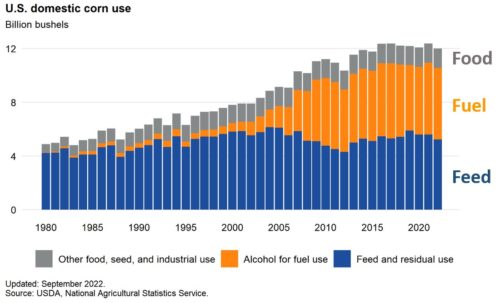
Its point (you have heard this from me repeatedly): the U.S. food system focuses on feed for animals and fuel for automobiles.  It ought to focus on food for people.

The current situation:

  • Most American farmland acreage is dedicated to animal feed and fuel production.
  • Over the last 5 years, American consumption of chicken and exports of pork continued to climb, increasing demand for soy, a key feed crop for pork and poultry.
  • Acreage of many key food crops including potatoes, sweet potatoes, sweet corn, tomatoes, apples, and oranges has fallen precipitously 20-90% from peaks in the 20th century.
  • Exports fell and imports rose for vegetables, fruits, melons, and key food grains.
  • Across produce items, the US was or became a net importer of all 5 of the top vegetables by 2021.

What can be done:

  • At 2022 prices, just 3.5-4.4 million acres of higher value fruit, vegetables, and melons would be needed to generate $32.9B in sales, the 2022 size of the US produce trade deficit and more than the projected $27.5B
    overall ag deficit projected for 2024—this amounts to just 0.4% of US farmland.
  • This could be accomplished by approximately doubling the amount of land currently harvested for these crops.

Policy (Legislative) recommendations for farmers who grow food for people:

  • Improve crop insurance and risk management
  • Expand market access

These analyses make these fixes look easy.  Make them happen!

Oct 6 2023

Weekend reading: the cost of growing Romaine lettuce in California

Every now and then I run across a report about something I know absolutely nothing about but wish I did, and this is one of them—an analysis from the University of California on Sample Costs to Produce and Harvest Romaine Hearts Lettuce.

I’m particularly interested in Romaine because it is one of those foods that turns up frequently in food poisoning incidents.  Why?  Because in California and Arizona it is often grown in close proximity to Confined Animal Feeding Operations (CAFOs), as shown in the Netflix film, Poisoned, in which I appear briefly.

Bill Marler, the lawyer featured in the film, does not eat bagged Romaine.  Neither do I.

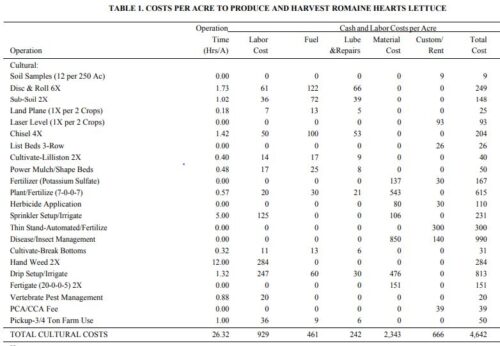
The cost analysis, which concludes that it takes about $17,000 an acre to produce Romaine, does not factor in fmeasures to assure safety.

But what it does consider is impressive.  Here is just the first part of a Table that continues well into another page.

I would not have guessed.

I grow Romaine lettuce in pots on my Manhattan terrace.  All I pay for is seeds.  I’ve never gotten sick from eating it.

Apparently, industrial lettuce is an entirely different matter.

Enjoy the weekend!

Sep 28 2023

US industrial agriculture at a glance

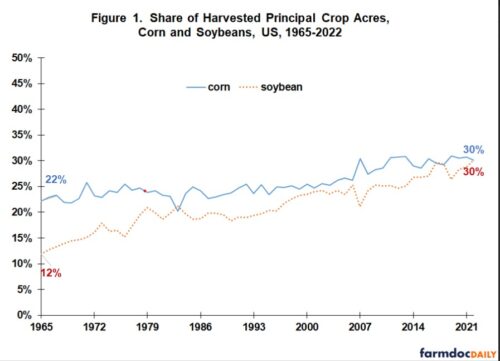
A post on X (the site formerly known as Twitter) displayed this graph.

It comes from a policy report published on FarmDocDaily: Concentration of US Principal Crop Acres in Corn and Soybeans.

The bottom line: 30% of harvested acres is devoted to corn, and another 30% to soybeans.

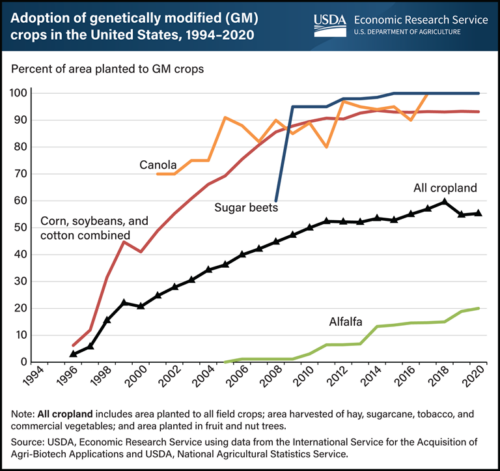
These, of course, are largely genetically modified.

This is industrial agriculture at a glance.

And here’s one more, worth seeing again in this context.

Regenerative agriculture anyone?

Apr 5 2023

Farm bill primer: 25 members of Congress get agriculture subsidies

If you want to understand why it is politically impossible to transform the Farm Bill into legislation that promotes health, sustainability, and regenerative farming, take a look at the Environmental Working Group’s  Website and Farm Subsidy Database.

This reveals that eight members of the House Agriculture Committee,received over $14 million in federal farm subsidies between 1995 and 2021.

The eight: Reps. James Baird (R-Ind.), Jim Costa (D-Calif.), Doug LaMalfa (R-Calif.), Frank Lucas (R-Okla.), Tracey Mann (R-Ks.), Mary Miller (R-Ill.), John Rose (R-Tenn.), and Austin Scott (R-Ga.)

This is a clear conflict of interest.

Are these agriculture committee members likely to put a stop to inappropriate subsidies?  Doubtful.  They ought to be taken off the Agriculture Committee immediately.

Note: the size of the subsidy doesn’t matter.  Even small subsidies exert influence.

EWG also says that lawmakers who received commodity subsidies are also likely to be getting crop insurance subsidies.

But because those subsidies are not disclosed to the public, it’s not possible to determine whether some legislators are double dipping this way.

The EWG provides a list of all current members of Congress and family members who get farm subsidies here.

*******

For 30% off, go to www.ucpress.edu/9780520384156.  Use code 21W2240 at checkout.


Nov 15 2022

What’s up with food systems at COP27?

COP27 is the term used to refer to the 27th annual United Nations Conference of the Parties of the UNFCCC [United Nations Framework on Climate Change Conference) taking place last week and this week in Sharm el-Sheikh, Egypt.

The New York Times has a COP27 explainer with a Q and A

This may be the 27th such conference, but it is the first to deal with the intersection of food production and consumption with climate change: how climate change affects agriculture and food systems and how agriculture and food systems affect climate change.

For the first time, several pavilions are devoted to food systems, this one specifically.

Food Tank is managing some of the programs at these pavilions.  Its president, Danielle Nierenberg, reports on them daily at this site

The official UN news site is here.

On November 12, agriculture was the theme of the day.   This is explained in a short video. 

Water was yesterday’s theme.

I’ve been trying to follow the events from Nierenberg’s comments and from the occasional article in the New York Times, for example, here (what the fights are about), here (videos of speeches), and here (protest and hunger strikes).

The Food4Climate pavilion’s YouTube channel for live streams and videos is here.

The Rockefeller Foundation is involved in COP27.  It sponsors a food and agriculture pavilion.

The Foundation also has produced a film, Food 2050.  The trailer is here.

I’m particularly interested in this film because Rupa Marya, who is attending the conference, says I’m in it and sent me this screen shot (I’m not in the trailer).

Will anything good come out of this COP27?  I’m inspired by this speech from the head of the World Health Organization.  Bringing these issues to public attention might help.

***********

For 30% off, go to www.ucpress.edu/9780520384156.  Use code 21W2240 at checkout.


Jun 29 2022

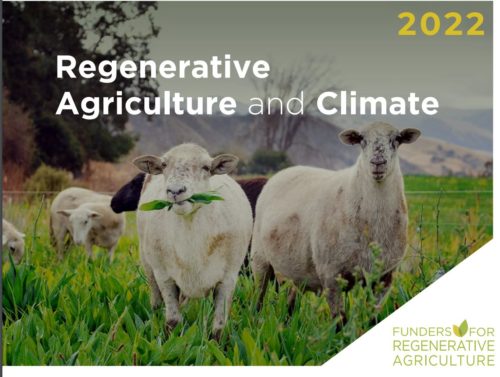
Regenerative agriculture and climate change: report

Urvashi Rangan of the Funders for Regenerative Agriculture (FORA) sent me the press release from this group’s report. 

From the press release:

We are very proudtodayto be publishing our first brief,RegenerativeAgriculture and Climate, which outlines how regenerative agricultureand livestock production can restore degraded land, reduce greenhouse gas emissions, and store carbon while producing nutritious food. The brief is clear that regenerative agriculture – including sustainable meat production – is a “shovel ready” climate solution that if scaled quickly could rapidly reduce greenhouse gas emissions and to remove carbon dioxide from the air. 

The report pulls together the arguments for the benefits of regenerative agriculture as a solution to climate change, deals with misconceptions about regenerative practices, and provides useful figures and references. 

The escalating climate crisis requires rapid action on two critical fronts: (1) a steep reduction in greenhouse gas emissions; and (2) the removal of carbon dioxide from the air and its safe, long-term storage.  Regenerative agriculture can do both. ..Using
photosynthesis and biology, it can restore and maintain the carbon cycle on land. Any amount of carbon dioxide (CO2) absorbed by trees, plants, and soils and subsequently stored has been removed directly from the atmosphere and will help alleviate climate change.  It can also reduce methane, a potent greenhouse gas, from livestock production.  

If you want to know more about regenerative agriculture—and why it matters—this is a great place to start.

Jun 14 2022

Do farm subsidies help alleviate poverty?

When it comes to analyses of agricultural policies, some of the most critical come from conservatives.

From the American Enterprise Institute: Farm Subsidies and the Poor (2022). The key points:

  • Despite claims to the contrary, farm subsidies do little to reduce food prices and almost nothing to alleviate rural poverty.
  • Payments of farm subsidies are roughly proportional to farm output; therefore, those who operate small farms receive minimal benefits from such programs.
  • Other US Department of Agriculture policies that provide low-income households with subsidies to buy food do increase food security and reduce poverty.

An earlier report from the American Enterprise Institute:  Agricultural subsidies aid the wealthy, not those in rural poverty (2017)

Taken together, these programs cost about $20 billion every year…Who gets all that federal money? About 70 percent of all crop insurance and other farm income safety net payments flow to 10 percent of the largest crop-producing farm businesses. This group comprises less than 100,000 farm operations, each of which on average receives more than $140,000 every year…In contrast, 10 percent of the smallest farms receive a mere pittance, on average no more than about $50 — from the federal crop insurance and safety net programs. And the bottom 80 percent, including midsize farms, receive less than 10 percent of all subsidy payments.

From the Cato Institute: Examining America’s Farm Subsidy Problem (2020)

U.S. agriculture is on track for one of the three most‐​profitable years in a half century. Adjusted for inflation since 1973, projected net farm income in 2020 will be surpassed only by 2011 and 2013 figures.  The chart and underlying data are available from the USDA here:

lincicome-15-img1.jpg
This year, farmers (on net) will derive almost 40 percent of their income directly from the U.S. government. Forty percent.
Comment: The main effect of agricultural subsidies is to encourage Big Ag to grow commodity crops in places where they should not be grown.  Clearly, ag policies need rethinking.  How about revising them to support production of real food, rather than feed for animals and fuel for cars?  How about redesigning ag policy to refocus it on health and sustainability?  These reports suggest that plenty of bipartisan support is available.  Let’s tap into it for the next farm bill.
Jun 2 2022

A better deal for poultry farmers? Fingers crossed.

Last week, the Biden-Harris Administration Announced “New Actions to Strengthen Food Supply Chains, Level the Playing Field for Growers, and Lower Prices for American Consumers.”

These follow up on promises made in July 2021 and January 2022 (I’ve written about these previously), so it’s not as if the meat and poultry producers haven’t been warned.

The new announcement specifically addresses the unfairness of current poultry production: Transparency in poultry grower contracting and tournaments.

I consider the system for raising chickens in this country an astonishing example of a monopoly-controlled business model.  In this model—brilliant from a business standpoint—big  poultry producers set all the rules and take most of the profits, leaving all the risks to the farmers who actually raise the chickens.

Even worse, this business model forces chicken farmers to compete against each other.  In what is called a “tournament” system, the farmers whose chickens gain the most weight get paid the most.  But which chicks they get to raise is determined by the producers.

As to how all this works and why it is so deeply unfair, it’s worth reading Leah Douglas’s Is the US chicken industry cheating its farmers?

The companies own and operate all the means of production, including the feed mills, slaughterhouses, trucking lines and even the hatcheries that develop the best strains of chickens.

Farms are the only part of the market these big companies don’t own. Independent farmers borrow millions of dollars to build sophisticated warehouses, where they raise hundreds of thousands of chickens at a time…Farmers raise the birds under contract with an integrated company, giving firms strict control over operations. The poultry companies own the chickens, the feed, and even control the chickens’ medical care. All farmers can do is try to raise the birds as efficiently as possible, even though most of the business is out of their hands.

The administration’s proposed rule is designed to increase transparency and accountability in this system.  Also,

USDA is opening an inquiry into whether some practices of processors in the tournament system are so unfair that they should be banned or otherwise regulated.

It’s about time.  I hope the administration moves quickly on the new rules.