by Marion Nestle

Currently browsing posts about: AHA(American Heart Association)

Apr 7 2026

Dietary guidelines: AHA v. MAHA

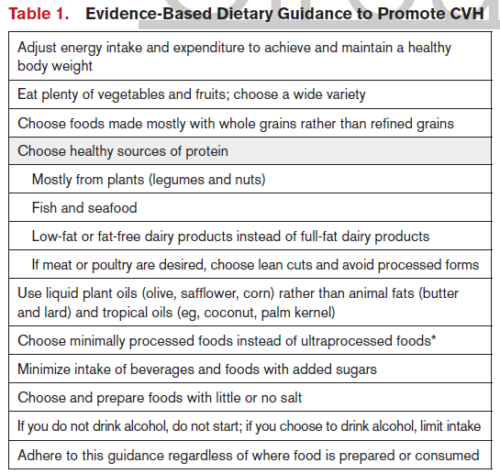
The American Heart Association has just published its updated dietary guidelines: The 2026 Dietary Guidance to Improve Cardiovascular Health: A Scientific Statement From the American Heart Association  [the press release is here].

These constitute a firm rebuttal to the MAHA (Make America Healthy Again) guidelines issued in January.

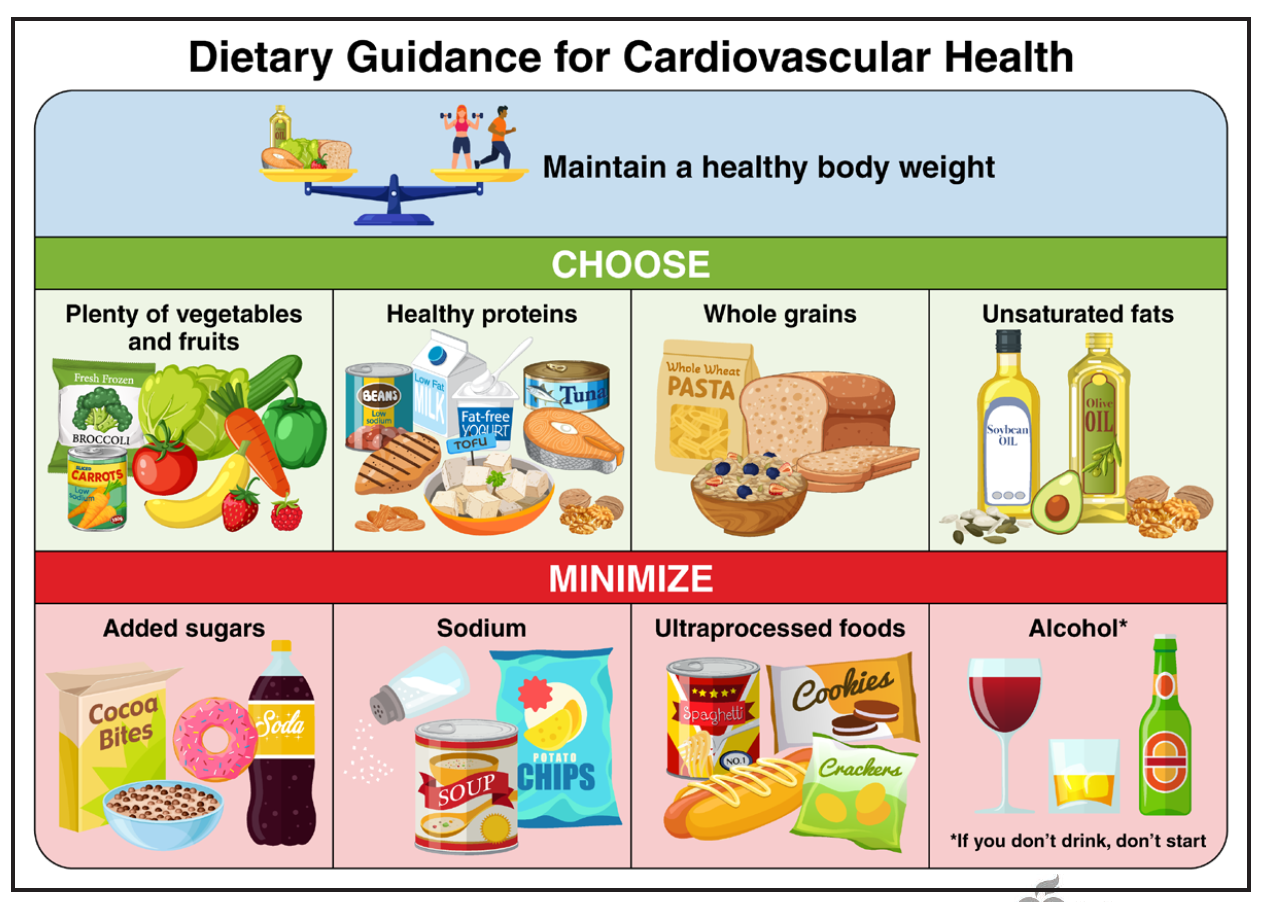
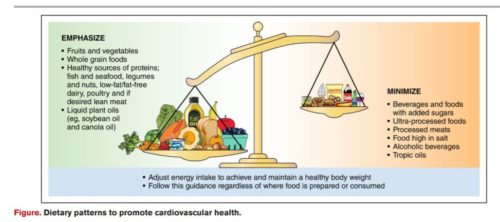
The AHA’s clear and straightforward messages are beautifully illustrated:

The AHA messages particularly differ from the MAHA messages:

  • Protein: Plant rather than animal sources
  • Meat: Lean cuts, avoid processed, limit portions
  • Dairy: Low-fat or fat-free rather than full-fat
  • Fats: Unsaturated rather than saturated; nontropical oils rather than animal fats and tropical oils

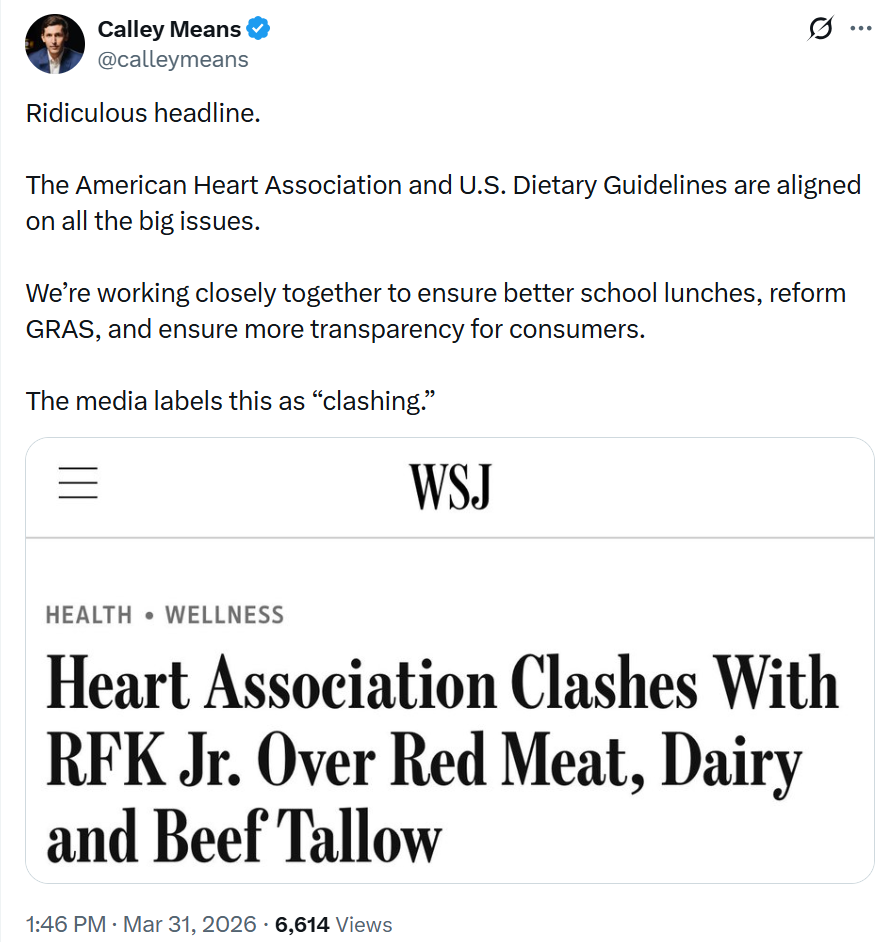
The Wall Street Journal summarized the differences in its headline: Heart Association clashes with RFK, Jr over red meat, dairy, and beef tallow.

The recommendations, released Tuesday by the association, contrast with dietary guidelines that the Trump administration introduced earlier this year. The differences add to disagreements between the federal government and mainstream medical groups on medicine and nutrition advice, after the Health and Human Services Department under Health Secretary Robert F. Kennedy Jr., for instance, sought to dial back vaccine recommendations and President Trump told pregnant women to minimize Tylenol use.

In response, senior food advisor to RFK, Jr, Calley Means, posted:

I suppose clashing is a matter of perception, but the differences are real.

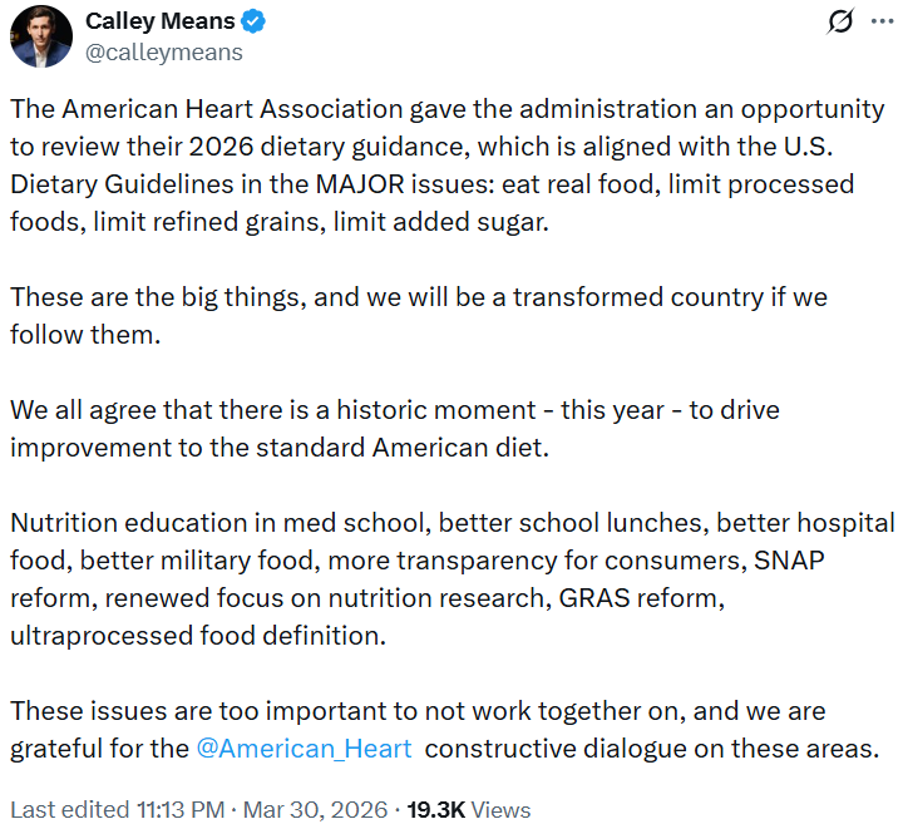
Earlier, Calley Means had posted a more gracious response:

Wow!  Applause to the American Heart Association.  Let’s hope its graphic replaces the meat-heavy inverted pyramid and ends up in all the textbooks.

One last point: This is dietary advice for heart disease prevention, but it works for everything else too—obesity, other major chronic diseases, overall longevity, and while it’s at it, planetary as well as human health.

Aug 12 2025

American Heart Association issues advisory on ultra-processed foods

The American Heart Association (AHA) has issued its long-awaited advisory on ultra-processed foods and heart health (and the CDC, just in time, says just about everyone consumes more than half their calories as UPFs).

The AHA advisory is complicated, somewhat schizophrenic in my view.

It says UPFs are bad for you but makes a big deal over how some UPFs are good for you.

It does not seem helpful to make a big fuss over the few UPF foods that are nutritious.

I say this for two reasons: The number of foods in that category is small, and a study of the effects of “healthy” UPFs still finds that people eat more calories from them than they would from minimally processed foods (I will write about this study when Nature Medicine publishes it and my accompanying editorial).

The key statement in the AHA report:

A small number of UPF products such as whole-wheat breads and unsweetened soy milk with emulsifiers can support nutrition security in low-income and low-access communities by offering convenient, affordable, and palatable options. However, the strong evidence linking HFSS {high fat, sugar, salt] UPFs to increased cardiovascular risk underscores the need for targeted policy interventions to regulate their availability, marketing, and accessibility in disproportionately affected communities.

The operative word here is “small.” This is a trivial issue, not worth fussing about.

Obviously the AHA committee thought so too.

Here is my translation of the report’s recommendations.

  1. Replace most UPFs with real foods.
  2. Enact policies to reduce UPFs, like front-of-package labels and taxation.
  3. Increase research funding on UPFs and heart health.
  4. Get the FDA to do a better job of assessing and regulating food additives.

I can’t argue with that.  Good job!

Resources

May 17 2023

American Heart Association weighs in on healthy diet plans

A committee of the American Heart Association has just published a position paper looking at how well popular weight-loss and other diets meet AHA standards.  The standards are worth a look.

When ranked against these standards, the diets come out in this order:

  • Tier 1: Mediterranean, DASH, Pescetarian, Ovo/Lacto Vegetarian
  • Tier 2: Vegan, Low-fat
  • Tier 3: Very Low-Fat and Low-Carbohydrate
  • Tier 4: Paleo and Keto

Proponents of full-fat diets will object that Paleo and Keto diets can be healthy, as well they may be depending on how much and what else their followers are eating.

Nearly any diet can be healthy if it does not include excess calories or too much junk food, but includes plants and is based on a wide variety of foods.

And they can all be delicious, and have no excuse not to be.

Enjoy!

Nov 16 2021

The American Heart Association’s new and groundbreaking dietary guidelines

The American Heart Association (AHA) has just issued its latest set of dietary guidelines aimed at preventing the leading cause of death in the United States: 2021 Dietary Guidance to Improve Cardiovascular Health: A Scientific Statement From the American Heart Association.

Because AHA guidelines apply not only to coronary heart disease but also to all other chronic disease conditions—and sustainability issues—influenced by dietary practices, they deserve special attention.

Most of these repeat and reinforce the 2020-2025 Dietary Guidelines for Americans.

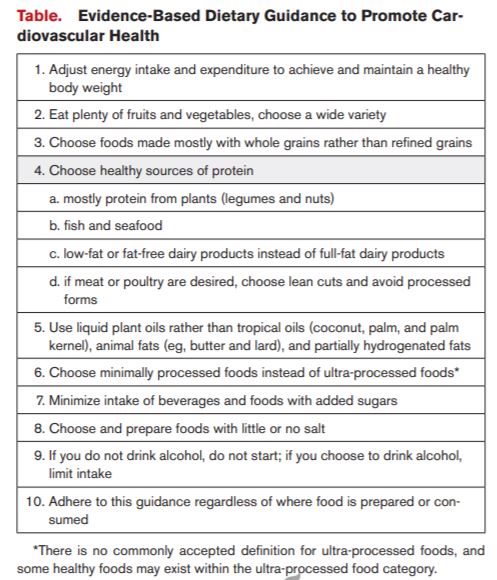
The two big differences in the recommendations:

  • Clarifying protein recommendations: these include all sources but emphasize plant sources (#4)
  • Including a new one: minimize ultra-processed foods (#6)

These recommendations are way ahead of the US Dietary Guidelines in recognizing how much ultra-processed foods contribute to poor health, and how important it is to minimize their intake.

Also unlike the US guidelines, these are unambiguous and easily summarized.


The statement is worth reading for its emphasis on two other points.

  • This dietary pattern addresses problems caused by other chronic conditions and also has a low environmental impact.
  • Following this dietary pattern requires much more than personal responsibility for food choices.  It requires societal changes as well.

The press release summarizes the problems in society that make following healthy diets so difficult, if not impossible:

  • Widespread dietary misinformation from the Internet;
  • A lack of nutrition education in grade schools and medical schools;
  • Food and nutrition insecurity – According to references cited in the statement, an estimated 37 million Americans had limited or unstable access to safe and nutritious foods in 2020;
  • Structural racism and neighborhood segregation, whereby many communities with a higher proportion of racial and ethnic diversity have few grocery stores but many fast-food outlets; and
  • Targeted marketing of unhealthy foods and beverages to people from diverse racial and ethnic backgrounds through tailored advertising efforts and sponsorship of events and organizations in those communities.

As the statement concludes: “Creating an environment that facilitates, rather than impedes, adherence to heart-healthy dietary patterns among all individuals is a public health imperative.”

Amen to that.

Comment: From my perspective, this statement thoroughly supersedes the 2020-2025 Dietary Guidelines for Americans, which—because they say nothing about ultra-processed foods , differential protein sources, sustainability, or doing anything to counter societal determinants of poor diets—were out of date the instant they appeared.

Some of the details of the AHA statement will be debated but its overall approach should not be.

The committee that put these guidelines together deserves much praise for basing its advice on today’s research and most pressing societal needs.

Additional AHA Resources:

Jun 20 2018

Not-so-smart snacks for kids

I am ever indebted to Dr. Yoni Freedhoff, the Canadian obesity specialist, for keeping a sharp eye out for the more amazing ways food companies push junk foods.

Check out his Weighty Matters blog.  This particular post describes the “Smart Snacks” for kids endorsed by the Alliance for a Healthier Generation, founded by the American Heart Association in partnership with the Clinton Foundation and the Robert Wood Johnson Foundation.

Check out Freedhoff’s selection of “Smart” items drawn from Amazon’s more complete list of Alliance-endorsed items.  Here is his first example (but don’t miss the others):

These are all junk foods tweaked to make them slightly less junky, thereby raising the questions I always like to ask in these situations: Is a slightly better-for-you product necessarily a good choice?

I’ve written about the Alliance’s partnerships previously.  As Freedhoff explains,

In case you’re not familiar with it, the Alliance For A Healthier Generations is the name given to the partnership program founded between the American Heart Association, The Clinton Foundation, and The Robert Wood Johnson Foundation with pretty what at first glance looks like pretty much every food industry corporation on earth…[this] is a partnership with the food industry whose job is to promote sales, not to protect health.

Freedhoff asks:

How is it possible that the American Heart Association, The Clinton Foundation, and The Robert Wood Johnson Foundation would describe a child washing down a bag of Doritos or a Pop-Tart with a can of Diet Coke as them consuming a Smart Snack?

The American Heart Association should not be a participant in this Alliance.  The “Smart Snacks” program’s endorsement by the Alliance covers these particular products but, by extension, the rest of those companies’ products—and the companies that make them.

Nov 18 2013

What’s up with the new cholesterol/statin guidelines?

Last week, a Feedback comment from a reader, Judith Rice-Jones, inspired me to try to understand what’s going on with the new heart disease prevention guidelines (I can’t say I’m succeeding very well).

Looking forward to your response to the recent recommendations for more people to take statins. Don’t see anything in the new recommendations about changing lifestyle or diet to reduce risks of stroke or heart attack.

Yes, there are lifestyle recommendations.   But lifestyle changes do not make money for drug companies, and they don’t get press attention.

The American College of Cardiology (ACC) and American Heart Association (AHA) issued four sets of guidelines:

  1. 2013 ACC/AHA Guideline on the Treatment of Blood Cholesterol to Reduce Atherosclerotic Cardiovascular Risk in Adults
  2. 2013 AHA/ACC/TOS Guideline for the Management of Overweight and Obesity in Adults
  3. 2013 AHA/ACC Guideline on Lifestyle Management to Reduce Cardiovascular Risk
  4. 2013 ACC/AHA Guideline on the Assessment of Cardiovascular Risk

These organizations say:

AHA and ACC are pleased to announce a series of new cardiovascular prevention guidelines for the assessment of cardiovascular risk, lifestyle modifications that reduce risk, management of elevated blood cholesterol, and management of increased body weight in adults. These guidelines are based on rigorous, comprehensive, systematic evidence reviews originally sponsored by the NHLBI. The ACC and AHA collaborated with professional organizations to finalize these AHA/ACC cardiovascular prevention guidelines, and stakeholder organizations were invited to review and endorse the final documents.

So these guidelines are a major big deal.  The New York Times said you need to know three things about them:

  • You don’t need to know your cholesterol number (unless it is very high).
  • You do need to know your risk (for this you need to use the risk calculator and, therefore, to know your LDL and HDL levels and blood pressure).
  • If you are at risk, take a statin (most, at least, are generics).

But wait!

As the New York Times also suggested, the new guidelines have taken many by surprise.

This is an understatement.

Problem #1: Authoritative clinicians say more patients should not be taking statins

This announcement is not a result of a sudden epidemic of heart disease, nor is it based on new data showing the benefits of lower cholesterol. Instead, it is a consequence of simply expanding the definition of who should take the drugs — a decision that will benefit the pharmaceutical industry more than anyone else.

This opinion piece points out that members of the group writing the recommendations have financial ties to drug makers, as do both the AHA and ACC.

The guidelines might make sense, they say, if statins

actually offered meaningful protection from our No. 1 killer, heart disease; if they helped people live longer or better; and if they had minimal adverse side effects. However, none of these are the case…as shown in a recent BMJ article co-written by one of us.

Perhaps more dangerous, statins provide false reassurances that may discourage patients from taking the steps that actually reduce cardiovascular disease…80 percent of cardiovascular disease is caused by smoking, lack of exercise, an unhealthy diet, and other lifestyle factors. Statins give the illusion of protection to many people, who would be much better served, for example, by simply walking an extra 10 minutes per day.

Problem #2: The risk calculator greatly overestimates risk

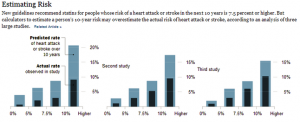
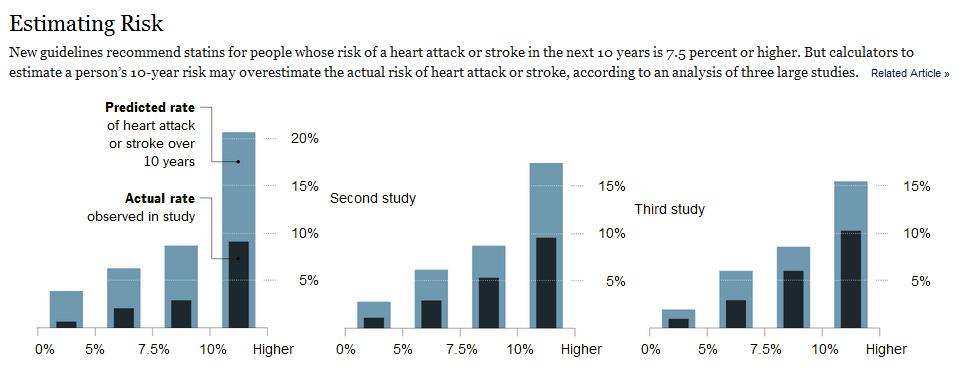
The lead article in today’s Times summarizes studies to be published in The Lancet tomorrow concluding that the risk calculator makes the risks seem greater than they really are.
gPy-ry4SPXk0G-GkICHODoRkn2G50X2w8zUU5-t3FrU

New Picture (1)

It will lead many doctors to prescribe statin drugs to people who do not need to take them (from the standpoint of drug companies, that’s the point).

The calculator overpredicted risk by 75 to 150 percent, depending on the population. A man whose risk was 4 percent, for example, might show up as having an 8 percent risk. With a 4 percent risk, he would not warrant treatment — the guidelines that say treatment is advised for those with at least a 7.5 percent risk and that treatment can be considered for those whose risk is 5 percent.

What to do?

  • Best to discuss this one with your doctor.
  • For sure, eat your veggies and be active.
  • If you still smoke cigarettes, stop.
  • Stay tuned for further developments.

Just for fun

Let’s let Brian McFadden (Sunday’s New York Times Week in Review) have the last word for today.

Feb 19 2011

American Heart Association says “I ♥ beef”!

The Beef Board, the USDA-managed checkoff program for marketing beef, proudly announces its new partnership with the American Heart Association (AHA).  The Beef Board gets its money from a compulsory tax on cattle ranchers computed every time they sell an animal.  Evidently, the money is well spent.

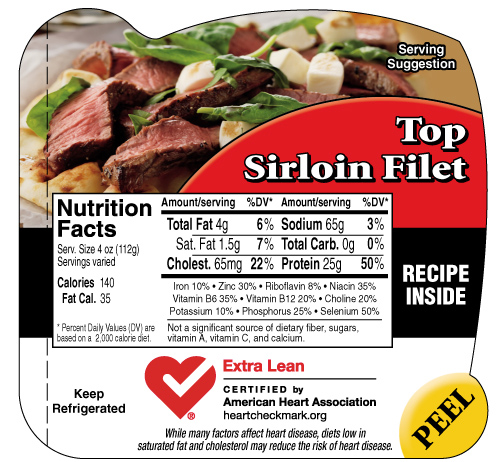
The AHA will put its HeartCheck symbol on three cuts of lean beef:

  • Boneless Top Sirloin Petite Roast (select grade)
  • Top Sirloin Filet (select grade)
  • Top Sirloin Kabob (select grade)

A member of the Beef Board says: “”We are extremely thrilled to receive the American Heart Association certification because, for consumers, it represents the independent voice of a trusted health organization.”

I’ll bet they are.

Today’s quiz: How much money is the Beef Board paying the AHA to use its CheckMark logo?

I hope it’s a lot more than what the AHA gets (or used to get) for putting its check mark on sugary cereals.  This was $4,500 per product when I updated Food Politics in 2007.  After all, sugary cereals don’t have any saturated fat or cholesterol so they must be heart healthy, no?

Ah partnerships and alliances.  You have to love them.  How will the Beef Board use the HeartCheck?  With an I ♥ Beef  campaign, of course.  Fat content unspecified.

Feb 2 2010

Oh those Canadians: heart-checking McDonald’s!

Thanks to Dr. Yoni Freedhoff for keeping me current on Canadian food politics. His latest post is about the Canadian Heart and Stroke Foundation’s new program to heart-check fast food meals.  The Foundation hasn’t officially announced the program yet, although you can  find it buried in an obscure questionnaire on its website.  Pizza Hut also mentions its participation in the program on its website.   [Update February 3: Pizza Hut has now announced its participation in the program]

The program is coming soon and here’s Dr. Freedhoff’s political cartoon of what it is likely to look like .  No, this isn’t real.  Dr. Freedhoff’s point is that it could be.

What, you might ask, are the criteria for the heart check?  Let’s just try sodium: 720 mg per serving.   Even the late and not lamented Smart Choices program did better than that (480 mg per serving).

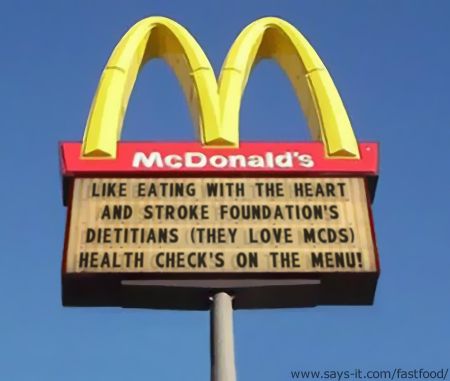
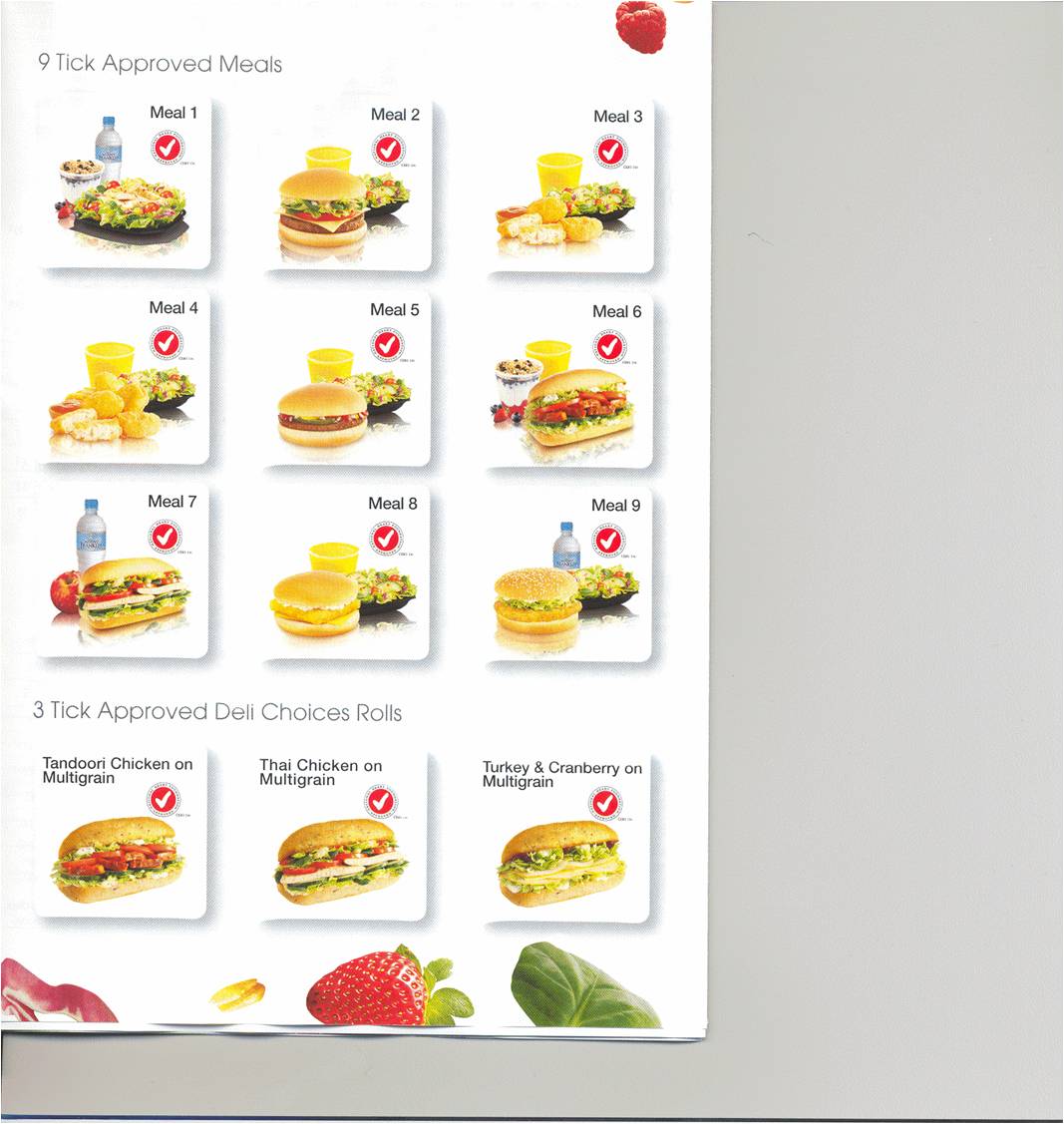
You think Dr. Freedhoff is exaggerating and this is improbable?  Alas, not so.  In Australia a couple of years ago, I took this snapshot at a McDonald’s on the Adelaide beach.

The check marks come from the Heart-Tick program of the National Heart Foundation of Australia.  So Canada is just now catching up.  Canadian readers: can’t you do something about this?  And American Heart Association: clean up your act too!

Addendum: Thanks to Lisa Sutherland for pointing out that what gets heart-checked in Canada is comparatively low in U.S. terms.  She sends McDonald’s nutrition information as proof.   Practically everything is higher in sodium than 720 mg.  When it comes to sodium, everything is relative, I guess, but all of it is way high.