by Marion Nestle

Search results: a life in food

May 29 2025

Let’s not lose sight of food safety risks

I’m hoping the Making America Healthy Again includes keeping us safe from food pathogens.

Four items relevant to food safety.

I.  Food Safety News: Salmonella outbreak sickens over 100; Animal operations blamed for leafy greens risk.

II. And the FDA is investigating yet another outbreak.

Cucumbers grown by Bedner Growers, Inc., and distributed by Fresh Start Produce Sales, Inc., to retailers, distribution centers, wholesalers, and food service distributors from April 29, 2025, to May 19, 2025. Cucumbers distributed before this timeframe should be past shelf life and should no longer be available on the market…FDA has posted a list of additional recalls being conducted by retailers that may have received potentially contaminated recalled cucumbers from Bedner Growers, Inc. This list includes recalls conducted by companies that further processed the cucumbers by using them as ingredients in new products or by repackaging them.

III.  The Journal of Food Protection just published this article: An Overview of Farm Investigation Findings Associated with Outbreaks of Shiga Toxin-Producing Escherichia coli Infections Linked to Leafy Greens: 2009 – 2021

These investigations showed that the outbreak strain can be found throughout the lifespan of leafy greens products, from the agriculture water used for the leafy greens, sediment from irrigation reservoirs, manure in nearby land, to retail product.

The contaminants come from animal manure leaching into water and soil.  Leafy greens should not be grown near CAFOs (concentrated animal feeding operations).

IV.  And what are FDA (plants) and USDA (animals) doing about all this?  The budget cuts are unlikely to help.

The Department of Government Efficiency (DOGE) recently laid off approximately 6,000 employees of the United States Department of Agriculture (USDA). Additionally, the Trump administration has proposed almost $40 million in budget cuts to the Food and Drug Administration (FDA) and a $1 billion decrease in the USDA budget, which recently resulted in workforce cuts and the suspension of services such as milk quality tests…The budget cuts and layoffs are partially intended to lessen federal government oversight and to shift many of the responsibilities to the state level. However, some states simply do not have the resources to serve as equally effective replacements.

This could have significant impacts on food safety and quality assurance.

How’s that for an understatement?


Jan 20 2025

Food Politics celebrates Martin Luther King Day

Today is Martin Luther King Day and it’s worth thinking about what he stood for as we inaugurate a new President.

Nneka M. Okona writing in Food & Wine tells us: Dr. Martin Luther King, Jr.’s Taste in Food Shows Us Who He Was: Sunday suppers at home and simple meals in restaurants give insight into the man behind the speeches.

I found that eating and following his tastes is as central to understanding him as a human and a thinker as his ideologies for the liberation of Black people and the poor. For King, eating was sustenance but also importantly, a time to pause, to take a reprieve, to be still, to connect with the most primal, urgent needs of his body. To experience pleasure while ensconced in the pain of racism’s brutalities.

Dec 18 2024

The first lawsuit against ultra-processed foods

The Dietary Guidelines Advisory Committee may not think there is much to ultra-processed foods (UPF), but companies making them have just been served with a lawuit.

I learned about this from a tweet (x) from Carlos Monteiro, the Brazilian public health professor who coined the UPF term.

CMonteiro_USP (@Carlos A. Monteiro) posted: A first-of-its-kind lawsuit against 11 UPF industries alleging they engineer their UPF products to be addictive with details on the actions taken to target children including internal memos, meetings & the research conducted to create addictive substances.

The lawsuit, filed by several law firms, is aimed at Big Food: Kraft, Mondelez, Post, Coca-Cola, PepsiCo, General Mills, Nestle, Kellanova, WK Kellogg, Mars, and Conagra.

The suit charges that these firms, through their deliberate marketing, are making people sick.

Due to Defendants’ conduct, Plaintiff regularly, frequently, and chronically ingested their UPF, which caused him to contract Type 2 Diabetes and Non-Alcoholic Fatty Liver Disease Plaintiff is now suffering from these devastating diseases, and will continue to suffer for the rest of his life.

The suit makes interesting reading.

Some examples:

  • Big Tobacco companies intentionally designed UPF to hack the physiological structures of our brains.  These formulation strategies were quickly adopted throughout the UPF industry, with the goal of driving consumption, and defendants’ profits, at all costs.
  • The same MRI machines used by scientific researchers to study potential cures for addiction are used by UPF companies to engineer their products to be ever more addictive.
  • Big Tobacco repurposed marketing strategies designed to sell cigarettes to children and minorities, and aggressively marketed UPF to these groups.
  • The UPF industry now spends about $2 billion each year marketing UPF to children.
  • UPF increase the risks of disease because they are ultra-processed, not because of how many grams of certain nutrients they contain or how much weight gain they cause. Therefore, even attempts to eat healthfully are undermined by the ultra-processed nature of UPF. One cannot evade the risks caused by UPF simply by selecting UPF with lower calories, fat, salt, sugar, carbohydrates, or other nutrients.
  • The UPF industry is well aware of the harms they are causing and has known it for decades. But they continue to inflict massive harm on society in a reckless pursuit of profits.

Can’t wait to see what happens with this one.  Stay tuned.

Resources

Consumer Federation of America: “Ultra-processed Foods: Why They Matter and What to Do About It.”

With government officials reluctant to issue advice on ultra-processed foods (UPFs), Consumer Federation of America aims to raise awareness about research on UPFs, explain the leading theories of how they harm health, and build support for public policies to reduce harms from UPFs in our diet.

The report pushes back on arguments that researchers have not consistently defined UPFs, or that the categorization lacks scientific rigor. In fact, researchers have operationalized the “Nova classification” system behind UPFs in a largely consistent manner, defining foods based on whether they contain ingredients that are “industrial formulations” or “rarely used in home kitchens,” with little serious disagreement about which ingredients should be considered “ultra processed.” Consumers can take CFA’s online quiz to test their knowledge of which ingredients are markers of “ultra processing.”

New research: Trends in Adults’ Intake of Un-processed/Minimally Processed, and Ultra-processed foods at Home and Away from Home in the United States from 2003–2018.  J Nutr 2024, https://doi.org/10.1016/j.tjnut.2024.10.048.  The data show that 50% or more of calories are consumed from UPF at home, away from home, and by pretty much everyone.

New research: Hagerman CJ, Hong AE, Jennings E, Butryn ML. A Pilot Study of a Novel Dietary Intervention Targeting Ultra-Processed Food Intake. Obes Sci Pract. 2024 Dec 8;10(6):e70029. doi: 10.1002/osp4.70029.  Behavioral interventions to reduce UPF intake cut calories by about 600 calories per day.

My post summarizing the three studies demonstrating that diets high in UPF induce intake of an excess of 500, 800, and 1000 calories per day.

Oct 16 2024

Pet Food I. Is the FDA doing enough to ensure its safety?

Two items about pet food this week.  Today: safety.  Tomorrow: environmental sustainability.

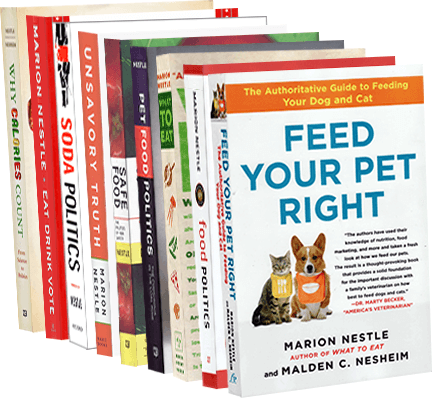
I have a long-standing interest in pet food, which I view as an integral—essential—component of our overall food system , not least because pet food uses food components that would otherwise be wasted.  I co-authored a book about pet food issues: Feed Your Pet Right.

If there are problems with the safety of pet food, you can bet those problems will occur in the food supply for humans.  I wrote a book about that too: Pet Food Politics: The Canary in the Coal Mine.

I am not the only one interested in such topics.  Phyllis Entis has written two books crticizing the safety hazards of pet foods.

She keeps me up-to-date on the latest problems that arise.

I don’t know how closely you’re watching the pet food industry these days, but I thought this piece I just posted might interest you: When ‘truths’ collide: Darwin’s, ANSWERS, and the FDA

This was an account of an FDA Advisory and its non-consequences: Do Not Feed Certain Lots of Darwin’s Natural Selections Pet Food Due to Salmonella and Listeria monocytogenes.

The U.S. Food and Drug Administration is cautioning pet owners that FDA samples of five Darwin’s Natural Pet Products raw cat and dog food made by Arrow Reliance, Inc. tested positive for Salmonella and a sixth FDA sample tested positive for Salmonella and Listeria monocytogenes (L. mono)…If you have any of the Darwin’s Natural Selections pet food product listed above, stop feeding the product to your pets and throw it away in a secure container where other animals, including wildlife, cannot access it. Do not donate the food.

The bigger story here, as Phillis Entis explains, is that the FDA did not force the company to recall the products; it asked Darwin to rissue a recall volunarily.

But in this case, the company resisted.  It voluntarily decided not to do the recall.  Pet Food Industry (an essential source of information) tells this story.

In a September 20, 2024, memo from the company to consumers which was sent to Petfood Industry, Darwin’s Natural Pet Products had this to say given the FDA’s public notice regarding the affected lots of cat and dog food.

The memo is worth a look.  It says things like this:

  • At Darwin’s, the health and safety of your pets is our absolute top priority, and we take rigorous steps to support their well-being and to foster strong lines of communication with you and our fellow community members.
  • It is also very important to know that the FDA has received no consumer complaints regarding any of these lots.
  • We find the FDA’s public notice to be wholly unnecessary, and ultimately, based on flawed regulatory decision-making, and we have taken steps to make this position clear to the agency.

Oh.

Food safety lawyer Bill Marler asks: Will the FDA use its Recall Authority to Mandate a Pet Food Recall due to Salmonella and Listeria?   .The FDA has that authority.  It did not use it.

That leaves you on your own to make sure you do not buy Darwin products for your pet.

The FDA provides plenty of information as a basis for you taking responsibility for such things.

Its advisory asks this question: Why is the FDA concerned about Salmonella and L. mono in pet food?

Pet foods contaminated with Salmonella and L. mono are of particular public health importance because they can affect both human and animal health. Pets can get sick from Salmonella and may also be carriers of the bacteria and pass it on to their human companions without appearing to be ill…The Federal Food, Drug, and Cosmetic Act requires that all animal foods, like human foods, be safe to eat, produced under sanitary conditions, contain no harmful substances, and be truthfully labeled. Refrigeration or freezing does not kill Salmonella or L. mono.

It provides  these resources:

Do we need more forceful regulation of pet food?  Of course we do.

Sep 25 2024

Brave new world: Tartrazine (an FDA-approved food color) makes mice transparent

I first read about this in a daily newsletter I subscribe to, Bakery and Snacks:   The Doritos effect: How tartrazine turns tissues temporarily transparent. When a study draws parallels with H.G. Wells’ The Invisible Man, you know it’s bound to be captivating. Could this scientific leap bring us closer to achieving a real-life version of Harry Potter’s invisibility cloak?… Read more

An ingredient in Doritos — tartrazine or Yellow 5 — is helping scientists see through the skin of mice. While they can’t see through human skin (it’s thicker and less permeable), this could be helpful in the future for early skin cancer detection. Imagine if it could replace a mammogram? On the other hand, Doritos food coloring is a chemical that the scientists said might not be totally harmless. (And to think so many people are eating it?) Read the Popular Science article about it. It’s fantastic.

Popular Science: The dye in Doritos can make mice transparent.  ‘It’s not magic, but it’s still very powerful.’

Because of a counterintuitive fundamental physics principle [selective absorption and scattering of light], Tartrazine, also known as Yellow 5, can temporarily turn biological tissue transparent to the naked eye, as described in a study published September 5 in the journal Science. 

The Science study: Achieving optical transparency in live animals with absorbing molecules.  Science.  Vol 385Issue 6713.  DOI: 10.1126/science.adm6869

We next sought to demonstrate the ability of absorbing molecules to achieve tissue transparency in the mouse abdomen. Specifically, when a tartrazine solution was topically applied to the abdominal skin of a live mouse under anesthesia and gently massaged on the skin (Fig. 1, G and H), the abdominal skin not only darkened in color but also became more transparent in the red window (fig. S8). This transparency effect can be readily visualized with the naked eye and does not require any specialized imaging equipment…The transparent abdomen allowed us to directly observe internal organs, including the liver, small intestine, cecum, and bladder (Fig. 1, I and J). Moreover, we could also discern their movements, such as peristalsis, as well as motions synchronized with the heartbeat and breathing (Movies 1 and 2). The achieved abdominal transparency can be reversed by rinsing and massaging the skin with water (fig. S8).


Tartrazine is FD&C  Yellow #5

Tartrazine is a synthetic food colorant classified as an azo dye. It is lemon yellow in color and water soluble. Tartrazine is approved for use as a food colorant in the EU, USA, Canada, and other parts of the world for use in food, cosmetics, and medications. Its use in foods includes dairy products, beverages, desserts, confectionary, spices, dressings, jellies and sauces…It is one of the most commonly used and best known food additives…Of the synthetic food dyes, tartrazine has been implicated most often as a cause of adverse reactions.

Here’s what CSPI says about it.

Yellow 5 can be found in many foods, including beverages, gelatin desserts, candy, and baked goods. It’s the second-most widely used coloring and sometimes causes allergy-like hypersensitivity reactions, primarily in aspirin-sensitive persons, and triggers hyperactivity in some children. It may be contaminated with such cancer-causing substances as benzidine and 4-aminobiphenyl (or chemicals that the body converts to those substances).

CSPI has filed a petition to

Ban the Use of Yellow 5 and Other Food Dyes, in the Interim to Require a Warning on Foods Containing These Dyes, to Correct the Information the Food and Drug Administration Gives to Consumers On the Impact of These Dyes on the Behavior of Some Children, and to Require Neurotoxicity Testing of New Food Additives and Food Colors.

And now here’s another reason not to use it, even though it doesn’t do this in people, apparently.  Our skin is too thick.

Addition

A reader points out that tartrazine is on the list of food dyes now banned in California.  Good idea.

Sep 17 2024

Bad news: US food insecurity getting worse, not better

The USDA has released its annual report on Household Food Security in the United States in 2023.

The news is not good.

What’s especially tragic is the reversal of the pandemic decline in food insecurity.

Pandemic income support and higher SNAP benefits did exactly what they were supposed to.  They reduced poverty.

Congress, in its infinite wisdom, stopped those benefits.

The results are entirely predictable.

These, alas, are political choices.

There’s an election coming up soon…

Resources


Aug 28 2024

Kamala Harris v. rising food prices

At last, a presidential candidate interested in food.

The Harris-Walz agenda aims to lower costs for Americans, food costs among them.

Vice President Harris and Governor Walz will work to enact a plan in their first 100 days to go after bad actors to bring down Americans’ grocery costs and keep inflation in check. They will work with Congress to:

  • Advance the first-ever federal ban on price gouging on food and groceries;
  • Set clear rules of the road to make clear that big corporations can’t unfairly exploit consumers to run up excessive profits on food and groceries.
  • Secure new authority for the FTC and state attorneys general to investigate and impose strict new penalties on companies that break the rules.

Furthermore,

Vice President Harris will also direct her Administration to crack down on unfair mergers and acquisitions that give big food corporations the power to jack up food and grocery prices and undermine the competition that allows all businesses to thrive while keeping prices low for consumers.

And her plan will support smaller businesses, like grocery stores, meat processors, farmers, and ranchers, so those industries can become more competitive….More competition means lower prices for you and your families.

Unfair mergers?  Mars had just proposed to buy Kellanova, and I discussed the Kroger-Albertson’s proposed merger yesterday.

At a campaign event in North Carolina, Vice President Kamala Harris again discussed food prices.

A loaf of bread costs 50 percent more today than it did before the pandemic.  Ground beef is up almost 50 percent.  Many of the big food companies are seeing their highest profits in two decades.  And while many grocery chains pass along these savings, others still aren’t.

…My plan will include new penalties for opportunistic companies that exploit crises and break the rules, and we will support smaller food businesses that are trying to play by the rules and get ahead.

…We will help the food industry become more competitive, because I believe competition is the lifeblood of our economy.  More competition means lower prices for you and your families.

Good, but these are campaign promises that necessarily depend on Congressional support.

As Politico explains,

…it’s unlikely Democrats will have the votes to pass price-gouging legislation in Congress. Her proposal essentially mirrors a bill from Democratic Sens. Elizabeth Warren (D-Mass.), Bob Casey (D-Pa.) and Tammy Baldwin (D-Wis.) that has stalled amid GOP opposition.

And Harris’ pitch, which includes giving the FTC more resources to investigate major acquisition deals in the food sector, would need GOP buy-in so Democrats can swing extra FTC resources via spending fights in Congress.

The food industry, of course, protests.

The Food Industry Association blames higher prices on inflation.

The National Grocers Association says its profit margins are already too thin.

I have no idea how any of this will play out, but it’s terrific to see food issues on the agenda.

Aug 22 2024

What I’m reading: AI in food and beverage

While I’m on the topic of AI—a hot issue in the food business—here are a few items I’ve collected recently.