by Marion Nestle

Search results: Coca Cola

Oct 25 2022

Academy of Nutrition and Dietetics: Captured by Food Corporations

The advocacy group, U.S. Right to Know, sent out a press release to announce publication of an article in the British journal, Public Health Nutrition: The corporate capture of the nutrition profession in the USA: the case of the Academy of Nutrition and Dietetics.

The Academy of Nutrition and Dietetics [AND, formerly the American Dietetic Association] accepted millions of dollars from food, pharmaceutical and agribusiness companies, had policies to provide favors in return, and invested in ultra-processed food company stocks, according to a study published today in Public Health Nutrition…The study was produced by public health scholars and U.S. Right to Know, a nonprofit investigative public health group that obtained tens of thousands of pages of internal Academy documents through state public records requests.

I’ve been writing about corporate capture of AND (formerly the American Dietetic Association) for years (see below), but this study shocked even me, for two reasons.

  • AND holds stock in food companies making ultra-processed foods.

The documents show that the Academy and its foundation invested funds in ultra-processed food companies. The Academy’s investment portfolio in January 2015 included $244,036 in stock holdings in Nestle S.A. and $139,545 in PepsiCo. The Academy foundation’s investment portfolio in June 2013 included $209,472 in stock holdings in Nestle S.A and $125,682 in PepsiCo.

  • The list of food companies donating to AND is extraordinarily long; it goes on for pages.

The Academy accepted more than $15 million from corporate and organizational contributors in the years 2011 and 2013-2017. The Academy’s top contributors in 2011 and 2013-2017 were:

  • National Dairy Council $1,496,912
  • Conagra Inc. $1,414,058
  • Abbott Nutrition $1,246,389
  • Abbott Laboratories $824,110
  • Academy of Nutrition and Dietetics Foundation: $801,261
  • PepsiCo Inc. $486,335
  • Coca-Cola Co. $477,577
  • Hershey Co. $368,032
  • General Mills Inc. $309,733
  • Agency for Healthcare Research and Quality $296,495
  • Aramark Co. $293,051
  • Unilever Best Foods $276,791
  • Kellogg USA $273,272

The Academy’s response: Inaccuracies in U.S. Right to Know Article

The report is disjointed, mostly opinion, emails taken out of context, picking and choosing items based on words out of Board reports, etc.

The Academy lists facts

  • One of the authors has strong financial ties to CrossFit, a staunch opponent to RDN licensure.
  • Less than 9% (12 out of 149) of named scholarships, awards and named research grants were established through industry. The funds that are established have input into scholarship criteria, which are approved by the Foundation’s Board. An independent review committee then reviews applications and selects recipients.
  • Less than 2% (32 out of 2,812) of donors to the Academy’s Second Century were industry donors.

Additional Academy facts

  • Fact: The Academy is NOT influenced by sponsorship money
  • Fact: Less than 3% of the Academy’s and the Foundation’s investments are in food companies.
  • Fact: The Academy has never changed a position at the request of sponsors.
  • Fact: Less than 9% of Academy funding comes from sponsorship.
  • Fact: The Foundation’s Fellows program allows participants to serve as catalysts for change and advancement in emerging areas of need for the evolving nutrition and dietetics profession.
  • Fact: The Academy and Foundation have always been committed to accountability through transparency and fiduciary responsibility.

Comment

I have been writing about the Academy’s ties with food companies for years.  See, for example,

In my book, I document how food companies exert influence through sponsorship of research and professional societies.  Typically, recipients of industry funding do not recognize the influence of sponsorship and deny it, as we see here.

If AND wants to be taken seriously as an organization devoted to public health, it needs to set strong guidelines for conflicts of interest and adhere to them.  At the moment, this organization gives the appearance of a public relations arm of the food industry.

The same can be said of the American Society of Nutrition, but that’s another story.

Resources

***********

For 30% off, go to www.ucpress.edu/9780520384156.  Use code 21W2240 at checkout.



Mar 30 2022

ILSI by any other name…

I received a press release announcing a June conference to be held by the Institute for the Advancement of Food and Nutrition Sciences.

I had never heard of it.  It says it “is a non-profit organization that catalyzes science for the benefit of public health” and that it “drives, funds, and leads actionable research and elevates food safety and nutritional sciences—all with the ultimate goal of advancing public health.”

That seemed pleasant, if vague, but I was still puzzled.  Nothing on the Institute’s website helped.

This took some digging, but I soon found a news release announcing its formation in February 2021: Leading Scientists Launch Institute for the Advancement of Food and Nutrition Sciences to Promote Collaborative Research:

Today marks the establishment of the Institute for the Advancement of Food and Nutrition Sciences (IAFNS), a 501(c)(3) organization focused on catalyzing science for the benefit of public health.

Previously known as the International Life Sciences Institute, North America, IAFNS is building on a proud heritage with a focus on actionable science that promotes nutrition, food safety and public health.

Aha!  ILSI,  The classic industry front group.

ILSI, you may recall, was formed by Coca-Cola.

Within the last few years, lots of articles have appeared describing its lobbying efforts on behalf of the food industry.  Some of these were so blatant that Mars withdrew from in in 2018 and Coca-Cola withdrew in 2021.

I’ve written about ILSI often over the years.  See, for example, this post about IlSI’s effort in China.  Or see this article about scientific integrity (or the lack thereof).

Could all the bad press have anything to do with the name change?

A leopard cannot change its spots, alas.

Mar 10 2022

The Ukraine War and food systems: items

The tragedy of the Ukraine War is beyond comprehension.  Like everything else, it affects food systems, and not just for the people caught up in it.

I’ve been collecting items, starting with Jose Andres @chefJoseAndres and World Central Kitchen @WCKitchen who are providing hundreds of thousands of meals to people fleeing from the Ukraine.

And then this one:

Why the silence?

  • “Unlike other chains, McDonald’s owns the vast majority of its 847 restaurants in Russia. According to a page for investors, Russia accounts for 9 percent of the company’s total revenues and 3 percent of its operating income.”
  • “Last year, Russia accounted for $3.4 billion, or more than 4 percent, of PepsiCo’s $79.4 billion in revenues.”

Other items are about what this war means for agricultural trade, food prices, and specific food businesses—especially pet food.

Here are the pet food items:

Feb 3 2022

The coming influx of hard soda

As if we don’t have enough trouble with alcohol in this country, it’s now being added to sodas.  In states that allow such things, expect to see them taking up more and more room in supermarket aisles.

The business press is interested in this trend; there is much money to be made on drinks of any kind.

See, for example, Bud Light to Launch Hard Soda.

Bud Light Seltzer Hard Soda will have no sugar or caffeine. Anheuser-Busch describes it as ‘light like a seltzer and bold like soda pop.’ Each can will contain 100 calories and 5% alcohol.

This comes in cola, cherry cola, orange and lemon-lime flavors.

Consumer demand has soared over the past few years for nonalcoholic seltzers such as LaCroix and alcoholic ones such as White Claw that are low on calories and offer just a hint of flavor. Now some consumers are migrating toward stronger flavors, industry experts say, and brewers are trying out new fizzy drinks.

This, then, is about market share.

Lots of other companies are getting into this act.

Given all that, what are we to make of this piece of news?

  • Alcohol and COVID-19: Good news for red wine drinkers, but blow for beer boozers?  People who consume red wine between one to more than five glasses a week had a 10 to 17% lower risk in contracting COVID-19, but beer drinkers had a heightened risk, according to a recent study…. Read more
  • Here’s the study: COVID-19 Risk Appears to Vary Across Different Alcoholic Beverages.
  • Here’s the caveat: Association does not equal causation.  Drinkers of red wine have different lifestyles than beer drinkers, perhaps?
  • And here are the study’s sensible conclusions:  The COVID-19 risk appears to vary across different alcoholic beverage subtypes, frequency, and amount…Consumption of beer and cider and spirits and heavy drinking are not recommended during the epidemics. Public health guidance should focus on reducing the risk of COVID-19 by advocating healthy lifestyle habits and preferential policies among consumers of beer and cider and spirits.

Amen.


Jan 3 2022

Conflicted review of the week: adopting the dietary guidelines

Let’s start 2022 off with a review sent to me by a reader who wishes to remain anonymous.

The review: Implementing the 2020–2025 Dietary Guidelines for Americans: Recommendations for a path forward. Sanders, L. M., Allen, J. C., Blankenship, J., Decker, E. A., Christ-Erwin, M., Hentges, E. J., Jones, J. M., Mohamedshah, F. Y., Ohlhorst, S. D., Ruff, J., &Wegner, J. (2021). J Food Sci. 86:5087–5099.  https://doi.org/10.1111/1750-3841.15969

Method: Based on a workshop aimed at developing strategies to promote adoption of dietary guideline recommendations.

Workshop funding: a grant from USDA with contributions from the Institute of Food Technologists.

Conflicts of interest: Mary Christ-Erwin is President and Owner of MCE Food and Agriculture Consulting and received an honorarium from the grant for moderating the meeting and panel and roundtable discussions. Julie M. Jones is a Scientific Advisor to USA Rice, Grain Foods Foundation, and the Quality Carbohydrate Coalition. John Ruff is an Investment Committee Member for Sathguru Catalyser Advisors Private Limited, the Asset Management Company of Innovation in Food and Agriculture Fund (IFA Fund) that invests in innovation-driven growth enterprises in the Food and Agriculture sectors, based in India. He is reimbursed for meeting fees and expenses related to attending committee meetings but has no investments in the fund. Lisa M. Sanders [Note: First author who wrote original draft] is the owner of Cornerstone Nutrition, LLC, a consultancy which has received funding from Kellogg Company, PepsiCo, and The Coca-Cola Company. Dr Sanders receivedwriting fees fromthe grant for development of this manuscript. JillWegner is an employee of Nestle. Jonathan C. Allen, Jeanne Blankenship, Eric A. Decker, Eric J.Hentges, Farida Y. Mohamedshah, and Sarah D. Ohlhorst have no conflicts to declare.

Comment: This workshop reflects a food industry perspective on the dietary guidelines.  Some of its reocmmendations make sense.  Others raise eyebrows, or should.

  • The first recommendation: “Emphasize health benefits…gained through cooking at home.
  • My favorite recommendation: “Leverage the current interest in science to debunk myths about food processing by demonstrating the similarity of techniques used to make foods at home and at scale in food industry, to show how food processing can contribute to the solution.”

This review is an excellent example of why the food industry needs to firmly excluded from nutrition policy discussions (for details on why, see my book, Unsavory Truth).

My strongest criticism of the 2020 dietary guidelines is that they fail to say anything about the health benefits of reducing consumption of ultra-processed foods (the junk food category strongly associated with excessive calorie intake, weight gain, and poor health).

Yet here we have a published review in a food science journal arguing for debunking “myths” about food processing.

They are not myths.  Evidence is abundant.

See, for example:

  • Monteiro CA, Cannon G, Levy RB, et al.  Ultra-processed foods: what they are and how to identify them.  Public Health Nutr; 2019;22(5):936–941.
  • Lawrence MA, Baker PI.  Ultra-processed food and adverse health outcomes.  BMJ. 2019 May 29;365:l2289.  doi: 10.1136/bmj.l2289.
  • Hall KD, Ayuketah A, Brychta R, et al. Ultra-processed diets cause excess calorie intake and weight gain: an inpatient randomized controlled trial of ad libitum food intake [errata in Cell Metab. 2019;30(1):226 and Cell Metab. 2020;32(4):690]. Cell Metab. 2019;30(1):67–77.e3. doi: 10.1016/j.cmet.2019.05.008.
Dec 15 2021

Let’s talk about food industry lobbying

Lobbying is legal; it is simply requests of legislators by interest groups for action in their own interests.  Everyone can do this, but corporations that donate to election campaigns have greater access to legislators and also deeper pockets to pay people to do this work.  And lobbyists are often former employees of government regulator agencies who now work for corporations—the “revolving door.”  The biggest problem for food advocacy groups: finding the funds to pay people to lobby for their issues.

Recent reports on lobbying and lobbyists:

I.  Food Research Collaboration: Examination of power, access, and influence of participants at the recent COP26 climate change negotiations in Glasgow.  Conclusions:

  • The Brazilian delegation had the highest number of food industry representatives, including beef producers.
  • Food industry members attended as part of groups officially considered Non-Governmental Organisations.
  • Representatives of many food corporations and trade groups attended.

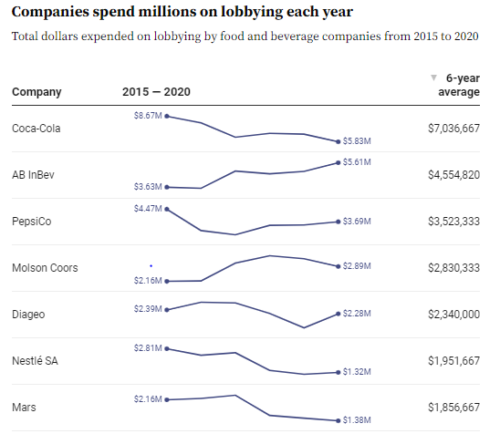
II.  Dive Wire: Where the dollars go: Lobbying a big business for large food and beverage CPGs.  Coca-Cola, PepsiCo, AB InBev and 27 other companies spend close to $40 million a year on issues including trade and taxes in an effort to make their voices heard by lawmakers and regulators.

III.  American Enterprise Institute: Political Influence Efforts in the U.S. Through Campaign Contributions and Lobbying Expenditures: An Index Approach

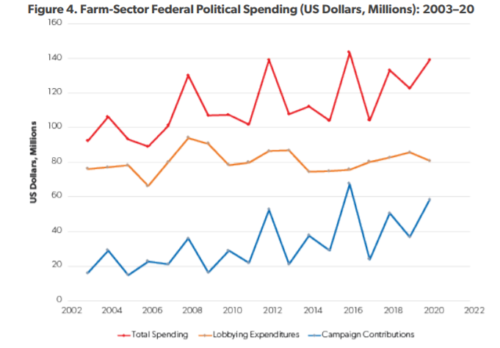
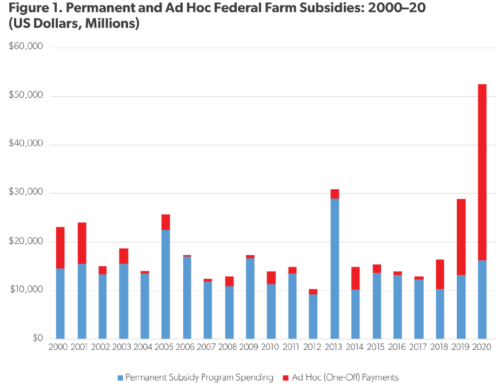
IV.  American Enterprise Institute.   Farm-Sector Spending on Federal Campaign Contributions snd Lobbying Expenditures: Evidence from 2003 to 2020.

Here’s why the farm sector lobbies:

The system is rigged: no group advocating for small and medium farms, “horticulture vs. commodities, conservation, sustainability, or regenerative agriculture can possibly compete with Big Food or Big Ag.

Dec 14 2021

My latest paper: portion size

My former doctoral student and now colleague Lisa Young has been tracking the increase in portion sizes of junk foods for more than 20 years.  Our latest report has just come out in the American Journal of Public Health: Portion Sizes of Ultra-Processed Foods in the United States, 2002 to 2021.

At first introduction, most companies offered products in just 1 size; that size is smaller than or equal to the smallest size currently available. For example, the original size of a Coca-Cola bottle was 6.5 ounces; today it comes in 6 sizes marketed as single servings; these range from 7.5 ounces to 24 ounces, 4 of which have been introduced since 2002.
Since 2002, McDonald’s has reduced the sizes of its french fries and eliminated its “supersize” french fries and soda, but still offers quart-sized sodas and double burgers. While McDonald’s and Burger King decreased the size of their largest portion of french fries, they increased the sizes of their smallest portions. While Burger King reduced the sizes of it’s hamburger sandwiches, since 2002 they added a triple Whopper.
As we have pointed out previously, portion sizes increased in parallel with the rising prevalence of obesity.
Larger portions are a problem for three reasons.  They:
  • Have more calories (if only this were intuitively obvious, but it is not)
  • Encourage people to eat more
  • Confuse people about how much they are eating

Our recommendations:

We think it is time to also consider caps and other legislatively mandated national policy options to require the food industry to make smaller food portions more available, convenient, and inexpensive:

•  offer consumers price incentives for smaller portions of ultra-processed foods,
•  discontinue the largest sizes of ultra-processed packaged foods and fast-food portions, and
•  restrict marketing of large portions of ultra-processed foods, especially those targeted to children and minorities.

Our article is accompanied by an editorial by Carlos Monteiro and Geoffrey Cannon, the inventors of the term, “ultra-processed”: Yes, Food Portion Sizes and People Have Become Bigger and Bigger. What Is to Be Done? 

Their point: reducing portion sizes is unlikely to work internationally.

In such countries, reduced portion sizes of ultra-processed foods would at best have limited effect, and most likely would be counterproductive if they were marketed to promote their consumption. Generally, the most rational guideline, for global as well as personal health and well-being, is to protect and promote minimally processed foods and freshly prepared meals and to discourage the consumption of ultra-processed foods altogether, together with statutory measures including fiscal policies and actions. These measures should make fresh and minimally processed foods cheaper and more available. Ultra-processed foods should be made more expensive and less available, if at all, especially in canteens and hospitals, other health settings, and in and near schools. Cosmetic additives should be banned or highly taxed.

We have much work to do.

Dec 9 2021

Some recent articles on food product reformulation

What with all the pressure to make foods healthier, food manufacturers have been tweaking their products to reduce less healthful ingredients, especially salt and sugar.

Reformulated ultra-processed foods are still ultra-processed.

They raise the question: is a slightly healthier ultra-processed food a good choice?

These articles come from FoodNavigator-Asia.com, which tracks the food industry in that part of the world.