by Marion Nestle

Search results: USDA meat

Apr 30 2025

Bad news: USDA withdraws proposals for reducing Salmonella contamination of chicken

The USDA announced last week that it is withdrawing its proposed framework for reducing Salmonella in raw poultry.  Oh great.

Why?

FSIS received 7,089 comments on the proposed framework…from a variety of stakeholders that included poultry and meat industry trade associations, small poultry producer and processor trade associations, large and small poultry processing establishments, consumer advocacy organizations…The issues that generated the most comments…[were] the proposed Salmonella levels and serotypes for the final product standards…the scientific and technical information used to support the proposed framework, the potential economic impacts of the proposed framework, and the potential impact of the proposed framework on small poultry growers and processors. Several comments also suggested alternative approaches other than the proposed framework for addressing Salmonella illnesses associated with poultry products.

While FSIS continues to support the goal of reducing Salmonella illnesses associated with poultry products, the Agency believes that the comments have raised several important issues that warrant further consideration.

Consumer Reports, which has for years been pushing the USDA to do something about Salmonella contamination in poultry, is not happy with this move, not least because its investigators found large numbers of poultry plants to be heavily contaminated with Salmonella. contamination.

The proposed rule was intended to help reduce the number of salmonella infections in the U.S. Of the estimated 1.35 million illnesses that occur each year from food tainted with the bacteria, nearly 200,000 of them are due to chicken, according to the Centers for Disease Control and Prevention. “And instead of declining, salmonella infections are increasing and expected to continue to grow…This move, along with the steep budget and staffing cuts at the USDA and FDA, appears to be part of an overall effort to weaken food safety oversight,” says director of food policy at Consumer Reports.

Comment

This is an extremely disappointing decision.  The poultry industry argues that Salmonella contamination is normal.  They don’t need to do anything to prevent chickens getting contaminated.  It is your responsibility to store and cook your chicken properly.

Safety advocates (like me) argue that Salmonella is not normal, contamination is preventable, and the industry ought to be doing that.  The USDA’s 2021 proposal to declare Salmonella an adulterant was a major step in making food safer.

This decision is a major setback.

Resources

What the USDA says about Salmonella

What the USDA says today about reducing Salmonella in poultry.  The web page displays USDA’s 2021 announcement that it would be “mobilizing a stronger and more comprehensive effort to reduce Salmonella illnesses associated with poultry products.”
 

Apr 16 2025

Two investigative reports worth reading: Eggs and Meat

Washington Post: As egg prices soared at the supermarket, so did producer profits: A USDA program doled out hundreds of millions in relief payments to big egg companies, even as the largest earned record profits.

On Tuesday, the nation’s largest egg producer, Mississippi-based Cal-Maine, announced quarterly profits of $509 million, more than three times what it made in the same period a year ago. It caps three years of extraordinary earnings, which have surged since the avian flu outbreak began in 2022.

By wiping out millions of laying hens, the avian flu has slowed egg production for many companies. But the outbreak also has driven up prices enough for some companies to recoup losses and, for Cal-Maine, to record exceptional profits….At the same time, Cal-Maine and other large egg companies have received tens of millions of dollars from the U.S. Department of Agriculture, which has been doling out relief payments to help egg companies restock after the virus strikes.

Unfork the Food System: Meat Industry’s PR Campaign Exposed: Undermining Climate-Friendly Diets: How EAT-Lancet Came Under Fire: The Meat Lobby’s Coordinated Smear Campaign.

In 2019, the EAT-Lancet Commission released a groundbreaking report advocating for a global shift towards a “planetary health diet”—a balanced, predominantly plant-based diet aimed at promoting human health and environmental sustainability…In our disinformation report from 2024, authored by Nicholas Carter, the Freedom Food Alliance unpacked the #YesToMeat campaign—a slick PR effort that masked corporate interests behind the guise of consumer choice and cultural pride. Our report revealed how front groups and influencer partnerships were used to normalize the overconsumption of meat while undermining credible science on sustainable diets…Fast-forward to today. A recent investigation by DeSmog and The Guardian has uncovered that the intense backlash against the EAT-Lancet report was not as organic as many had thought. Instead, it was significantly fueled by a coordinated public relations campaign orchestrated by the meat and dairy industry.

DeSmog:  Revealed: Meat Industry Behind Attacks on Flagship Climate-Friendly Diet Report: A new document shows that vested interests were behind a “mud slinging” PR campaign to discredit the 2019 EAT-Lancet study.

A document seen by DeSmog appears to show the results of a campaign by the consultancy Red Flag, which catalogues the scale of the backlash to the [EAT-Lancet] report. The document indicates that Red Flag briefed journalists, think tanks, and social media influencers to frame the peer-reviewed research as “radical”, “out of touch” and “hypocritical”…Based on DeSmog’s review of the document, Red Flag’s attack campaign appears to have been conducted on behalf of the Animal Agriculture Alliance (AAA), a meat and dairy industry coalition that was set up to protect the sector against “emerging threats”. The AAA counts representatives from Cargill and Smithfield Foods – two of the world’s five largest meat companies – on its board.

Comment: Let me restate the obvious: food companies are not public health or social service agencies; they are businesses with stockholders to please.  They will take advantage of any profitable opportunity, and oppose anything that threatens profits.  The EAT-Lancet initiative is a threat to meat industry profits.  We would not know how the meat industry fights back were it not for the work of investigative reporters.  They deserve our thanks.

Tags: ,
Apr 15 2025

Rumor: USDA to move out of Washington DC

To me personally, the big news last week (besides my profile in the New York Times) is the announcement that the USDA plans to move its headquarters out of Washington, DC to three locations yet to be determined.

USDA is expected to offload one of its two Washington headquarters buildings, according to two employees familiar with the matter.

The relocations will accompany widespread layoffs at the department, according to four officials made aware of the plans, though the exact number is not yet clear. Those cuts are expected in late April or early May.

Some employees have been told to expect the department to cut back to fiscal 2019 staffing levels—which would lead to USDA slashing around 9,000 of its 98,000 employees—while others have been told there is a an overall federal workforce reduction number the administration has developed and the department will do its part proportionally to meet that target.

My translation: I haven’t been able to confirm this story, but what better way to get USDA employees to quit en masse.  This worked during Trump I to dismantle the Economic Research Service, a national treasure in my view.  I complained early and often about its transfer to Kansas City, MO.

As this article explains,

In 2019, the department relocated the Agriculture Department’s Economic Research Service and National Institute of Food and Agriculture to Kansas City, Mo., over the objections of employees and some lawmakers. Following the move, both agencies lost more than half of their staff, leading to a significant loss of productivity from which it took the agencies years to recover. Under President Biden, both agencies moved their headquarters back to Washington while maintaining their Kansas City offices.

I would say (and the Government Accountability Office agrees) the ERS has never recovered.  It still produces technical reports, but no longer publishes the kind of analytical pieces that I found so valuable to my work.

It’s fine to move government offices to the middle of the country.  Anything to help repopulate middle America is a good thing.

But this move has only one real purpose: to reduce staff.

This means reducing meat inspectors, and people who help participants use food assistance programs.  It means getting rid of agricultural and other USDA-supported researchers.  Basically, it means getting rid of anyone good enough to get another job without having to relocate.

Even without this, USDA staff are quitting in droves: USDA employees head for the doors as potential RIFs [reduction in forces] loom

I considered the transfer of the ERS to Kansas to be a national tragedy.  This is another one.

Tags: ,
Feb 1 2024

Cultured meat: of great interest, still not on market

Cell-Based or Cultured Meat continues to generate predictions, positive (new products, new approvals, growth) and negative (doom, bans).

Current status: The FDA and USDA have approved sales of cell-cultured chicken but the only place selling it is Bar Crenn in San Francisco (where I have not been).

While waiting for it to get scaled up (if this ever will be possible), here are a few items I’ve collected recently.

THE POSITIVES

THE NEGATIVES

THE QUESTIONS

Jul 11 2023

USDA Concentration and Competition in US Agribusiness

Well here’s a big surprise.  The USDA is taking a look at concentration in agribusiness.

TODAY: Webinar at 1:00 p.m. ET.  Register here.

Here’s what this is about:

This report details issues surrounding market concentration in agribusiness, particularly in three agribusiness sectors where concentration has increased over time: seeds, meatpacking, and food retail. Market concentration and its impact on competition have attracted growing public scrutiny. Critics argue that many industries have grown too concentrated, with fewer firms competing with one another and a consequent weakening of competition. The report covers the consolidation in each of these industries, explains the driving forces behind increased concentration, and examines public policies aimed at encouraging competition, focusing on the implementation of merger policy.

This report has lots of interesting tidbits about those three industries.

  • Two firms, DuPont Pioneer and Monsanto, control 71.6% of U.S. corn and 65.9% of U.S. soybeans.
  • Four U.S. meat firms (not necessarily the same ones) control 85% of steers and heifers, 67% of hogs, 55% of turkeys, and 53% of chickens.

But what is shocking to me about this report is what it does not say.

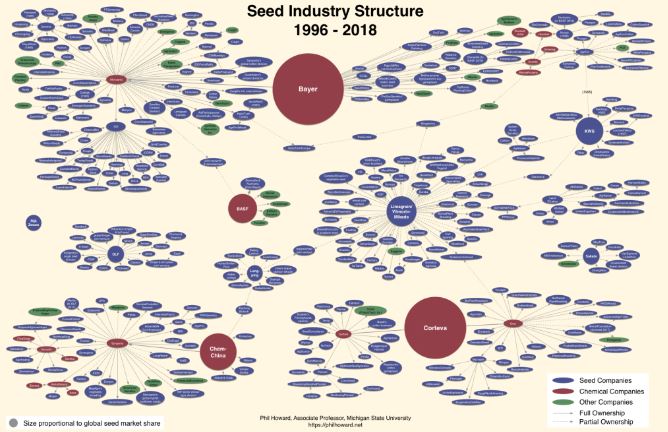
It does not refer to or even cite Phil Howard’s book: Concentration and Power in the Food System: Who Controls What We Eat?

I wrote about Howard’s book when it came out in a new edition.

How could the USDA’s economists fail to mention Howard’s analysis of the global seed industry (since updated).

It’s great the USDA is taking this on.  But if you really want to know what’s going on in industry concentration, read Phil Howard’s book first.

Jan 19 2023

Politics in (in)action: USDA and JBS

I’m indebted to Politico for this one: Federal government won’t stop buying food from meatpacker tied to bribery case.

Should the US government do business with a company that uses bribes to conduct its business?  The answer, apparently, is yes.

At issue is the relationship of USDA to the Brazilian meatpacking company, JBS, one of four companies controlling 85% of the US meat supply.

In 2020, JBS paid a $256 million fine to the US to resolve charges of bribing Brazilian officials.  A US subsidiary of JBS pleaded guilty to price-fixing charges in 2021.

The USDA has awarded nearly $400 million in contracts to JBS since October 2017, and at leat $60 million since the 2020 fines.

“Removing a firm from government-wide procurement would potentially impair competitive choice for the taxpayer in securing affordable food for the range of needs that government must provide for, from school lunches to meals for our soldiers,” Vilsack wrote.

Meat companies have way too much power.  Secretary Vilsack vowed to break up some of that power.  It would be good to make good on those promises.

********

For 30% off, go to www.ucpress.edu/9780520384156.  Use code 21W2240 at checkout.

Oct 27 2022

USDA aims to reduce Salmonella in poultry products: a good first step

The USDA is at long last giving some attention—a small but significant first step—to reducing Salmonella contamination of poultry products.

Salmonella is a big problem in poultry and eggs.  For decades, food safety advocates have called on the USDA to declare Salmonella an adulterant.  Adulterated food is illegal to sell.

The poultry industry has resisted, arguing that chicken gets cooked before it is eaten; cooking kills Salmonella.

It does, but you don’t want toxic forms of Salmonella in your kitchen where they can get into other foods.  For background all this, see my book, Safe Food: The Politics of Food Safety.

In a press release, the USDA’s Food Safety and Inspection Service (FSIS) announces that it

is considering a regulatory framework for a new strategy to control Salmonella in poultry products and more effectively reduce foodborne Salmonella infections linked to these products…The most recent report from the Interagency Food Safety Analytics Collaboration estimates that over 23% of foodborne Salmonella illnesses are attributable to poultry consumption—almost
17% from chicken and over 6% from turkey.

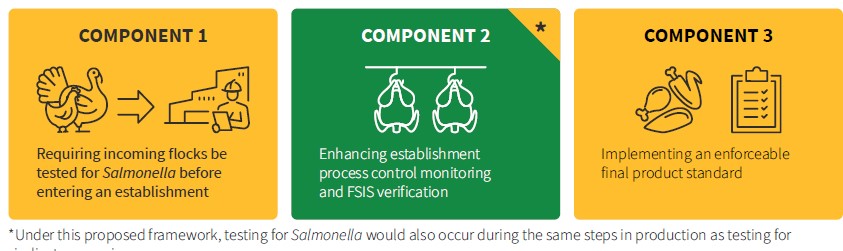
The proposed Salmonalla framework has three components:

What FSIS is actually doing:

We will publish a proposed notice of determination to declare Salmonella an adulterant in NRTE [not ready to eat] breaded and stuffed chicken products in 2022, and we intend to publish additional proposed rules and policies implementing this strategy in 2023, with the goal of finalizing any rules by mid-2024.

The adulterant consideration only applies to breaded and stuffed chicken or turkey products that are likely to be microwaved but not necessarily thoroughly cooked.  It does not apply to plain, unbreaded and unstuffed poultry.

Consumer Reports finds lots of poultry to be contaminated with Salmonella.  Consumer Reports says Salmonella is “lethal but legal.”

Currently, a chicken processing facility is allowed to have salmonella in up to 9.8 percent of all whole birds it tests, 15.4 percent of all parts, and 25 percent of ground chicken. And producers that exceed these amounts are not prevented from selling the meat. If salmonella became an adulterant, even in some poultry products, it would help reduce the amount of contaminated meat that hits the market.

As might be expected, the National Chicken Council opposes the USDA’s proposed framework: “lacks data, research.”

the facts show that the Centers for Disease Control and FSIS’s own data demonstrate progress and clear reductions in Salmonella in U.S. chicken products.  “Increased consumer education about proper handling and cooking of raw meat must be part of any framework going forward…Proper handling and cooking of poultry is the last step, not the first, that will help eliminate any risk of foodborne illness. We’ll do our part to promote safety.”

In other words, the poultry industry wants you to be responsible for protecting yourself against Salmonella.  If only you would do a better job of handling and cooking raw chicken.  It does not want to have to reduce Salmonella in its flocks in the first place (something quite possible, by the way).

This is a good first step.  Let’s urge the USDA to go even further and declare Salmonella an adulterant on all poultry sold in supermarkets.

And maybe require poultry producers to do everything possible to prevent Salmonella geting into flocks in the first place.

This won’t be easy, according to a United Nations report from a recent expert meeting.

The expert consultation noted that no single control measure was sufficiently effective at reducing either the prevalence or the level of contamination of broilers and poultry meat with NT-Salmonella spp. Instead, it was emphasized that control strategies based on multiple intervention steps (multiple or multi-hurdle) would provide the greatest impact in controlling NT-Salmonella spp. in the broiler production chain.

The experts concluded that all of the following approaches were needed:

  • Biosecurity and management
  • Vaccination
  • Antimicrobial
  • Competitive exclusion/probiotics
  • Feed and water
  • Bacteriophage (bacterial viruses)
  • Processing and post-processing interventions

***********

For 30% off, go to www.ucpress.edu/9780520384156.  Use code 21W2240 at checkout.


Aug 23 2022

USDA takes a baby step to making the chicken tournament system a bit more fair

USDA has finally proposed new rules to try to make the current poultry farming system a bit more fair to the people who actually raise the chickens.

Under the current system, the big poultry producers get the benefits while the chicken farmers take all the risks.  The companies supply the chicks; the farmers pay for the houses, equipment, and management—and take on immense debt to do so.

They are paid according to a tournament system.  Farmers who produce the most amount of chicken using the least amount of feed are paid the most; others get less.  But the farmers do not control the quality of the chicks they receive.  They also sell to only one buyer, a system with its own name, monopsony.

John Oliver did a synopsis of the tournaent system in 2015.

Hence the new rule: Transparency in Poultry Grower Contracting and Tournaments.  This does not get rid of the tournament system, unfortunately, but it does require poultry companies to disclose key information to growers about realistic outcomes before making important contracting decisions such as capital investments, and about key inputs.

The point is to enable growers to understand the terms of their contracts so as to have a better chance to compete.

Also see:

According to Politico, advocates for a fairer system are complaining that the largest poultry companies are pressuring farmers to oppose the USDA’s proposed rule and providing them with form letters to send in.

The USDA acknowledged these complaints when it announced an extension of the public comment period.

USDA is taking these steps to help ensure the integrity of the Federal rulemaking process and to ensure all parties have the opportunity to fully comment.

“There is fear throughout the meat and poultry industry as we saw earlier this year at two separate Congressional hearings where witnesses did not testify due to concerns of retaliation,” Vilsack said. “But it is still critical that we hear the full story, so we are highlighting the option for comments to be provided anonymously.”

Politico says that as of Aug. 18, the USDA had received at least 350 public comments.  According to its analysis, at least 200 of public comments support the rule, though some supporters have significant reservations and are imploring USDA to go further.