by Marion Nestle

Search results: tobacco

Oct 12 2011

House holds hearings on nutrition standards for food marketing to kids

Reports are coming in on the House hearings on the IWG report recommendations.  The IWG, recall from the previous post, is an Interagency Working Group of four federal agencies attempting to set nutrition standards for foods allowed to be marketed to kids.

This first report comes from Broadcasting & Cable:

The first panel of a joint hearing Wednesday on government-proposed food marketing guidelines featured government officials explaining that the principles, announced last April, are only voluntary recommendations to Congress that industry can ignore if they chose, while legislators, primarily Republicans, countering that they represent Big Brother government intruding into meal planning for families and a focus on marketing, without scientific backing, rather than focusing on more physical activity.

Republican lawmakers, it seems, want more science.  That’s always step one in undermining public health proposals: attack the science.  Subsequent steps, you may recall, include attacking critics, focusing on physical activity, and blaming personal responsibility for obesity and its consequences.

According to Healthwatch, Representative Henry Waxman (Dem-Calif)

Compared Republican defenders of unbridled food marketing to children to past champions of the tobacco industry. [He]  drew parallels between Wednesday’s hearing on proposed voluntary marketing restrictions and a 2003 hearing during which some Republicans promoted the safety of smokeless tobacco.

“I just find this an amazing hearing,” Waxman said. “The only thing I can analogize it to is after all the tobacco issues we discussed for many years, Republicans took charge and we never heard anything more about tobacco. Then, suddenly we had a hearing about tobacco.

And the hearing was about how smokeless tobacco should be encouraged as a way for smokers to give up smoking. It was geared to promoting an industry that no doubt supported financially many of the members. I wonder if this hearing is about the same subject.”

What I find most disturbing is the FTC’s backing down on the recommendations which were agreed upon by four federal agencies and voluntary.  CNN reports that David Vladeck, director of the FTC Bureau of Consumer Protection, said:

The coalition of government agencies is “in the midst of making significant revisions” to the original proposal.

Among the changes he suggested are narrowing the age group targeted and focusing on children aged 2 to 11 instead of up to age 17 and allowing marketing of the unhealthier foods at fundraisers and sporting events.

Vladeck also said that his agency would not recommend that companies change packaging or remove brand characters from food products that don’t qualify, as was originally suggested in the guidelines.

“Those elements of packaging, though appealing to children, are also elements of marketing to a broader audience and are inextricably linked to the food’s brand identity,” Vladeck said at the hearing.

This, as I keep pointing out, is about protecting corporate health at the expense of children’s health.

Sad.
Sep 19 2011

United Nations to consider the effects of food marketing on chronic disease

In what Bloomberg News terms an “epidemic battle,” food companies are doing everything they can to prevent the United Nations from issuing a statement that says anything about how food marketing promotes obesity and related chronic diseases.

The U.N. General Assembly meets in New York on September 19 and 20 to develop a global response to the obesity-related increase in non-communicable, chronic diseases (cancer, cardiovascular disease, respiratory disease, type 2 diabetes) now experienced by both rich and poor countries throughout the world.

As the Bloomberg account explains,

Company officials join political leaders and health groups to come up with a plan to reverse the rising tide of non- communicable diseases….On the table are proposals to fight obesity, cut tobacco and alcohol use and expand access to lifesaving drugs in an effort to tackle unhealthy diets and lifestyles that drive three of every five deaths worldwide. At stake for the makers of snacks, drinks, cigarettes and drugs is a market with combined sales of more than $2 trillion worldwide last year.

Commenting on the collaboration of food companies in this effort:

“It’s kind of like letting Dracula advise on blood bank security,” said Jorge Alday, associate director of policy with World Lung Foundation, which lobbies for tobacco control.

The lobbying, to understate the matter, is intense.  On one side are food corporations with a heavy financial stake in selling products in developing countries.  Derek Yach, for example, a senior executive of PepsiCo, argues in the British Medical Journal that it’s too simplistic to recommend nutritional changes to reduce chronic disease risk.  [Of course it is, but surely cutting down on fast food, junk food, and sodas ought to be a good first step?]

On the other side are public health advocates concerned about conflicts of interest in the World Health Organization.  So is the United Nations’ special rapporteur for  the right to food, Olivier De Schutter.  Mr. De Schutter writes that the “chance to crack down on bad diets must not be missed.”

On the basis of several investigative visits to developing countries,  De Schutter calls for “the adoption of a host of initiatives, such as taxing unhealthy products and regulating harmful food marketing practices…Voluntary guidelines are not enough. World leaders must not bow to industry pressure.”

If we are serious about tackling the rise of cancer and heart disease, we need to make ambitious, binding commitments to tackle one of the root causes – the food that we eat.

The World Health Organization’s (WHO) 2004 Global Strategy on Diet, Physical Activity and Health must be translated into concrete action: it is unacceptable that when lives are at stake, we go no further than soft, promotional measures that ultimately rely on consumer choice, without addressing the supply side of the food chain.

It is crucial for world leaders to counter food industry efforts to sell unbalanced processed products and ready-to-serve meals too rich in trans fats and saturated fats, salt and sugars. Food advertising is proven to have a strong impact on children, and must be strictly regulated in order to avoid the development of bad eating habits early in life.

A comprehensive strategy on combating bad diets should also address the farm policies which make some types of food more available than others…Currently, agricultural policies encourage the production of grains, rich in carbohydrates but relatively poor in micronutrients, at the expense of the production of fruits and vegetables.

We need to question how subsidies are targeted and improve access to markets for the most nutritious foods.…The public health consequences are dramatic, and they affect disproportionately those with the lowest incomes.

In 2004, the U.N. caved in to pressures from food companies and weakened its guidelines and recommendations.  The health situation is worse now and affects people in developing as well as industrialized countries.  Let’s hope the General Assembly puts health above politics this time.


Aug 26 2011

Surprise! Food companies still market to children

At the end of 2005, the Institute of Medicine (IOM) produced an unusually hard-hitting  report on food marketing to children.  The report complained about lack of cooperation from food companies in providing data.  Even so, the report concluded that “marketing works.” It is highly effective at getting kids to demand and eat junk foods.

The report gave the food industry two years to cease and desist.  If it didn’t, federal regulation should be considered.

Well, five years have come and gone and some of the people involved in the IOM report have just published a progress assessment in the American Journal of Preventive Medicine:  Despite lack of evidence in their review of the literature for real progress, the investigators’ assessment is anything but hard-hitting:

Food and beverage companies made moderate progress; however, limited progress was made by other industry subsectors. Industry stakeholders used integrated marketing communications (IMC) to promote primarily unhealthy products, which threaten children’s and adolescents’ health and miss opportunities to promote a healthy eating environment.

Miss opportunties?  That’s one way to put it.  Here are the conclusions:

Diverse industry stakeholders have several untapped opportunities to advance progress by promoting IMC to support a healthful diet; substantially strengthening self-regulatory programs; supporting truthful and non-misleading product labeling and health claims; engaging in partnerships; and funding independent evaluations of collective efforts.

The paper acknowledges:

the tensions among private- and public-sector stakeholders to promote a healthful diet to children and adolescents…conveying consistent and appealing messages; ensuring transparency by sharing relevant marketing data; obtaining company-wide commitments…balancing freemarket system goals with protecting young people’s health; and committing to monitor and evaluate all efforts.

Oh those pesky freemarket system goals.  Food companies cannot stop marketing junk foods to kids because the foods are profitable and their job as publicly traded companies is to grow profits every quarter.

That’s why federal regulation is essential, a point not mentioned by these investigators or in the accompanying editorial.  Instead, the editorial calls for counter-advertising:

The experience with tobacco is instructive. The most rapid period of decline in the use of cigarettes occurred not after television advertising was banned but in the period before the ban when counter ads were mandated as a proportion to the product ads.

I remember that period well.  The counter-advertisements were so effective that kids insisted that their parents stop smoking.

But those ads were mandated.  That’s still government.  Food companies cannot and will not stop marketing to kids on their own.

Note to physicians: you can 1 CME credit by reading this paper.

Jul 5 2011

Resources for advocacy: school food and ag policy

My San Francisco Chronicle column on food advocacy includes a severely edited list of organizations working on food issues, particularly school food and the farm bill.   I thought the entire list might be useful.

Note that information about how to contact government officials appears at the end.

I consider this list preliminary.  Please use the Comments to add to it.  And pass it along, use, and enjoy!

Organization Advocacy resources
General
Edible Communities ~60 Edible magazines throughout U.S.  Useful for identifying local food resources
Center for Science in the Public Interest (CSPI) Advocacy and lobbying for a broad range of food and nutrition issues, school food among them.
Slow Food USA Promotes policies favoring slow, as opposed to fast, food
Strategic Alliance for Healthy Food and Activity Environments Promotes policies to improve corporate and government practices that affect food and activity environments in California
Community Food Security Coalition More than 300 organizations working to build sustainable, self-reliant, local and regional food systems, and promote a healthier farm bill.
School Food
Background legislation 


The Healthy, Hunger-free Kids Act of 2010 

Proposed nutrition standards for school meals

USDA programs Team Nutrition: supports child nutrition programs through training 

Chefs Move to Schools: partners chefs with schools

Public Health Advocacy Institute Promotes use of the legal system to improve school food
National Alliance for Nutrition and Activity (NANA) Lobbies for federal policies and programs to improve school food and activity environments (a project of CSPI)
Public Health Law & Policy  


Offers a policy package with goals and actions for school wellness policies, and a fact sheet on the schools section of its website
National Farm to School Network Promotes connecting farm produce to schools
California ProjectLEAN (Leaders Encouraging Activity and Nutrition) Helps develop school wellness policies and healthier food and activity environments (a joint project of the California Department of Public Health and the Public Health Institute)
CANFIT (Communities, Adolescents, Nutrition, Fitness) Community-based initiatives to improve diet and fitness among low-income, minority adolescents
Center For Ecoliteracy Rethinking School Lunch Guide shows how to incorporate ecological understanding into school meals
School Food Focus Focus: Food Options for Children in Urban Areas
One Tray More direct connection between local farms and school meal programs
Better School Food Community-based connection of school food to health
Cook For America Culinary training to support healthy school lunches cooked from scratch
The Lunch Box Online toolkit with information about healthy lunch options
Let’s Move Salad Bars to School Supports salad bars in schools
Project Lunch Improves Marin County school lunch program
Nourish Life Food and sustainability in schools and communities
PEACHSF How-to guides and resources
Farm Bill
Institute for Agriculture and Trade Policy Public policies for food and farming 


Food and Water Watch Bring agricultural policy in line with health and environmental policy
National Sustainable Agriculture Coalition Promotes healthier and more sustainable systems for small- and medium-size farms, farming opportunities, fair competition
Organic Trade Association (OTA) Supports organic food production, large and small
Food Research and Action Center (FRAC) Protect and expand food assistance programs 


Environmental Working Group Exposes inequities in food subsidies; provides data on who gets what
PolicyLink Working to get Healthy Food Financing Initiative into the Farm Bill


How to contact federal and state government officials

The White House: http://www.whitehouse.gov/contact

Members of Congress http://www.congress.org/congressorg/directory/congdir.tt

State officials: http://www.congress.org/legislative_protocol

Local media: http://www.congress.org/congressorg/dbq/media/


Tags:
Jun 2 2011

Deconstructing the USDA’s new food plate

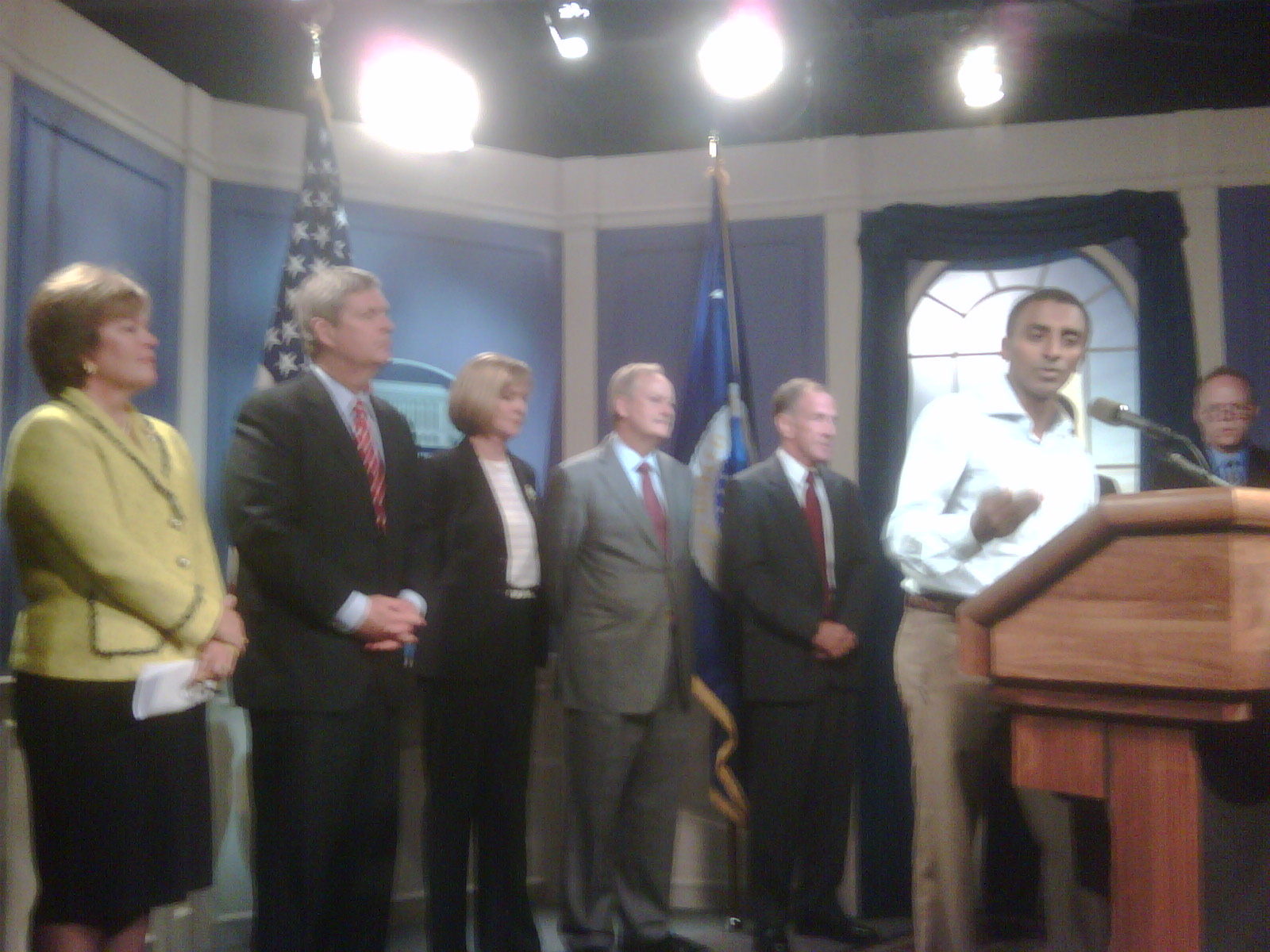
I attended the launch of the new food icon this morning, and the press conference following it (which featured Red Rooster chef Marcus Samuelson).


As USDA Secretary Tom Vilsack explained, we have an obesity crisis in America that imperils our nation’s national security, economic vitality, and health care system.  It’s time for action.

I got a preview of the design on a conference call last week (while I was in Spain) and took a screen shot:


This may not look much like action, but it is a sharp departure from previous USDA icons (which USDA has delightfully put online).   These mostly emphasize the importance of meat and dairy foods (the 1992 Pyramid was an exception, which was why the Bush II USDA got rid of it).

Before yawning, consider its strengths:

  • It is easy to understand (as Mrs. Obama explained, even a child can use it).
  • Vegetables comprise the largest sector.
  • Together, vegetables and fruits are half the plate.
  • You can put whatever foods you like on that plate.
  • You don’t have to count servings or worry about portion size (if the plate isn’t too big).
  • Dairy foods–a discretionary group–are off to the side.

My one quibble?  Protein.  I’m a nutritionist.  Protein is a nutrient, not a food.  Protein is not exactly lacking in American diets.  The average American consumes twice the protein needed.  Grains and dairy, each with its own sector, are important sources of protein in American diets.

Why protein?  USDA used to call the group “meat” even though it contained beans, poultry, and fish.  The meat industry ought to be happy about “protein.”  Meat producers have spent years trying to convince Americans to equate meat with protein.

And USDA says its consumer testing (as yet unpublished) indicated that the public understood “protein” to cover diverse food sources.

According to William Neuman’s report in the New York Times, USDA official Robert C. Post said that:

U.S.D.A. had spent about $2 million to develop and promote the logo, including conducting research and focus groups and creating a Web site. Some of that money will also be used for the first year of a campaign to publicize the image.

I would like to see that research.  Post told me that the research would be published on the website within the next few days.  I look forward to seeing it.

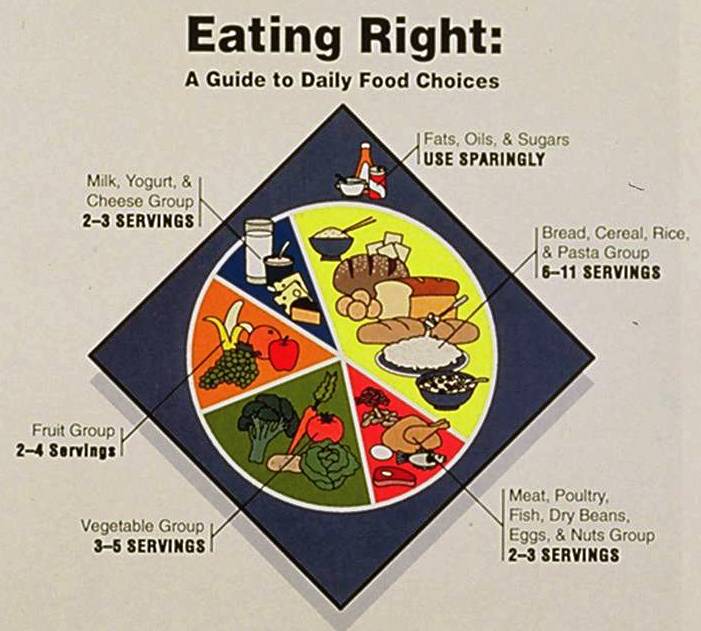
One other point: consider the alternative.  Just for fun, here’s the plate the USDA was considering in its last efforts to try to get rid of the Pyramid in 1991.  We have Marian Burros, then at the New York Times, to thank for rescuing the Pyramid that came out in 1992.


The next step, of course, is to bring agricultural policy in line with the plate, meaning doing a much better job of supporting producers of vegetables and fruits.  This is part of Secretary Vilsack’s plan for repopulating and revitalizing rural America—a goal that I strongly support.

Given the pushback against public health that is happening in Congress this week—Cut school lunches! Cut WIC! Get rid of nutrition recommendations! Go easy on tobacco and antibiotics!—the more I think it took courage for USDA to do this.

Let’s hope USDA can stand up to the heat.


May 12 2011

Robert K. Ross: Speaking truth to power

The Future of Food conference in Washington last week is now pretty much online (although I’m still having trouble with some of the links).  Much of it is well worth a listen, certainly Prince Charles’ thoughtful speech on sustainability, but also the one that I thought the most powerful—comments by Robert K. Ross, head of the California Endowment.

In the first 8 minutes of his talk, Dr. Ross explained that he comes to the issues discussed at the conference from the angle of public health and obesity, yet climate change, soil quality, hunger, and economic development are all wrapped up in the obesity issue.   Here is my paraphrase of what he said (with my emphasis):

If you care about these issues, you have to decide whether you are a group, network, or a movement.

Nothing short of a powerful movement will reverse the trends that are in front of us.

The tobacco battle is the proudest victory of public health, although not yet fully accomplished.

The scientific community first understood that tobacco was bad for health in 1921.  Hundreds of studies followed.  Yet it was not until 1965 that the Surgeon General first got permission for a warning label on cigarettes.  Only in the 1990s did we have policy and practice changes that included environmental incentives to drop the tobacco habit.

In other words, we have had a 100-year war on tobacco.

A side-by-side comparison of food and tobacco indicates that food, health, and sustainability are far more complex issues than tobacco.  We do not have 100 years to deal with these problems.

The tobacco wars were not about lack of scientific data.  They were and are a power issue.

The only way to confront power is to build a movement that wields power.

Science-based, evidence-driven policy wonks and researchers want more science.  But if you think you are in a policy debate and the other side thinks it is in a fight, you are not going to come out too well.

We need to bring as much rigor to the fight as we do to the science.

Food advocates: take careful note.

May 5 2011

Future of Food: the food movement goes mainstream

I’m just back from yesterday’s Future of Food conference in Washington DC.  The event, designed by WashingtonPostLive to “advance the conversation” about sustainable food, featured a glittering array of speakers from many aspects of the food movement. (You can watch the conference on video here, and the Washington Post will have a special section on it next Wednesday, May 11.)

The keynote speaker was none other than the Prince of Wales, fresh from his son’s wedding, who gave a serious and inspriring talk that touched on a great range of pressing issues related to agriculture, health, and the state of the world.

Anyone who has been involved in food issues for any length of time had heard these opinions before and most of the speakers were talking to an audience of a few hundred of the converted.

Nevertheless, I think there’s a story here, and not just because I was on one of the panels.

The story is that the event happened.  The food movement has gone mainstream.

The conference—sponsored by the Washington Post no less—brought in heavy hitters.  These included the Prince of Wales, of course, but also the President of Georgetown University, where the event was held, Eric Schlosser, Wendell Berry, Vandana Shiva, and officials of the FDA and White House.

USDA Secretary Tom Vilsack came, gave thoughtful remarks, and responded with equally thoughtful answers to not-always-friendly comments from the audience.  This was the first time I’d seem him in person and I was impressed by how carefully he has thought through the issues he has to deal with.   Even when I viewed the issues differently,  it seemed clear that his were the result of much intelligent thought and weighing of alternatives.

Montana Senator Jon Tester, of the Tester amendment to the food safety bill, gave closing remarks.

The speakers, young and old, famous and not, made it clear that concerns about the relationship of agriculture to the health of people and the planet were major and were getting focused attention at very high levels.

The food movement can no longer be considered fringe.  It’s mainstream.  Speakers provided much evidence for that from their own points of view.

They said, it’s now time to take the movement to the next step, and that means doing what it takes to become even more powerful.

For example, see if you can find the remarks of Robert Ross, President of the California Endowment and listen to the opening remarks of his speech about the analogy with tobacco and the need to counter the power of food corporations.

My slightly facetious suggestion: if Congress is for sale, let’s buy our own.

Perhaps you have other ideas for expanding the movement and making it more powerful?  Do tell.


Apr 15 2011

Why partnerships with food companies don’t work

Michael Siegel, MD, MPH, a Professor at the Boston University School of Public Health (whom I do not know), has been mailing me copies of his recent blog posts on partnerships between food corporations and health organizations, particularly the American Academy of Pediatrics (AAP), the American Academy of Family Physicians (AAFP) (see my previous posts), and the American Dietetic Association (ADA) (see my previous posts on this one too).

Dr. Siegel’s current post discusses two reasons why these partnerships do more for the food companies than they do for the organizations:

1. Coca-Cola and other Big Food companies are using these partnerships to enhance their corporate image, and therefore, their bottom line: sales of unhealthy products that are contributing towards the nation’s obesity epidemic.

In its 2010 annual report, Coca-Cola writes: “…researchers, health advocates and dietary guidelines are encouraging consumers to reduce consumption of sugar-sweetened beverages, including those sweetened with HFCS or other nutritive sweeteners. Increasing public concern about these issues…may reduce demand for our beverages, which could affect our profitability.”

…Pepsico, in its 2010 annual report, also makes clear the connection between the company’s public image and its bottom line: “Damage to our reputation or loss of consumer confidence in our products for any of these or other reasons could result in decreased demand for our products and could have a material adverse effect on our business, financial condition and results of operations, as well as require additional resources to rebuild our reputation.”

2. The American Dietetic Association, American Academy of Pediatrics, and American Academy of Family Physicians are supporting companies that oppose virtually every state-specific public health policy related to improvement of school nutrition, reduction of junk food and soda consumption, and environmental health and safety.

…Through its contributions to the Grocers Manufacturers Association (GMA), Coca-Cola is opposing any and all taxes on sugar-sweetened beverages (soft drinks), opposing the removal of BPA from bottles containing liquids consumed by infants, opposing legislation to simply require the disclosure of product ingredients, opposing taxes on candy, opposing bottle bills, opposing all restrictions on BPA-containing packaging, opposing standards for food processing, and opposing school nutrition standards.

…That the AAP, AAFP, and ADA have fallen for Coca-Cola’s tricks is one possibility. The other, which I find more likely, is that they have been bought off. In other words, that the receipt of large amounts of money has caused them to look the other way. It’s amazing what a little financial support will do. And of course, this is precisely the reason why companies like Coca-Cola and Pepsico include the sponsorship of public health organizations in their marketing plans.

I’m just back from the American Society of Nutrition meetings in Washington, DC, where the daily newsletter put out by the society included full-page advertisements from Coca-Cola, the beef industry, and the Corn Refiners Association (see yesterday’s post).  And then there is the astonishing example of Coca-Cola’s $10 million gift to Children’s Hospital of Philadelphia to head off a potential city soda tax.

It is completely understandable why food and beverage companies would want to buy silence from health professionals.  It is much less understandable why health organizations would risk their credibility to accept such funding.  Professor Siegel’s analyses of these issues are worth close attention.