by Marion Nestle

Search results: Complaint

Jul 8 2015

Chartwells and DC schools

Sadie Barr, who writes about school food problems in Washington, DC, wants me and readers to know about the recent $19.4 million settlement paid to the DC school district by its food service provider, Chartwells.

For what?  Overcharging the schools for its meals.

In an e-mail to me, she writes:

The issue of school food fraud isn’t new, and isn’t unique to DC. It happened in New York in 2010 and in 2012, and is probably occurring within the quarter of school districts nationwide that outsource their food service. It was written about in the New York Times in 2011 and in an investigative report published in 2009. This fraud represents millions (if not billions) of public funds going toward a company’s profits, instead of education.

How does this work?  Food service companies buy foods from manufacturers who give them kickbacks, but do not pass the savings along to the schools.

She points out that this scam affects quality of school food, posing a special burden to the more than 50% of students nationwide (it’s more than 70% in DC) who qualify for free and reduced priced meals.

The lawyers negotiating the settlement were from Phillips & Cohen LLP, a firm that specializes in representing whistleblowers.  In this case, the whistleblower was Jeffrey Mills, director of food services for the DC public schools from 2010 to 2013.

The Phillips & Cohen press release quotes Mills as complaining that Chartwells overcharged the school district and also caused circumstances when “food was delivered late, the number of meals was insufficient or the food was of poor quality or spoiled.”

Mills said that his goal had always been to improve food programs for DC’s school children: “District funds should be used to feed students the best quality food at the lowest cost.”

This is not the first time Chartwells got caught doing something like this.

In 2012, Chartwells’ parent company, Compass Group USA, paid $18 million to settle allegations by the New York Office of the Attorney General that the company wrongfully retained rebates on purchases of food and non-food commodities made under contracts with 39 school districts in that state.

Phillips & Cohen also say:

The allegations made in the District’s complaint and Mr. Mills’ complaints are allegations only.   The allegations against Chartwells have not been adjudicated.  Chartwells denies liability for the allegations.

Maybe so, but the company agreed to the $19.4 million of the DC case.

If you are having trouble understanding the fights over the USDA’s school nutrition standards, the Chartwells’ case should help.

For food service companies and the companies that supply food products, there is lots of money to be made on school meals.

Addition, July 9: DC, it seems, is renewing its contract with Chartwells, according to the Washington City paper’s story on Jeff Mills.

Addition, July 10:  The Washington City paper explains the politics of Chartwells in DC.
Apr 9 2015

Consumer advocates petition FTC to keep junk food advertising out of YouTube for Kids

A coalition of children’s and consumer advocacy groups (see list below) filed a complaint with the Federal Trade Commission (FTC) charging that Google’s new YouTube Kids app violates restrictions on marketing junk foods to kids.

The coalition’s letter to the FTC details the charges.  YouTube Kids, it says:

  • Intermixes advertising and programming in ways that deceive young children.
  • Features “branded channels” for McDonald’s, Barbie, Fisher-Price, and other companies.
  • Distributes “user-generated” segments that feature toys, candy, and other products without disclosing the business relationships.

The Washington Post gives some examples:

On the American Greetings’ Strawberry Shortcake channel, for instance, a 37-second video features the red-haired doll describing the company’s “Food Fair” app, where characters pick ingredients for recipes. At the end, a banner appears showing the app can be downloaded on iTunes. McDonald’s has a 7-minute video dispelling myths about the contents of Chicken McNuggets. On another video, a deep-voiced announcer warns, “All vegetarians, foodies and gastronauts, kindly avert your eyes,” with a slow-cam close up of a juicy Big Mac. “You can’t get juiciness like this from soy or quinoa.”

Here’s the Coalition list: the Center for Digital Democracy, Campaign for a Commercial-Free Childhood, American Academy of Child and Adolescent Psychiatry, Center for Science in the Public Interest, Children Now, Consumer Federation of America, Consumer Watchdog, Corporate Accountability International, and Public Citizen.

This will be fun to watch.  Stay tuned.

Apr 6 2015

Is SmartCandy smart policy?

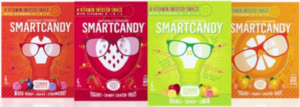
I was surprised by FoodNavigator-USA’s story about “SmartCandy,”—a “vitamin-infused snack.

smart candy

Could the name and contents of this candy be violating the FDA’s “jelly bean” rule?

The “jelly bean” rule refers to FDA’s fortification policy,* which aims to discourage food and beverage makers from adding vitamins to “foods of minimal nutritional value” (a.k.a. junk foods) so they can be marketed as healthy.

The policy is explicit.  The FDA does not consider it appropriate to add nutrients to candies and beverages.

Here’s what the article says about what’s in it:

Smartcandy is formulated with a blend of Vitamin A for eye health, three B vitamins to support converting sugar and carbohydrates into sustained energy, and vitamin C for immunity. The trans fat-, high-fructose corn syrup-free candies come in four varieties: sweet and sour gummies; and Froot, a proprietary snack with a candy shell and a layer of yogurt encasing a strawberry or orange center.

Here’s the Nutrition Facts label (thanks to a reader for sending).

Here’s what the website says Orange Froot candy can do:

This is the visionary leader of the snacking world, it’s the one they listen to and admire. He can make a three point shot with his eyes closed, build the best fort you’ve ever seen, or solve an algebra question like it was a nursery rhyme, this flavor packed snack will push you to achieve anything!

If SmartCandy can get away with this, won’t Coca-Cola and Pepsi be next?

Candy is candy and has an place in kids’s diets—occasionally.  But a health food that makes kids do better in school?  I’d like to see the evidence for that.

FDA: take a look please.

*Thanks to Michael Jacobson for forwarding.

Update, April 13: The New York State Attorney General has filed a complaint.

Mar 4 2015

Goodbye to artificial colors?

I was invited by CNN to comment on the announcement by Nestlé that it is removing artificial colors from its chocolates.

Here’s what I said:

(CNN) When food giant Nestle USA (to which I am, alas, not related) last month announced plans to remove all artificial flavors and colors from its chocolate candies, it understandably made headlines. According to the company, by the end of 2015, none of a group of 250 chocolate products including Butterfinger and Baby Ruth will contain artificial flavors or colors such as Red #40 or Yellow #5.

With the expectation that these chemicals will also disappear from the company’s other candies, it looks like the end of the use of artificial flavors and colors in anything but the cheapest food products. If that proves to be the case, it will be a welcome shift.

Nestle USA intends to advertise the reformulated products with a “No artificial flavors or colors” claim on package labels. If sales of the “no artificial” candies grow as expected, the company will surely extend the removal to all of its other colored and flavored food products. After all, Nestle’s international parent company — and the company’s competitors — will have to take notice and find ways to remove these chemicals from all their product lines.

Nestle USA has undeniable clout. It accounts for a quarter of the $100 billion in annual revenues of the more than century-old, privately held parent corporation, which itself is the largest food company in the world. This move surely will not only reverberate through the candy industry, but also affect every other major food company.

In substituting natural for artificial flavors and colors, Nestle USA is responding to what its customers are saying. The company’s own research indicates that Americans prefer their beloved candy brands to be free of artificial flavors and colors, while other surveys find majorities of respondents saying that artificial chemical additives negatively influence their buying decisions.

Nestle is also responding to decades of complaints from consumer advocates about the potential health risks of these chemicals, especially the dyes. Studies in experimental animals have linked high doses of food dyes to health problems, among them organ damage, cancer, birth defects, and allergic reactions. In humans, studies link food dyes to hyperactivity and other behavioral problems in young children.

The credibility of these studies and their implications for human health remain hotly debated. In the 1970s, for example, Ben Feingold, a physician in California, suggested that food additives caused children to become hyperactive. Much of the evidence for the “Feingold hypothesis” rested on anecdotal reports by parents, whereas double-blind, controlled clinical trials produced contradictory results.

On the basis of current evidence, some artificial food dyes have been banned, while others remain in use despite suggestions that they too might be harmful. But the makers and users of food dyes argue that the chemicals are safe at current levels of usage. As a result of all this, and in the absence of convincing evidence of their safety, the advocacy group Center for Science in the Public Interest has campaigned since the 1970s to remove food dyes and other chemicals from foods, and has continued to petition the Food and Drug Administration to ban them.

The opposing views complicate the regulatory status of food dyes. But after one clinical trial reported that dyes induce hyperactivity in half the children studied, the British government asked companies to stop using most food colors; the European Union requires a warning notice on many foods made with them.

In the United States, the FDA does not permit artificial food dyes to be used unless the manufacturers can meet safety requirements. But the amounts of these substances in the country’s food supply have greatly increased in recent years — soft drinks, breakfast cereals, frozen desserts and even salad dressings all contain artificial coloring agents. True, the FDA considers a dye to be safe if there is a reasonable certainty that no harm will result from its intended use. But that standard is vague enough to cause concern.

Given the unresolved scientific questions, it is reasonable to ask why artificial colors have to be in foods at all. From the standpoint of manufacturers, such additives are essential for covering up and hiding unattractive colors in processed foods. To the public, red candy seems to taste better than the drab variety. And while natural colors exist, they are less stable or more expensive to produce. But for Nestle to have taken the action that it has, the company must have found substitutes it can live with. And appealing to consumers’ preference for “natural” makes good business sense.

The truth is that whether artificial colors do or do not cause health problems in adults or children, they are there strictly for cosmetic purposes. For that reason alone, getting rid of them is a good idea.

Tags:
Dec 22 2014

GAO: USDA and FDA need to coordinate food safety activities

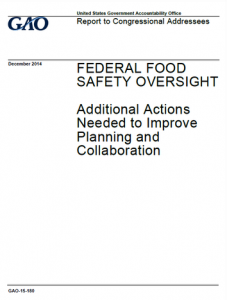
The Government Accountability Office has just released a new report.

Much of the report is about the need for better coordination of the food safety oversight responsibilities of the USDA (meat and poultry) and those of the FDA (everything else), not to mention the 13 other agencies that deal with aspects of food safety (the report provides a handy summary chart).

lpEK8r7sc9nBS8F0Cj59z3AoErH18mUv6v_LaDXyzeY


This report points out that both agencies

have mechanisms in place to facilitate interagency coordination on food safety that focus on specific issues, but none provides for broad-based, centralized collaboration…[Existing]mechanisms do not allow FDA, FSIS [USDA], and other agencies to look across their individual programs and determine how they all contribute to federal food safety goals. Nearly all the experts GAO interviewed agreed that a centralized collaborative mechanism on food safety is important to foster effective interagency collaboration and could enhance food safety oversight. The Food Safety Working Group (FSWG) served
as a centralized mechanism for broad-based food safety collaboration and resulted in a number of accomplishments, including improved coordination. However, the FSWG is no longer meeting…Without a centralized collaborative mechanism on food safety, there is no forum for agencies to reach agreement on a set of broad-based food safety goals and objectives.

The GAO complains that “for more than a decade, we have reported on the fragmented nature of federal food safety oversight.”

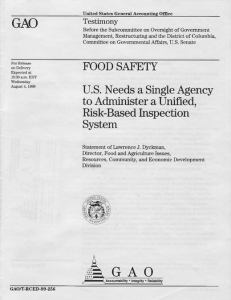
Actually, its complaints go back longer than that but here’s one from 1999:

New Picture

I will have to go through my files but as I recall, the GAO started arguing for a single food safety agency sometime in the early 1990s.  Political realities make that idea impossible.  Instead, we have the Food Safety Working Group which seems to have stopped meeting.

It’s good the GAO is still on the case.  We need better food safety oversight.

Tomorrow’s example: Caramel apples.

Dec 18 2014

The Healthy Nation Coalition doesn’t like the Dietary Guidelines. But what does it want?

This is my week to be talking about the Dietary Guidelines, apparently.  Yesterday’s Politico Morning Agriculture, a news source on which I greatly depend, noted yet another attack on the Dietary Guidelines, this one from a group called  The Healthy Nation Coalition.

The Coalition wrote a letter to the secretaries of USDA and HHS, the agencies sponsoring the Guidelines, with many complaints about process and ineffectiveness.

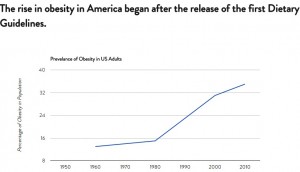
I had never heard of this group, so I went to its website and laughed when I saw this graph—a terrific example of why epidemiologists insist that association does not necessarily say anything about causation.

Screenshot 2014-12-17 10.46.00


The implication here is that the Dietary Guidelines either cause obesity (something patently absurd) or have had no effect on its prevalence (something only to be expected given the other changes in society that predisposed to obesity beginning in the early 1980s).

If anything, the Dietary Guidelines are a result of those forces in society, not their cause.

I have my own issues with Dietary Guidelines (see Fo0d Politics), mainly about the use of advice that is euphemistic (“choose lean meats”) or incomprehensible (reduce SoFAS—solid fats and added sugars), and their focus on nutrients (fat, sugar, salt) rather than foods.

But I can’t understand what this Coalition is about or what it wants.

Its website says the Coalition formed because

A sense of community has arisen around questioning our current approach to food and nutrition. Healthy Nation Coalition has its beginnings in the ancestral health, Weston A. Price Foundation, and low-carbohydrate nutrition communities.

I understand what the Coalition does not want.  It

suggests that the 2010 Guidelines are not appropriate for population-wide diet recommendations, especially with regard to restrictions on dietary fat, saturated fat, cholesterol and salt.

indicates that the 2010 Guidelines may lead to increased risk of weight gain, diabetes, and chronic disease in many populations.

indicates that reducing intake of sugars and starches has health benefits.

indicates that adequate, complete protein is a critical part of the adult diet and that many adults benefit from intakes above current minimum recommendations.

Here’s what it says it wants

the Healthy Nation Coalition proposes that this process be removed from the USDA and HHS and given to one or more independent agencies, offices, or entities that can create dietary guidance that is without bias and responsive to the needs of the people of America.

Really?  Like what?

The “ask” in the letter is this:

It is the duty of USDA and DHHS leadership to end the use of controversial, unsuccessful and discriminatory dietary recommendations. USDA and DHHS leadership must refuse to accept any DGA that fail to establish federal nutrition policy based on the foundation of good health: adequate essential nutrition from wholesome, nourishing foods. It is time to create DGA that work for all Americans.

But what would they look like?

I don’t recognize any of the names of the individuals listed as part of the Coalition.

Can anyone explain to me what this group wants and is about?

May 22 2014

A roundup on pet food items

I haven’t said anything about pet food in a while, but plenty is happening with it since my pet food books came out—Pet Food Politics (2008) and Feed Your Pet Right (2010).

A few items I’ve collected over the past month or so.

  • FDA regulations: The FDA finally issued its proposed rule for processing standards for all facilities engaged in manufacturing, processing, packing or holding animal feed and pet food.  These include  Good Manufacturing Processes (GMPs) and risk-based preventive controls (formerly known as HACCP), among other provisions.
  • Safety tips: Food Safety News lists ten ways to make pet food safer—pay attention and follow food safety procedures diligently, for one thing.
  • Double standard: Bill Marler complains that the FDA is constantly announcing recalls of Salmonella-contaminated pet foods, even though few of them result in cases of Salmonella in pets or humans, whereas foods for humans take forever to get recalled even when they cause illness.
  • Pet food recalls: The FDA certainly lists plenty of pet food recalls, and even has a web page for them.
  • FDA oversight: The FDA is on the job and testing.  Bravo issued recalls because of potential Listeria contamination.  It did so because the FDA says an independent lab detected the bacteria in a sample.
  • Marketing wars: Pet Food Industry, the excellent publication for manufacturers, has a juicy story about the marketing claims war between Nestlé (no relation) Purina PetCare and Blue Buffalo.  Each has sued the other.  Blue Buffalo has already been called on its advertising claims, perhaps in response to a complaint from  Hill’s Pet Nutrition.
  • The ongoing mystery: Pet jerky treats, mostly imported from China, linked to at least 3 human illnesses and more than 1,000 dog deaths and 4,800 dog illnesses, mostly from gastrointestinal problems, liver and kidney disease, and neurological and skin conditions.  The FDA says it still can’t figure out the cause, despite 7 years of trying. symptoms in their pets,” said FDA.

If we can’t get pet food right, there’s not much hope for human food either.

Mar 17 2014

The battles over school food: cupcakes again.

In devising science-based nutrition standards for school meals, USDA’s goal was to promote healthier diets.

You might think everyone would rally around proposals to help America’s kids grow up healthier, but no.  Special interests are at stake.

Jerry Hagstrom writes that “First Lady has food industry in a frenzy.”

Over the decades the food industry, school food service directors, farmers, and the rest of agribusiness have won many battles with nutritionists and the medical profession over government policies on what Americans should eat.

Interesting lineup of allies, no?

Last week, Congress held a hearing on all the complaints it’s getting about school meals.

Politico Morning Agriculture reports that the issue is cupcakes—again.

THE CUPCAKES ARE SAFE: The Department of Agriculture does not intend its proposed rules on the marketing or sale of junk foods in schools to prohibit class treats, Agriculture Secretary Tom Vilsack said during a hearing held by the House appropriations agriculture subcommittee Friday.

“We are not going to stop mom or dad from bringing in cupcakes,” Vilsack said.

The arguments over school food are not about kids’ health.

They are about who makes the most money from taxpayer subsidies of school meals.

School food service directors are on the wrong side of this one, alas.