by Marion Nestle

Search results: the corporation not me

Apr 23 2024

At long last: legislation to reduce childhood obesity and diabetes!

I received an e-mailed press release from the Senate Committee on Health, Education, Labor, and Pensions (HELP), chaired by Sen. Bernie Sanders (I-VT):  NEWS: Sanders and Booker Take on Food and Beverage Industry with New Legislation to Address Childhood Diabetes and Obesity Epidemics.

Sen. Sanders, along with Sens. Cory Booker (D-NJ) and Peter Welch (D-VT), have introduced legislation to

Take on the greed of the food and beverage industry and address the growing diabetes and obesity epidemics negatively impacting millions of American children and families across the country. The Childhood Diabetes Reduction Act establishes a first-of-its-kind federal ban on junk food advertising targeted to children in the United States, requires the Food and Drug Administration (FDA) to implement strong health and nutrient warning labeling, directs the National Institutes of Health (NIH) to investigate the dangers posed by ultra-processed foods, and develops a national education campaign for children and caregivers through the Centers for Disease Control and Prevention (CDC).

The press release quotes Sen. Sanders:

“Let’s be clear: The twin crises of type 2 diabetes and obesity in America are being fueled by the food and beverage industry that, for decades, has been making massive profits by enticing children to consume unhealthy products purposely designed to be overeaten…We cannot continue to allow large corporations in the food and beverage industry to put their profits over the health and well-being of our children.

Nearly 30 years ago, Congress had the courage to take on the tobacco industry, whose products killed more than 400,000 Americans every year. Now is the time for Congress to act with the same sense of urgency to combat these diabetes and obesity epidemics. That means banning junk food ads targeted to kids and putting strong warning labels on food and beverages with unacceptably high levels of sugar, salt, and saturated fat.”

Resources:

At long last, congressional representatives are trying to do something to prevent childhood obesity.  Let’s urge our representatives to sign on to this bill.

Apr 19 2024

Weekend reading: Eric Schlosser on our cartel food system

In the Atlantic (to which I subscribe), Eric Schlosser writes: Do We Really Want a Food Cartel? 

Mergers and acquisitions have created food oligopolies that are inefficient, barely regulated, unfair, and even dangerous.

He begins with the Federal Trade Commission’s report on what happened to the US food supply during the COVID-19 pandemic: Feeding America in a Time of Crisis: FTC Staff Report on The United States Grocery Supply Chain and the COVID-19 Pandemic.  This report focuses on the hazards of corporate consolidation for workers and consumers.

We see the effects in the grocery store.  Prices are up and executive compensation even more so.

As Schlosser puts it,

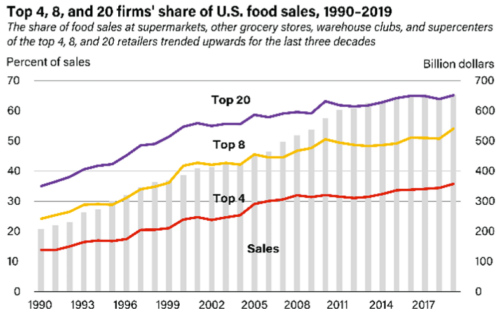
When four companies gain a combined market share that is greater than 40 percent, an oligopoly has formed. The prices offered to suppliers, the prices charged to consumers, and the wages paid to workers are no longer determined mainly by market forces. Further, the power these corporations exert within their industries and the economy as a whole leads to a well-documented dynamic: Effective government regulation becomes difficult, whether because state and federal agencies are “captive” or because they are outmatched in terms of resources and personnel.

This brings us back to my post this week about the FDA.  Schlosser describes the agency as “Poorly managed and notoriously reluctant to confront major food companies,” as shown by its inability to get on top of infant formula shortages.

Read his piece and see if he makes the case for his conclusion:

the fight against oligopolies and monopolies won’t be easy. A small number of corporations have tremendous political influence, expensive attorneys, and great skill at rigging markets in ways the public just can’t see.

We all need to pay close attention.

Mar 22 2024

Weekend reading: family monopolies over food

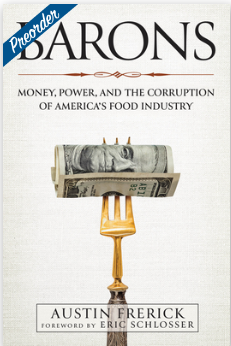
Austin Frerick.  Barons: Money, Power, and the Corruption of America’s Food Industry.  Island Press, 2024.  With an Introduction by Eric Schlosser.

Wow.  This is one important book.

Frerick’s thesis is that a small number of individuals or families have been allowed to accumulate unconscionable levels of wealth by exploiting or getting around laws (mostly legally but sometimes with bribes), pressuring government to collude, and doing everything possible to enrich themselves at the expense of community and worker welfare—all in the name of low food prices for consumers whether or not they are the reality.

Frerick takes on family enterprises in pigs, grain, coffee, dairy, berries, animal slaughter, and groceries.

This is one tough book.  Frerick structures the chapters to describe the rise of the families’ fortunes, how they exploited rules and customs, and how that got government to collude in giving these companies so much market share and power.

I learned a lot from every chapter, so much that I found myself checking references—-these are extensive—constantly to find our where he had gotten information I’d never seen before.

.About Walmart’s payment of low wages to employees, for example,  Frerick writes,

These low wages also obscure a generous hidden subsidy that the company receives from taxpayers. Many Walmart employees depend on government public assistance programs such as Medicaid (health care), Earned Income Tax Credit (a low-wage tax subsidy), Section 8 vouchers (housing assistance), LIOHEAP (energy assistance), and SNAP (food assistance), among others. In 2013, one estimate by congressional House Democrats found that taxpayers subsidized Walmart to the tune of more than $5000 per employee each year….In effect, instead of paying a living wage to these employees, the Walton family shifts the burden to taxpayers.

Not only that, but SNAP users spend a lot of their benefits at Walmart.

With some back-of-the-envelope math, I came up with a rough estimate that Walmart now receives somewhere around $26.8 billion each year from SNAP.

The chapter on JBS, the Brazilian company now one of four companies controlling 85 percent of meat slaughtering, is particularly worth reading for its documentation of the company’s use of bribery to achieve its ends.

If you want to know how corporations control the food supply, start here.

Jan 3 2024

Senator Bernie Sanders vs. Big Food

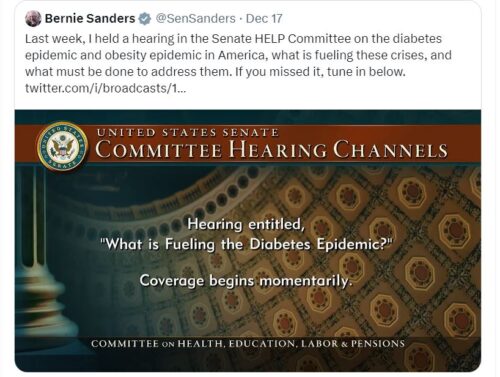
Just before the Christmas holidays, Senator Bernie Sanders (Ind-VT), who chairs the Senate Health, Education, Labor & Pensions Committee , held a hearing: What is Fueling the Diabetes Epidemic? 

The Senator’s Tweet:

Some of the quotes from the Senator’s remarks are amazing.  They need to be said, loud and clear:

  • Why is the number of children in America today who have Type 2 diabetes estimated to skyrocket by nearly 700% over the next four decades?
  • For decades, in my view, we have allowed large corporations in the food and beverage industry to entice children to eat foods and beverages loaded up with sugar, salt, and saturated fat, purposely designed to be over-eaten,
  • The situation has gotten so bad that most of what children in America eat today consists of unhealthy, ultra-processed foods that doctors have told us lead to a higher risk of type 2 diabetes.
  • While diabetes and obesity rates in America soar, the food and beverage industry spends billions on advertising to get consumers, including young children, hooked on their unhealthy products.
  • This has got to stop. A good place to start? Banning junk food ads targeted at kids.
  • This is not a radical idea.
  • We must have the courage to take on the greed of the food and beverage industry which, every day, is undermining the health and well-being of our children by pushing extremely unhealthy products which far too often cause obesity and type-2 diabetes.

The hearing began with:

Witness testimony

Senator Sanders also wrote an op-ed in USA Today: “We can’t allow the food and beverage industry to destroy our kids’ health.

Helena Bottemiller Evich, writing in Food Fix “Bernie Sanders vs. Big Food,” asks why Sanders is doing this now?  She has no answer, but I think its fabulous that he is taking this on and joining Senator Cory Booker in this endeavor.

Diet-related chronic diseases are a big problem for kids as well as adults.

It’s way past time to take on the food industry’s manipulative marketing practices.

Cheers to Senators Sanders and Booker.  We need more of you in Congress.

Dec 1 2023

Weekend reading: The Taste of Water

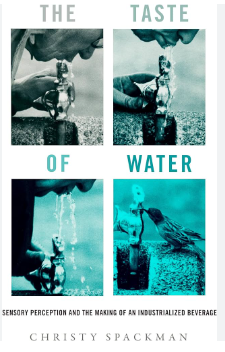
Christy Spackman.  The Taste of Water: Sensory Perception and the Making of an Industrial Beverage.  University of California Press, 2023. 289 pages.

Food Studies scholar Christy Spackman proves that, yes, an entire book—-and a riveting one at that—-can be devoted to how water tastes, thereby explaining how it can be turned into a bland commodity with its non-taste sold at exorbitant cost.

My blurb for it:

After reading this book, I now view tasting water as just the same as tasting food, and so will you.

Here is a brief excerpt:

The tasting work done by the Nestlé team, and subsequent website and print information, paints a specific form of relationship between environment and corporation. Rather than highlighting Nestlé Waters (and one might say, all bottled water producers) as operating via extractive economies that produce PET bottles that then circulate in the environment for millennia in increasingly small particles—the tasting situated Nestlé as a core protector of the environment. Teaching dégustation meant teaching consumers to prioritize terroir, rather than the entire political economy of bottled water production….the stories that emerge through dégustation prioritize attention to long-standing understandings of the relationship between earth, food, and flavor at the expense of more recent environmental impacts of water exploitation. Attending to terroir makes it is easy to miss that the systems and ways in which bottled water is produced are, like municipal water, deeply technoscientific.

Another one:

Frankly, from a flavor perspective, for many people accustomed to the taste of bottled water, or filtered tap water, the ingestible argument DPR presents is pretty exciting. DPR [Direct Potable Reuse—i.e., reclaimed] water directly from Scottsdale’s Tap 2 completely lacks the green, musty flavors that plague so many water producers in the metropolitan Phoenix region. It tastes remarkably—or eerily—similar to many mainstream bottled water brands with its lack of minerality. Current proposals for integrating DPR into municipal water sources anticipate blending the purified effluent with treated water from the regular source. Once regulatory bodies take the step of allowing DPR, in the near future water will still slightly taste of the rivers, lakes, canals, wells, and aquifers it travelled through. Just less so.

Full disclosure: Christy Spackman is a doctoral graduate of NYU’s Food Studies program and we could not be more proud of what she has accomplished.  Read her book, judge for yourself, and enjoy!

Nov 28 2023

The hazards of feeding babies and young children: What to do?

I’ve been collecting items on feeding kids.  Here are four.

I.  FDA Warning Letters: The FDA has sent warning letters to ByHeart, Mead Johnson Nutrition (Reckitt), & Perrigo Wisconsin for violating basic food safety standards in manufacture of infant formula.

They [letters] reflect findings from FDA inspections of these facilities over the last several months. At the time of each inspection, the FDA issued inspectional observations and exercised oversight of each firm as they initiated recalls (in December 2022February 2023 and March 2023) to remove product potentially contaminated with Cronobacter sakazakii from the marketplace…The FDA is issuing these letters now as part of its normal regulatory process and to reinforce to these firms the importance of instituting and maintaining appropriate corrective actions when they detect pathogens to ensure compliance with the FDA’s laws and regulations. As part of this, the firms must, among other things, thoroughly conduct root cause investigations and perform subsequent cleaning and sanitation activities. Notably, firms also need to properly evaluate their cleaning and sanitation practices, schedules, and procedures before releasing product. 

Comment: What shocks me is the implication that the companies are not already doing this as part of their normal routines.

II.  Baby food pouches with lead sicken children.   

At least 18 more children have been sickened by the recently recalled applesauce fruit pouches due to dangerous lead contamination, the Food and Drug Administration said, in a recent update.  That brings the total number of affected children to 52. Applesauce pouches recall timeline:From recalls to poisoned kids in multiple states

Comment: Yes, I know self-feeding pouches are convenient, but I sure don’t like them much.  They are usually loaded with sugar and they don’t teach kids about diverse food flavors and textures.  Quality control, apparently, is a big issue.  My vote: avoid.

III. Environmental Working Group study finds 40% of commercial baby foods to contain toxic pesticides.

  • EWG sampled 73 products from three popular brands: 58 non-organic, or conventional, baby foods and 15 organic.
  • At least one pesticide was detected in 22 of the conventional baby foods.
  • No pesticides were detected in any of the 15 organic products.

Comment: Pesticides may be in all foods but they get concentrated in baby foods.  The moral here is clear; if you want baby foods free of harmful pesticides, buy organic.  For more on this, see article in The Guardian.

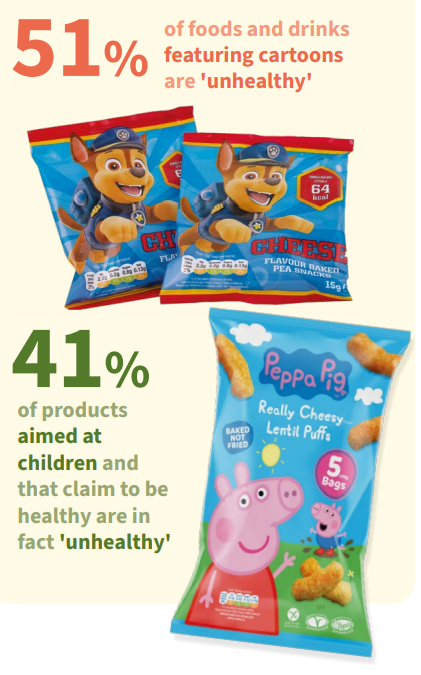
IV. The marketing of ultra-processed foods especially targets infants and young children.   A study done in the UK provides ample documentation of anything you would want to know about this practice.

Comment: Food companies say they have to market to young children in order to meet sales growth targets.  Ethics is not a consideration here.

Given that situation, what to do?

Understand: commercial infant and baby foods are convenient, but enormously profitable to manufacturers.  Profits induce corporations to cut safety and health cautions.  This tension should make you think twice about using commercial infant and child feeding products.

To the extent you can:

  • Breast feed when possible, for as long as possible
  • If you use infant formula, switch around the brands (they are all the same, nutritionally); buy organic if you can afford it.
  • Make your own baby foods (put whatever healthy foods you are eating or have around in a tiny blender).; buy organic foods if you can afford them.
  • Feed kids real foods as soon as they can grab, chew, and swallow them without choking.

If you eat a generally healthy diet, get your kids eating it as soon as they can.

Oct 16 2023

Industry funded studies of the week: Nuts and more nuts

I have so many of these waiting to be posted that I might as well do a bunch of them all at once.

Almonds

The study: Prospective Randomized Controlled Trial on the Effects of Almonds on Facial Wrinkles and Pigmentation. Nutrients 2021, 13(3), 785; https://doi.org/10.3390/nu13030785.

Conclusion: “the daily consumption of almonds may contribute to the improvement of facial wrinkles and reduction of skin pigmentation among postmenopausal women with Fitzpatrick skin types I and II.”

Funder: Almond Board of California

Comment: Thanks to Lori Rothman for sending this one.  It’s not the first time I’ve posted an almonds-and-wrinkles study; here’s the other from 2021.   And please note.  It’s not just almonds.  Mangos do this too.  But the Almond Board is working hard on turning almonds into superfoods. Members of the Academy of Nutrition and Dietetics were sent an announcement “Exciting new research investigates the link between almonds and these three key areas: Exercise recovery, prediabetes and skin health. That ad sends you to “Dietitian Tools” on the California Almonds website, where you can find a handy link to the study.

Here’s another one:

The study: Almond intake alters the acute plasma dihydroxy-octadecenoic acid (DiHOME) response to eccentric exercise.Front. Nutr., 09 January 2023  Volume 9 – 2022 | https://doi.org/10.3389/fnut.2022.1042719

Conclusions: “In general, the elevated post-exercise plasma levels of 12,13-DiHOME with almond intake support positive metabolic outcomes for adults engaging in unaccustomed eccentric exercise bouts. Other almond-related benefits for exercisers revealed in this study include reduced feelings of fatigue and tension, better leg-back strength during recovery, and decreased muscle damage during the first day of recovery.”

Funding: This work was supported by Almond Board of California, Modesto, CA. The funder had no role in the study design, data collection, analysis and interpretation, the preparation of the manuscript, or in the decision to submit the article for publication.

Comment: That’s what they all say.

Macadamias

The study: Macadamia nut effects on cardiometabolic risk factors: a randomised trial  J Nutr Sci. 2023.

Conclusion: “Daily consumption of macadamia nuts does not lead [sic]to gains in weight or body fat under free-living conditions in overweight or obese adults; non-significant cholesterol lowering occurred without altering saturated fat intake of similar magnitude to cholesterol lowering seen with other nuts.”

Funding: This study was funded by Hort Innovation, Sydney, Australia (Project code MC17005).  J. J., K. O. and F. M. – None; J. S., S. R. and C. H. have received research funding through their institution from Hort Innovation, Sydney, Australia.  Note: “Hort Innovation is a grower-owned, not-for-profit research and development corporation with the goal of creating value for horticulture growers and those across the horticulture supply chain. It invests more than $120 million in R&D, marketing and trade programs on behalf of industry.”

Peanuts

The study:  Urinary Phenolic Metabolites Associated with Peanut Consumption May Have a Beneficial Impact on Vascular Health Biomarkers. Antioxidants. 2023; 12(3):698. https://doi.org/10.3390/antiox12030698.

Conclusion:  “the present study shows for the first time that regular peanut and peanut butter consumption could have a positive impact on vascular biomarkers in healthy young adults.”

Funding: This research was supported by funding from the Peanut Institute.

Tree Nuts

The study: Tree Nut and Peanut Consumption and Risk of Cardiovascular Disease: A Systematic Review and Meta-Analysis of Randomized Controlled Trials. Advances in Nutrition.  May 04, 2023  https://doi.org/10.1016/j.advnut.2023.05.004

Conclusion: “The findings of this review provide evidence of a combined effect of tree nuts and peanuts on a range of biomarkers to create an overall CVD risk reduction.”

Funding: “The findings of this review provide evidence of a combined effect of tree nuts and peanuts on a range of biomarkers to create an overall CVD risk reduction.”

Author disclosures: Two of the authors received previous funding from the International Nut and Dried Fruit Council or the California Walnut Commission.

Comment: If you are interested in doing nut research, trade associations will be happy to fund it.  But maybe only if the results come out the way the funder wants them to?

And another one on tree nuts.

The study: Mixed Tree Nuts, Cognition, and Gut Microbiota: A 4-Week, Placebo-Controlled, Randomized Crossover Trial in Healthy Nonelderly Adults.  J. Nutrition.   VOLUME 152, ISSUE 12, P2778-2788, DECEMBER 2022.  https://doi.org/10.1093/jn/nxac228

Conclusions: “These findings indicate a positive effect of nut on cognition following only 4 wk of consumption in a healthy nonelderly sample, as well as upregulation of a microbial taxa associated with gut health.

Funding: This study was supported by funding from the INC (International Nut and Dried Fruit Council).

Walnuts

The California Walnut Commission and the USDA have put out a request for research proposals on the effects of walnuts on sleep and mental health (I learned about this one from a Tweet (oops, X).  Want to do it?  You can get up to $300,000.

Comment: I guess I don’t have much imagination but I cannot think of a reason why walnuts in particular would have anything to do with sleep or mental health.  But I’ll bet enterprising investigators can figure something out.  Stay tuned on this one.

Overall comment

My point about all of these studies is that you can usually predict who paid for them by their titles and if you know who paid for them, you can pretty well predict what they will find.  Nut trade associations want you to eat more nuts, preferably the kind they represent.  Nuts are just fine for health, but watch the calories.  And do not expect miracles—ever—from eating just one healthy food.
Tags: ,
Oct 4 2023

The Academy of Nutrition and Dietetics responds to the Washington Post

I was not going to bother to say anything about this letter addressed to the Washington Post from the President of the Academy of Nutrition and Dietetics (AND), Laurie Wright, which she sent to all members.  But at least five recipients sent it to me for comment, so here goes.

From: Commission on Dietetic Registration <cdr@eatright.org>
Date: September 29, 2023 at 3:19:42 PM EDT
To: [REDACTED]
Subject: Letter to the Editor of the Washington Post from Academy President Lauri Wright

The September 13 article “The food industry pays ‘influencer’ dietitians to shape your eating habits” does a disservice to the nation’s hundred thousand plus registered dietitian nutritionists by painting broad-stroke misrepresentations about the dietetics profession and its association, the Academy of Nutrition and Dietetics.

Using examples of only seven individuals, the authors imply it is common practice for RDNs to have undisclosed affiliations with food companies and sponsors. This could not be further from the truth. More than 90 percent of registered dietitian nutritionists work in clinical health care, such as hospitals, medical centers and long-term care facilities, as well as in private practice, public and community health, school nutrition and other foodservice operations.

A growing number of practitioners do share their knowledge and expert opinions through social platforms, engaging with online communities and correcting health misinformation (much of which comes from potentially harmful fads promoted by infinitely larger numbers of uncredentialed influencers with much larger followings). The Academy of Nutrition and Dietetics has a strict Code of Ethics — which includes adhering to disclosure rules and guidelines established by the Federal Trade Commission — and has published many articles over the years about the importance of disclosure.

The authors further implied that the Academy is funded by the food and beverage industry, citing a long-since debunked “investigation” conducted by a small group of activists that disbanded six years ago. The truth lies in the facts: The Academy uses an independent advisor to manage our financial investments in all sectors of the S&P 500, and less than 3 percent of the Academy’s and its Foundation’s investments are in the food sector. Further, only 7 percent of the Academy’s revenue comes from sponsorships. This information has always been fully transparent to the public through our annual reports.

All this information was provided to the Post reporters in advance of the story, but unfortunately the writers elected to mislead their readers with a false narrative implying that non-disclosure of sponsorships is rampant in our profession. Speaking for Academy members who abide by our Code of Ethics, we expected the Post to abide by a higher journalistic standard as well.

Oh dear.  The cozy relationship between AND members and food companies is something I’ve written about extensively in my books, Food Politics and, more recently, Unsavory Truth.  

I’ve also written about the Academy’s conflicted interests on this site, most recently here.

And then there is Michele Simon’s deep dive into the Academy’s relationships with sponsors from a decade ago.

Here’s what President Wright’s defensive letter does not say:

  • We apologize for the unethical behavior of some of our members and will immediately take steps to make sure no member does this again.
  • Non-disclosure of sponsorship is grounds for dismissal from the Academy.
  • We will strengthen our policies to make clear that the Academy will not tolerate such non-disclosure.
  • We will insist not only of disclosure of paid posts, but also disclosure of the name of the sponsor.
  • To make sure members fully understand what is at stake, we are providing guidelines for ethical disclosure and illustrations of what and what is not appropriate.

For your amusement, one reader sent me an Instagram example of full disclosure from Gwyneth Paltrow (who is not, to my knowledge, an AND member)—clearly labeled as a paid partnership with Copperfit.  You have to be logged in to Instagram to open the link.