by Marion Nestle

Currently browsing posts about: Sugars

Jul 27 2022

Taxing sugar-sweetened beverages: a how-to guide to legislation

We have Healthy Food America and the University of Washington, the UCONN Rudd Center for Food Policy & Health, and the Public Health Law Center at Mitchell Hamline School of Law to thank for this guide to tax legislation that will promote health and racial equity.

The report:

  • Reviews tax laws proposed and achieved in the US
  • Summarizes the experience of advocates and policymakers
  • Examines approaches used in alcohol, tobacco, and cannabis taxes
  • Recommends how to draft legislation to promote equity

The full report: Investing Sweetened Beverage Tax Revenues to Advance Equity: Recommendations for Drafting Legislation

The brief report is here.

An infographic provides a quick overview.

Other supporting materials are available on the Healthy Food America website.

Want to give this a try?  Here’s how.

May 23 2022

Industry funded study of the week: cranberries

The study:  Daily consumption of cranberry improves endothelial function in healthy adults: a double blind randomized controlled trial.  Christian Heiss,  et al.  Food & Function.  2022;7.  DOI https://doi.org/10.1039/D2FO00080F

Objective: To investigate the vascular effects of acute and daily consumption of freeze dried whole cranberry in healthy men and how effects relate to circulating cranberry (poly)phenol metabolites.

Methods: A double-blind, parallel-group, randomized controlled trial was conducted in 45 healthy male adults randomly allocated to 1 month daily consumption of either cranberry (9 g powder solubilized in water equivalent to 100 g of fresh cranberries, 525 mg total (poly)phenols) or control (9 g powder, no (poly)phenols).

Results: Cranberry consumption significantly increased FMD [flow-mediated dilation].

Conclusions: Acute and daily consumption of whole cranberry powder for 1 month improves vascular function in healthy men and this is linked with specific metabolite profiles in plasma.

Funding: This study was funded by the Cranberry Institute and by the Research Committee of the Medical Faculty of Heinrich-Heine University Dusseldorf (grant number 9772574). The authors also acknowledge a Susanne Bunnenberg Heart Foundation grant to Dusseldorf Heart Centre.

Comment: I like cranberries.  Of course I consider them healthy to eat.  All fruits have health benefits.

But cranberry powder?

And cranberries are tart,; they need sugar.  Ocean Spray’s cranberry sauce recipe calls for one cup of sugar added to 12 ounces of cranberries.

Moderation, please!

May 16 2022

Industry-sponsored study of the week: Sugars!

Here’s a good one for my collection:

The Study: TRENDS IN ADDED SUGARS INTAKE AND SOURCES AMONG U.S. CHILDREN, ADOLESCENTS AND TEENS USING NHANES 2001-2018.  Laurie Ricciuto,Victor L. Fulgoni III, P. Courtney Gaine, Maria O. Scott, Loretta DiFrancesco. The Journal of Nutrition, Volume 152, Issue 2, February 2022, Pages 568–578, https://doi.org/10.1093/jn/nxab395 

  • Background: Over the past 2 decades, there has been an increased emphasis on added sugars intake in the Dietary Guidelines for Americans (DGA), which has been accompanied by policies and interventions aimed at reducing intake, particularly among children, adolescents, and teens.
    Objectives: The present study provides a comprehensive time-trends analysis of added sugars intakes and contributing sources in the diets of US children, adolescents, and teens …focusing on variations according to sociodemographic factors.
  • Methods: Data from 9 consecutive 2-year cycles of the NHANES were combined…Trends were also examined on subsamples stratified by sex, race and ethnicity…income (household poverty income ratio), food assistance, physical activity level, and body weight status.
  • Results: From 2001–2018, added sugars intakes decreased significantly…mainly due to significant declines in added sugars from sweetened beverages.
  • Conclusions: Declines in added sugars intakes were observed among children, adolescents, and teens…Despite these declines, intakes remain above the DGA recommendation; thus, continued monitoring is warranted.
  • Support: The funding for this research was provided by The Sugar Association, Inc. The views expressed in the manuscript are those of the authors and do not necessarily reflect the position or policy of The Sugar Association, Inc. The Sugar Association, Inc. had no restrictions regarding publication.
  • Author Disclosures: LR and LD as independent consultants provide nutrition and regulatory consulting to various food manufacturers, commodity groups and health organizations. VLF III as Vice President of Nutrition Impact, LLC conducts NHANES analyses for numerous members of the food, beverage and dietary supplement industry. PCG and MOS are employed by The Sugar Association, Inc.
Comment: The Sugar Association would dearly love to demonstrate that sugar intake has nothing to do with weight gain or its consequences.  Its logic: sugar intake is declining while body weights continue to rise.  But here’s the key: “Despite these declines, intakes remain above the DGA recommendations.”  Yes they are, and we would all do better eating less sugar.
Tags: ,
Jan 20 2022

Mexico confiscates improperly labeled kids’ cereals

What a concept!  A government cracking down on illegally labeled Kellogg kids’ cereals, lots of them.

The Associated Press report of the matter, widely reproduced, does not say which cereals or show photos of the ones that were seized.

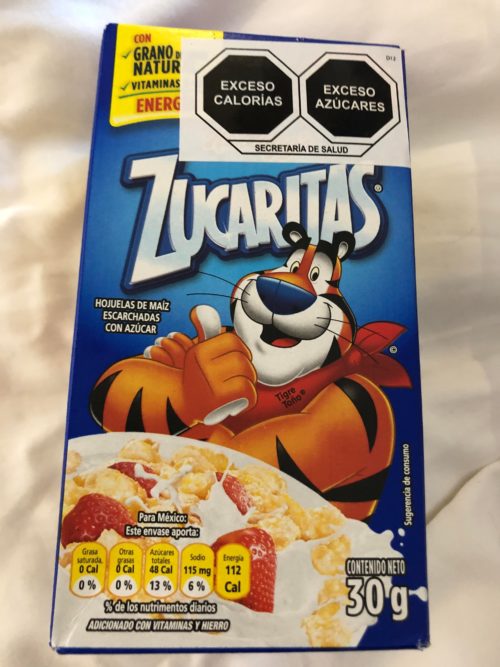
Mexico has seized 380,000 boxes of Corn Flakes, Special K and other Kellogg’s cereals, claiming the boxes had cartoon drawings on them in violation of recently enacted laws aimed at improving children’s diets.

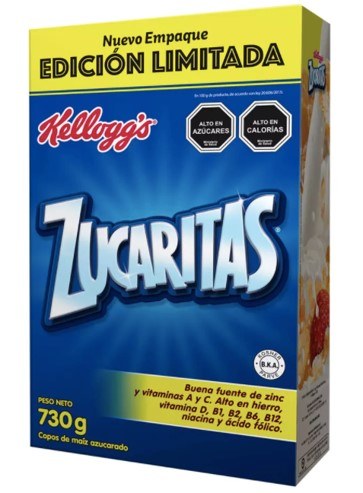
These laws put warning labels on foods and beverage high in calories, sugar, saturated fat, trans fat, sodium, artificial sweeteners, and caffeine.  These cover practically all ultra-processed foods.

At the same time, restrictions were placed on the advertising of unhealthy products to children, so that products with warning labels cannot be advertised to children or use cartoon characters.

I’m wondering if some of the seized products violated the law by having cartoons on the package, like this one.

Here is what the boxes of sugary cereals are supposed to look like now.

I want to know more about what got seized.

But how terrific that the Mexican government is taking this public health measure seriously.

Felicidades!

Jan 5 2022

Ben & Jerry’s top flavors: in order of calories???

Ben & Jerry’s is now owned by Unilever.

Here are its top-ten best-selling flavors:

  1. Half Baked: unbaked cookie dough and baked fudge brownies.
  2. Cherry Garcia: in the top three since its launch in 1987
  3. Chocolate Chip Cookie Dough
  4. Chocolate Fudge Brownie: this contains brownies from New York’s Greyston Bakery, which provides jobs and training to low-income people in Yonkers
  5. Tonight Dough: Jimmy Fallon’s second flavor; proceeds to SeriousFun Children’s Network
  6. Strawberry Cheesecake
  7. Phish Food: since 1997
  8. Americone Dream: a partnership with Stephen Colbert, whose staff chooses the nonprofit its proceeds go to
  9. Chunky Monkey: banana ice cream with fudge chunks and walnuts
  10. Brownie Batter Core

Whether or not proceeds go to charity, these are commercial ice creams, and highly caloric, ultra-processed ones at that.

Here, for example, is the ingredient list for a Cherry Garcia.

CREAM, SKIM MILK, LIQUID SUGAR (SUGAR, WATER), WATER, CHERRIES, SUGAR, EGG YOLKS, COCONUT OIL, COCOA (PROCESSED WITH ALKALI), FRUIT AND VEGETABLE CONCENTRATES (COLOR), COCOA POWDER, GUAR GUM, NATURAL FLAVORS, LEMON JUICE CONCENTRATE, CARRAGEENAN, MILK FAT, SOY LECITHIN.
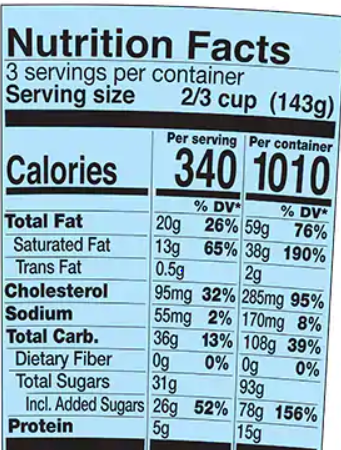
And here’ the Nutrition Facts label for a pint.
The new serving size is 2/3 cup and you get three of those in the container at 340 calories each.  Eat the whole pint and you’ve done half your daily calories along with 78 grams of added sugars (oops).
Half-Baked has even more!
If ever a situation called for moderation, this one is it.
Dec 16 2021

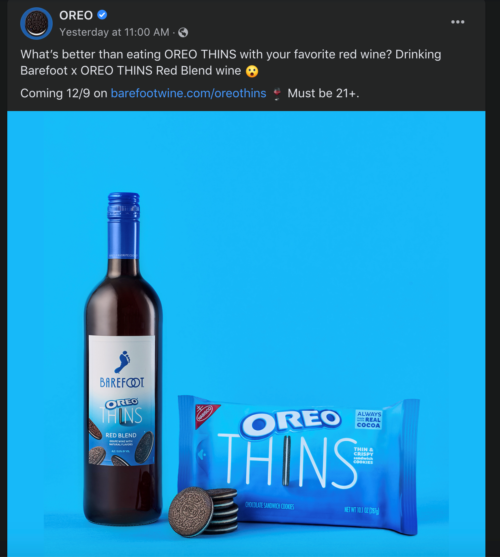
One picture is worth…


Oreo Thins?  These have 35 calories per cookie instead of the original 50 or so.   The difference is hardly worth fussing about unless you eat a lot of them.

As for wine?  Sorry about this, but alcohol has calories—7 per gram, more than protein or carbohydrate (4 per gram) but less than fat (9 per gram).

Cookies and wine?  Sugars and alcohol?  Not my idea of a great partnership.

Thanks to Jennifer Pomeranz for sending this one.

Dec 9 2021

Some recent articles on food product reformulation

What with all the pressure to make foods healthier, food manufacturers have been tweaking their products to reduce less healthful ingredients, especially salt and sugar.

Reformulated ultra-processed foods are still ultra-processed.

They raise the question: is a slightly healthier ultra-processed food a good choice?

These articles come from FoodNavigator-Asia.com, which tracks the food industry in that part of the world.

Oct 29 2021

Weekend eating: the food politics of Halloween

Halloween is about one thing only: candy.

Candy has a place in diets, just not a big one—added sugars are best consumed at no more than 5% to 10% of calories (for many people, that’s 100 to 200 calories).  It doesn’t take much candy to get to those numbers.

Consumer Reports has a helpful report on what 100 calories looks like: 13.6 candy corn kernels (see note at end) and 2.3 Hershey’s miniatures.

The candy industry doesn’t think you eat enough.  Candy, it says, fuels the U.S. economy.

Making chocolate, candy, gum and mints, our industry plays an important role in the U.S. economy. We create good-paying jobs in the manufacturing sector in the U.S., and support thousands of additional American jobs as we sell our products in the marketplace, and source our ingredients, packaging and transportation. Additional jobs, known as induced jobs, are supported through the re-spending of wages throughout the supply chain.

Not only that, but candy is an essential part of health and wellness lifestyles (the candy industry’s at least):

The National Retail Federation predicts that this fall “consumer spending on Halloween-related items is expected to reach an all-time high of $10.14 billion, up from $8.05 billion in 2020.” Of this total, spending on candy is estimated to reach $3 billion, up from $2.14 billion.

Trick or Treat?  Enjoy the Halloween weekend.

A note on candy corn

It would never occur to me that anyone would care, but how’s this for candy-industry research:

While there is some debate about the best way to enjoy this classic Halloween candy, most Americans say they enjoy the whole piece of candy corn at once (52%), while 31% of people start at the narrow white end and 17% of people start with the wider yellow end.

Tags: ,