Currently browsing posts about: Coca Cola

Aug 11 2010

More about imaginative food marketing

The Pop-Tarts store in Times Square (see yesterday’s post) is only the loudest example of innovative food marketing to come out recently.  I’ve been collecting more subtle examples:

Using social media (and getting customers to pay for it): For 99 cents to I-tunes, you can buy an app that gives nutritional information for products at Jack-in-the-Box or at McDonald’s.   As Mark Douglas of Culinate explains: “They want $0.99 to tell you what you probably already know… Watch Out!”

Co-opting health professionals: Michele Simon (author of Appetite for Profit) writes on AlterNet about how PepsiCo hires distinguished health professionals and experts to give a company that sells snack foods and soft drinks an aura of health and wellness.

Co-opting professional organizations: Lisa Young (the Portion Teller) points me to a Webinar on August 25 run by the industry-sponsored School Nutrition Foundation and the Milk Processor Education Program on what is surely an urgent issue for sellers of chocolate (sugar-added) milk: “Keep flavored milk from dropping out of school!”

Deflecting attention from diet: Lisa sends another Webinar notice for September 14, this one for “skills & tools to enhance change in physical activity behavior.”  Its sponsor?

The Coca-Cola Company’s Beverage Institute For Health & Wellness is a Continuing Professional Education (CPE) Accredited Provider with the Commission on Dietetic Registration (CDR) – provider number BF001.

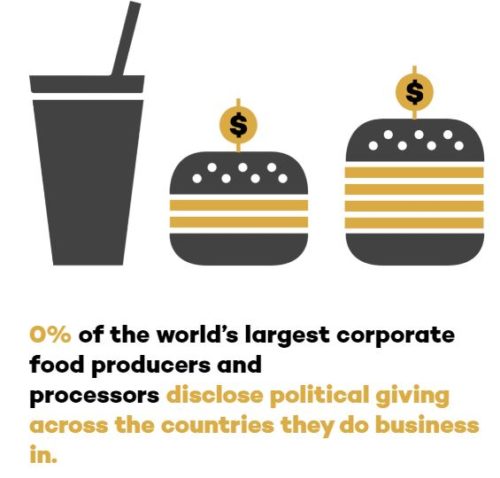
Plain, old-fashioned lobbying: Food Safety News has a nifty report on food company lobbying expenditures (huge), mainly on the food safety bill but also on many other bills that might affect labeling or sales of food products.

I reviewed these methods in my book, Food Politics. A revised edition came out in 2007.  Not much change, alas.

Addition: Attracting school kids: Michele Simon sends this Pepsi partnership with Hy-Vee stores in Iowa.  Parents buy five Pepsi products; Pepsi buys backpacks for their kids.

Feb 17 2010

Should our national heart agency partner with Coke?

I went to the reception last week for Diet Coke’s red dress event,:

Diet Coke and the National Heart, Lung, and Blood Institute (NHLBI) of the National Institutes of Health have joined forces to raise awareness about women’s risk of heart disease — in support of NHLBI’s The Heart Truth campaign — with a multi-faceted program that will reach consumers across the nation.

To celebrate American Heart Month in February, Diet Coke’s Red Dress Program will take center stage at high-profile events, including sponsorship of The Heart Truth’s, Red Dress Collection fashion show at Fashion Week 2008. Diet Coke will also unveil new packaging and programs featuring The Heart Truth and Red Dress logos and messages on heart health.

The Center for Science in the Public Interest points out that Coca-Cola, whose products are not exactly heart healthy, is a strange partner for the NHLBI.  The agency should reconsider.  It wrote NHLBI to say so.

New York Times reporter Tara Parker-Pope asks: “Should Coke talk about heart health?”

I don’t know how long Diet Coke and NHLBI have been engaged in this partnership but it is surely more than five years.  From NHLBI’s point of view, the partnership publicizes the risk of heart disease to women.  For Coca-Cola, the benefits are obvious.

Are such partnerships a benign win-win?  History suggests otherwise.  In 1984, Kellogg cooked up a partnership with the National Cancer Institute to put health claims for fiber on the boxes of All-Bran cereals (I discuss this incident in Food Politics).  In doing so, Kellogg (and NCI) went around the FDA and undermined that agency’s control over health claims on food packages.  This let to the current mess over health claims, which the FDA is now trying to clean up.

Update March 3: The Public Health Advocacy Institute at Northeastern University has filed a petition to NHLBI to give up the partnership.

Feb 4 2010

The real cost of Coke

I received this note yesterday from Michael Jacobson, director of the Center for Science in the Public Interest, about his latest column in The Huffington Post:

How would you feel if you had to pay $8.50 a gallon for gasoline?

Then why on Earth would you pay that much for water and high-fructose corn syrup?

That’s how much Coke costs in those new 7.5-ounce, 90-calorie cans.  Calorie-counters may appreciate the small size (90 calories) but dollar-counters beware:  We did a little math and it turns out that Coke in the new can costs between 50- and 140-percent more than Coke in the old 12-ounce cans.  Basically, Coke is charging two or three cents more per ounce for Coke in a smaller can—and this from a company that throws temper tantrums when lawmakers propose a one-cent-per-ounce tax on soda!

I once asked a group of retailing executives why the cost of smaller size containers was so high (surely the containers don’t cost that much.  They said: “if customers want smaller portions they ought to be willing to pay for them.”  Oh.

Dec 7 2009

Saving the earth: Coca-Cola?

I greatly admire the work of Jared Diamond.  His book, Guns, Germs, and Steel: The Fate of Human Societies, is as clear an explanation as you will ever get of how the inequitable distribution of favorable geography, climate, and natural resources affects the development and maintenance of human societies.

But here he is, incredibly, in the Sunday New York Times writing a fan letter to corporate social responsibility for protecting those favorable environments.  He writes:

There is a widespread view, particularly among environmentalists and liberals, that big businesses are environmentally destructive, greedy, evil and driven by short-term profits. I know — because I used to share that view.  But today I have more nuanced feelings…I’ve discovered that while some businesses are indeed as destructive as many suspect, others are among the world’s strongest positive forces for environmental sustainability.

And which corporations does he include as “strongest positive forces?”  Chevron, Walmart, and Coca-Cola.   I’ll leave discussion of Chevron and Walmart to others, but Coca-Cola?

Coca-Cola, Diamond says, is protecting the world’s water supplies.  The company needs clean water in the 200 countries in which it operates.  This, says Diamond:

compels it to be deeply concerned with problems of water scarcity, energy, climate change and agriculture. One company goal is to make its plants water-neutral, returning to the environment water in quantities equal to the amount used in beverages and their production. Another goal is to work on the conservation of seven of the world’s river basins, including the Rio Grande, Yangtze, Mekong and Danube — all of them sites of major environmental concerns besides supplying water for Coca-Cola. These long-term goals are in addition to Coca-Cola’s short-term cost-saving environmental practices, like recycling plastic bottles, replacing petroleum-based plastic in bottles with organic material, reducing energy consumption and increasing sales volume while decreasing water use.

Please note the future tense.  These are things Coke says it plans to do.  As for what the company is doing now, Diamond does not say.  His piece does not mention Coke’s negotiating with officials in developing countries to buy water at rates significantly below those charged to local communities, a topic under much discussion when I was in India last year.  It does not mention campaigns in India to hold Coke accountable for its abuse of local water rights or any of the similar campaigns in other countries.

Diamond’s piece does not talk about the efforts Coke puts into selling bottled water at the expense of local water supplies.  As described by Elizabeth Royte in her book, Bottlemania, companies like Coke exhibit every one of of the characteristics formerly deplored by Diamond in attempting to secure plentiful and reliable sources of cheap local water: in his words, “environmentally destructive, greedy, evil and driven by short-term profits.”

Diamond says he sits along side and has gotten to know and appreciate the motives of many corporate executives.  Me too.  Personally, many of them mean well and wish that they could do more to be socially responsible.  But they work for businesses that are required, by law, to make short-term profit their reason for existence.  This means that corporate social responsibility is necessarily limited to actions that bring visible – and immediate – returns on investment.

We need some critical thinking here.  If Diamond gave any thought at all to what Coca-Cola produces – bottled water and sodas – he would surely have to agree that less of both would be good for our own health and that of the planet.

Oct 29 2009

Family doctors resign from AAFP over Coke partnership

Yesterday, 20 family physicians in Contra Costa County, California, ripped up their membership cards in the American Academy of Family Physicians in protest over the AAFP’s partnership with Coca-Cola.

coke_1

The director of the Contra Costa Department of Health Services, Dr. William Walker, announced that he was resigning his 25-year membership in AAFP.  In his statement, Dr. Walker said:

…I am appalled and ashamed of this partnership between Coca-Cola and the American Academy of Family Physicians. How can any organization that claims to promote public health join forces with a company that promotes products that put our children at risk for obesity, heart disease and early death.

…The AAFP is supposed to be an organization that works to protect the health of children not put them at risk. Their decision to take soda money is all the more unconscionable because, unlike doctors in the 40s, they well know the negative health impact of soda. There is no shortage of documentation that soda is a major contributor to our nation’s obesity epidemic.

…Let me be clear about something: as disappointed as I am with the American Academy of Family Physicians for being duped into thinking that Coca Cola wants to help promote health, the real problem here is our children are being put at risk.

Companies like Coca Cola are polluting our communities with deceptive advertising promoting products that put our children’s health at risk.

…as a family practice doctor and the Health Officer for Contra Costa, I do have a prescription for every parent, teacher, community leader and student:

Look beyond the glitzy advertising that makes you think pouring liquid containing sugar into your body is healthy. Read the label. Look at the ingredients. I’m not suggesting that you boycott sugared drinks, but please make an informed decision about what you are consuming.

I’m calling on every city and neighborhood in our County to fight back against the industry that pushes these harmful products. I ask the American Academy of Family Physicians to end this unhealthy partnership and to join us in leading this important campaign to take back the health of our residents and end the obesity epidemic.

Strong words, indeed.  I hope that the AAFP – and other health and nutrition organizations that might consider food industry partnerships – pay close attention to these words.

* The event was covered in the Contra Costa Times. The Health Department’s website includes the press release and also a video and podcast.

Addendum:

Dr. Wendel Brunner, PhD, MD, Director of Public Health in the Contra Costa Department of Health Services has given me permission to post excerpts from his letter to a representative of the California Association of Family Physicians who had asked for more information about the protest:

“The epidemic of obesity is the greatest public health and clinical medicine issue of our time, and will lead to untold disease, shortened life spans, and medical cost. That epidemic took off rapidly in the 80’s. While genes and personal choices do have an impact on obesity, only profound environmental changes could lead to such a rapid development of the epidemic, and it will only be stopped by policy development and environmental and norm change. We need to create an environment that supports people in making good choices for themselves and their families.

One of the best choices families can make is to pretty much eliminate sweetened beverages. And the soda industry doesn’t want that to happen, so they are looking for credible groups who will say that drinking soda is OK for your health. But you know all that already, which makes this even more frustrating.

I am an old county doctor, but I still believe that physicians have a responsibility to advocate for their patients and fight to protect their health, and to first of all, do no harm. I am truly gratified to see that our younger physicians in Contra Costa have those same values too. The responsibility of a physician to their patient is a sacred trust; physicians should never sell out their patients’ health and well-being for a price, not even one “in the mid six figures”.

The AAFP needs to change their policy and thereby begin to redeem themselves. In the process, they would educate the country and do something valuable for the nations health, as well as for their own integrity. If they do not, they will continue an unfortunately long and sordid tradition of professionals and their organizations forgetting their purpose and their ethics and putting their narrow organizational financial interest above the interest of the public that they serve. Resigning membership seems to be the most effective way for physicians to provide a wake-up call to the AAFP, and at this point is the best thing a physician could do to benefit the organization.We anticipate that there will be more resignations as this story develops.

Everything cannot be blamed on the environment or peer pressures or economic factors; patients do have a personal responsibility to make good choices for their health and the health of their families. But physicians have the personal responsibility to make good choices too, and so do the professionals who work for them.

The AAFP and the individuals in it made a bad choice. They now have the responsibility to fix it.”

Oct 9 2009

Another sad partnership story: AAFP and Coca-Cola

On October 6, the American Academy of Family Physicians (AAFP) announced its new partnership with Coca-Cola.  What does AAFP get from this?  A grant “to develop consumer education content on beverages and sweeteners for FamilyDoctor.org.”

The AAFP, says its president, looks forward to

working with The Coca-Cola Company, and other companies in the future, on the development of educational materials to teach consumers how to make the right choices and incorporate the products they love into a balanced diet and a healthy lifestyle.

Coca-Cola must be thrilled with this.  As its CEO explains in an op-ed in yesterday’s Wall Street Journal, soft drinks are entirely benign and have nothing to do with obesity.  Obesity is due to lack of physical activity and eating too much of other foods, not Coke.  His view of the situation is entirely predictable.

But what about the AAFP?  Family practice doctors have been telling me for years that it is not unusual for them to see overweight kids and adults in their practices who consume 1,000 to 2,000 calories a day from soft drinks alone.  The first piece of advice to give any overweight person is to stop drinking soft drinks (or other sugary drinks).

This partnership places the AAFP in embarrassing conflict of interest.  I gather that members were not consulted.  They need to make their voices heard.  I hope AAFP members decide that no matter what Coke paid for this partnership, their loss of credibility is not worth the price.

Addendum: Here’s what a Chicago Tribune blogger has to say about this.

Further addendum, October 10: As noted in the comments, AAFP members were consulted, more or less.  Apparently, they decided Big Food was less of a problem than Big Pharm.  Really?  How about selling out to neither?

Oct 2 2009

Coca-Cola reveals calories?

Well, sort of reveals.  Coca-Cola announces that it will put calories on the front of its packages (so you don’t have to search for and put on glasses to read the Nutrition Facts).  You can see what the label will look like in the story in USA Today.

calories01x-large

This sounds good but I view this action as another end run around FDA’s proposed regulations.  In March 2004, the FDA proposed to require the full number of calories to be placed on the front of food packages likely to be consumed by one person, like a 20-ounce soda for example (see figure).  A 20-ounce soda is 275 calories, not 100.

FDA

If Coca-Cola followed that FDA proposal, a label of a 2-liter bottle would have to say 800 Calories right on the front of the package.

This idea got stuck in Bush administration but there’s a good chance the new folks at FDA might take it up again.

Is Coca-Cola serious about helping people avoid obesity?  If so, maybe it could send out a press release distancing itself from those consumer-unfriendly ads run by the Center for Consumer Freedom (see previous post).

Here’s another question: Does Coca-Cola fund the CCF directly or indirectly through the American Beverage Assocation or some other industry trade group?  I will believe that they might really have an interest in consumer health when I know they have no connection whatsoever to CCF and its current ad campaigns.

Dec 23 2008

FDA warns Coke: Coke Plus violates Jelly Bean rule!

Thanks to Jack Everitt for forwarding an article from Reuters U.K. about the FDA’s recent warning to Coca-Cola.  Coke Plus, says the FDA, violates the Food and Drug Act.  Food companies are not allowed to add vitamins and minerals to sugary carbonated water (or jelly beans)  just so they can be marketed as healthy.

OK, but Coke Plus is not exactly a secret.  How come the FDA waited to do this until this “midnight” period just before a new administration takes over?  And how come, asks Jack, do we have to “hear about this from a UK newspaper, rather than a US one. Just like with the last election, we now have to rely on out-of-the-country news sources.”

Let’s hope the FDA is a high priority for Obama.  It should be!

Mar 17 2008

Soft drinks in decline?

The Wall Street Journal reports that sales of Coke and Pepsi and other top brands slipped last year by a percentage point or two. They can’t keep up in the face of rising commodity costs, prices, and the popularity of vitamin waters and sports drinks. The drop might seem like a blip but these companies have stockholders to please and are supposed to be growing and increasing their sales every quarter. So it’s no surprise that the WSJ is taking such a hard look at the declining bottom lines. Expect to see even more production of functional drinks, sweetened and not, and at higher prices, of course.

Jan 27 2008

Coke and Pepsi promote health!

I’m getting lots of e-mails about Coca-Cola’s co-sponsorship of the National Heart, Lung and Blood Instutite’s HeartTruth Red Dress campaign to increase women’s awareness of their risk for heart disease. You can find out more about Diet Coke’s sponsorship on the Coca-Cola website. Here’s my favorite line in the news release: “Participation by Coca-Cola does not imply endorsement by DHHS/NIH/NHLBI.” Really? I’ll bet Coke hopes people will think it does.

But that’s not all. The American Dietetic Association (ADA) is partnering with Pepsi. Pepsi, it says, “will work with ADA to develop consumer and professional education programs, and tackle nutrition research questions.” How’s that for unbiased?

Page 1 of 212