by Marion Nestle

Search results: corn refiners

Jan 27 2009

Mercury in high fructose corn syrup

Never a dull moment.  The Institute for Agriculture and Trade Policy (IATP), a think-tank in Minneapolis, tested brand-name foods made with high fructose corn syrup (HFCS) and found about half of them to contain mercury.  HFCS, it seems, is made by a process that involves lye, which in turn is made in chlorine – alkali plants by a method that uses mercury. Mercury is a neurotoxin, although not as bad a toxin as methymercury, the kind that accumulates in large, predatory fish. A scientific report published in Environmental Health says the amounts of mercury in HFCS ranged from 0.00 to 0.57 micrograms per gram. The IATP’s bottom line: the process for making HFCS should be changed to one that does not introduce mercury.

This seems like quite sensible advice, but how worried should we be about mercury in HFCS? I agree that mercury in any form is unlikely to be good, but I have no idea whether such low levels do measurable harm.  For one thing, these studies did not compare the amounts of mercury found in HFCS to those typically found in foods that do not contain HFCS.  My guess is that most foods contain low levels of mercury because mercury is prevalent in air, water, and soil, especially around coal-burning power plants.  Also, soft drinks are the major sources of HFCS in American diets, but these were found to be relatively free of mercury.  This is puzzling.

If anything, these studies are a call for more research on heavy metal toxicology.  In the meantime, let’s lobby for changing this process for making HFCS, but even more so for cleaning up coal-burning power plants that supply 40% of mercury in our environment.

Update January 28: Food Production Daily has a good report on this, with quotes from the Corn Refiners.
Jun 23 2008

Corn sweeteners: enjoy in moderation?

My upstate New York edition of the New York Times today carries a full-page, full-color advertisement from the Corn Refiners Association: “A little sweetness in life is good. And what sweetens a lot of our favorite foods and beverages are sugars made from corn, such as high fructose corn syrup. It has the same natural sweeteners as table sugar and honey. And the same number of calories. But like most foods, sweeteners should be enjoyed in moderation. Please visit our website and learn the facts.”

I went right to the website and took the quiz. If you were wondering why this group would buy an expensive ($80,000?) ad like this, check out question #3: “Which of the following sweeteners is considered a natural food ingredient? (a) High fructose corn syrup, (b) Honey, (c) Sugar, (d) All of the above.”  Aw come on.  You can guess.

Feb 24 2026

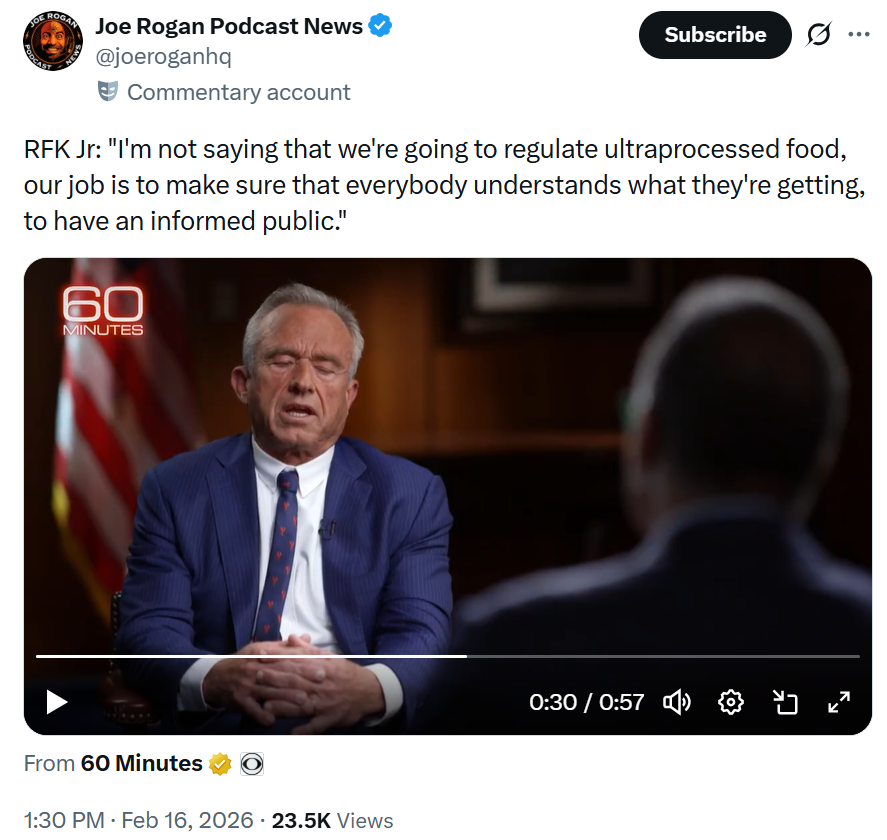
60 Minutes: RFK Jr on non-regulation of ultra-processed food

On February 15, CBS News’ Bill Whitaker interviewed RFK Jr, former FDA Commissioner David Kessler, and journalist Michael Pollan about ultra-processed foods and what to do about them.
As far as I am concerned, this is the money quote:
This is classic RFK Jr: put everything on personal responsibility, never mind how hard it is for people to resist eating unhealthfully in today’s food environment.
As I explained last August, David Kessler gave RFK Jr a gift.  He sent him a letter presenting a  Citizen’s Petition arguing that if the FDA wanted to help people reduce consumption of ultra-processed foods, all it had to do was to define ultra-processed foods as Not GRAS.
The FDA is required to respond to citizens’ petitions within 180 days.
During the 60 Minutes program, RFK Jr said:
We will act on– on David Kessler’s petition. And the questions that he’s asking are questions that FDA should’ve been asking a long, long time ago.
“Act on?”  What does this mean?
Will the FDA act to regulate ultra-processed foods?
I will believe it when I see it.
Jul 22 2025

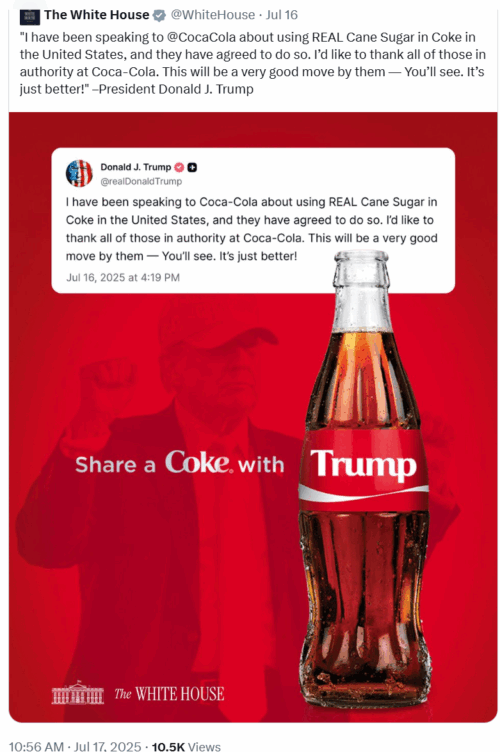
President Trump says sucrose is better than HFCS (both are glucose plus fructose)

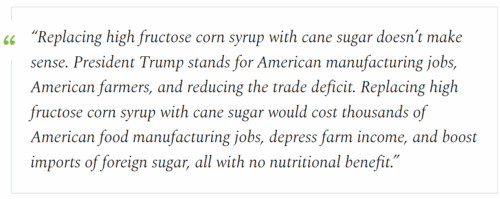
The President of the United States says Coke should switch from high fructose corn syrup (HFCS) to cane sugar.

My response: this is nutritionally hilarious.

  • HFCS is glucose and fructose separated in liquid form.
  • Cane sugar (sucrose) is glucose and fructose bonded, but quickly split (so is beet sugar, but the President is not mentioning it).
  • Both HFCS and cane sugar are sugar(s).  Both provide about 4 calories per gram.
  • There may be people who can taste the difference, but when Coke found that nobody could tell the difference, it switched from sucrose to HFCS.

I’ve written about this previously, most recently in 2014: HFCS politics, continued. Endlessly.

Yes, HFCS is derived from genetically modified corn, but that doesn’t change the basic biochemistry, taste, or health effect.

Note: A 12-ounce Coke has 39 grams of either one.  It doesn’t matter which sugar is used; it’s too much to be consumed at one time.

At the time Coke switched to HFCS, it was much cheaper.  It is still cheapter but less so (because half of corn production is used to produce ethanol).

It will cost Coke more to replace HFCS with cane sugar or even beet sugar (which is identical to cane sugar).  So Coke is not exactly committing to doing this.

As Reuters reports, the switch would raise prices for consumers and be tough on US farmers too.

On this issue, I have to agree for once with the Corn Refiners Association.

This is one of those issues it will be enormous fun to watch.  Stay tuned.

Oct 16 2019

Hey–Sugar is Plant-Based!

I love the Sugar Association, the chief lobbying group for producers of sugar cane and sugar beets, for its endlessly creative ways of trying to convince that more sugar is good for us. [Note: High Fructose Corn Syrup is represented by a separate group, the Corn Refiners Association, which does much of the same.]

I was sent this account of  sugar-industry speeches at a symposium run by the American Sugar Alliance, another trade group.

What to do about all those pesky “eat less sugar” messages?  According to one public relations speaker,

The fact that sugar comes from a plant is a positive for consumers…The terms “real” and “pure” create positive associations in consumers’ minds…Consumers believe that honey is “the most healthy and natural” of sweeteners and that high-fructose corn syrup is “not real.”

Only 30% think sugar is naturally grown…A key message should be that “sugar comes from a plant—like sugar beets or sugar cane.  It’s grown on a farm and it’s minimally processed.

As always, you can’t make this stuff up.

Tags:
Feb 7 2018

Food industry lobbyists running the dietary guidelines?

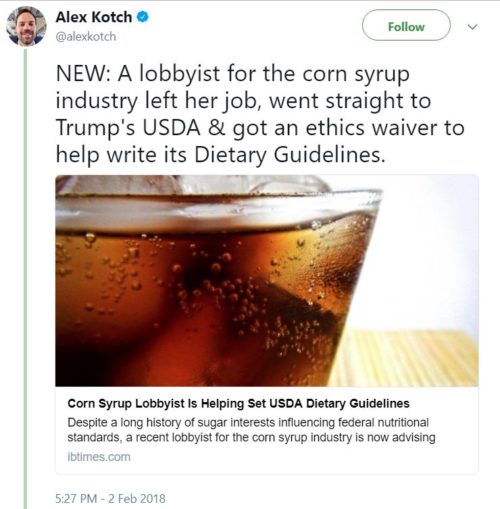
This tweet certainly got my attention:

It referred to Alex Kotch’s article in the International Business Times about how White House lawyer Donald McGahn has granted a waiver of conflict of interest rules to allow Kailee Tkacz, a former lobbyist for the Snack Food Association and, more recently, for the Corn Refiners Association, to advise the USDA about the forthcoming 2020 dietary guidelines.

Ms. Tkacz also was food policy director for the Corn Refiners Association, which represents producers of high fructose corn syrup (HFCS).

McGahn explained that this waiver would allow Ms. Tkacz “to advise the Secretary of Agriculture and other senior Department officials with respect to the Dietary Guidelines for Americans process.”

He says “it is in the public interest to grant this limited waiver because of Ms. Tkacz’s expertise in the process by which the Dietary Guidelines for Americans are issued every five years.”

The dietary guidelines historically have issued recommendations to consume less salt and sugar.  Snack foods are major sources of salt in U.S. diets.  Soft drinks sweetened with HFCS are major sources of sugars.

USDA is the lead agency for the 2020 guidelines.

Want to make some bets on what they will say about salt and sugar (a wild guess: the science isn’t firm enough to suggest eating less of either).

Nov 29 2017

Good news about farming!

How about some good news for a change?

I.  Politico reports on on a new report, Feeding the Economy, on the importance of agriculture for the US economy (you can search the site for your own state and congressional district).

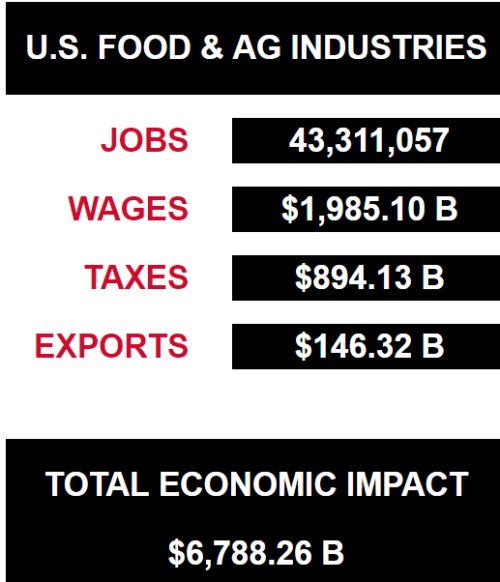
The findings are impressive:

As Politico puts it, “more than a fifth of the U.S. economy and a quarter of American jobs are either directly or indirectly tied to the food and agriculture sectors.”

That’s more than 43 million jobs and $1.9 trillion in wages, and $894 billion in taxes.  That’s $6.7 trillion for the impact..

Who paid for the study?  22 food and agriculture groups, including the Corn Refiners Association, the American Bakers Association and the United Fresh Produce Association.

II.  The Washington Post writes:

For only the second time in the last century, the number of farmers under 35 years old is increasing, according to the U.S. Department of Agriculture’s latest Census of Agriculture. Sixty-nine percent of the surveyed young farmers had college degrees — significantly higher than the general population.

The implications for public policy are obvious: promote farming opportunities for young people.

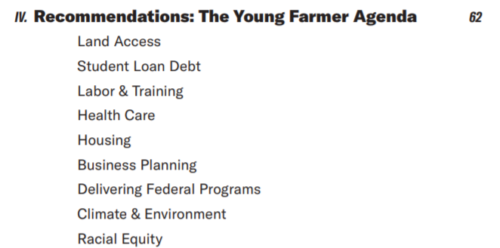
III.  Here’s what The National Young Farmers Coalition says in its new report:

Its agenda:

Now, to make that happen…

May 20 2016

New food label! Congratulations Let’s Move! & FDA

I kept hearing rumors this week that Michelle Obama would announce the revised Nutrition Facts panel at today’s summit meeting of the Partnership for a Healthier America, the public-private partnership organization that supports Let’s Move!

And here is the graphic from the White House press release:

Congratulations on the long-awaited changes:

  • Calories big and bold
  • Added sugars

  • Serving sizes updated
  • “Dual column” labels for “per serving” and “per package”
  • Daily Value footnote: “The % Daily Value (DV) tells you how much a nutrient in a serving of food contributes to a daily diet.  2,000 calories a day is used for general nutrition advice.”
  • Nutrients: Vitamin D, Calcium, Iron, and Potassium.  Voluntary: Vitamins A and C.

Expect to see this on food packages in two years (small food producers get an additional year to comply).

Here are the relevant FDA documents:

Here are the early comments (I will be adding more as they arrive):

The new food label is an extraordinary accomplishment, especially in the light of a political climate in which the food industry and its friends in Congress fight public health nutrition measures tooth and nail.

For background, see some of my posts on food labels since 2008:

Addition, May 26: Politico reports that 6 food trade groups commissioned a study to demonstrate that the cost of implementing the new food labels would be much higher than estimated by the FDA.  Although the paper does not disclose its funding (or if it does, I missed it), Politico says the funders included the Corn Refiners Association, the Grocery Manufacturers Association, the Sugar Association, the American Bakers Association, and the International Dairy Foods Association.  As with most industry-funded studies, they got what they paid for.

Tags: